
FuelEU
CTI-Maritec: FuelEU Maritime regulation effective 1 January 2025
FuelEU Maritime Regulation will be enforced by the EU for all ships trading within the EU or European Economic Area (EEA).

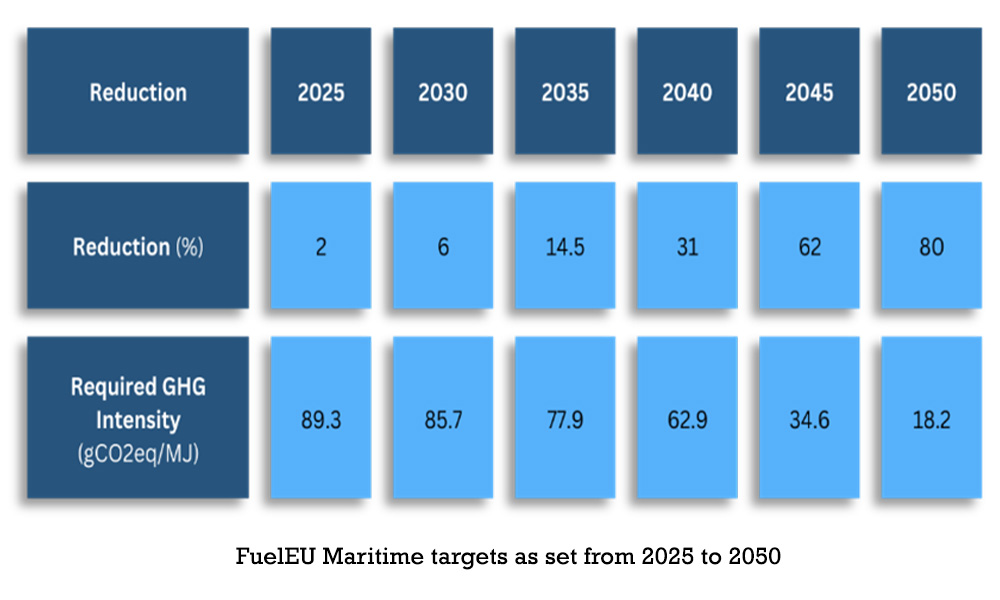
Marine environmental services and fuel testing solutions company CTI-Maritec on Friday (27 December) shared an update detailing the workings of the upcoming FuelEU Maritime regulation effective next year:
With its impending implementation on 01 January 2025, the FuelEU Maritime Regulation will be enforced by the EU for all ships trading within the EU or European Economic Area (EEA). FuelEU Maritime sets ‘Green House Gas (GHG) Intensity’ targets (not to be exceeded) on the annual average GHG Intensity of energy used by vessels.
The GHG Intensity targets are strategically reduced every 5 years, set from 2025 up to 2050. This will start at a 2% reduction of GHG Intensity in 2025, increasing to 6% in 2030, and accelerating from 2035 to reach an 80% reduction by 2050.
How It Works & Key Aspects to Note
- GHG Intensity is measured as GHG emissions per energy unit (gCO2e/MJ) and, in turn, GHG emissions are calculated in a Well-To-Wake (WTW) perspective.
- The calculation takes into account emissions related to the extraction, cultivation, production and transportation of fuel, in addition to emissions from energy used on board the ship.
- The baseline for the calculation is the average WTW GHG Intensity of the fleet in 2020 (HFO 91.16 gCO2e/MJ).
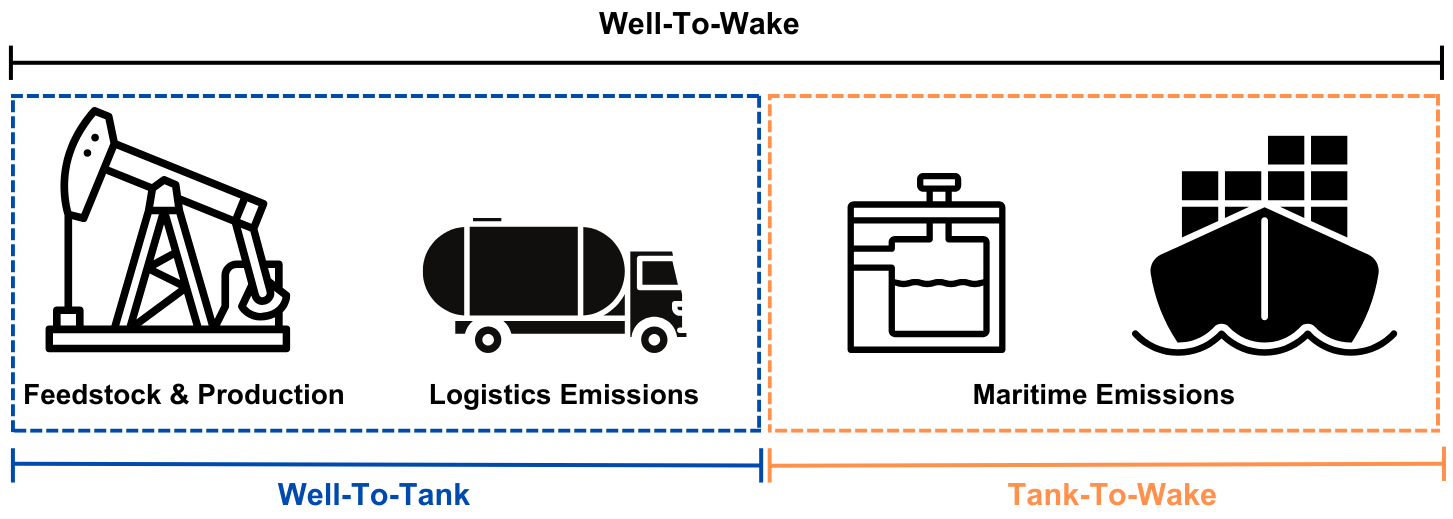
- The GHG intensity requirement applies to 100% of energy used on voyages and port calls within the EU or EEA, and 50% of energy used on voyages into or out of the EU or EEA.
- Not complying with the WTW GHG intensity target from 2025 will result in a penalty of approx. EUR 30 per tonne of VLSFO-equivalent.
- Owing to its GHG Intensity, fossil fuels except LNG will not comply from 2025 onwards.
- Vessels require only approx. 15% adoption of B24 BioFuel for EU voyages fuel consumption to avoid penalty
- Use of B24 BioFuel is a “ready solution” in your marine energy transition journey.
- Ship owners must purchase fuel from Traders with EU recognized Sustainability Certification (such as ISCC EU)
Recommended Plan of Action for Ship Owners
CTI-Maritec recommends the following as key overarching actions to help set you on course in your journey towards compliance with FuelEU Maritime, however must state that the same is not limited to only the below:
- Submit a FuelEU Monitoring Plan to an accredited verifier. This plan should outline how you intend to monitor and report emissions for each ship in your fleet. This should be completed by 31 August 2024 or within 2 months after first port of call in 2025.
- Start reporting key data related to FuelEU Maritime from 1 January 2025. This data includes fuel consumption, carbon emissions, and distance travelled.
- Submit the individual ship’s FuelEU reports by 31 January 2026.
- By 30 April 2026, have the compliance balance approved in the FuelEU Maritime database
- By 30 June 2026, have the FuelEU Document of Compliance on board. This is also the penalty payment deadline.
What Mechanisms to Adopt to Ensure You are Meeting your FuelEU Maritime Targets
- Use energy sources of a lower well-to-wake GHG intensity, such as sustainable biofuels like B24 BioFuel, renewable fuels of non-biological origin (RFNBO), recycled carbon fuels (RCF), Fossil LNG/LPG, shore power, wind-assisted propulsion, etc.
- Ensure fuel is purchased from traders with EU recognized Sustainability Certification (achieved when systems such as the ISCC EU scheme is adopted)
- Use of flexibility mechanisms, such as borrowing an advance compliance surplus from the next year (maximum 2%, not allowed for two consecutive periods) or include the ship’s compliance balance in a pool of ships (also possible in collaboration with other companies)
- For Fuel Suppliers: Integrate robust systems established by credible institutes such as the ISCC (International Sustainability and Carbon Certification) EU Schemes into your organisations procedures, which ensures sustainability in feedstock production (e.g. Proof-of-Sustainability documents from fuel traders), traceability of sustainable products through the supply chain as well as credible, verified reductions of life cycle emissions. With the ISCC system recognized under the EU’s revised Renewable Energy Directive (“RED II”) as well as other major energy markets, ISCC certification is set to play a major role under the upcoming FuelEU Maritime regulation and beyond.
Photo credit and source: CTI-Maritec
Published: 31 December 2024
FuelEU
GTT Marine partners with BetterSea on FuelEU trading, pooling integration
Integration will enable GTT Marine customers and platform users to execute FuelEU trading and pooling end-to-end, directly from the Vesper Insights platform.
Biofuel
APPEC 2026: Future of bio-bunkers determined by economics and regulations, highlights Dan-Bunkering
Marine biofuel growth hindered by economic squeezes and fragmented policies, requiring predictable carbon pricing and demand guarantees to scale.
Alternative Fuels
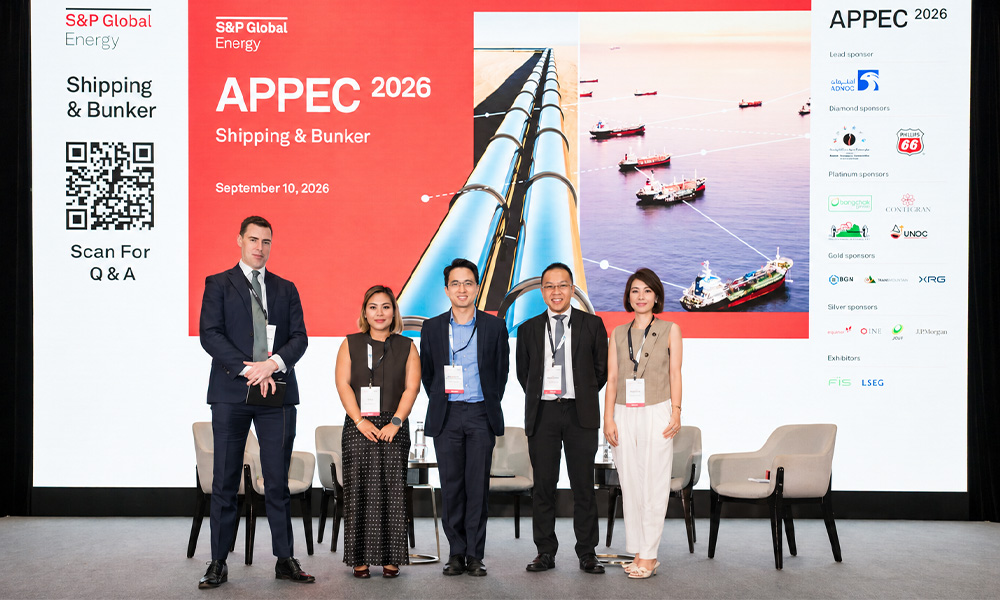
APPEC 2026: Panellists navigate maritime decarbonisation and alternative marine fuel strategies
Experts discuss maritime decarbonisation, emphasising global regulatory clarity, crew training, and collaborative strategies for adopting sustainable alternative marine fuels.

OUR INDUSTRY PARTNERS

Singapore-based Golden Island, Qingdao Port team up on alternative bunker fuels

HD HHI and HD KSOE secure ABS AiP for ammonia bunkering vessel design

J-ENG completes land-based testing of hydrogen-fuelled marine engine

Trafigura launches Volare Shipping with six VLCCs, eight newbuilds on order

Bunkering firm Eleven Energy establishes presence in Greece with two trading hires

GTT Marine partners with BetterSea on FuelEU trading, pooling integration

DNV on IMO CCC 12: Revised guidelines for methanol as marine fuel

Singapore: Marine fuel testing firm CCIC Singapore faces winding up application

Peninsula confirms one fatality, crew member missing from bunker tanker “Hercules Star”

Singapore: MPA working with industry on next phase of digital bunkering, says Deputy CE

Amogy and LOTTE Fine Chemical to explore ammonia bunkering in South Korea

High Court of Singapore issues winding up order against Hengli Petrochemical International

China: Guangzhou completes first bio-methanol STS bunkering operation

Polaris Shipping orders WinGD engines capable of running on methanol, ethanol
-
 Winding up1 week ago
Singapore: Marine fuel testing firm CCIC Singapore faces winding up application
-
 Incident2 weeks ago
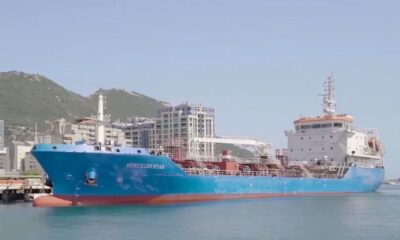
Peninsula confirms one fatality, crew member missing from bunker tanker “Hercules Star”
-
 Technology2 weeks ago
Singapore: MPA working with industry on next phase of digital bunkering, says Deputy CE
-
 Ammonia2 weeks ago
Amogy and LOTTE Fine Chemical to explore ammonia bunkering in South Korea
-
 Winding up1 week ago
High Court of Singapore issues winding up order against Hengli Petrochemical International
-
 Alternative Fuels2 weeks ago
China: Guangzhou completes first bio-methanol STS bunkering operation
-
 Engine2 weeks ago
Polaris Shipping orders WinGD engines capable of running on methanol, ethanol
-
 Technology1 week ago
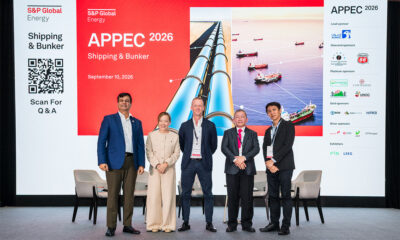
APPEC 2026: Digitalisation in bunkering not merely a ‘paper-to-screen’ swap, states panellists