
Biofuel
Clyde & Co on legal issues pertaining to bio bunker fuels in international shipping
Paul Collier and Benjamin Soh highlighted several key legal issues raised with the use of biofuel bunkers which should be considered by parties prior to their purchase and consumption on ships.


International law firm Clyde & Co LLP on Tuesday (28 March) published an insight highlighting several key legal issues raised with the use of biofuel bunkers:
By Paul Collier, Partner, and Benjamin Soh, Associate, of Clyde & Co
Biofuels are poised to play an increasing role in international shipping as part of global efforts to decarbonise the sector. However, the use of biofuels raises several important legal issues which should be considered by parties prior to their purchase and consumption on ships.
Potential benefits from the use of biofuels by ships
There are two main regulatory regimes which provide significant incentives for shipowners and ship operators to shift to using biofuels.
First, the IMO introduced a target for achieving net zero greenhouse gas (“GHG”) emissions by or around 2050, as well as an interim target for reducing GHG emissions by at least 20% by 2030. As part of this initiative, shipowners are required to calculate and report their vessel’s carbon intensity annually under the Carbon Intensity Indicator (“CII”) regime and vessels will receive a CII rating ranging from A to E. Biofuels which have appropriate international certification and provide a well-to-wake GHG emissions reduction of 65% compared to marine gasoil (“MGO”)[1] may be assigned a lower carbon emission factor. This could potentially assist shipowners and ship operators with retaining or improving their vessel’s CII rating.
Secondly, the EU has taken steps to incentivise decarbonisation, as part of their target of achieving a 55% GHG emissions reduction by 2030. Starting from 1 January 2024, the EU has extended the application of the EU Emissions Trading System (“EU ETS”) to shipping. Shipping companies are now required to surrender emissions allowances for CO2 emissions on voyages to or from the EU. In addition, from 1 January 2025, FuelEU Maritime (“FuelEU”) will also be applicable, requiring significant reductions in the GHG intensity of fuel used by ships, with penalties for failing to comply with GHG intensity reduction targets. Vessels consuming biofuels which meet sustainability and GHG emissions saving requirements and are certified under the Renewable Energy Directive 2018/2001 (“RED II”), will benefit from preferable calculations of their emissions and GHG intensity, compared to the position if they continued solely consuming fossil fuel bunkers.
The CII and EU regimes, therefore, heavily incentivise the consumption of biofuels that meet applicable certification requirements.
Biofuels also offer a significant advantage compared to other forms of zero and low carbon technology, because they can operate as “drop-in” fuel (i.e. biofuels could potentially be used in conventional ship engines without any engine modifications). The use of biofuels could, therefore, allow shipowners to achieve GHG emissions reductions without expensive outlays on new ships or vessel modifications, that would otherwise be required for other forms of alternative fuel technology.

Issues relating to sustainability, emissions savings, and certification
Whilst there are considerable potential benefits for shipowners and ship operators in using biofuels under the CII and EU regimes, they should be mindful that these potential benefits are conditional on biofuels meeting the applicable sustainability and emission reduction criteria, as well as on receiving appropriate certification. If the biofuel does not meet the applicable standards or have the appropriate certification, then, under the CII and EU regimes, the biofuels are likely to be treated as producing emissions equivalent to the fossil fuel type. This would place shipowners and ship operators opting for biofuels in no better position than if they had continued using fossil fuel bunkers.
For this reason, it is essential for parties to consider whether the contractual wording in their charterparties and in biofuel supply contracts adequately protects their position.
Where shipowners are time chartering a vessel and have agreed that time charterers may stem biofuels, shipowners should carefully consider whether their charterparty terms properly set out the specification and certification requirements for any biofuels stemmed. Here, shipowners could be exposed to the risk that their time charterers might not stem appropriately certified biofuel, such that they do not receive any preferential treatment under the CII and EU regimes as compared to the position if the vessel had consumed fossil based bunker fuel. If this were the case, shipowners could face unexpected penalties and suffer losses.
Biofuel purchasers should consider whether the supply contracts include adequate provisions to protect their position under the regulations, for example, by including warranties that the biofuel meets applicable international standards, that evidence of certification will be provided, and that Bunker Delivery Notes (“BDN”) provided by the supplier will include details of the GHG emissions for the production and use of the biofuel supplied.
More generally, biofuel purchasers and sellers should consider whether the terms of the supply contract should include a mechanism for advancing claims for losses if there is a lack of appropriate certification. Typically, most bunker supply terms and conditions contain short time bars and provisions restricting claims for consequential loss. It may be that such contractual provisions could restrict the ability of purchasers to advance claims for consequential loss which arise from a lack of certification or from non-compliance with sustainability or emissions reduction criteria.
Potential issues with biofuel quality, handling, and storage
A further point worth considering relates to the quality of biofuels and to related onboard handling and management issues.
Bunker quality issues are not uncommon when it comes to traditional fossil based marine fuels. However, the use of biofuels presents additional challenges for shipowners, ship operators and bunker suppliers, given their unique physical characteristics and the fact that many vessels will have limited experience of handling and storing them.
Particular concerns revolve around difficulties with respect to the oxidation stability and cold flow properties of biofuels, the possibility that biofuels could cause the corrosion of engine parts and clog fuel filters, and the risk that biofuels could degrade in quality whilst stored in vessel tanks.
There is currently no clear international standard setting out quality specifications for biofuel bunkers. ISO 8217, which sets out quality specifications for conventional marine fuel oil, only covers biodiesel blends containing up to 7% of fatty acid methyl ester (FAME) by volume. While the ISO continues to work on the next ISO 8217 standard, with the intention of including specifications for biofuels, national authorities are stepping in to provide temporary frameworks for quality and testing of biofuel bunkers.
Singapore has developed its own specification for marine biofuel (WA 2:2022), which incorporates additional quality parameters and testing methods seeking to address the unique physical characteristics of biofuels. Meanwhile, South Korea has announced that it will be issuing its own standard for marine biofuel this year, ahead of planned biofuel bunkering trials, with a view to fully adopting biofuel bunkering by 2025.
In the absence of a recognised international standard for biofuels, buyers may wish to consider protecting their position by requiring that fuel supplied complies with a national specification or alternatively by agreeing bespoke terms regarding the specification of the biofuel to be supplied. Furthermore, given potential issues in relation to the quality of biofuels, it would be prudent for buyers to put in place robust testing and handling procedures to mitigate the risk of bad biofuel bunkers, and to avoid potential damage to vessel engines. This may involve testing for additional parameters that are not included in table 1 or 2 of ISO 8217.
Finally, given the risk of degradation of biofuels and the short time bars for quality claims typically found in bunker supply contracts, it is recommended that prompt fuel sampling takes place and that evidence of the handling and storage of the biofuel on the vessel is retained in the event of a bunker quality dispute. From the bunker supplier perspective, if any engine problems are alleged following the consumption of biofuels, it is likely to be worth investigating whether the biofuel was properly handled and stored on board, as this could potentially be a cause of any problems experienced.
Alternative Fuels
DNV: Alternative-fuelled vessel orders hit highest monthly level since October 2024
LNG-fuelled vessels accounted for the vast majority of August activity while the strong summer performance marked a significant acceleration in ordering activity after a relatively slow start to the year.
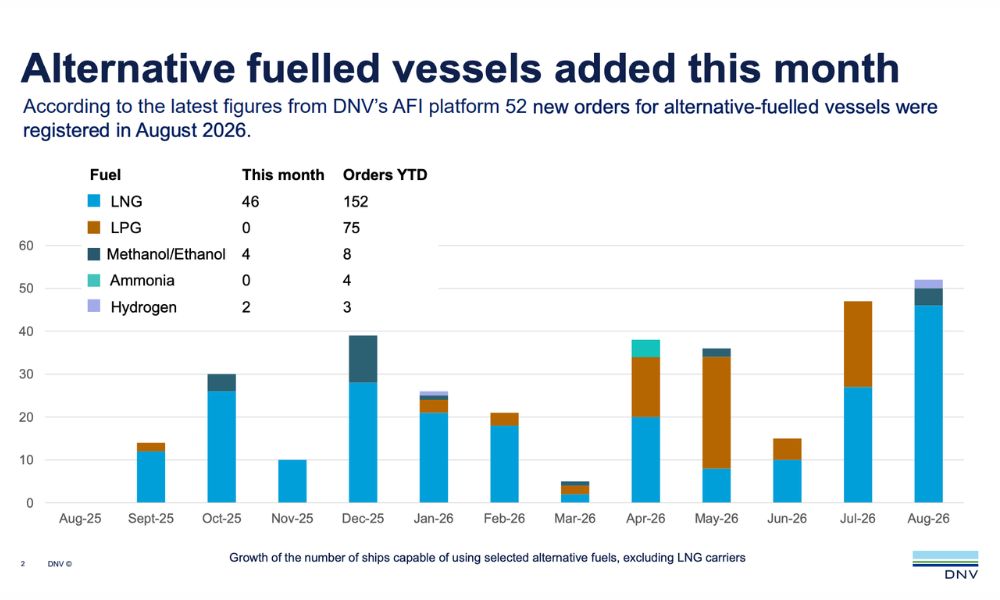
Latest data from classification society DNV’s Alternative Fuels Insight (AFI) platform alternative-fuelled vessel ordering was strong in August, with 52 new vessels added to the platform.
This is the highest monthly total since October 2024 and follows another active month in July, when 47 vessels were added to the database.
LNG-fuelled vessels accounted for the vast majority of August activity, with 46 orders recorded. The container segment led the way with 30 orders, while the car carrier segment contributed a further 12 LNG-fuelled vessels. In addition, four ethanol-fuelled bulk carriers and two hydrogen-powered bulk carriers were added during the month, as well as one LNG bunker vessel.
The strong summer performance marked a significant acceleration in ordering activity after a relatively slow start to the year. In total, 242 alternative-fuelled vessel orders have been placed in the first eight months of 2026, representing a 27% increase compared with the same period in 2025.
LNG remains the dominant fuel choice, accounting for 63% of all alternative-fuelled vessel orders registered so far this year. Container vessels represent the largest share of these LNG orders (59%), followed by car carriers (30%).
Jason Stefanatos, Global Decarbonization Director at DNV Maritime, said: “The past two months have been particularly strong for alternative-fuelled vessel ordering, with August recording the highest monthly total we’ve seen since October 2024. This has helped lift year-to-date orders to a level well above the same period last year.
“LNG remains the leading fuel choice, driven largely by activity in the container and car carrier segments. These sectors have been among the earliest adopters of alternative fuels, supported by predictable liner operations and increasing demand from cargo owners to reduce emissions across supply chains.
“For many owners, LNG offers a combination of emissions reductions, fuel availability and future flexibility while the longer-term fuel landscape continues to evolve.
“At the same time, the latest figures include orders for ethanol- and hydrogen-fuelled vessels, highlighting that owners continue to explore a range of decarbonization pathways. Different segments are making different fuel choices, but the overall level of activity demonstrates continued investment in lower-emission shipping.”
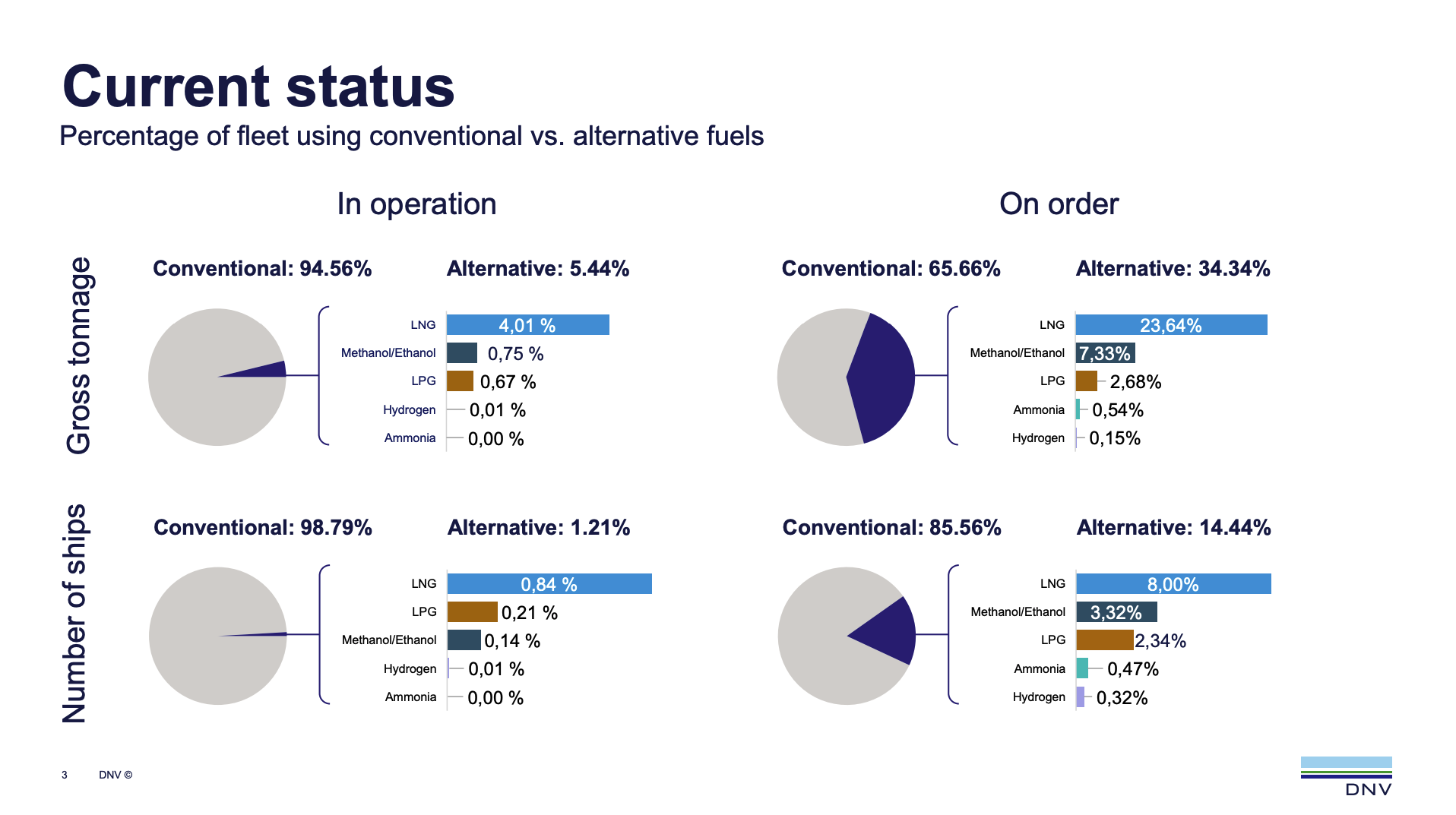
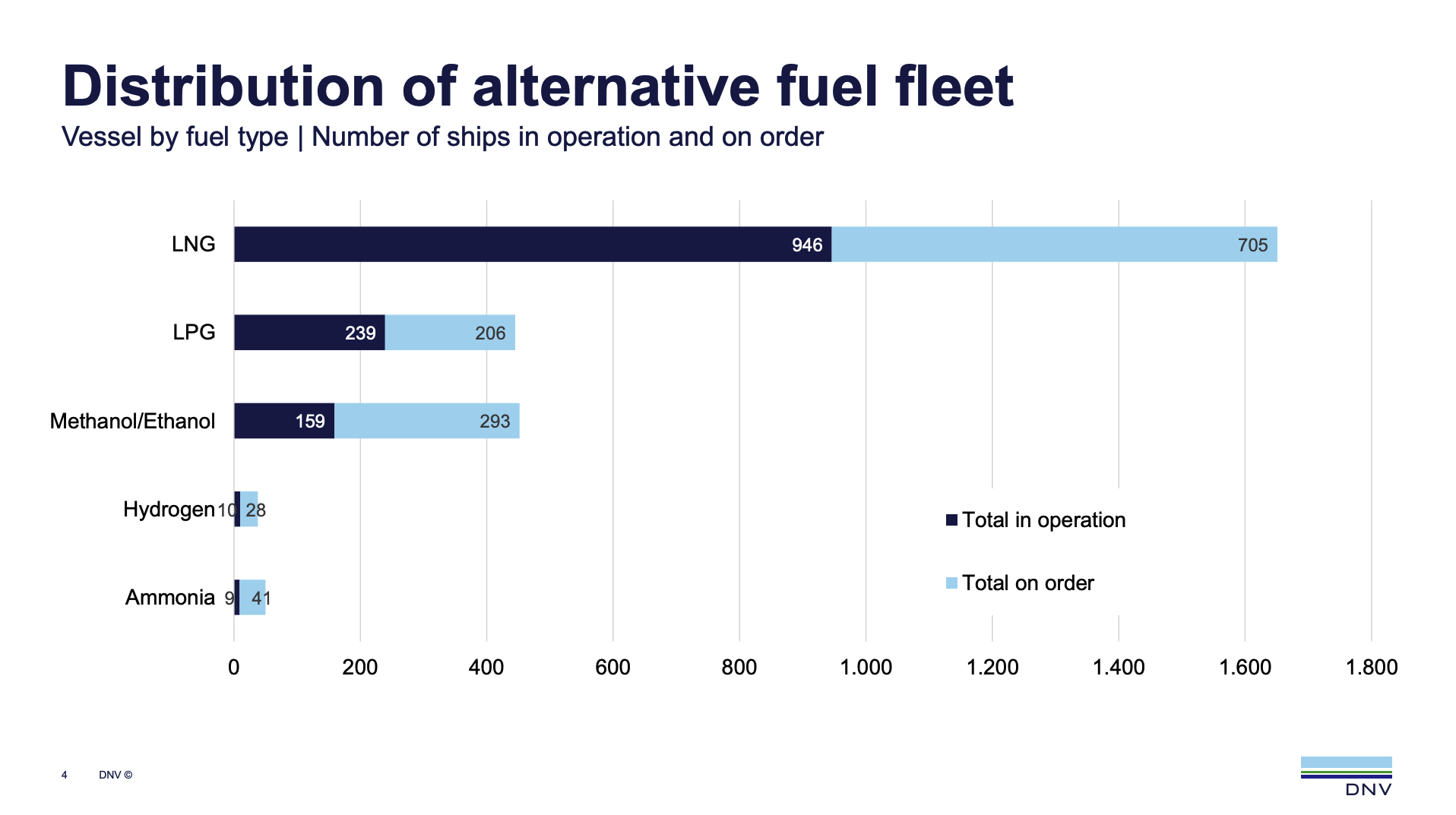
Photo credit: DNV
Published: 4 September, 2026
Alternative Fuels
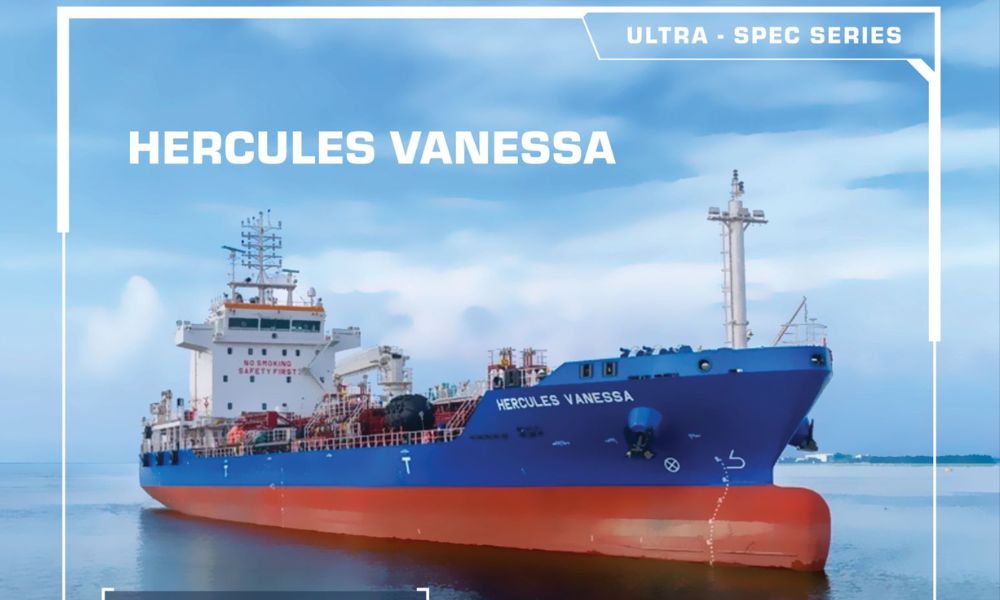
Hercules Tanker Management’s ‘Ultra-Spec Series’ tanker “Vanessa” begins maiden voyage
Designed for worldwide deployment, the series can transport and supply conventional marine fuels as well as alternative fuels up to B100 and methanol.
Alternative Fuels
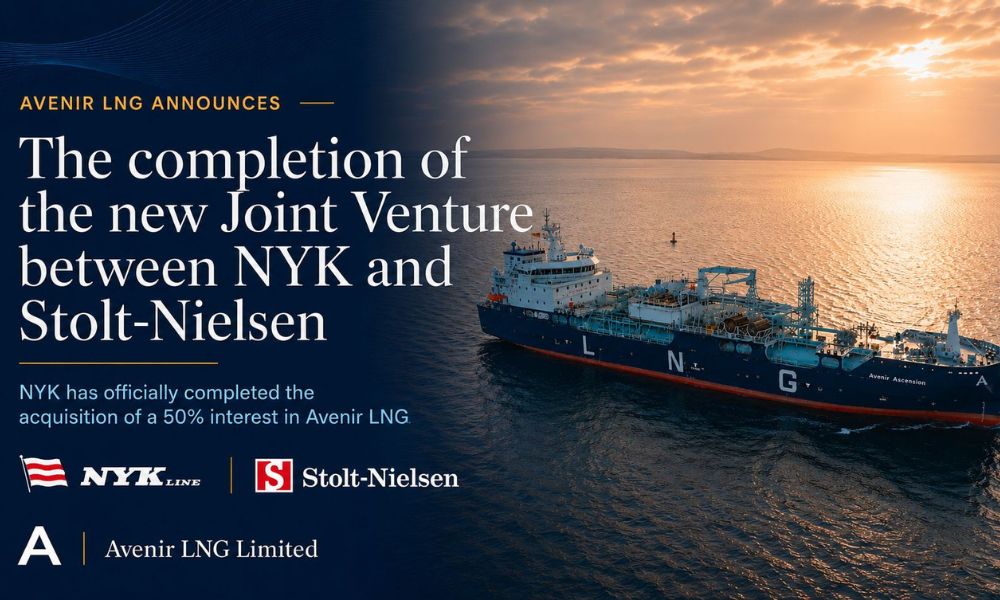
NYK and Stolt-Nielsen target LNG, bio-LNG bunkering growth through Avenir LNG JV
NYK says joint venture will pursue opportunities in LNG and bio-LNG bunkering, supporting the maritime industry’s transition to lower-emission fuels.

OUR INDUSTRY PARTNERS

Yang Ming orders six LNG dual-fuel, ammonia-ready containerships from Hanwha Ocean

LR, China’s MARIC unveil tanker concept ready for three future bunker fuels

DNV: Alternative-fuelled vessel orders hit highest monthly level since October 2024

TFG Marine advances global MFM rollout with two US Gulf bunker barges

GENA Solutions: Total renewable and low-carbon methanol project pipeline increases from 61.8 to 62.2 Mt by 2032

Baltic Exchange: Bunker Report (3 September 2026)

ENGINE: Americas Fuel Availability Outlook (3 September 2026)

Singapore-flagged tugboat “Kim Heng 3203” placed under Sheriff’s arrest

US targets five bunker companies in latest sanctions campaign against Iran

Singapore bunkering community supports Living Hope Evangelism’s 7th anniversary outreach for residents in need

China’s bunker market reshaped by tax rebates, trade flows and refining changes, says economist

Hengli Petrochemical’s ex-Singapore trading arm faces winding up application

Rajah & Tann: Bunker disputes are won in the first 48 hours

Report: GCMD outlines practical approach to quantity assurance in marine biofuel supply chains
-
 Vessel Arrest2 weeks ago
Singapore-flagged tugboat “Kim Heng 3203” placed under Sheriff’s arrest
-
 Sanctions2 weeks ago
US targets five bunker companies in latest sanctions campaign against Iran
-
 Events2 weeks ago
Singapore bunkering community supports Living Hope Evangelism’s 7th anniversary outreach for residents in need
-
 Interview1 week ago
China’s bunker market reshaped by tax rebates, trade flows and refining changes, says economist
-
 Winding up2 weeks ago
Hengli Petrochemical’s ex-Singapore trading arm faces winding up application
-
 Bunker Claim5 days ago
Rajah & Tann: Bunker disputes are won in the first 48 hours
-
 Biofuel2 weeks ago
Report: GCMD outlines practical approach to quantity assurance in marine biofuel supply chains
-

 Winding up1 week ago
Singapore: Notices of annual meeting issued for Vroon Shipping Asia and related firms