Connect with us

MoU

Air Liquide and Vopak to collaborate on Singapore ammonia and hydrogen infrastructure

‘As Singapore gears up for receiving and handling ammonia for power generation and bunkering, cracking of ammonia into hydrogen presents an additional application to help the industry shift to lower carbon feedstock,’ says Rob Boudestijn of Vopak.

Admin

Published

on

Air Liquide and Vopak to collaborate on Singapore ammonia and hydrogen infrastructure

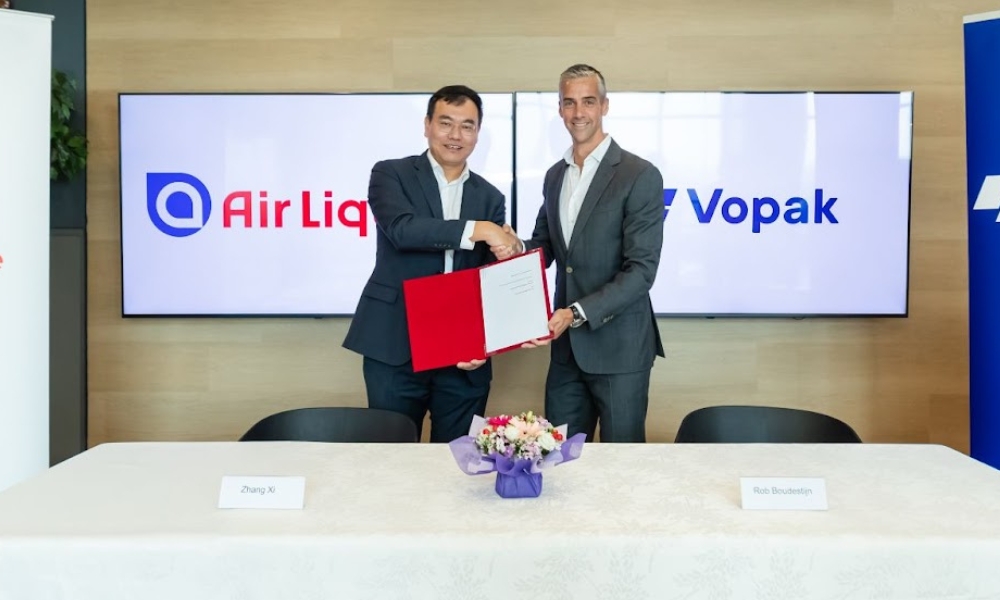
Liquid and gas storage and infrastructure solutions provider Vopak on Monday (11 March) said it signed a memorandum of understanding (MoU) with Air Liquide to collaborate on the development and operation of infrastructure for ammonia import, cracking and hydrogen distribution in Singapore. 

Ammonia is considered as one of the low-carbon fuels for power generation and the maritime industry. As a hydrogen carrier, it is one of the most efficient ways to store and transport hydrogen. 

Leveraging on an established global supply chain and infrastructure for ammonia production, transportation and utilisation, once transported, ammonia can be converted into hydrogen to contribute to the decarbonisation of industry and mobility. 

As such, the parties will study and explore the joint development of low carbon ammonia supply chains in Singapore, including the potential development of ammonia cracking facilities, associated ammonia storage and handling infrastructure at Vopak’s Banyan terminal, and the distribution of low-carbon hydrogen through a hydrogen pipeline network. 

This collaboration aims to support  Singapore’s National Hydrogen Strategy, focusing at driving advanced hydrogen technologies with high commercial readiness to establish low-carbon hydrogen supply chains.

Zhang Xi, Southeast Asia Cluster Vice President, and Managing Director of Air Liquide Singapore, said: “Air Liquide is committed to partnering with industry partners, such as Vopak, to offer innovative and sustainable solutions in support of Singapore’s decarbonisation efforts.”

“Air Liquide’s industrial scale ammonia (NH3) cracking pilot plant is under construction in Belgium.”

“We are proud to apply our expertise to crack low carbon ammonia into low-carbon hydrogen, aimed at reducing carbon emissions in industrial basins and hard to abate sectors, advancing towards a more sustainable future.”

Rob Boudestijn, President of Vopak Singapore, said: “Hydrogen and ammonia have the potential to significantly contribute to Singapore’s transition towards a low-carbon economy.”

“As Singapore gears up for receiving and handling ammonia for power generation and bunkering, cracking of ammonia into hydrogen presents an additional application to help the industry shift to lower carbon feedstock.”

“We are excited about collaborating with Air Liquide to accelerate the adoption and commercialisation of industrial ammonia cracking in Singapore.”


Photo credit: Vopak
Published: 12 March 2024

Continue Reading

Methanol

Wah Kwong clean fuels trading subsidiary ink green methanol MoU with CSSC affiliates

Venture Energy signed a MoU to establish a long-term offtake framework for green methanol supply with CSSC Science & Technology CSST and China Shipbuilding Trading CSTC.

Admin

Published

on

By

Wah Kwong clean fuels trading subsidiary ink green methanol MoU with CSSC affiliates

Hong Kong shipowner Wah Kwong Maritime Transport on Friday (22 May) said its subsidiary, Venture Energy, signed a Memorandum of Understanding (MoU) on green methanol cooperation last month in Beijing, with CSSC Science & Technology (CSST) and China Shipbuilding Trading (CSTC). 

The MoU establishes a long-term offtake framework for green methanol supply.

Last year, Wah Kwong established Venture Energy, a subsidiary focusing on the procurement and trading of clean fuels. Venture Energy connects producers of clean fuels in China to end users around the world, developing plant projects and procuring product for downstream customers and for the potential future requirements of Wah Kwong and other shipowners.

The representatives from the three parties attended the signing ceremony, including Zheng Song, General Manager of CSST, Di Weibing, Assistant General Manager of CSTC, and Greg McMillan, Executive Director of Venture Energy.

Under the MoU, the three parties will expand the scope of cooperation in line with market demand, focusing on the development of green methanol production initiatives and integrated collaboration across production, procurement, technical development and investment. 

This partnership aims to strengthen extensive engagement and technical dialogue, covering areas such as optimising green methanol technology pathways, ISCC EU certification and full-chain delivery solutions, to secure future fuel supply.

By leveraging complementary strengths, the partnership will enhance collaboration among the parties, supporting the maritime sector’s low-carbon transition, while advancing the development of sustainable fuels.

Related: Wah Kwong launches clean fuels procurement and trading subsidiary Venture Energy


Photo credit: Wah Kwong Maritime Transport
Published: 26 May, 2026

Continue Reading

Alternative Fuels

Algae-based biofuel project in Oman targets bunker fuel demand

Collaboration between HutanBio and Utopia seeks to develop and scale next-generation sustainable biofuel production to produce sustainable aviation and maritime fuel at commercial scale.

Admin

Published

on

By

Algae-based biofuel project in Oman targets bunker fuel demand

UK Asian biotechnology company HutanBio recently entered into a strategic Memorandum of Understanding with Oman’s Utopia World Investment (UWI) to support the growth of a sustainable fuels sector, including bunkering, in Oman.

Utopia is a majority shareholder in Wakud International which owns and operates Oman’s first dedicated biodiesel refinery. The collaboration seeks to develop and scale next-generation sustainable biofuel production to address one of the most difficult challenges in the fight against climate change: producing sustainable aviation and maritime fuel at commercial scale.

John Jones, COO of Utopia World BioEnergy, said: “By partnering with HutanBio, Utopia World is proactively building a pipeline of ultra-low carbon feedstocks for 2027 and beyond, ensuring continuity, scalability, and integrity in future fuel production.”

The partnership centers on the commercialisation of HutanBio’s proprietary algae-based oil technology, regarded as a scientific breakthrough for its proven ability to harness a newly discovered genus of algae identified by Dr John Archer, whose distinguished career includes leadership roles at Cambridge, MIT, and as one of the founders of KAUST’s biology department.

HutanBio’s novel microalgae strain demonstrates significantly higher productivity than conventional varieties, offering a potential path to producing sustainable crude alternatives at cost parity with traditional fossil fuels. Significantly, the technology has already proven successful in external pilot operations in Malaysia.

Under the terms of the agreement, Wakud will act as an offtaker as both entities scale their operations. Simultaneously, creating a robust framework for the domestic production and deployment of low-carbon fuels. This initiative arrives at a critical juncture for the aviation industry, which currently utilises less than 0.5% sustainable aviation fuel despite aggressive long-term decarbonisation targets of 25%.

Beyond its environmental impact, the project is expected to stimulate the growth of a specialised biotechnology industry, generating skilled employment opportunities and fostering local research and development capabilities. In addition to producing a green crude oil, the biotechnology has the potential to simultaneously enhance food security with the protein rich biomass byproduct.

Following successful discussions with government representatives and industry leaders, Manshu Agarwal, CEO of HutanBio, said the partnership reflects a shared ambition to position Oman at the forefront of the global clean energy transition.

“Oman is perhaps the single best place on Earth to build and scale this project, particularly because of its geopolitical stability, excellent human capital and refinery infrastructure in oil and gas, and of course the ideal climate for growing this algae,” he stated.

The first site is set to deploy in late 2027, before massive scale expansion in Oman, followed on by deployment through licensing in Asia, Northern Africa, Australia and parts of the US – supporting the needs of the entire aviation and maritime industry. 

By utilising arid coastlines and existing refinery infrastructure, HutanBio’s technology, supported by Wakud’s refinery expertise will transform Oman’s non-arable land into a high-tech biofuel hub to drive decarbonisation in the aviation and maritime sectors.


Photo credit: HutanBio
Published: 22 May, 2026

Continue Reading

Battery

Wah Kwong NatPower and CKS target Hong Kong–Guangdong electric inland shipping

Both will focus on areas including electric vessel construction and technological innovation, charging and battery-swap networks at Guangdong–Hong Kong terminals, among others.

Admin

Published

on

By

Wah Kwong NatPower and CKS target Hong Kong–Guangdong electric inland shipping

Wah Kwong NatPower Holdings (Wah Kwong NatPower) on Friday (15 May) said it has recently signed a Memorandum of Understanding (MoU) with Chu Kong Shipping Enterprises (Group) (CKS), a subsidiary of Guangdong Provincial Port & Shipping Group Company Limited. 

The two parties have agreed to establish a cooperative framework with a focus on advancing industries related to the electrification of Hong Kong’s waterborne transport. 

Under the MoU, the two parties will engage in in-depth discussions aligned with the shipping industry’s low-carbon transition, focusing on areas including electric vessel construction and technological innovation, charging and battery-swap networks at Guangdong–Hong Kong terminals, and the overall promotion of water transport electrification in Hong Kong. Both sides will share industry information and jointly explore relevant policy and technical developments.

The MoU was signed by Mr. Vincent Ni, the General Manager of Wah Kwong NatPower. Mr. Ni noted that establishing industry-wide collaborative mechanisms is essential to translating low-carbon transition concepts into tangible outcomes. He stated that water transport electrification is a systemic endeavour that requires close coordination across the entire value chain. 

Wah Kwong NatPower said the cooperation with CKS reflects a shared vision for the development of water transport electrification in Hong Kong and the Greater Bay Area. 

The shipping industry is entering an accelerated phase of green and low-carbon transition. As a leading hub for maritime innovation, the Guangdong–Hong Kong–Macao Greater Bay Area is advancing the deployment of electric vessels alongside the development of supporting infrastructure.

“At the same time, the region is building an interconnected green energy ecosystem, expanding shoreside charging networks and promoting standardisation across charging and battery-swapping systems. This coordinated approach is critical to enabling seamless cross-regional operations and overcoming key energy replenishment challenges,” the company added. 

Together, the parties will deepen collaboration to explore practical, scalable pathways for water transport electrification, aligned with Hong Kong’s specific operating environment and broader industry trends.

Following the agreement, both parties will establish a joint working group and structure collaboration framework to accelerate project development, identify priority opportunities, and bring forward tangible infrastructure solutions.


Photo credit: Wah Kwong NatPower
Published: 18 May, 2026

Continue Reading

Trending