Connect with us

Business

IBIA and ISO provide key input on bunker fuel quality to IMO meeting

Both presented and participated in a Q&A to elaborate on their joint paper where they explained why it is considered unadvisable to regulate oil fuel parameters other than flashpoint.

Admin

Published

on

MT photos 13 February 2023 48

The International Bunker Industry Association (IBIA) on Tuesday (13 June) released an article on IBIA and International Organization for Standardization (ISO) providing presentations followed by a Q&A to elaborate on the subjects covered in their joint paper: 

IBIA and ISO made a real impact at the IMO’s recent Maritime Safety Committee meeting, MSC 107 (31 May to 9 June), where we provided presentations followed by a Q&A session to elaborate on the subjects covered in our joint paper, MSC 107/6/4. It was a great opportunity to bring more clarity to long-running discussions on fuel oil safety at the IMO, and it was very well received by IMO delegates who found our session very informative.

In MSC 107/6/4, IBIA and ISO described why we would not recommend making the ISO 8217 standard mandatory (one of the proposals under discussion at MSC 107). Our paper also outlined test precision principles as per ISO 4259, and explained why it is considered unadvisable to regulate oil fuel parameters other than flashpoint due to uncertainties in establishing clear and consistent links between specific fuel parameters and the safety of ships.

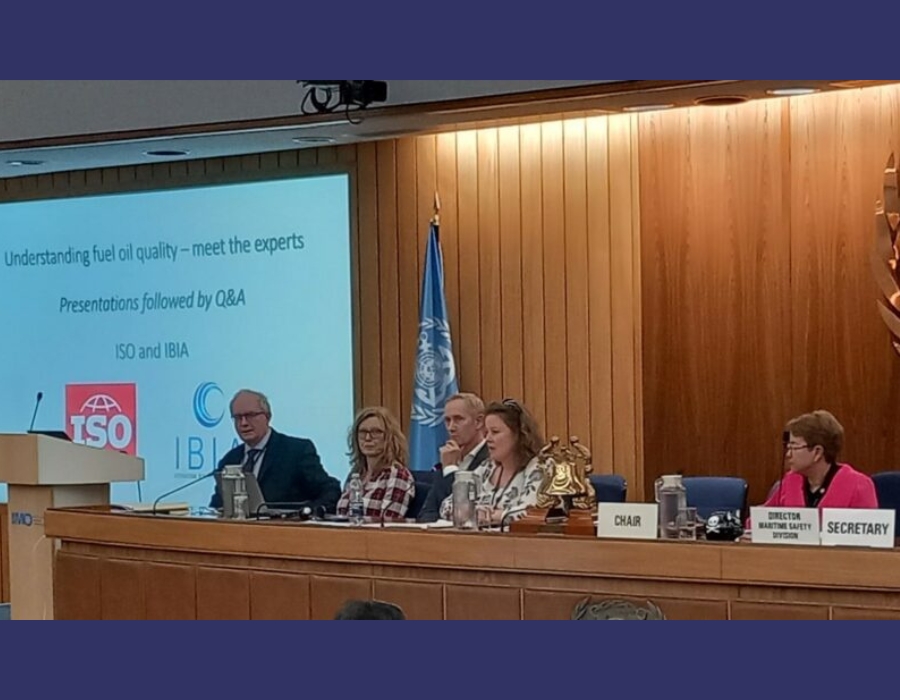
Early on during MSC 107, on June 1, ISO and IBIA jointly held a session with the title “Understanding fuel oil quality – meet the experts” where we provided two presentations followed by a Q&A. IBIA’s Director and IMO Representative Unni Einemo introduced the panel of experts and moderated the Q&A.

First up, Timothy Wilson, Principal Consultant Engineer at Lloyd’s Register, provided key insights into the scope of ISO 8217. He explained how the primary objective of 8217 is to safeguard ships from operational issues, but that a fuel testing off-spec does not necessarily impose a significant risk for the ship. In fact, off-specs very rarely means that the fuel is “unusable” or “unsafe”, but requires the engineers to understand the capacity of the ship to handle and manage the fuel safely.

Sharing test data from LR FOBAS from so far in 2023, he said 98.02% of distillate marine fuels met ISO 8217 specifications when taking into account the ISO 4259 test method precision application for the receiving ship. For residual fuel grades, the corresponding figure was 97.37% of all samples.

The most common off-specs include viscosity, water and sulphur. Analysing the data more closely, Wilson said only around 0.25% of total global off-specs for residual marine fuel grades were regarded as potentially problematic or even unusable fuels due to either significant offspecs for flashpoint (0.03%), cat fines (0.04%), water content (0.06%) or total sediment (0.12%).

Wilson shared that the next edition of ISO 8217 will see changes regarding categorisation, fuel stability, biofuels/FAME content, and an update on chemical compounds and test methodologies, in particular for Organic Chlorides.

Next, Charlotte Røjgaard, VeriFuel Global Business Director, did a presentation explaining the complexities of identifying clear cause and effect when a fuel has met ISO 8217 specifications, but the ship experiences operational problems. In these cases, fuel testing agencies are known to use advanced GCMS testing to try to identify if there are chemical compounds present that may be the culprit. She described how in some cases, such investigative testing has been successful in narrowing down the cause(s), but in other cases there was no consensus among fuel testing agencies about which chemical(s) were to blame, if any.

One of the difficulties stems from testing agencies using in-house methods. They can produce very different analysis results when testing the same fuel, both with regards to which chemical compounds they detect, and at which concentrations. This makes it hard to make meaningful comparisons and draw clear conclusions.

Unless there has been an operational problem, fuels will mostly not be subjected to GCMS tests, but Røjgaard shared data indicating that some of the chemical species often pointed to as the culprit were often also found in fuels that had caused no known operational problems. She said more research is needed into building a better understanding of how common specific chemical compounds are, whether they are in fact problematic and if so at what concentrations, or if they perhaps only cause operational issues under very specific onboard conditions.

In addition to Wilson and Røjgaard, Jeroen de Vos, Head of Quality at Peninsula and an IBIA board member, joined the expert panel for the Q&A with IMO delegates. A former employee of DNVPS and VPS, he too has deep knowledge of fuel quality testing, and all three panellists are members of the of ISO TC28/SC4/WG6, the technical committee overseeing the revision of the ISO 8217 marine fuel quality standard.

There were plenty of questions and comments from IMO delegates during the Q&A. The message from the expert panel was to highlight the importance of transparency and sharing information in an objective and constructive way. Ship operators can help by documenting the onboard experience, to establish if specific problems can be clearly linked to a specific fuel batch. Suppliers can help by providing more clarity and traceability on the supply chain. Testing agencies can help by sharing data with engine makers, authorities and organisations like CIMAC, and working toward finding standardised test methods.

Wilson also noted all the good work that has been made available to the industry to provide guidance on dealing with fuel quality since the introduction of the 0.50% sulphur limit in 2020. This included the ISO PAS  23263: 2019, the IMO’s Ship Implementation Plan and other IMO guidelines, and the Joint Industry Guidance on the supply and use of 0.50%-sulphur marine fuel that was published in August 2019 (available on THIS LINK).

Related: IBIA proposals to IMO on bunker fuel safety and sampling guidelines


Photo credit: International Bunker Industry Association
Published: 21 June, 2023

Continue Reading

Winding up

Singapore: High Court to hear Norvic Shipping Asia winding up application on 31 July

Application for the winding up of Norvic Shipping Asia Pte Ltd was filed by Netherlands-registered Mur Shipping BV on 8 April, according to Government Gazette notice.

Admin

Published

on

By

RESIZED singapore high court

An application for the winding up of Norvic Shipping Asia Pte Ltd was filed by Netherlands-registered Mur Shipping BV on 8 April, according to a Tuesday (21 July) notice on the Government Gazette.

It noted the winding up application is directed to be heard before the Judge sitting in the General Division of the High Court at 10am on 31 July.

Any creditor or contributory of the company desiring to support or oppose the making of an order on the winding up application may appear at the time of hearing by himself or his counsel for that purpose.

A copy of the winding up application will be furnished to any creditor or contributory of the company requiring the copy of the winding up application by the solicitors of the applicant’s, Oon & Bazul LLC, on payment of the regulated charge for the same.

The Applicant’s address is Hiridostraat 5, Gebouw Prismatrium, 1101CW Amsterdam, The Netherlands.

The Applicant’s solicitors are Oon & Bazul LLC of 103 Penang Rd, #04-04/05/06 Singapore 238467. 

Queries on the winding up application may be directed to the following email addresses: [email protected] and [email protected].


Photo credit: Manifold Times
Published: 22 July, 2026

Continue Reading

Methanol

World Fuel and partners complete first green methanol bunkering of car carrier in Shanghai

Operation involved the delivery of approximately 2,800 MT of green methanol to “Arctic Tern” via a ship-to-ship transfer using SIPG Energy’s dedicated methanol bunkering vessel “M/V Hai Gang Zhi Yuan”.

Admin

Published

on

By

World Fuel and partners complete first green methanol bunkering of car carrier in Shanghai

Marine fuel provider World Fuel on Tuesday (21 July) said it successfully completed the first green methanol bunkering of M/V Arctic Tern, with EUKOR Car Carriers and SIPG Energy at the Port of Shanghai. 

Arctic Tern is the first vessel in the new Shaper Class series of car carriers. 

The operation involved the delivery of approximately 2,800 MT of green methanol to Arctic Tern via a ship-to-ship transfer using SIPG Energy’s dedicated methanol bunkering vessel M/V Hai Gang Zhi Yuan, the largest vessel of its kind in operation. 

The bunkering operation was carried out at Haitong Terminal, Waigaoqiao Port Area, Shanghai Port, with cargo handling operations conducted simultaneously during bunkering.

This marks EUKOR Car Carriers’ first green methanol operation and the first time Arctic Tern has bunkered methanol since its delivery on 9 July. The operation marked the first bunkering at Shanghai Port of green methanol produced locally in Shanghai for an international PCTC operator. 

It also demonstrated the city’s integrated green methanol value chain, spanning local production, storage and bunkering, and established a replicable “Shanghai Model” for green methanol supply.

World Fuel arranged the supply and delivery of the fuel on behalf of EUKOR Car Carriers, working with SIPG Energy as the physical supplier at the Port of Shanghai.

The green methanol supplied was produced from municipal solid waste, ISCC-EU certified, and had a carbon intensity value below 25 gCO₂e/MJ.

Arctic Tern is the first of fourteen Shaper Class vessels ordered by Wallenius Wilhelmsen. With a capacity of 9,300 car equivalent units and methanol dual-fuel capability, the vessel will be operated by EUKOR Car Carriers, jointly owned by Wallenius Wilhelmsen and Hyundai Motor Group. Following her first green methanol bunkering, Arctic Tern will continue her maiden voyage from Asia to Europe.

Xavier Leroi, COO Shipping Services at Wallenius Wilhelmsen and CEO of EUKOR Car Carriers, said: “Completing Arctic Tern’s first green methanol bunkering shortly after delivery is a significant milestone towards our decarbonisation ambition for both EUKOR Car Carriers and Wallenius Wilhelmsen. It demonstrates how investments in next-generation vessel technology and fuel flexibility are being translated into real-world operations. 

“This achievement reflects the strong collaboration between all parties involved. Together, we have shown how partnerships across the maritime value chain can help make lower-emission fuels available and operationally viable at scale.”

Mark Tamsitt, SVP Global Marine Sales at World Fuel, said, “The first bunkering event with a new fuel is a significant moment for any shipowner, and our role is to make it as seamless as possible. By connecting EUKOR Car Carriers with SIPG Energy’s proven green methanol capability at the Port of Shanghai, we were able to deliver on reliable supply, fuel quality, and safe processes. As more of our customers bring methanol dual-fuel tonnage into service, we are committed to being the partner that makes these kinds of operations routine.”

Mr. Zhang Da, General Manager of SIPG Energy, said, “Welcoming Arctic Tern to the Port of Shanghai for her first green methanol bunkering demonstrates the strength and maturity of our supply capability. Building on our well-established methanol ship-to-ship bunkering services for container vessels, we have already extended such services to pure car and truck carriers (PCTCs). This bunkering sets a new record for the largest single SIMOPs green methanol bunkering for PCTCs in China, marking another step in building Shanghai’s position as a global green energy hub for international shipping.”

This operation follows Wallenius Wilhelmsen’s announcement on 9 July that Arctic Tern would complete her first methanol bunkering shortly after delivery. The vessel entered service on routes between Asia and Europe immediately following handover from China Merchants Jinling Shipyard in Nanjing.


Photo credit: World Fuel
Published: 22 July, 2026

Continue Reading

Ammonia

HPA and MB Energy develop safety concept for STS ammonia bunkering

HPA says the Port of Hamburg will become “bunker ready” for ammonia, laying the groundwork for safe and reliable ammonia bunkering in the future.

Admin

Published

on

By

HPA and MB Energy develop safety concept for STS ammonia bunkering

The Hamburg Port Authority (HPA) and integrated energy company MB Energy on Tuesday (21 July) said they have completed a comprehensive risk analysis and developed a dedicated safety concept for ship-to-ship ammonia bunkering.

MB Energy said the analysis lays the groundwork for the safe introduction of ammonia as a future marine fuel.

“With our planned ammonia import terminal in Hamburg-Blumensand, MB Energy intends to provide the reliable land side supply infrastructure needed to support this transition across northern German ports,” it said in a social media post. 

Mabanaft Group was renamed to MB Energy last year and merged over 50 existing brands under one identity. 

Separately, HPA said the Port of Hamburg will become “bunker ready” for ammonia, laying the groundwork for safe and reliable ammonia bunkering in the future.

“The focus is in particular on container ships, cruise ships as well as RoRo and ConRo (Container/RoRo) ships,” it said. 

“We expect ammonia to establish itself as an alternative marine marine fuel in the coming years. With our preparatory work, we are already creating the conditions to welcome the first ammonia-powered ships in Hamburg and to bunker them safely.:

HPA added that the import terminal for ammonia planned by MB Energy from 2029 will make a decisive contribution to ensuring the reliable availability of ammonia as a bunker fuel in northern German ports in the long term. 

“The use of an ammonia bunker barge is considered a possible addition to the landside infrastructure to enable ship bunkering in the port and beyond in the future,” it said.

Related: Mabanaft Group renames as MB Energy, merging over 50 brands under one identity


Photo credit: Hamburg Port Authority
Published: 22 July, 2026

Continue Reading

Trending