Connect with us

Business

ENGINE: Europe & Africa Bunker Fuel Availability Outlook

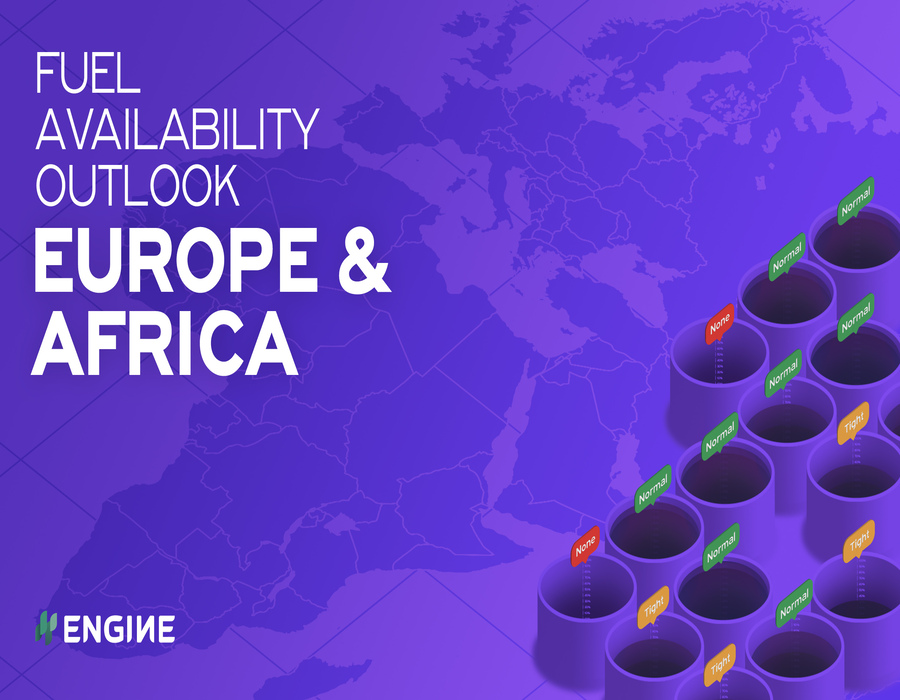
Bunkering resumes in Gibraltar; ARA fuel oil inventories slip to six-week lows; no bunker backlog in Algoa Bay.

Admin

Published

on

ENGINE Europe

The following article regarding Europe and Africa bunker fuel availability has been provided by online marine fuel procurement platform ENGINE for post on Singapore bunkering publication Manifold Times:

14 September 2022

  • Bunkering resumes in Gibraltar
  • ARA fuel oil inventories slip to six-week lows
  • No bunker backlog in Algoa Bay


Northwest Europe

LSMGO has become more readily available in the ARA hub with several suppliers now offering prompt deliveries, sources say. The recommended lead time for LSMGO delivery in Rotterdam and other ports in the ARA is three days.

Securing VLSFO and HSFO stems for prompt dates can be more difficult, especially for HSFO. Some suppliers are running low on fuel oil in storage and await resupply, sources say. While VLSFO requires a lead time of around 5-7 days, HSFO now needs seven days at the very least.

Independently held fuel oil inventories in the ARA fell by 60,000 bbls to 7.13 million bbls in the week ending 8 September, according to Global Insights. Signs of dwindling Russian inflows seem to have contributed to draw down stocks.

According to cargo tracker Vortexa, Russian fuel oil imports accounted for about a quarter of ARA’s fuel oil imports in July, but nothing was imported throughout August or so far this month.

The cargo tracker has instead picked up fuel oil cargoes flowing into the ARA from the UK, Greece, Germany, Saudi Arabia and other sources. The UK has been the biggest exporter to the ARA in since last month.

With European Union countries preparing to phase out imports of Russian oil products within eight months after an embargo was approved in June, refineries and oil traders in northwest Europe will eventually switch to non-Russian oil.

The region’s gasoil stocks have decreased by 480,000 bbls, to 12.39 million bbls last week.

Some suppliers can offer limited quantities of LSMGO and HSFO off Skaw. Recommended lead times for the two grades are around seven days, a source says.

Bunker fuel availability remains normal in Hamburg and recommended lead times are about five days across all grades.

LSMGO availability is normal in Bremerhaven, but securing VLSFO and HSFO deliveries for prompt dates can be difficult, a source says.


Mediterranean

Bunker operations resumed in Gibraltar from last Friday evening, after being suspended for 10 days. Two vessels collided in Gibraltar on 31 August, which caused an oil spill and forced the Gibraltar Port Authority (GPA) to suspend bunkering along with other port operations.

Availability of LSMGO and VLSFO has normalised in Gibraltar and Algeciras, with some suppliers offering prompt deliveries. Recommended lead times are about 4-6 days.

Securing HSFO stems for prompt dates can be slightly difficult in Gibraltar Strait ports, sources say.

With bunkering mostly resumed in Gibraltar, congestion has eased in the nearby ports of Algeciras, Ceuta and Las Palmas. Bunker calls were diverted from Gibraltar to these ports while bunkering was suspended.

Nine vessels were scheduled to arrive for bunkers in Ceuta on Wednesday, down from a peak of 12 last week, shipping agent Jose Salama & Cia says.

In Malta, nine vessels were due to arrive for bunkers on Wednesday, down from a high of 15 last week, according to Seatrans Shipping agency. Bunker supply is said to be normal in Malta, where suppliers can delivery for prompt dates, a source says.

LSMGO availability is said to be normal in Las Palmas, while VLSFO is tight for prompt delivery, sources say.


Africa

Bunker supply is said to be normal in South Africa’s Algoa Bay, a source says. No backlog was reported in the region on Wednesday amid conducive weather conditions, according to Rennies Ships Agency. Five vessels are scheduled to arrive for bunkers this week, it says.

VLSFO and LSMGO availability is normal in Durban, and some suppliers can offer delivery for prompt dates, a source says. Recommended lead times for the two grades in Durban are around seven days.

By Shilpa Sharma


Photo credit and source: ENGINE
Published: 15 September, 2022

Continue Reading

Bunker Fuel

Huanghua Port expands bunkering capabilities with dedicated fuel oil terminal

Previously, bunkering vessels serving Huanghua Port were required to replenish marine fuel oil at other ports, including Tianjin, before returning to carry out bunkering operations, often resulting in delays.

Admin

Published

on

By

China Flag

Huanghua Port has strengthened its marine fuel supply infrastructure with the commissioning of its first dedicated, all-weather bunker terminal, a move aimed at improving vessel turnaround times and supporting growing shipping activity at the port, according to China-based news outlets on Thursday (11 June). 

On 9 June, bunker tanker Heng Feng You 165 completed fuel loading operations at the terminal in the Huanghua Port Comprehensive Port Area before proceeding to an anchorage to provide bunkering services to waiting cargo vessels.

According to local authorities, the new facility addresses a longstanding bottleneck in the port’s marine fuel supply chain. 

Yao Meichen, Deputy Director of the Cangzhou Municipal Ocean and Port Administration Bureau said bunkering vessels serving Huanghua Port were required to replenish marine fuel oil at other ports previously, including Tianjin, before returning to carry out bunkering operations, often resulting in delays for vessels awaiting bunkers.

As cargo throughput and vessel traffic have increased in recent years, the absence of a specialised bunker terminal became a constraint on port efficiency. To address the issue, local authorities invested RMB 266 million (USD 39 million) to develop Huanghua Port’s first dedicated marine fuel oil terminal and actively pursued regulatory approvals for both a domestic transfer export bonded warehouse and a liquid bonded storage facility.

The terminal, which entered service at the end of last year, features a dedicated 5,000-dwt berth and storage tanks with a combined capacity of 66,000 cubic metres. It has a designed annual throughput capacity of 820,000 tonnes and primarily handles marine gasoil as well as 120 CST and 180 CST fuel oils.

Authorities said the facility has been operating smoothly since its launch and is capable of ensuring a stable supply of bunker fuel for vessels calling at the port.

The bunkering infrastructure will be further enhanced following approval from Shijiazhuang Customs for the establishment of both the domestic transfer export bonded warehouse and liquid bonded storage facilities. The additions are expected to strengthen Huanghua Port’s ability to provide bunkering services to international-going vessels.

“The commissioning of the marine fuel oil terminal has completely changed the previous situation of off-site fuel supply and ships queuing for fuel, achieving benefits for both bunkering vessels and cargo ships,” said Dong Xianke, General Manager of Cangzhou Bohai New Area Gangkun Marine Fuel Co., Ltd., the terminal’s operator.


Photo credit: David Yu from Pixabay
Published: 16 June, 2026

Continue Reading

Methanol

China: Chimbusco takes delivery of new methanol bunkering vessel in Zhoushan

Company says commissioning of “Zhong Ran LV Neng 85” will further enhance its service capabilities in green methanol bunkering in major domestic ports.

Admin

Published

on

By

Chimbusco takes delivery of new methanol bunkering vessel in Zhoushan

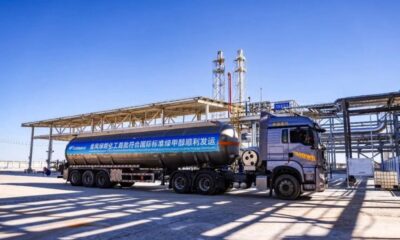
China Marine Bunker (PetroChina) (Chimbusco) recently took delivery of its first bunkering vessel in China to deliver methanol to dual-fuel ships.

The 8,500-dwt duplex stainless steel chemical tanker Zhong Ran LV Neng 85 was successfully delivered in Zhoushan.

The company said the commissioning of this new ship will further enhance Chimbusco’s service capabilities in green methanol bunkering in major domestic ports and expand its national marine new energy service and support network

During the delivery period, Chimbusco said it focused on safe operations and conducted special training for all crew members of the vessel.

The training covered methanol bunkering operation specifications, prevention of collisions between commercial and fishing vessels, daily vessel reporting, and voyage report filling standards.

Manifold Times previously reported the launching of the bunkering vessel at Taizhou Fangzhen Shipbuilding Wharf in Zhejiang.

The floating out of the ship comes after Chimbusco has obtained methanol bunkering licences for Shanghai Port and Ningbo Port.

Related: Chimbusco launches new methanol bunkering vessel in Zhejiang


Photo credit: China Marine Bunker (PetroChina) (Chimbusco)
Published: 16 June, 2026

Continue Reading

LNG Bunkering

CCEC and CMA CGM form joint venture to build and operate LNG bunkering vessel

Each party will hold a 50% ownership stake in the joint venture, which has been established for the purpose of constructing, chartering, and operating one 20,000 cbm dual-fuel LNG bunkering vessel.

Admin

Published

on

By

RESIZED scott graham

Capital Clean Energy Carriers Corp. (CCEC), an international owner of ocean-going gas vessels, on Friday (12 June) announced the formation of a joint venture company with CMA CGM. 

Each party will hold a 50% ownership stake in the joint venture, which has been established for the purpose of constructing, chartering, and operating one 20,000 cbm dual-fuel LNG bunkering vessel. 

The joint venture marks CCEC’s entry into the LNG bunkering segment, the company’s first vessel dedicated to marine fuel supply.

In connection with this transaction, the joint venture has entered into a shipbuilding contract with Nantong CIMC Sinopacific Offshore & Engineering (CIMC SOE) for the construction of the vessel at a contract price of USD 82.8 million, with delivery expected in the third quarter of 2028.

Incorporating the latest technologies, the vessel is designed to enable safe and reliable LNG transfers across a wide range of operating conditions. Advanced emissions reduction systems, combined with highly efficient dual-fuel power generation, are designed to help the vessel meet applicable environmental standards of the global shipping industry.

In addition, the joint venture is expected to enter into a 12-year time charter with a joint venture company formed between CMA CGM and TotalEnergies, commencing upon delivery of the vessel from the shipyard.

Jerry Kalogiratos, CEO of Capital Clean Energy Carriers, commented: “This joint venture marks CCEC’s entry into LNG bunkering — a natural extension of our gas platform from carriage into marine fuel supply. 

“Working alongside counterparties of the calibre of CMA CGM and TotalEnergies, we can help build the infrastructure that allows LNG to deliver a cleaner emissions profile, alongside security and diversity of supply, while opening a new, long-term contracted revenue stream for the Company through the Joint Venture.”

Christine Cabau, Executive Vice President Operations and Assets of CMA CGM, said: “Together with Capital Clean Energy Carriers and TotalEnergies, we are committed to building a reliable and high-performance LNG bunkering supply chain, which is essential to ensuring the availability and reliability of fuels such as LNG that represent the first step in the decarbonization of our industry.”


Photo credit: Scott Graham
Published: 16 June, 2026

Continue Reading

Trending