Connect with us

Alternative Fuels

Argus Media Q&A: Bunker One to test bio-bunker B7 blend

Bunker One Brazil chief executive Flavio Ribeiro shares his outlook on the opportunity for Brazil to become a global biodiesel supplier for the shipping industry.

Admin

Published

on

5e16c2fc7aa8e 1578550012 1

Global bunker fuel trading company Bunker One is gearing up to test biodiesel blends in marine fuels in Brazil. In an interview with Argus, Bunker One Brazil chief executive Flavio Ribeiro shared his outlook on the opportunity for Brazil to become a global biodiesel supplier for the shipping industry:

What role can biodiesel play in decarbonizing the marine fuel industry?

Brazilian biodiesel could play a relevant role in reducing emissions in the shipping industry. We are major soybean producers and we are the largest exporter. We have the means to produce more biodiesel. While many in the fuel industry argue that biodiesel blends increase costs, we see it differently. With more demand for biodiesel, production will increase. There is untapped potential. We work in an industry that has massive amounts of fuel. One vessel consumes more fuel in a month than the average filling station. The shipping industry is focused on reducing emissions and Brazil has surplus capacity for biodiesel production. As part of the largest conglomerate in this industry in the world, we see potential.

When does Bunker One plan to begin its tests with biodiesel blends?

The test will begin shortly with our Rio barge operations and will be conducted by the Federal University of Rio Grande do Norte state. We have been approached by other companies interested in testing the fuel in their vessels. But we think this is unnecessary, because we are convinced that the results will be positive. Tests have been done in the US and Denmark. ISO (International Standardization Organization) has approved blends of up to 7pc for marine fuel. We are conducting the tests to spark interest in biodiesel blends. The tests will also allow the government and regulatory agencies to create proper regulations.

How could biodiesel contribute to lower emissions in the bunker fuel market?

This is part of our broader global agenda to reduce emissions by 2050. It is important to try new technologies, but biodiesel blends are drop-in. It is possible to use existing engines, which makes it much easier to adopt. Although ISO already allows 7pc biodiesel in marine diesel, there are still regulatory issues that need to be resolved by the IMO (International Maritime Organization). The IMO has certain regulations for NOx emissions from fossil fuels. These regulations need to be adjusted to stipulate a NOx cap for bio-blend and fossil fuels. We are hoping that the Brazilian government will use its role on the IMO board to resolve this issue. Once this resolution is fixed, countries all over the world will be able to certify the bio-blend.

How much demand does Bunker One see for biodiesel bunker-fuel blends?

The potential is at least 8-10mn metric tons per year. That is more biodiesel than Brazil currently produces per year. The potential is massive, even if we stick to the 7pc limit. We are focused on 7pc now, but down the road, we could push for a higher blend.

Would subsidies be necessary to implement a B7 blend? Would a blend result in higher fuel costs?

We believe the government needs to pave the way for this program to develop, but not to subsidize its use. With the blend, biodiesel production would increase, which would help lower prices. Of course, nobody wants to pay more for fuel, but the market is pushing for actions to reduce emissions and this comes at a cost. Companies will need to decide how they are going to cover the costs of lowering emissions.

Is the Brazilian government on board with the biodiesel blend project?

We have presented this to (mines and energy) minister (Bento Albuquerque), to the (hydrocarbons regulator) ANP and to ports regulator Antaq. All of them are on board for this research. We need them to work with the IMO to change the regulations. Even if the ANP creates B7 regulations, it could limit sales, because international ships could be prohibited from using the fuel if it is not regulated by the IMO. As the president of the Brazilian Bunkering Association, I am working to create awareness and to push for regulatory changes.

Would bio-bunker B7 potentially compete with LNG bunkering?

Bio-bunker B7 is a drop-in fuel – it uses the same engine and same tanks. To switch to LNG, ships need new tanks, new engines and new import infrastructure. LNG is an option for some global shipping lines, but for general shipping – where ships go where the freight is – B7 offers more flexibility.

Is Bunker One looking to blend its own 7pc biodiesel, or will it buy the finished 7pc biodiesel from local suppliers?

For this project, we have a special permit to buy B100 from producers and will blend it ourselves. Once the blended product is regulated, this process can be done by fuel distributors. There is a lot of interest from the biodiesel industry to move ahead with this process and many potential suppliers have already contacted us.


Photo credit and source: Argus Media
Published: 31 January, 2022

Continue Reading

Methanol

China launches methanol shipping supply chain alliance to accelerate green transition

Marine fuel suppliers in the alliance include Sinopec Fuel Oil Sales, China Marine Bunker (PetroChina), SIPG Energy (Shanghai), and Shenzhen Port Energy Development.

Admin

Published

on

By

China Flag

China Waterborne Transport Research Institute under the Ministry of Transport and China Transport News recently jointly launched a Methanol Fuel Shipping Supply Chain Innovation Alliance with 20 organisations spanning the shipping, port, energy, equipment, research and industry association sectors.

The alliance was officially announced during the main event of China Maritime Day 2026 on 11 July, where members also released a joint initiative to develop a collaborative methanol-fuelled shipping supply chain.

The alliance aims to implement China’s national strategy for green economic transformation and support the Ministry of Transport’s “One Network, Four Modernisations” initiative by building a safe, efficient, economical and reliable methanol marine fuel supply chain

Under the joint initiative, alliance members pledged to align with China’s national decarbonisation strategy by promoting methanol as a key pathway for the shipping sector’s green transition and optimising the industry’s energy mix.

The members also pledged to strengthen collaboration across the supply chain to improve coordination between bunker fuel production, transportation and end users while advancing technological innovation.

Lastly, the alliance will support the development of policies, planning and technical standards, promote resource sharing and joint research, and accelerate the large-scale adoption of methanol as a marine fuel.

The alliance brings together companies and organisations representing the entire methanol shipping supply chain.

Members include shipping and port members such as China Changjiang National Shipping (Group) Corporation, COSCO Shipping Bulk Co., Ltd., Shandong Port Group, and Wuhan Chuangxin Jianghai Shipping Co., Ltd.

Energy companies in the alliance include Sinopec Chemical Commercial Holding Company Limited and Methanex Corporation.

Marine fuel suppliers including Sinopec Fuel Oil Sales, China Marine Bunker (PetroChina), SIPG Energy (Shanghai) Co Ltd and Shenzhen Port Energy Development Co Ltd are also part of the alliance. 

Equipment manufacturers in the alliance are CSSC 711th Research Institute, CSSC Power (Group) Corporation Ltd and Chongqing Hongjiang Machinery Co Ltd.

Research, media and industry organisations participating in the alliance include the China Waterborne Transport Research Institute, China Transport News, and the Methanol Institute.

The Methanol Institute said methanol is moving beyond individual projects towards coordinated action across the entire value chain. 

“And China continues to play a leading role in advancing methanol as a marine fuel,” it said in a social media post.  

“We’re proud to work alongside our fellow alliance members to help strengthen the methanol supply chain and support the continued growth of methanol as a marine fuel.”


Photo credit: David Yu from Pixabay
Published: 17 July, 2026

Continue Reading

Alternative Fuels

KR, HD Hyundai tap first ammonia dual-fuel sea trial to develop vessel operating standards

Trial generated data on the vessel’s fuel supply system and engine, which will provide a technical foundation for KR’s future development of domestic guidelines for ammonia-fuelled ships.

Admin

Published

on

By

KR, HD Hyundai tap first ammonia dual-fuel sea trial to develop vessel operating standards

Korean Register (KR) on Tuesday (14 July) said it is collaborating with HD Hyundai Heavy Industries (HHI) to establish a domestic operating environment for ammonia-fuelled vessels under the Ministry of Oceans and Fisheries’ Green Shipping Corridor Construction Support Project. 

The initiative supports the development of ammonia as one of the most promising next-generation marine fuels.

HHI recently conducted a sea trial of Korea’s first ammonia dual-fuel propulsion vessel. The trial generated operational data on the vessel’s fuel supply system and engine, which will provide a valuable technical foundation for KR’s future development of domestic guidelines for environmentally friendly vessel operations and supporting wider maritime decarbonisation efforts.

A spokesperson for HD Hyundai, said: “Drawing on our group’s R&D capabilities and on-site technical expertise, we have made meaningful progress in advancing the application of ammonia as a marine fuel. We expect this to help enhance a sustainable maritime ecosystem while strengthening the competitiveness of Korea’s shipbuilding industry.”

Kim Daeheon, Executive Vice President of KR’s R&D Division, added: “The close collaboration between KR and HD Hyundai has enabled us to build the technical foundation for introducing ammonia-fueled vessels in Korea. We will continue to drive national projects forward together with HD Hyundai and establish technical standards befitting the era of Green Shipping Corridors.”


Photo credit: HD Hyundai Heavy Industries
Published: 17 July, 2026

Continue Reading

Alternative Fuels

SEA-LNG: LNG, biomethane bunkering continue to grow despite geopolitical uncertainty

The industry coalition says LNG-fuelled vessels, LNG bunker vessels, and LNG bunkering volumes, as well as biomethane bunkering and production, all continue to grow in 2026.

Admin

Published

on

By

SEA-LNG: LNG, biomethane bunkering continue to grow despite geopolitical uncertainty

Industry coalition SEA-LNG on Thursday (16 July) published its 2026 Mid-Year Market Review. 

It provides a snapshot of the current market conditions facing the methane pathway, with particular focus on the growth of liquefied biomethane (LBM/bio-LNG). This report comes as SEA-LNG celebrates its tenth anniversary and gains provisional consultative status at the International Maritime Organization (IMO).

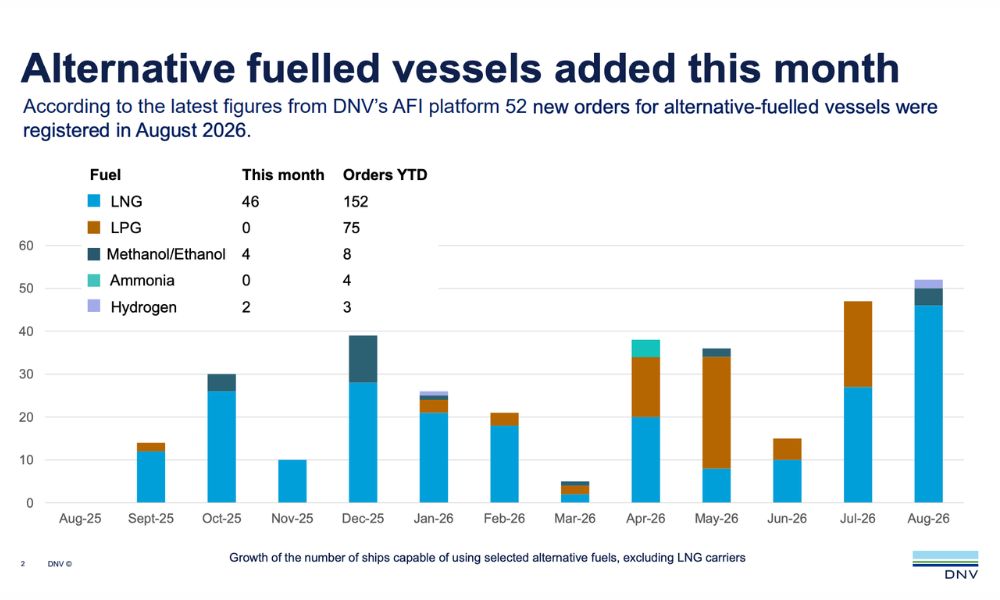
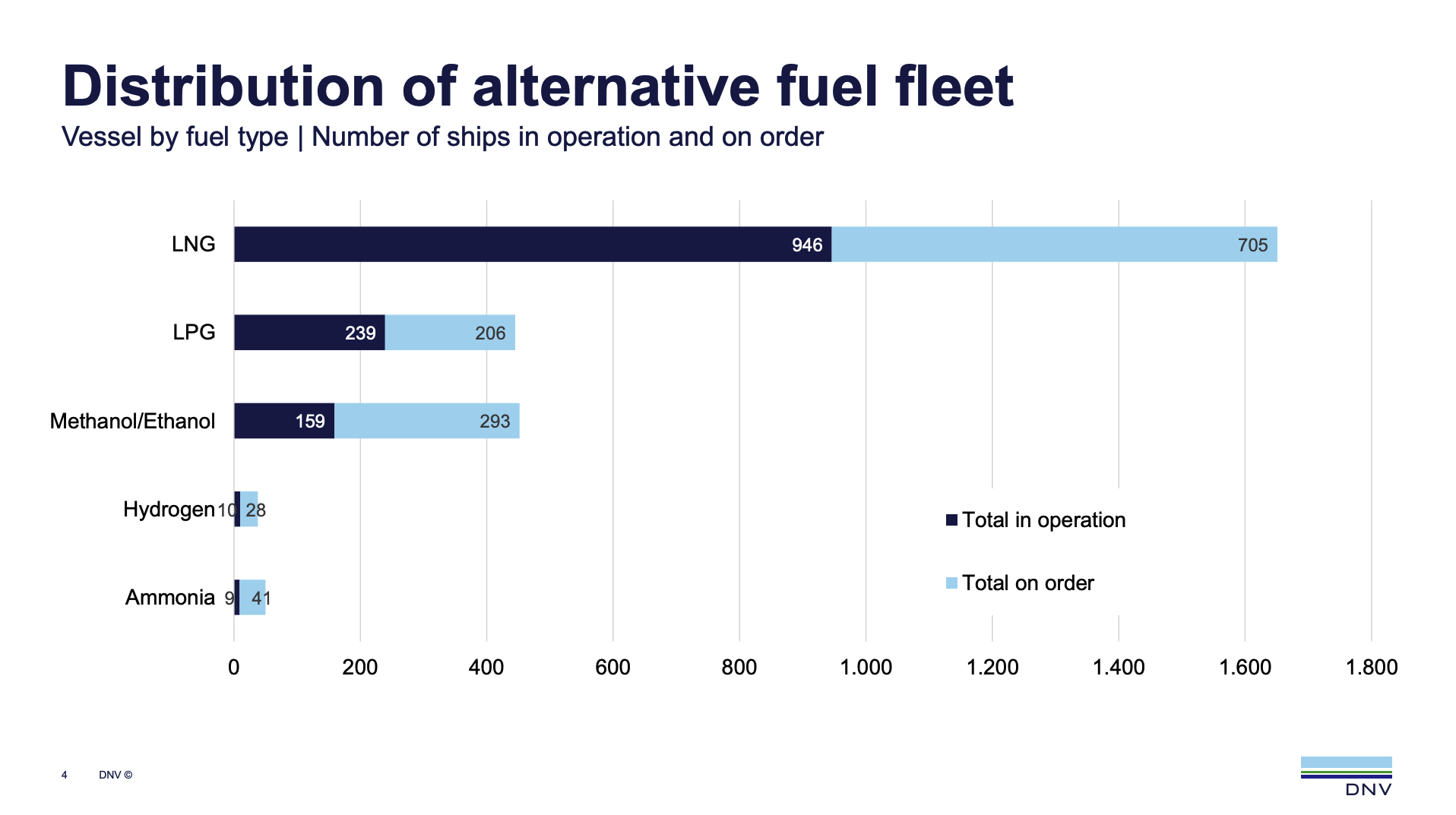
According to analysis of vessel orders from January to June 2026 from SEA-LNG member DNV, LNG dual-fuel orders remain robust at 73 vessels, accounting for almost 90% of the alternatively fuelled order book, when compared with ammonia, hydrogen and methanol. Additionally, there are now 67 LNG bunker vessels in operation, plus 42 more on order.

The LNG order book continues to be dominated by vessels serving liner trades especially container vessels and pure car and truck carriers (PCTCs). This is consistent with recent analysis by the World Shipping Council which shows that LNG remains the preferred fuel for container ship owners, accounting for 58% of total tonnage ordered versus conventional fuels at 36%.

There was also an increase in bunkering volumes and infrastructure. According to analysis by Kpler, global LNG bunker volumes were around 770,000 cubic meters (m3) per month in the period January to May 2026. This represents an increase of about 13% on the same period in 2025 as more LNG fuelled vessels have entered into operation together with favourable LNG and conventional fuel prices.

Liquefied biomethane is bunkered routinely today, and liquefied e-methane is in development. Since the introduction of regulations like FuelEU Maritime, LBM supply and demand have grown significantly. Data from the European Biogas Association show biomethane production capacity reached 8.2 bcm a year by the end of Q2 2026. This represents an additional 1 bcm in a single year, or growth of 17%. The number of operational biogas plants rose from 1,678 to 1,975 plants with €36 billion of allocated capital investment driving the sector.

Steve Esau, SEA-LNG COO, said: “Despite geopolitical and regulatory uncertainties in 2026, the industry is maintaining momentum on the methane decarbonisation pathway. This year’s mid-year review confirms that methane is the practical and realistic solution for shipping decarbonisation. 

“This is reflected in the growing numbers of LNG-fuelled vessels, LNG bunker vessels, and LNG bunkering volumes, as well as biomethane bunkering and production growth. As we look ahead, with e-methane also materialising, we are confident in the trajectory of the methane pathway to decarbonisation.”

SEA-LNG is active at the IMO and EU to underline the importance of goal-based and technology-neutral decarbonisation regulations, and ensure a global market for low and net zero fuels. As the methane pathway continues to mature, efforts have shifted from raising awareness to sharing members’ collective expertise on important technical details that will, for example, further reduce global well-to-wake emissions and scale up bio- and e-methane development and deployment.

As part of these efforts, last week SEA-LNG was granted provisional consultative status at the IMO. This status will enable SEA-LNG to engage directly with Members States as it advocates for practical and realistic regulations to help move the maritime industry forward.

Peter Keller, SEA-LNG Chairman, said: “I have been with SEA-LNG since we founded it 10 years ago, and what strikes me is how methane has ramped up from a pathway to a clear runway for shipping decarbonisation. When building the first LNG-powered containership, I didn’t imagine that within ten years over 10% of the global fleet by deadweight could be powered by methane. 

“What started as a solution to reduce harmful local emissions has cemented itself as the practical and realistic option for reducing greenhouse gas emissions today and into the future. As I look ahead, the fundamentals are strong, the orderbook is growing, the bunkering infrastructure is expanding at a record pace, and biomethane and e-methane are building on LNG’s foundation. Just as we expected.”

Note: SEA-LNG’s Methane Pathway – 2026 mid-year market review can be viewed here.


Photo credit: SEA-LNG
Published: 17 July, 2026

Continue Reading

Trending