Connect with us

Business

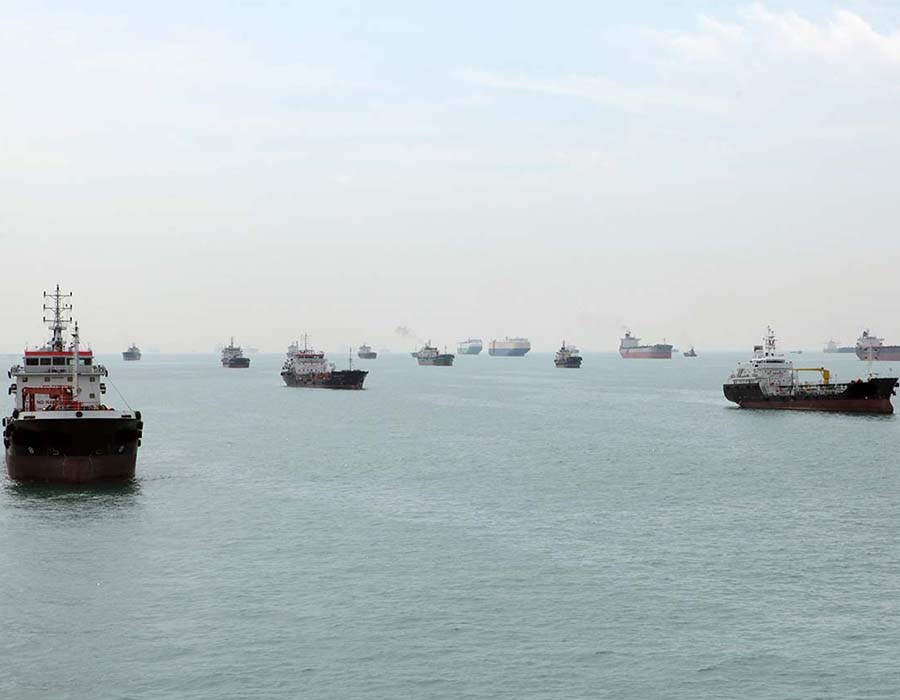
Singapore remains world’s busiest transhipment and bunkering port in 2021

Bunker sales remained strong crossing 50 million mt for only the second time, while Singapore closes 2021 with record container throughput of 37.5 million TEUs.

Admin

Published

on

post 50436

The Port of Singapore remained open and connected to the world in 2021 despite the ongoing COVID-19 pandemic, according to a on Thursday (13 January) statement from the Maritime and Port Authority of Singapore (MPA).

Singapore’s port performance saw a record high container throughput of 37.5 million twenty-foot equivalent units (TEUs). Bunker sales also remained strong, crossing 50 million tonnes for only the second time.

Singapore has also been ranked the top Leading Maritime City of the World for a fifth consecutive time in the international benchmarking study by Norwegian classification society, DNV; and Norwegian consultancy, Menon Economics AS.

“This is a strong testament of Singapore’s performance in not only the port sector, but also as an international maritime centre in shipping services and maritime technology,” said MPA in a statement.

Mr S. Iswaran, Minister for Transport and Minister-in-charge of Trade Relations, announced the 2021 performance of the Port of Singapore at the Singapore Maritime Foundation New Year Conversations 2022 event on Thursday.

He also outlined the four thrusts – resilience, digitalisation, decarbonisation and talent – that will guide the government’s efforts to advance the maritime sector and consultations with the industry and unions on the refreshed Sea Transport Industry Transformation Map.

“Maritime Singapore has shown itself to be resilient despite the challenges of the pandemic over the past two years. I am confident that the continued strong tripartite partnership between the Government, industry and unions will see us through the recovery phase and allow Maritime Singapore to emerge even stronger,” said Minister Iswaran.

Strong Bunker Sales in 2021

Singapore also kept its position as the top bunkering port, registering total bunker sales volume of 50.04 million tonnes in 2021. This comprised 49.99 million tonnes in conventional bunkers sales and 0.05 million tonnes in LNG2 bunker sales. Singapore commenced regular ship-to-ship LNG bunkering operations from March 2021 and will continue to diversify our fuel offerings in line with our push for maritime decarbonisation.

Record-high Container Throughput; Cargo Throughput and Vessel Arrival Tonnage Remained Resilient

Singapore remains the world’s busiest container transhipment port, handling a record high of 37.5 million TEUs of container throughput in 2021. In total, Singapore handled 599.0 million tonnes of cargo in 2021. Vessel arrival reached 2.81 billion gross tonnage (GT).

Singapore Registry of Ships amongst Top Registries

The Singapore Registry of Ships continued to rank amongst top ship registries globally, reflecting Singapore’s reputation as a quality flag of choice for international ship owners. The total tonnage of ships under the Singapore flag stood at 92.3 million GT, as of December 2021.

Details of Singapore’s maritime performance from 2012 to 2021 are listed below:

Year Vessel Arrival Tonnage (billion GT) Container Throughput (million TEUs) Cargo Throughput (million tonnes) Bunker Sale Volume (million tonnes) Tonnage under Singapore Registry of Ships (million GT)
2021 2.81 37.5 599.0 50.0 92.3
2020 2.90 36.9 590.7 49.8 95.0
2019 2.85 37.2 626.5 47.5 97.3
2018 2.79 36.6 630.1 49.8 90.0
2017 2.80 33.7 627.7 50.6 88.8
2016 2.66 30.9 593.3 48.6 88.0
2015 2.50 30.9 575.8 45.2 86.3
2014 2.37 30.9 581.3 42.4 82.2
2013 2.33 32.6 560.9 42.7 73.6
2012 2.25 31.6 538.0 42.7 65.0


Photo credit: Manifold Times
Published: 14 January, 2022

Continue Reading

Mass Flowmeter

Hong Kong backs MFM adoption with voluntary scheme to boost bunkering competitiveness

Hong Kong’s Marine Department launched the Quality Bunker Operator Scheme to encourage bunker operators to install and use mass flow meter systems on their bunker vessels.

Admin

Published

on

By

RESIZED EH dual mfm setup

Hong Kong’s Marine Department (MD) on Wednesday (3 June) launched the Quality Bunker Operator Scheme to encourage bunker operators to install and use mass flow meter systems (MFM systems) on their bunker vessels.

MD said the scheme aims to enhance Hong Kong’s bunkering service quality and the competitiveness of Hong Kong ports, thereby further consolidating Hong Kong’s position as an international maritime centre and a major bunkering port.

Under the Scheme, bunker operators of traditional maritime fuel and biodiesel that install and use MFM systems on their bunker vessels, with the MFM systems inspected and certified by an accredited body in accordance with the International Organization for Standardization’s ISO 22192 Standard or equivalent requirements, can apply to the MD for inclusion in the scheme’s “List of Quality Bunker Vessels”, provided they meet the relevant technical and operational requirements. 

Details of the bunker vessels successfully included in the List will be published on a dedicated page on the MD’s website for reference by shipping companies and relevant stakeholders.

Participation in the Scheme is voluntary. In addition to receiving recognition from the MD, participating bunker operators will benefit from enhanced corporate image and competitiveness through the adoption of MFM systems, thereby boosting customers’ confidence and helping to create new business opportunities.

 A spokesman for the MD, said: “As an international maritime centre supported by our country, Hong Kong has a strategic location adjacent to major international fairways. Coupled with years of development in marine fuel bunkering, Hong Kong possesses rich experience and talent in the field. For many years, Hong Kong has consistently ranked as the seventh-largest bunkering port globally, the second-largest in our country, and the largest in the Greater Bay Area, providing reliable and competitive fuel bunkering services to ocean-going vessels from around the world. 

“As the international shipping industry has an increasing demand for accuracy and transparency in bunkering services, service quality and measurement precision in bunkering operations have become important indicators of a bunkering port’s competitiveness. The Scheme will enhance bunkering accuracy and transparency, further enhancing the quality of Hong Kong’s bunkering services.

The spokesman added that comprehensive port services are one of Hong Kong’s key advantages as an international maritime centre.

“We will also mandate the use of MFM systems on all methanol bunker vessels this year to ensure that Hong Kong continues to provide high-quality bunkering services in the era of green maritime fuels.” 

Note: The application form for the Scheme can be found on the MD’s website. Interested bunker operators can download the application form from the website or contact the MD’s Green Maritime Fuel Team via email ([email protected]) for details.


Photo credit: Manifold Times
Published: 4 June, 2026

Continue Reading

Alternative Fuels

MPA and MSC ink MoU to support adoption of alternative bunker fuels

MPA and MSC will explore new routes and services to strengthen connectivity, support the adoption of alternative marine fuels such as bio-LNG, and advance technologies to improve vessel energy efficiency.

Admin

Published

on

By

MPA and MSC ink MoU to support adoption of alternative bunker fuels

The Maritime and Port Authority of Singapore (MPA) on Wednesday (3 June) said it signed a Memorandum of Understanding (MoU) with MSC Mediterranean Shipping Company to strengthen collaboration in maritime decarbonisation, digitalisation, innovation, and manpower development. 

The MoU was signed on 25 May 2026 by Mr Ang Wee Keong, Chief Executive of MPA, and Mr Soren Toft, Chief Executive Officer of MSC.

The MoU underscores the shared commitment of MPA and MSC to foster a sustainable, digital, and future-ready maritime sector, while enhancing MSC’s operational and business activities in Singapore. This year also marks the 30th anniversary of MSC establishing its Asia Regional Office and local office in Singapore.

Under the MoU, MPA and MSC will explore new routes and services to strengthen connectivity, support the adoption of alternative marine fuels such as bio-LNG, and advance technologies to improve vessel energy efficiency and operational performance.

MPA and MSC will also collaborate on maritime digitalisation initiatives to improve operational efficiency, including streamlining vessel arrivals and port operations. 

On manpower development, MSC will support internship and scholarship opportunities through Singapore Maritime Foundation’s Maritime Outreach Network (MaritimeONE) platform, an industry-led tripartite partnership comprising industry, government and institutes of higher learning that aims to raise awareness of the maritime industry and attract quality talent into the maritime sector.

Mr Ang Wee Keong, Chief Executive of MPA, said: “This partnership reflects the strong collaboration between MPA and MSC in driving sustainability and digitalisation in the maritime sector. By working together on decarbonisation, operational efficiency and talent development, we aim to strengthen Maritime Singapore’s position as a trusted and future-ready global maritime hub.”

Mr Soren Toft, Chief Executive Officer of MSC, said: “Singapore is a strategically important hub for MSC and a key gateway to the broader Asia region. As we mark 30 years in Singapore, this MOU reinforces our long-term commitment to strengthening our presence here. MSC and Singapore are closely aligned on the priorities shaping the future of global shipping, and we look forward to deepening this partnership to drive the continued growth and resilience of the maritime industry.”


Photo credit: Maritime and Port Authority of Singapore
Published: 4 June, 2026

Continue Reading

Emissions reporting

StormGeo and OceanScore link emissions data, compliance workflows

Cooperation combines StormGeo’s expertise in operational vessel and emissions data with OceanScore’s expertise in emissions compliance workflows across EU ETS, FuelEU Maritime and UK ETS requirements.

Admin

Published

on

By

StormGeo and OceanScore link emissions data, compliance workflows

Weather intelligence and decision support solutions provider StormGeo and Hamburg-based technology platform OceanScore on Wednesday (3 June) said they have deepened their ongoing cooperation through the signing of a collaboration agreement during Posidonia 2026 in Athens on 2 June.

The cooperation combines StormGeo’s expertise in operational vessel and emissions data with OceanScore’s expertise in emissions compliance workflows across EU ETS, FuelEU Maritime and upcoming UK ETS requirements.

Together, the companies aim to help shipping companies seamlessly navigate increasing regulatory complexity more efficiently — from emissions reporting and data validation to compliance exposure management, pooling and financial settlement.

As emissions regulation becomes an increasingly important part of commercial shipping operations, the need for reliable operational data and streamlined compliance processes continues to grow. The cooperation between StormGeo and OceanScore is designed to support shipping companies with more connected, transparent and actionable processes across operational and commercial teams.

“From the outside, companies like StormGeo and OceanScore may sometimes be perceived as competitors because both operate around emissions and compliance workflows,” said Albrecht Grell, Managing Director at OceanScore. 

“But in reality, the industry increasingly needs both perspectives working together: trusted operational emissions data on one side and commercial compliance execution on the other. Our cooperation reflects that shipping companies are no longer looking for isolated solutions — they need connected processes, automated across different systems and reliable decision-making throughout the full compliance chain.”

By connecting validated operational emissions data with commercial compliance management, the cooperation supports workflows across:

  • emissions reporting and validation 
  • compliance management across EU ETS, FuelEU Maritime and upcoming UK ETS requirements
  • exposure visibility and cost transparency
  • pooling, settlement and financial processes 

The cooperation also aims to improve commercial transparency and coordination across operational and commercial stakeholders.

“StormGeo plays a central role in helping shipping companies turn operational vessel and emissions data into trusted, decision-ready insights,” said Espen Martinsen, Chief Commercial Officer at StormGeo. 

“As emissions regulations become more complex, this data is essential for transparent and efficient compliance management. By working with OceanScore, we can help customers connect StormGeo’s validated operational data with commercial compliance processes, creating a more integrated and practical approach to emissions management.”

The signing ceremony took place at the StormGeo booth during Posidonia 2026 in Athens and was attended by representatives from both companies.

Both companies expect the cooperation to continue evolving alongside upcoming regulatory developments, including FuelEU Maritime, EU ETS, the upcoming UK ETS and future emissions-related frameworks affecting global shipping.


Photo credit: StormGeo
Published: 4 June, 2026

Continue Reading

Trending