
Analysis
Innospec Fuel Specialties technical bulletin: Considerations when heating VLSFO and Case Studies
Heating VLSFOs to prevent cold flow issues causes issues related to distillate ageing, and there is a gentle balance to be maintained when handling the product.

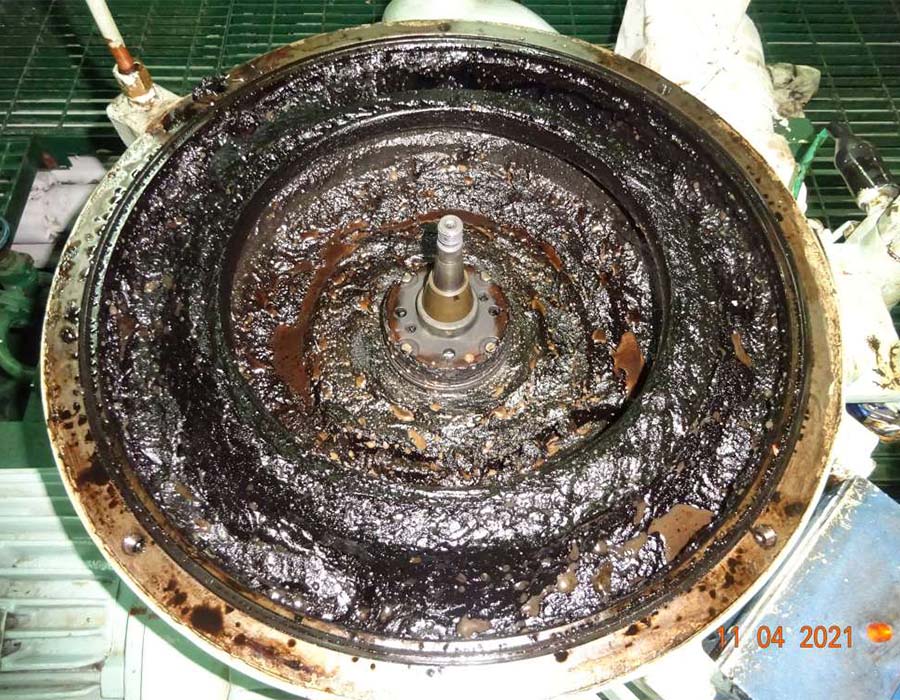
Colorado-based global specialty chemicals company Innospec Fuel Specialties in December published a technical bulletin entitled Cold Flow – A Point on Pour Point. The document has been shared with Singapore bunkering publication Manifold Times:
Considerations when heating VLSFO
Heating VLSFO to prevent cold flow issues will cause unintentional issues related to distillate ageing i.e. the rapid change in fuel quality due to chemical reactions in the lighter fractions of the fuel.
A study into the storage stability of VLSFO from global ports shows how the sediment present in VLSFO increases over time when a fuel is stored at slightly elevated temperatures (50°C). The Total Sediment Existent (TSE) increases with time across most fuels, and rapidly increases in most cases to exceed the ISO 8217 limits within weeks.
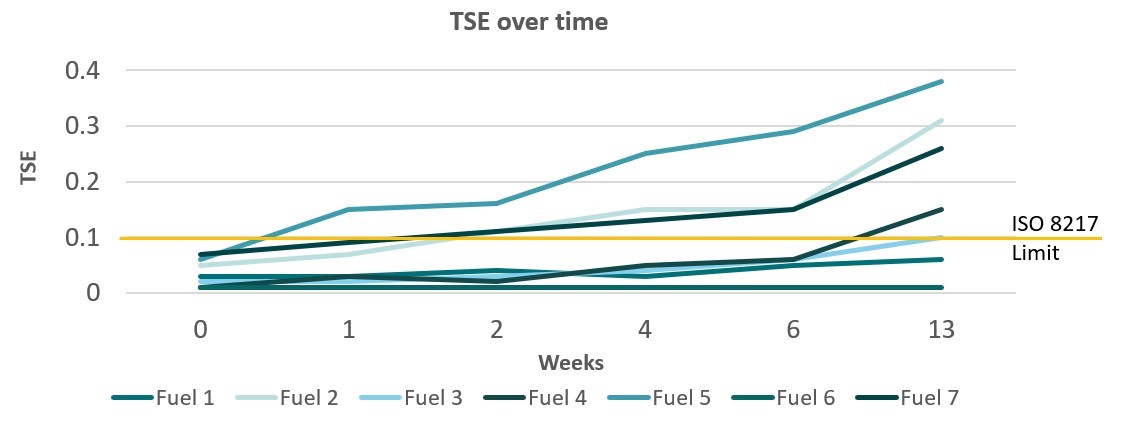
The increased sedimentation would manifest as excessive sludge, filter blocking and centrifugal purifier maintenance. However, these are only symptoms of ageing and other issues besides might be expected, such as reduced fuel efficiency, poor combustion and contamination of future bunkers.

There is clearly a gentle balance to be maintained when handling VLSFO that did not previously exist when using HSFO. If temperatures are too low there is the risk of cold flow issues, poor separation efficiently etc. Too high and fuel will age, leading to excess sludge and deposits. Diligent monitoring and housekeeping practices are one of the best ways to combat this, ensuring that storage temperatures are maintained high enough to prevent wax but not so high that the ageing process is unduly accelerated.
At this time there is little information on how low is too low, or how high is too high. Chemical treatments are available that retard the chemical ageing process and mitigate against the consequences of aged fuel.
Case Story 1: Wax sludge experienced in cold climate

Bunker Grade, Quantity: VLSFO IFO380, 2000MT
ISO 8217: Met
Viscosity, Pour Point: 28cSt, 6°C
WAT, WDT: Not tested
Issue: Sludge clogging backwash filters and overloading purifier. Heavy sludge left behind at bottom of bunker tank unable to be dissolved.
It was during the winter season and the container ship was transiting through a cold climate region. There was no issue faced when the first 200MT of fuel was consumed but soon after, the vessel started to experience sludge issues. Some fluctuation was also observed at the viscometer.
Why did this happen? Where heating is insufficient, especially when the vessel transits through cold climates, the fuel can separate into layers. Initially, lighter components will enter the fuel system and leaves behind the heavier components. Even with the highest possible temperature that can be achieved in bunker tanks, the sludge that remains at the bottom of the tank will not dissolve.
Case Story 2: Wax sludge experienced with on spec pour point fuel, WAT/WDT unknown
Port: South Korea
Bunker Grade, Quantity: VLSFO IFO380, 400MT
ISO 8217: Met
Viscosity, Pour Point: 33cSt, 15°C
WAT, WDT: Not tested
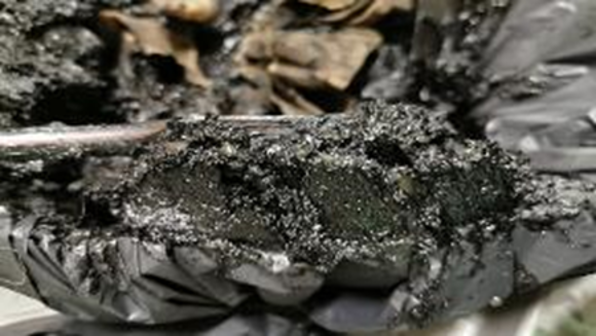
Issue: High generation of sludge overloading the purifier.
In this case, the sludge appeared to have both the consistency of waxes and asphaltene sludge. Hence, to eliminate the possibilities, the vessel carried out a trial and error at the purifier by increasing the separation temperature in steps of 5 °C from the recommended separation temperature which was 60 °C. When the separation temperature was maintained at 75 °C, the sludge generated was observed to be minimal and therefore, the sludge is likely waxes.
Sometimes, purifying at the recommended temperature is insufficient when the fuel has a higher risk of experiencing cold flow issues. At any point of time, if the temperature falls below WAT, wax crystals will form and they can only be dissolved by increasing the heating temperature to above WDT.
However, excessive heating either by high temperature or long-term heating can accelerate the distillate ageing process. Hence, correct heating must be applied.
Case Story 3: Wax sludge experienced with low pour point fuel, high WAT/WDT
Port: Singapore
Bunker Grade, Quantity: VLSFO IFO380, 800MT
ISO 8217: Met
Viscosity, Pour Point: 57cSt, 3°C
WAT, WDT: 74 °C, >75 °C
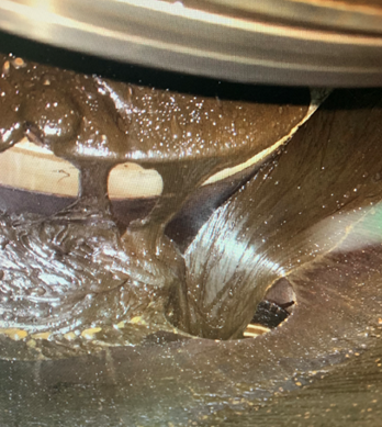
Issue: High generation of sludge overloading the purifier
The vessel suspected waxes due to the softer appearance of sludge that was clogging the purifier and hence, requested for the fuel lab to carry out WAT, WDT testing with the fuel. From the results, it is likely that waxes have formed in the bunker tank as the fuel’s temperature at storage fell below its’ WAT result. In an attempt to dissolve the waxes before consuming the fuel, the vessel increased the storage temperature to as close to WDT as possible, managing to achieve only 50 °C inside the bunker tanks. The sludge issue did improve for the next 48hrs before it took a turn and worsened.
Why did this happen? This is an example where issues and solutions overlap. In this case, the temperatures required to dissolve the waxes (WDT) were extremely high which brought a new problem into the equation- an irreversible distillate ageing process through thermal instability. In addition, distillate sludge can similarly clog filters and purifiers.
The fuel’s resistance to oxidation and thermal instability can be improved significantly with the help of fuel additives. However, if the distillate ageing process has already started then it cannot be reversed. Its’ effectiveness will only be to stabilise the fuel and the chances is dependent on the extent the fuel has aged. Hence, pre-combustion additives are always recommended to be dosed at an early stage- into the storage tanks before bunkering.
Please contact your local sales representative for more information. Email:
For Technical support or questions please email:
Find out more about Innospec Fuel Specialties’ series of OctamarTM products here.
Photo credit: Innospec Fuel Specialties
Published: 12 January, 2022
Bunker Fuel
Alkagesta highlights key insights on European choke point pressures in August
Update covers dual supply crisis currently shaping global bunker markets — a stalled Strait of Hormuz peace process and Rhine water levels at a 140-year record low — and the implications for Singapore.
Bunker Fuel
Integr8 Fuels: Why bunker markets could be lower than we thought
Marine fuel prices could prove lower than previously anticipated as easing refinery margins and improving bunker market fundamentals outweigh a still-uncertain crude oil outlook, says Integr8 Fuels.

By Steve Christy, Expert Contributor, Integr8 Fuels
29 July 2026
We have just seen one false dawn, is there another to come?
Last month, we wrote about how close we were to the expected lows in Brent and Rotterdam bunker prices, but not yet Singapore. Given what has happened since, a month is not only a long time in politics, but also a very long time in the bunker market.
There was a resumption of attacks in the Arabian Gulf region on 13 July, followed by targeted Houthi attacks on Saudi Arabia’s Red Sea oil infrastructure and shipping in the Bab el-Mandeb region, the gateway between the Red Sea and the Gulf of Aden. As a result, Brent futures fell to lows of around $70/bbl in late June and early July before surging to a high of $100/bbl on 23 July. Over the same period, Singapore VLSFO fell to $635/mt before climbing to $865/mt, a swing of $230/mt in just 16 days.
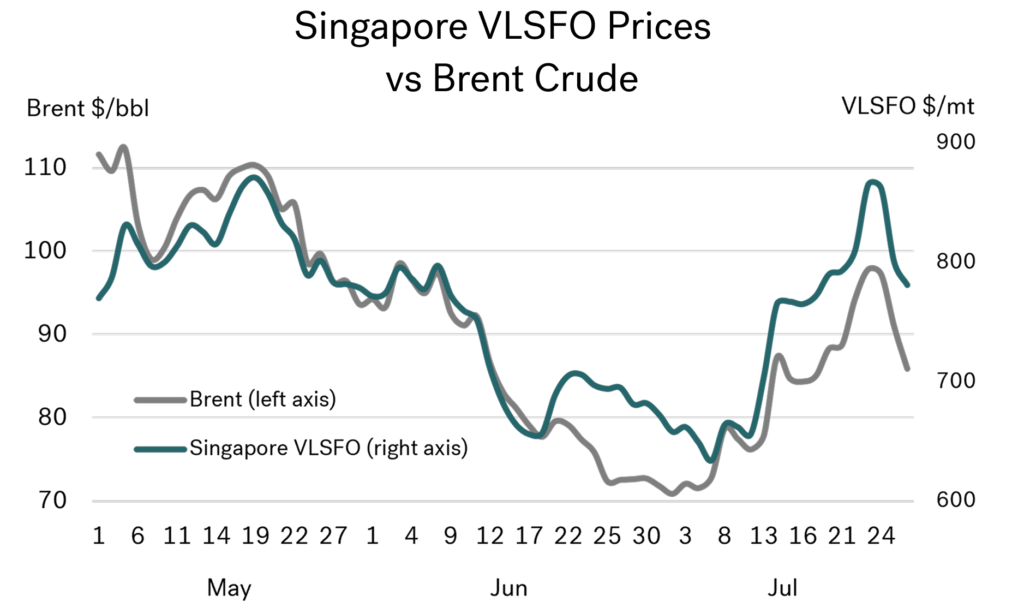
Prices at the start of this week fell sharply after a halt in Arabian Gulf attacks over the weekend, with front month Brent was down to intra-day lows of $84/bbl, and Singapore VLSFO $750/mt. However, at the time of writing there has been a ‘surprise’ attack by Iran, and retaliatory action by the US, with prices rising again. It looks like we could be at another false dawn.
The obvious questions are: will there be a return to peace negotiations, and are we close to the end of the war and free-flowing traffic through the strait of Hormuz (and also the Bab el-Mandeb)? The obvious answer is, we don’t know; there are only a few people that are likely to know the answer to this. All we can do is plan for every eventuality.
Low stocks, higher bunker prices, and a strong Singapore VLSFO premium: it’s a challenge
For those of us in the bunker market, the point we made last month about Singapore VLSFO trading at a strong premium to crude still holds, albeit slightly less pronounced. The loss of supplies through the Strait of Hormuz, together with the added uncertainty surrounding Saudi product exports from the Jizan and Rabigh refineries on the Red Sea, has sustained this premium.
These developments are likely to keep the Singapore VLSFO premium to crude at elevated levels until there is greater confidence that Middle East crude and product supplies are returning to more normal trading patterns. Amid all the price volatility, this Singapore VLSFO premium remains a key indicator to watch.
Backwardation in Brent futures illustrates market psychology
One month ago, backwardation in Brent futures (front month minus second month) had fallen from $7/bbl to virtually nothing, reflecting the market’s belief that an end to the war was little more than a negotiating step away. It wasn’t. The resumption of attacks, coupled with Houthi involvement in the Red Sea, sent prices sharply higher again, with backwardation in the Brent futures market returning to almost $6/bbl.
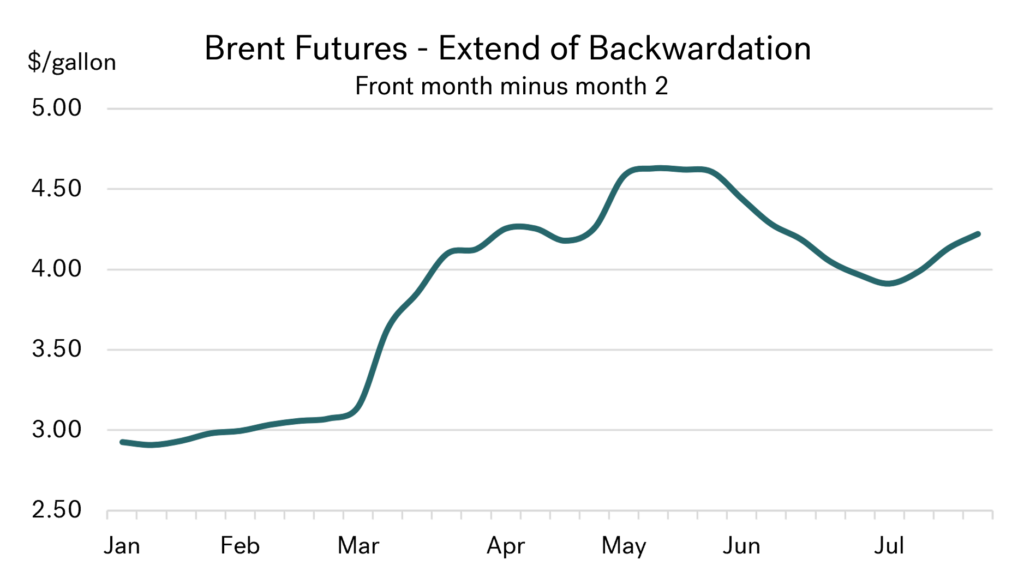
The halt in attacks over the past weekend has taken steam out of the market, with prices and backwardation falling sharply. Where we go from here depends if there is again a belief peace is on the horizon, or if this is another false dawn. The past month highlights how impossible it is to predict an ending to the war, and how fragile any expectations of peace can be.
We cannot ignore the price, but still must look to the future
It is impossible to write a report and not highlight the turmoil of the current market and what is happening. However, we still must look beyond this, to see where we could end up.
In an earlier report, we suggested the run-up to the US mid-term elections in November may be a backstop to the war. However, even this is not guaranteed. There are many dynamic elements to the economy and voter intentions, but one feature that will always crop up in the US is the gasoline price. This has risen from $3/gallon before the war to over $4/gallon for the past four months.
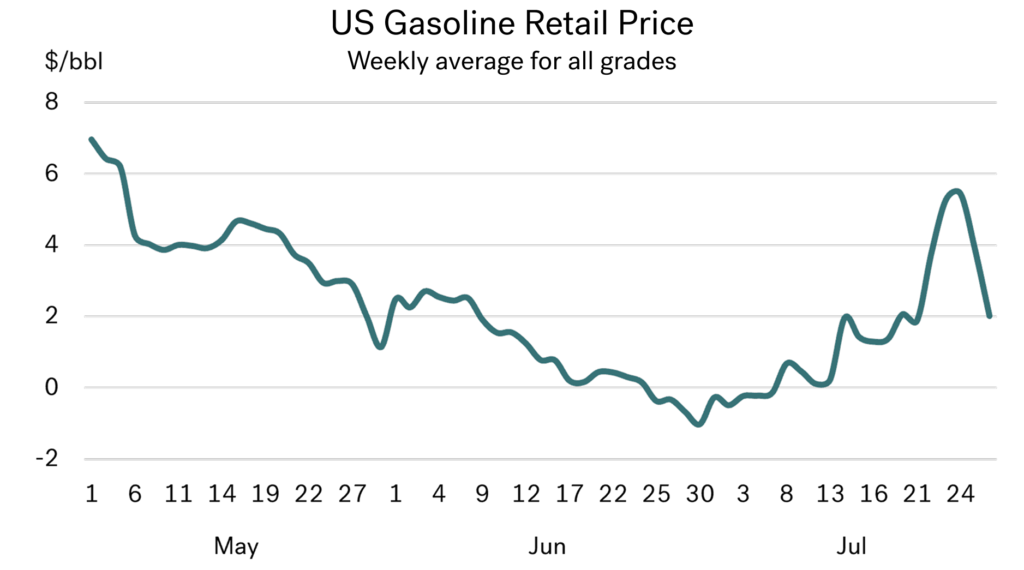
If it comes to it, will Republican voters want to see a resolution to the war and a return to $3 gasoline prices ahead of the elections?
We have a change of heart on how low bunker prices can go
We don’t know exact timings, but in any planning, we must look at what happens when the war does finally end and prices fall, whenever that may be. In past reports we have highlighted the view that Brent crude prices are unlikely to fall back to pre-war levels in the $60s, and Singapore VLSFO unlikely to go back in to the $400s. This may be the point at which these views change.
Previous thinking was based on a relatively short war, where there would be a large loss of oil supply and a massive stock-draw. In this case, tighter stock levels would be sufficient to keep prices higher than their pre-war levels once we returned to ‘normality’. This would mean Brent futures in the $70s (and not in the $60s), and Singapore VLSFO in the $500s, and not the $400s.
A number of mainstream analysts also held this view, although there were some that were lower and some higher.
Given the war has already gone on for much longer than almost everyone expected, this thinking must change. Yes, global stocks have been drawn down at a rapid rate, but this is slowing. Higher pricing and inflationary blows have had a major impact on global oil demand, with current indications that total oil demand in the second quarter of this year was some 4 million b/d lower than year earlier levels.
The graph below shows this sharp drop in demand and even if the war comes to an end relatively soon, and demand gets back towards some normality, a structural loss of more than 1 million b/d in global oil demand is still expected to have taken place because of the extended period of conflict.
If the war goes on for even longer, structural losses in global oil demand are likely to be even greater.

Source: US EIA
It’s a hard road, but we can get there
This means that once the war does end, market psychology will be looking at a rapid increase in oil supplies going into a global market which is much lower in demand. This opens the way for prices to easily return to their pre-war levels of Brent in the $60s and Singapore VLSFO in the $400s.
Now we just need those at the centre of negotiations to get us there.
Photo credit and source: Integr8 Fuels
Published: 30 July, 2026
Bunker Fuel Quality
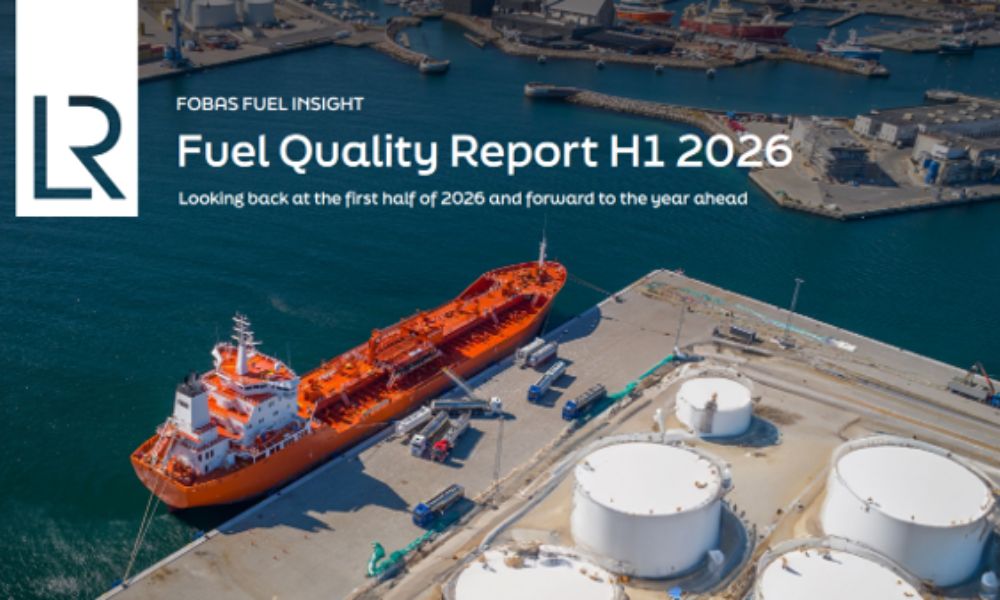
FOBAS report warns of growing operational risks from ISO-compliant bunker fuels
LR’s latest FOBAS Fuel Quality Report reveals that the biggest fuel quality risks are no longer confined to off-specification fuels, with some compliant fuels creating operational challenges.

OUR INDUSTRY PARTNERS

Yang Ming orders six LNG dual-fuel, ammonia-ready containerships from Hanwha Ocean

LR, China’s MARIC unveil tanker concept ready for three future bunker fuels

DNV: Alternative-fuelled vessel orders hit highest monthly level since October 2024

TFG Marine advances global MFM rollout with two US Gulf bunker barges

GENA Solutions: Total renewable and low-carbon methanol project pipeline increases from 61.8 to 62.2 Mt by 2032

Baltic Exchange: Bunker Report (3 September 2026)

ENGINE: Americas Fuel Availability Outlook (3 September 2026)

Singapore-flagged tugboat “Kim Heng 3203” placed under Sheriff’s arrest

US targets five bunker companies in latest sanctions campaign against Iran

Singapore bunkering community supports Living Hope Evangelism’s 7th anniversary outreach for residents in need

China’s bunker market reshaped by tax rebates, trade flows and refining changes, says economist

Hengli Petrochemical’s ex-Singapore trading arm faces winding up application

Report: GCMD outlines practical approach to quantity assurance in marine biofuel supply chains

Singapore: Notices of intended dividend issued for Ocean Bunkering Services, Hin Leong Marine
-
 Vessel Arrest1 week ago
Singapore-flagged tugboat “Kim Heng 3203” placed under Sheriff’s arrest
-
 Sanctions1 week ago
US targets five bunker companies in latest sanctions campaign against Iran
-
 Events2 weeks ago
Singapore bunkering community supports Living Hope Evangelism’s 7th anniversary outreach for residents in need
-
 Interview1 week ago
China’s bunker market reshaped by tax rebates, trade flows and refining changes, says economist
-
 Winding up1 week ago
Hengli Petrochemical’s ex-Singapore trading arm faces winding up application
-
 Biofuel1 week ago
Report: GCMD outlines practical approach to quantity assurance in marine biofuel supply chains
-
 Winding up2 weeks ago
Singapore: Notices of intended dividend issued for Ocean Bunkering Services, Hin Leong Marine
-

 Bunker Claim3 days ago
Rajah & Tann: Bunker disputes are won in the first 48 hours