Connect with us

Business

Newport Shipping: Tackling the fuel conversion conundrum

Upgrading ships in line with new environmental rules will be considered a dilemma for the industry due to commercial and technical risk factors.

Admin

Published

on

NEWPORT 1

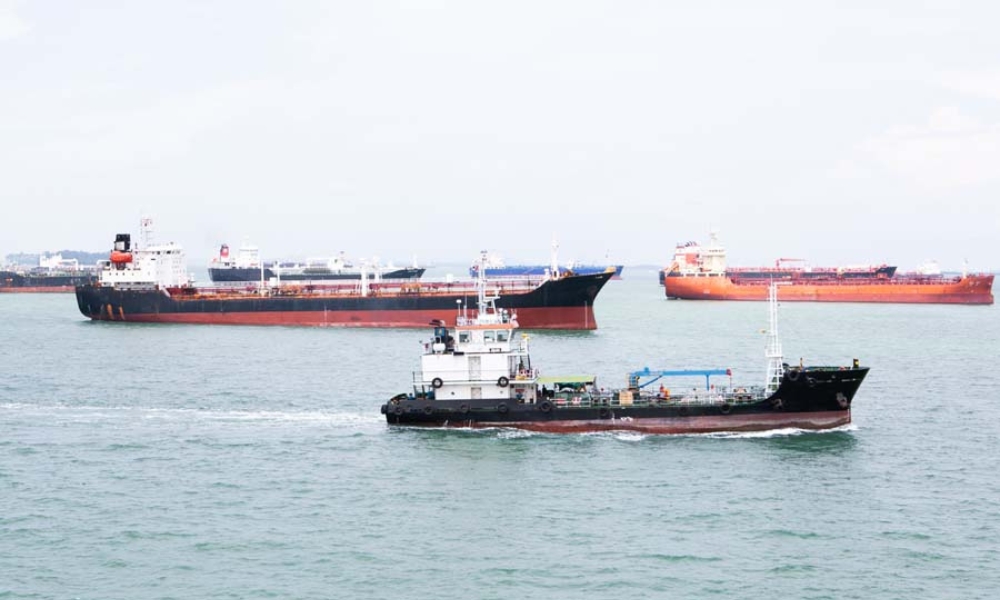
Newport Shipping, a provider of drydocking services for ship repair works, on Tuesday (20 July) released an article Tackling the fuel conversion conundrum discussing the challenges of decarbonisation within the maritime sector:

The need to upgrade ships in line with new environmental rules represents a billion-dollar dilemma for the industry as it faces a range of commercial and technical risk factors that will determine whether retrofits for alternative fuels will be worth the investment.

It is estimated that investments of as much as $182 billion will be required on ship machinery and onboard storage for ships to run on low-carbon fuels, both for retrofits and newbuilds, between 2030 and 2050 in order to halve greenhouse gas emissions from global shipping, according to a study by consultancy UMAS and the Energy Transitions Commission for the Getting to Zero Coalition.

This is about 13% of estimated cumulative investments over the same period of up to $1.4 trillion, of which the remainder would be required for land-based infrastructure and production facilities for low-carbon fuels.

Doing nothing is not a real option for shipowners, but it would also be foolhardy to throw money at the problem without knowledge of the most optimal alternative fuel that can secure their fleets for the long haul and ensure payback under a green shipping regime.

A multitude of fuel options are now on the industry’s radar screen to replace more pollutive fossil fuels such as heavy fuel oil (HFO), very low-sulphur fuel oil (VLSFO) and marine gas oil (MGO) currently used by much of the global fleet.

Among these are low-carbon liquefied natural gas (LNG), as well as carbon-neutral fuels including ammonia, methanol and hydrogen produced from sustainable sources such as biomass, to give biofuels, and renewable electricity, to give electrofuels.

Price must be right

These alternative fuels are all at different stages of maturity in terms of availability, cost and performance, with carbon-neutral fuels mostly still at a relatively early stage of development.

These fuels also presently lack the regulatory framework, production capacity, acceptable safety protocols, and bunkering infrastructure for widespread adoption across deepsea shipping.

In determining which fuel is most economically viable, shipowners must consider the fuel price and cost of implementing it onboard vessels through retrofits to adapt engine systems and provide onboard storage.

In addition, the fuel must have sufficient energy content, or calorific value, to power a large vessel such as a VLCC. It must also be available and abundant, as well as technically feasible and safe for storage onboard.

Planning for fuel flexibility will be a key consideration in upgrading the fleet to ensure it remains competitive as regulations tighten in future and carbon-neutral fuels become available, given an average vessel lifetime of around 20 years.

Aside from other fossil fuels, LNG already satisfies these criteria given there are abundant natural gas reserves of around 7177 trillion cubic feet – more than 700 times the size of proven oil reserves. There is also an existing bunkering network for this fuel, which is presently available in at least 93 ports, while price-wise LNG can be cheaper than both VLSFO and HFO in certain periods and regions, according to a study by consultancy Ocean Dynamex.

Reduced emissions

LNG has a much lower emissions footprint than other fossil fuels as it emits zero SOx and negligible amounts of particulate matter and NOx, cutting emissions by between 20% and 30%.

There has been concern over methane slip from gas-fuelled engines, whereby unburned methane gas can escape at the exhaust into the atmosphere, but this type of leakage has been drastically reduced with modern high-pressure engines.

Gas is a much cleaner fuel with excellent combustion and no need for fuel heating, offering technical benefits such as no sludge and less wear-and-tear on engine parts, thereby cutting maintenance costs.

Furthermore, LNG has sufficient energy content, or calorific value, to power vessels and is technically feasible to carry onboard ships, while LNG fuel systems can be easily adapted for carbon-neutral drop-in fuels such as bio-LNG and synthetic LNG to make this a sustainable solution also in the longer term.

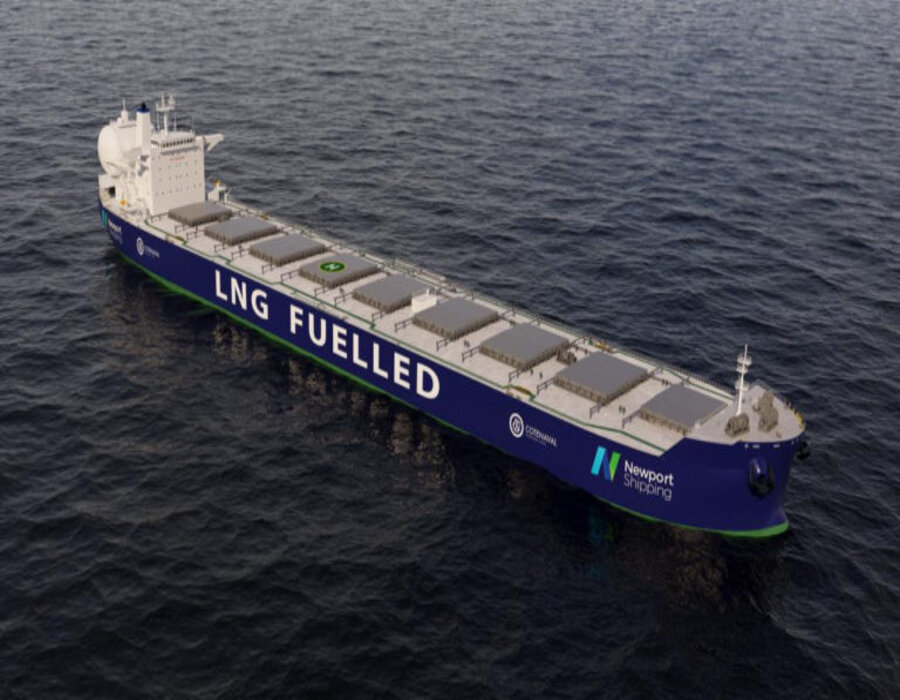
A DNV case study showed the use of a dual-fuel LNG engine on a Panamax bulk carrier was the most commercially robust solution compared with other alternative fuel technologies due to cost, reduced tank-to-wake emissions and flexibility in regard to future decarbonisation options.

Transition fuel

Consequently, DNV sees a significant part of the global fleet adopting LNG as fuel towards 2040, with carbon-neutral fuels gaining ground around mid-century.

LNG is seen as an important transition fuel towards a net-zero future and such retrofits of existing vessels can be implemented with minimal modifications to the engine system and hull structure, according to Newport Shipping Managing Director, Lianghui Xia.

“LNG is presently the most expedient and practical solution for the industry to meet immediate emissions targets, as the perfect solution may not be available for some years,” he says.

The UK-based ship repair and retrofitting group has now gained a key approval-in-principle from DNV for its unique low-cost LNG retrofit concept for VLCCs and Capesize bulkers as it targets this emerging market.

But Xia believes collective action is also needed to facilitate the shift to LNG through measures such as tax incentives for such conversions, wider bunkering access, and lower production and delivery costs for the fuel from energy companies.

“Apart from agreeing on the optimum fuel option, the speed of implementation of the environmental agenda will be governed by financial metrics.” adds Mr. Xia.


Photo credit: Newport Shipping
Published: 23 July, 2021


Continue Reading

Winding up

Singapore: High Court to hear Norvic Shipping Asia winding up application on 31 July

Application for the winding up of Norvic Shipping Asia Pte Ltd was filed by Netherlands-registered Mur Shipping BV on 8 April, according to Government Gazette notice.

Admin

Published

on

By

RESIZED singapore high court

An application for the winding up of Norvic Shipping Asia Pte Ltd was filed by Netherlands-registered Mur Shipping BV on 8 April, according to a Tuesday (21 July) notice on the Government Gazette.

It noted the winding up application is directed to be heard before the Judge sitting in the General Division of the High Court at 10am on 31 July.

Any creditor or contributory of the company desiring to support or oppose the making of an order on the winding up application may appear at the time of hearing by himself or his counsel for that purpose.

A copy of the winding up application will be furnished to any creditor or contributory of the company requiring the copy of the winding up application by the solicitors of the applicant’s, Oon & Bazul LLC, on payment of the regulated charge for the same.

The Applicant’s address is Hiridostraat 5, Gebouw Prismatrium, 1101CW Amsterdam, The Netherlands.

The Applicant’s solicitors are Oon & Bazul LLC of 103 Penang Rd, #04-04/05/06 Singapore 238467. 

Queries on the winding up application may be directed to the following email addresses: [email protected] and [email protected].


Photo credit: Manifold Times
Published: 22 July, 2026

Continue Reading

Methanol

World Fuel and partners complete first green methanol bunkering of car carrier in Shanghai

Operation involved the delivery of approximately 2,800 MT of green methanol to “Arctic Tern” via a ship-to-ship transfer using SIPG Energy’s dedicated methanol bunkering vessel “M/V Hai Gang Zhi Yuan”.

Admin

Published

on

By

World Fuel and partners complete first green methanol bunkering of car carrier in Shanghai

Marine fuel provider World Fuel on Tuesday (21 July) said it successfully completed the first green methanol bunkering of M/V Arctic Tern, with EUKOR Car Carriers and SIPG Energy at the Port of Shanghai. 

Arctic Tern is the first vessel in the new Shaper Class series of car carriers. 

The operation involved the delivery of approximately 2,800 MT of green methanol to Arctic Tern via a ship-to-ship transfer using SIPG Energy’s dedicated methanol bunkering vessel M/V Hai Gang Zhi Yuan, the largest vessel of its kind in operation. 

The bunkering operation was carried out at Haitong Terminal, Waigaoqiao Port Area, Shanghai Port, with cargo handling operations conducted simultaneously during bunkering.

This marks EUKOR Car Carriers’ first green methanol operation and the first time Arctic Tern has bunkered methanol since its delivery on 9 July. The operation marked the first bunkering at Shanghai Port of green methanol produced locally in Shanghai for an international PCTC operator. 

It also demonstrated the city’s integrated green methanol value chain, spanning local production, storage and bunkering, and established a replicable “Shanghai Model” for green methanol supply.

World Fuel arranged the supply and delivery of the fuel on behalf of EUKOR Car Carriers, working with SIPG Energy as the physical supplier at the Port of Shanghai.

The green methanol supplied was produced from municipal solid waste, ISCC-EU certified, and had a carbon intensity value below 25 gCO₂e/MJ.

Arctic Tern is the first of fourteen Shaper Class vessels ordered by Wallenius Wilhelmsen. With a capacity of 9,300 car equivalent units and methanol dual-fuel capability, the vessel will be operated by EUKOR Car Carriers, jointly owned by Wallenius Wilhelmsen and Hyundai Motor Group. Following her first green methanol bunkering, Arctic Tern will continue her maiden voyage from Asia to Europe.

Xavier Leroi, COO Shipping Services at Wallenius Wilhelmsen and CEO of EUKOR Car Carriers, said: “Completing Arctic Tern’s first green methanol bunkering shortly after delivery is a significant milestone towards our decarbonisation ambition for both EUKOR Car Carriers and Wallenius Wilhelmsen. It demonstrates how investments in next-generation vessel technology and fuel flexibility are being translated into real-world operations. 

“This achievement reflects the strong collaboration between all parties involved. Together, we have shown how partnerships across the maritime value chain can help make lower-emission fuels available and operationally viable at scale.”

Mark Tamsitt, SVP Global Marine Sales at World Fuel, said, “The first bunkering event with a new fuel is a significant moment for any shipowner, and our role is to make it as seamless as possible. By connecting EUKOR Car Carriers with SIPG Energy’s proven green methanol capability at the Port of Shanghai, we were able to deliver on reliable supply, fuel quality, and safe processes. As more of our customers bring methanol dual-fuel tonnage into service, we are committed to being the partner that makes these kinds of operations routine.”

Mr. Zhang Da, General Manager of SIPG Energy, said, “Welcoming Arctic Tern to the Port of Shanghai for her first green methanol bunkering demonstrates the strength and maturity of our supply capability. Building on our well-established methanol ship-to-ship bunkering services for container vessels, we have already extended such services to pure car and truck carriers (PCTCs). This bunkering sets a new record for the largest single SIMOPs green methanol bunkering for PCTCs in China, marking another step in building Shanghai’s position as a global green energy hub for international shipping.”

This operation follows Wallenius Wilhelmsen’s announcement on 9 July that Arctic Tern would complete her first methanol bunkering shortly after delivery. The vessel entered service on routes between Asia and Europe immediately following handover from China Merchants Jinling Shipyard in Nanjing.


Photo credit: World Fuel
Published: 22 July, 2026

Continue Reading

Ammonia

HPA and MB Energy develop safety concept for STS ammonia bunkering

HPA says the Port of Hamburg will become “bunker ready” for ammonia, laying the groundwork for safe and reliable ammonia bunkering in the future.

Admin

Published

on

By

HPA and MB Energy develop safety concept for STS ammonia bunkering

The Hamburg Port Authority (HPA) and integrated energy company MB Energy on Tuesday (21 July) said they have completed a comprehensive risk analysis and developed a dedicated safety concept for ship-to-ship ammonia bunkering.

MB Energy said the analysis lays the groundwork for the safe introduction of ammonia as a future marine fuel.

“With our planned ammonia import terminal in Hamburg-Blumensand, MB Energy intends to provide the reliable land side supply infrastructure needed to support this transition across northern German ports,” it said in a social media post. 

Mabanaft Group was renamed to MB Energy last year and merged over 50 existing brands under one identity. 

Separately, HPA said the Port of Hamburg will become “bunker ready” for ammonia, laying the groundwork for safe and reliable ammonia bunkering in the future.

“The focus is in particular on container ships, cruise ships as well as RoRo and ConRo (Container/RoRo) ships,” it said. 

“We expect ammonia to establish itself as an alternative marine marine fuel in the coming years. With our preparatory work, we are already creating the conditions to welcome the first ammonia-powered ships in Hamburg and to bunker them safely.:

HPA added that the import terminal for ammonia planned by MB Energy from 2029 will make a decisive contribution to ensuring the reliable availability of ammonia as a bunker fuel in northern German ports in the long term. 

“The use of an ammonia bunker barge is considered a possible addition to the landside infrastructure to enable ship bunkering in the port and beyond in the future,” it said.

Related: Mabanaft Group renames as MB Energy, merging over 50 brands under one identity


Photo credit: Hamburg Port Authority
Published: 22 July, 2026

Continue Reading

Trending