Connect with us

Business

DNV Industry Insights: Five lessons to learn on hydrogen as a bunker fuel

DNV and industry consortium publishes “MarHySafe handbook” for hydrogen-fuelled vessels to discuss pressing issues surrounding hydrogen as a bunker fuel.

Admin

Published

on

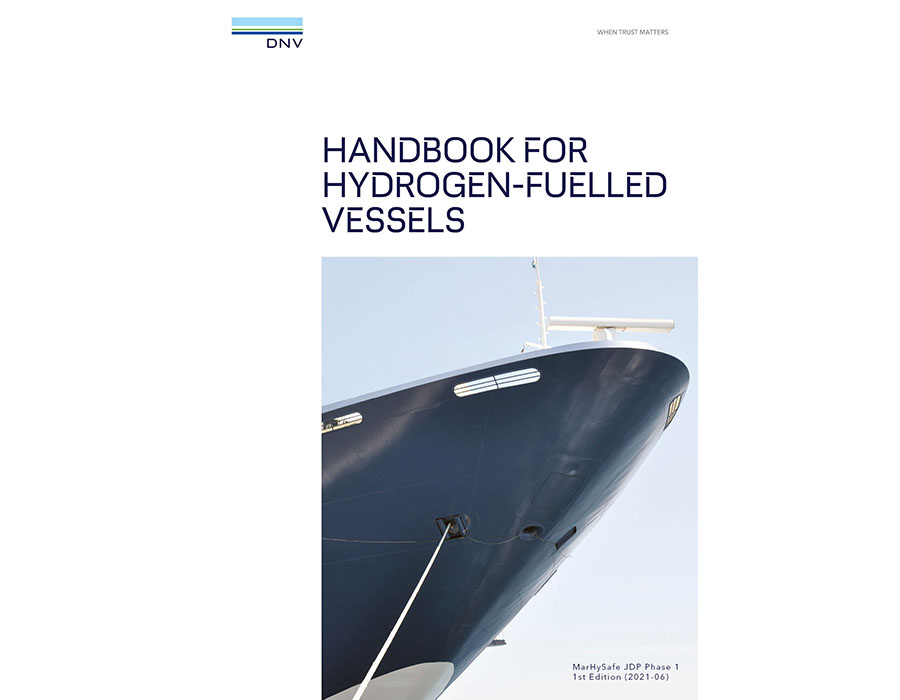
Handbook for hydrogen fuelled vessels title

DNV, classification society on Thursday (15 July) said a consortium of 26 leading companies and associations has published a handbook for hydrogen-fuelled vessels to shed light on the most pressing issues surrounding hydrogen as ship fuel. Explore the key takeaways of the DNV-led MarHySafe project:

Green hydrogen could play a crucial role in the maritime industry’s journey towards decarbonisation produced through electrolysis, H2 is free of carbon emissions and could be widely available across the globe in the future – as a marine fuel or a key enabler for synthetic fuels.

Many in shipping recognize hydrogen’s potential, but the barriers to implementing H2 technology are substantial. Led by DNV, a consortium of 26 partners and observers have come together in the MarHySafe joint development project (JDP) to address the challenges surrounding hydrogen operations: safety and regulations. 

With Phase 1 complete, the consortium has published the Handbook for Hydrogen-fuelled Vessels, which creates a roadmap towards safe hydrogen operations using fuel cells. The handbook will be updated continually as the second phase of MarHySafe progresses. Here are five lessons learnt so far.

Knowledge gaps: More testing needed on the safety aspects of handling, storage and bunkering hydrogen

Testing and modelling needs to be fine-tuned to hydrogen’s unique properties and safety considerations. 

There are uncertainties about the behaviour of cryogenic hydrogen (LH2), as well as thresholds when detonations occur. “Experiments on cryogenic (liquid) hydrogen, commissioned by the Norwegian Public Roads Administration and carried out at the DNV Spadeadam Research and Testing Centre in the UK, yielded valuable learnings for the handbook,” says Asmund Huser, Senior Principal Specialist, Quantitative Analysis at DNV.

Safety: Hydrogen’s unique properties make it very different from natural gas

Experience of working with natural gas can be very useful for starting hydrogen operations in shipping. But there are considerable differences between these different fuel types, and on-board configurations that work for natural gas may become dangerous to use for hydrogen.

This is because of hydrogen’s unique properties: H2 is the lightest of all atoms, making it harder to contain, and it can embrittle materials that would be safe to use with natural gas. For example, hydrogen requires certain types of steel and welded connections rather than fittings. H2 also ignites more easily than natural gas and has a wider flammability range. “Most of the hydrogen technology we expect to see on board ships will have already been used in other applications such as cars, trucks and other modes of land-based transport and storage. So, we don’t have to start from scratch. Some of the challenges include adapting this technology to the marine environment and making it safe to use in varying environmental conditions, in smaller spaces, and when personnel cannot be evacuated as easily as on land,” says Gerd Petra Haugom, Principal Consultant Environment Advisory at DNV and Phase I Project Manager for MarHySafe.

Fuel system: Use hydrogen in its pure form when possible

Powering vessels with hydrogen can be done via combustion engines, blending hydrogen in with other fuels, or storing it in a liquid organic solution or as ammonia. The most common and greenest way of generating power from H2 is using hydrogen fuel cells. 

This is also what the MarHySafe project has focused on. Each energy conversion step in a value chain represents energy losses. 

This makes hydrogen especially relevant as a range extender and a supplement for use cases within coastal and short-sea shipping, when battery electric solutions are not possible or feasible, for example due to a lack of local grid capacity. 

Framework: The Alternative Design process is currently the best approach

The Alternative Design process is a risk-based approval process for novel ship designs that cannot be approved with the current prescriptive regulations and need safety optimization. 

The process is in line with SOLAS Chapter II-2 and is described in the IMO Guidelines for the Approval of Alternatives and Equivalents (MSC.1/Circ. 1455). 

The approval is evaluated in line with the goals and functional requirements of the International Code of Safety for Ship Using Gases or Other Low-flashpoint Fuels (IGF Code, Part A). “The Alternative Design process requires a significant effort from the projects leading the technology development.” 

The project owners have to actively demonstrate how the hazards and consequences of the design are managed by applying risk-based design instead of demonstrating passive compliance with prescriptive rules. “This may seem arduous, but it is the best tool we currently have to help projects materialize,” says Mónica Álvarez Cardozo, Senior Engineer Piping Systems & Alternative Fuels at DNV Maritime. 

“Hydrogen is a new technology in a new environment, so a risk-based design process is needed to keep personnel, assets and the environment safe.” 

The MarHySafe handbook examines the Alternative Design process in detail, offering interpretations that fulfil the varying expectations of Flag States and providing guidance on how to navigate requirements as efficiently as possible.

“One of our main aims in the MarHySafe JDP is to build a foundation of knowledge that can be used for developing rules for hydrogen in the future,” says Gerd Petra Haugom. 

Currently there are too many knowledge gaps to draft rules, “but the more we know, the closer we get to changing this. In Phase II, we will start proposing input to early requirements.”

Implementation: Scaling up hydrogen operations will be a challenge

The MarHySafe handbook offers a comprehensive overview of the regulatory environment. “In the absence of definitive rules, it is all the more important for the industry to come together and learn from existing projects. We need to make sure that any future requirements account for all necessary safety and operational aspects, ensuring that the technology can be developed on a large scale,” says Nathaniel Frithiof, Senior Consultant Environment Advisory at DNV and Project Manager for Phase II of MarHySafe.


Related: Industry first: DNV and industry consortium publish “Handbook for Hydrogen-fuelled Vessels”


Photo credit: DNV
Published: 16 July, 2021


Continue Reading

Legal

Singapore withdraws remaining 127 charges against Hin Leong founder OK Lim

Lim Oon Kuin, also known as OK Lim, was issued a stern warning and a district court granted him a discharge amounting to an acquittal for these charges on 17 July.

Admin

Published

on

By

RESIZED Sora Shimazaki on Pexels

Founder of collapsed oil trader Hin Leong Trading, Lim Oon Kuin, also known as OK Lim, has had the remaining 127 charges against him withdrawn, according to The Straits Times on Monday (20 July). 

OK Lim was issued a stern warning and a district court granted him a discharge amounting to an acquittal for these charges, including those for cheating, on 17 July. The discharge means Lim cannot be prosecuted again for the same offences.

Lim, 84, is currently serving a 13½-year prison sentence after the High Court reduced his original 17½-year jail term in March 2026. He was convicted in 2024 on two cheating charges and one count of abetting forgery in a case prosecutors described as one of Singapore’s most serious trade finance frauds.

Lim was convicted in May 2024 of two charges of cheating the Hongkong and Shanghai Banking Corporation (HSBC) and one count of abetting forgery that proceeded to trial out of a total of 130 criminal charges.

He was first charged in court on 14 August 2020, and was subsequently handed further charges in court on 25 September 2020, 30 April 2021 and 24 June 2021 for his role in perpetuating fraud on various financial institutions. 

A total of 130 charges were eventually brought against him for cheating and forgery-related offences.

Related: Singapore: Hin Leong Founder OK Lim gets jail term slashed to 13.5 years


Photo credit: Sora Shimazaki
Published: 21 July, 2026

Continue Reading

Winding up

Singapore: Coastal Logistics Pte Ltd to be wound up voluntarily

Coastal Logistics was reportedly affiliated with troubled Singapore bunker player Coastal Oil (Singapore) Pte Ltd.

Admin

Published

on

By

RESIZED Drew Beamer

Several resolutions for Coastal Logistics Pte Ltd were made during an extraordinary general meeting held on 14 July, according to a notice in the Government Gazette on Friday (4 July).

The following resolutions were duly passed during the meeting:

As Special Resolution

  • That it has been proved to the satisfaction of the meeting that the Company cannot by reason of its liabilities continue its business and accordingly the Company be wound up voluntarily pursuant to Section 160(1)(b) of the Insolvency, Restructuring and Dissolution Act 2018 (No. 40 of 2018);

As Ordinary Resolutions

  • that Mr. Wong Pheng Cheong Martin and Ms. Koay May Yee, both care of FTI Consulting (Singapore) Pte Ltd, One Raffles Quay, #27-10 South Tower, Singapore 048583 be appointed as the joint and several Liquidators of the Company for the purpose of such winding up; and
  • that the Liquidators be at liberty to open, maintain and operate any bank account(s) or account(s) for monies received by them as Liquidators with such bank(s) as they deem fit; and
  • that a Committee of Inspection will not be formed.

Manifold Times previously reported Nicholas James Gronow, director of Heng Tong Fuels & Shipping and Coastal Logistics, filed statutory declarations for both companies stating the firms cannot continue their businesses due to liabilities.

Both companies were reportedly affiliated with troubled Singapore bunker player Coastal Oil (Singapore) Pte Ltd. 

In 2019, several vessels owned by both firms entered the sale & purchase (S&P) market in Singapore.

Related: Singapore: Director declares Heng Tong Fuels & Shipping’s inability to continue business
Related: Heng Tong Fuels & Shipping in court over DBS Bank bunker tanker loan
Related: Singapore: Bunker tanker “Coastal Neptune” arrested
Related: Heng Tong Fuels & Shipping, Coastal Logistics tankers enter S&P market


Photo credit: Drew Beamer
Published: 21 July, 2026

Continue Reading

LNG Bunkering

PIL’s LNG dual-fuel boxship “Kota Elok” arrives in Singapore on maiden call

As the first of 13 new 13,000 TEU vessels joining its fleet, Kota Elok is equipped to operate on LNG and low-sulphur fuel oil that helps reduce our greenhouse gas emissions.

Admin

Published

on

By

PIL's LNG dual-fuel boxship “Kota Elok” arrives in Singapore on maiden call

Singapore-based Pacific International Lines Pte Ltd on Monday (20 July) said its first 13,000 TEU LNG dual-fuel container vessel, Kota Elok, recently made her maiden call to Singapore on 15 July.

As the first of 13 new 13,000 TEU vessels joining its fleet, Kota Elok is equipped to operate on liquefied natural gas (LNG) and low-sulphur fuel oil that helps reduce our greenhouse gas emissions. 

The vessel also incorporated energy-saving features and digital technologies to reduce fuel consumption and enhance operational performance, as well as a bow windshield to improve aerodynamics, contributing to improved fuel efficiency and lower emissions over the course of long-haul voyages.

“Following Singapore, Kota Elok will continue her voyage on our East Coast Service 1 (ES1) route to South America, calling at ports in Brazil, Uruguay, and Argentina before returning to Asia,” the company said in a social media post. 

Kota Elok also became PIL’s first vessel to receive Lloyd’s Register certification for compliance with the IACS UR E26 and UR E27 cyber security requirements.

Developed by the International Association of Classification Societies (IACS), UR E26 and UR E27 are mandatory cyber resilience requirements for newbuild vessels contracted from 1 July 2024. 


Photo credit: Pacific International Lines
Published: 21 July, 2026

Continue Reading

Trending