Connect with us

Alternative Fuels

Study shows South Africa is well placed to lead the production of zero carbon bunker fuels

Country’s location, economic development and vast renewable energy sources make it well suited to be a hub for green maritime fuel, says report.

Admin

Published

on

South Africa fueling the future of shipping frontpage

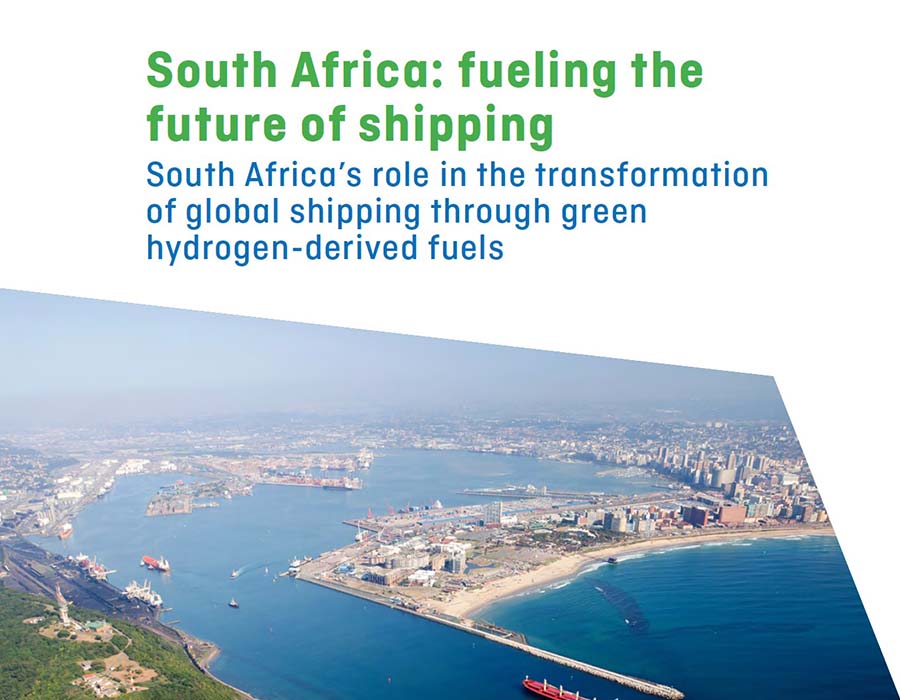
A study by Ricardo and Environmental Defense Fund for the P4G Getting to Zero Coalition Partnership finds that South Africa holds an untapped opportunity to supply the global shipping industry with zero carbon bunker fuels, according to the Global Maritime Forum on Thursday (24 June).

The production of green hydrogen-derived fuels can help to meet decarbonisation targets and act as a catalyst for the country’s economy – opening new export markets, supporting an equitable transition, and creating the jobs of the future.

The study explores the economic and environmental potential for the implementation of zero carbon shipping fuels through the shipping sector of South Africa. South Africa has vast renewable energy sources, and the country has committed to reach net zero emissions by 2050.

“Our study shows that South Africa has an abundance of renewable energy potential. It is enough to supply the country’s domestic electrical demand as well as the production of zero carbon fuels to supply commercial vessels refuelling in its international ports,” says Aoife O’Leary, Director, International Climate, Environmental Defense Fund.

“The adoption of zero carbon propulsion technologies at South Africa’s ports could attract investment of between 122 and 175 billion Rand in onshore infrastructure by 2030. All that is needed to unlock this investment are the right policy incentives set at the International Maritime Organization.”

The report finds that South Africa’s geographical location and economic development make it particularly well suited to distribute zero carbon fuels for the South African shipping sector, and export to international markets.

“South Africa has the opportunity feed into the growing global demand for decarbonized materials, products and services by offering bunkering capability for zero carbon fuels to vessels of all types,” states Olivia Carpenter-Lomax, future energy specialist and project lead, Ricardo.

“With access to busy shipping routes, abundant renewable energy potential, and experience handling these and other fuels, South Africa is in a great position to produce the shipping fuels of the future, access a growing global market, and thus catalyze a new low carbon economy.”

Several zero carbon fuels can potentially be used in shipping. The abundance of renewable energy resource in South Africa means that shipping fuels can be derived from renewable electricity generation.

It highlights the ports of Saldanha Bay, Ngqura (Coega) and Richards Bay as great examples of how South African can capitalize on a zero carbon fuel transition due to established shipping routes and significant port export hubs.

“Zero carbon shipping presents South Africa with the opportunity to usher in ‘a new economy in a new global reality’, to quote President Ramaphosa in our national Economic Reconstruction and Recovery Plan,” says Kaashifah Beukes, Chief Executive Officer, Saldanha Bay Industrial Development Zone.

“For this, the SBIDZ supports this research in its efforts to stimulate solutions and investment into a global megatrend that is becoming the agenda of our time. It will require sustainable capital investment into new technologies, new vessel designs, new landside infrastructure and a shake-up of the services and logistics sub-sectors.

“This is exactly the work the SBIDZ is vested in as a catalyst for economic growth and transformation, and the unique potential of the Port of Saldanha Bay as the first Freeport in South Africa.”

Note: Download the full report South Africa: fuelling the future of shipping – South Africa’s role in the transformation of global shipping through green hydrogen-derived fuels here.


Photo credit: South Africa: fuelling the future of shipping
Published: 25 June, 2021

Continue Reading

Methanol

OOCL dual-fuel boxship completes first green methanol bunkering op at Qingdao Port

“OOCL Wisdom” completed its first green methanol bunkering and commenced its maiden voyage to Europe at Qingdao Port on 3 July.

Admin

Published

on

By

OOCL dual-fuel boxship completes first green methanol bunkering op at Qingdao Port

​International container transportation and logistics company Orient Overseas Container Line (OOCL) on Friday (3 July) said its first methanol dual-fuel containership, OOCL Wisdom, completed its first green methanol bunkering and commenced its maiden voyage at Qingdao Port.

OOCL Wisdom is the first in a series of seven methanol dual-fuel container vessels. With a maximum capacity of 24,168 TEU, it is currently the world’s largest methanol dual‑fuel container vessel and is deployed on the Asia – North Europe Loop 1 (LL1) service.

Mr. Peter Pan, Director of Trades of OOCL, said: “OOCL Wisdom completed its first green methanol bunkering and commenced its maiden voyage to Europe at Qingdao Port, representing a significant achievement of the deepening collaboration between OOCL and Shandong Port Group, and reflecting OOCL’s steadfast commitment to green and low‑carbon development, digital intelligence and sustainability.”


Photo credit: Orient Overseas Container Line
Published: 6 July, 2026

Continue Reading

LNG Bunkering

Zhejiang Province wraps up first cross-regional bonded LNG bunkering operation

“Hai Yang Shi You 302” supplied container ship “MSC Maria Laura” with 3,500 cubic meters of bonded LNG at Chuanshan Port Area, after the bunkering vessel received bonded LNG in Zhoushan.

Admin

Published

on

By

Zhejiang Province wraps up first cross-regional bonded LNG bunkering operation

Zhejiang Province on Saturday (27 June) completed its first cross-regional bonded LNG bunkering operation at Chuanshan Port Area of ​​Ningbo-Zhoushan Port, according to Hangzhou Customs. 

Bunkering vessel Hai Yang Shi You 302 travelled to ENN Zhoushan LNG receiving terminal to load bonded LNG. The vessel then supplied container ship MSC Maria Laura with 3,500 cubic meters of bonded LNG at Chuanshan Port Area. 

Zhejiang Province wraps up first cross-regional bonded LNG bunkering operation

Compared with the traditional single-port bunkering model, the cross-regional operation removes the geographical barriers between Zhoushan’s gas supply and bunkering demand in Ningbo’s core port area, enabling cross-port LNG transfer within the province.

“The new operating model addresses longstanding constraints associated with the geographical limitations of LNG supply reloading and tight operational time windows,” said Chen Bangkui, Business Manager at CNOOC Zhejiang New Energy Co Ltd. 

“We can now flexibly source bonded LNG from both Zhoushan and Ningbo, significantly improving operational flexibility and efficiency.”


Photo credit: Hangzhou Customs
Published: 6 July, 2026

Continue Reading

Battery

ICCT: China’s electric cargo ship fleet grows 950% in three years

In its latest blog, ICCT says vessel sizes for electric cargo ships have grown significantly, indicating that China is testing the feasibility of electrification for increasingly larger ships.

Admin

Published

on

By

CHUTTERSNAP MT

The International Council on Clean Transportation (ICCT) recently said China’s fleet of electric cargo ships has grown by 950%, from just four vessels in 2022 to 42 in 2025.

According to its latest blog, electrification is rapidly expanding along inland waterways in the country, offering a pathway to cut emissions, improve air quality, and lower operating costs.

ICCT said electric cargo ships are entering real-world operation at a rapidly growing pace

“Ship types have diversified, from bulk carriers and container ships to multi-purpose cargo ships. At the same time, vessel sizes have grown significantly, with the maximum deadweight tonnage (DWT) rising from around 3,000 tonnes in 2022 to approximately 14,000 tonnes in 2025,” it said.

“This indicates that China is testing the feasibility of electrification for increasingly larger ships.”

Although battery capacity constraints continue to limit sailing range per charge—which typically hovered between 150 km and 400 km from 2022 to 2025—trends show steady improvement; by 2025, electric cargo ships with a range of up to 500 km were already in operation in China.

Inland waterways have become the primary testing ground for electric cargo ship deployment. 

By the end of 2025, 86% of electric cargo ships in China were operating on internal rivers. 

“Nine provinces and municipalities have already launched pilot projects, covering major waterways such as the Yangtze River, the Pearl River, and the Beijing-Hangzhou Grand Canal,” ICCT added.

The blog also explored the opportunities, challenges, and policy actions that could accelerate the shift to electric inland shipping.

“Developing an enhanced subsidy that favors electric vessels, on top of the current vessel trade-in subsidy program, could help reduce the upfront investment burden for electric vessel adoption,” it recommended.

ICCT added that tightening ship engine emission standards toward world-leading levels could increase the compliance costs of conventional-fuel vessels and improve the relative competitiveness of electric ships.

“The electrification of inland shipping in China is already underway; what is needed now is smart policy to accelerate the transition,” it said.


Photo credit: CHUTTERSNAP on Unsplash
Published: 6 July, 2026

Continue Reading

Trending