Connect with us

Environment

Black carbon in the Arctic: IBIA supports voluntary measures prior to regulation

Voluntary measures could be promoted to reduce BC emissions in the Arctic i.e. a switch to distillate fuels on ships using medium/high speed 4-stroke engines, it said.

Admin

Published

on

IBIA Unni

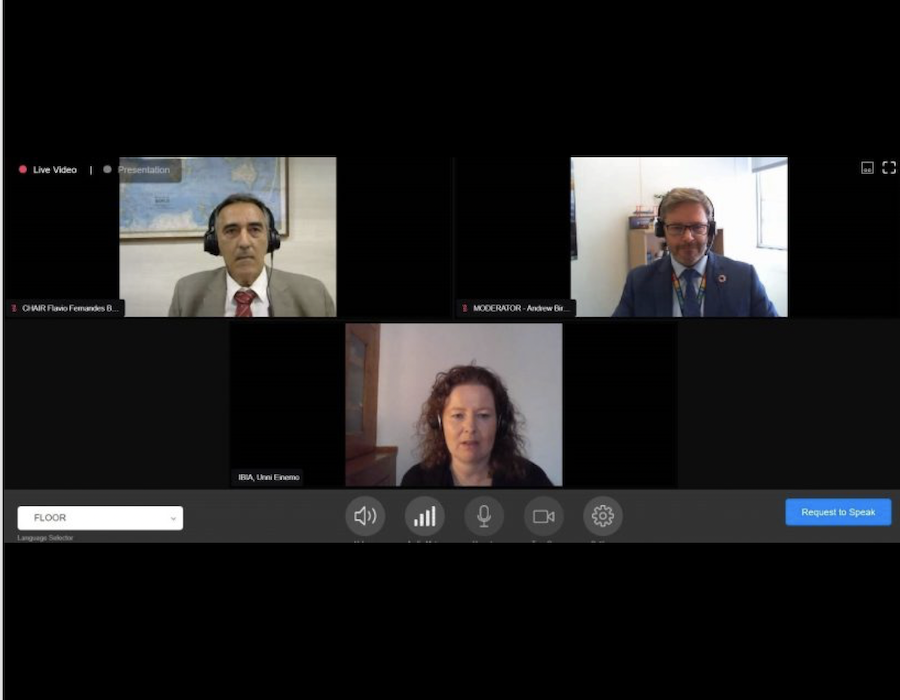
Various measures could reduce black carbon emissions from ships in the Arctic before any potential new policy instruments are agreed and developed at the IMO, highlighted the International Bunker Industry Association (IBIA) at the eight session of the IMO’s Sub-Committee on Pollution Prevention and Response (PPR 8), which took place virtually from 22 to 26 February.

IBIA and IPIECA submitted a document to the session, commenting on the PPR/8/5/1 submitted by Germany and Finland which carried the final part of a Black Carbon measurement campaign first presented to PPR 7 just over a year ago. 

In its joint submission IBIA said PPR 8/5/3 offered some additional information it believes is relevant to put the results presented in document PPR 8/5/1 in perspective.

IBIA made the following statement to introducing its joint submission at PPR 8:

The Black Carbon measurement campaign presented in document PPR 8/5/1, while interesting in demonstrating a link between fuel aromatic content and tendency to form BC emissions, gives us only part of the picture for two key reasons:

Firstly, the VLSFO samples used in the measurements are clearly not representative of the fuels actually in the market, as they were blended to represent fuels with unusually high aromatic content. It has been clearly demonstrated through test data that the VLSFOs actually in the market are predominantly more paraffinic in nature.

Secondly, the Black Carbon emission measurements reported in PPR 8/5/1 were limited to one type of engine. The type of engine used is known to emit significantly more Black Carbon than 2-stroke large bore engines, which are also less sensitive to fuel type than 4-stroke engines like the one used in the measurement study.

This means that the results presented in document PPR 8/5/1 may not be representative of neither the engine type used by a large part of the global merchant fleet, nor of the predominant types of fuels used, at least with regards to VLSFO.

Another aspect worth noting is that the measured Black Carbon levels reported in document PPR 8/5/1, compared to the emission factor used in the Fourth IMO GHG Study, were about 80% lower for HFO.  This is a very significant difference which highlights the need to review the emission factors for BC.

Notwithstanding the fact that VLSFOs are typically more paraffinic than aromatic in nature, and the fact that engine type, condition and operational profile are key factors influencing BC emissions, the co-sponsors support ISO’s ongoing work to evaluate possible indicators as to whether a fuel tends to have a paraffinic or aromatic character.

While we note that a ban to use and carry HFO in the Arctic will effectively eliminate the vast majority of VLSFOs, a number of measures could be promoted on a voluntary basis in the near term to reduce BC emissions in the Arctic. Avoiding ships with older mechanical injection engines would be most effective, followed by employing ships that use LNG or similarly clean-burning fuels in the Arctic. A voluntary switch to distillate fuels, in particular on ships using medium or high speed 4-stroke engines, could also have a positive impact.

IBIA said PPR 8 discussed various direct and indirect black carbon control mechanisms, but a clear way forward was not identified.

It made the following statement to comment on the discussions on the final day of PPR9:

In light of proposals submitted and the discussion on Tuesday, we have some observations.

One way forward is to set a limit on black carbon for ships operating in the Artic. This would eliminate the uncertainty about the actual efficiency of the measure associated with all other approaches. The challenge is to establish what the limit should be and how to measure and enforce it.

We have a proposal for including a Hydrogen/Carbon ratio in ISO 8217. As we have heard, the relevance of this is questionable for effectively targeting black carbon emissions and we need more research, and there are cost implications that would deter uptake of the next revision of the standard.

Then we have the proposals in PPR 8/5/4 to establish an Arctic Emission Control Area and amend MARPOL Annex VI to exclude use of HFO in the Artic. While this would reduce overall black carbon emissions to a certain extent, we know that fuel type is only one of the factors that impacts black carbon emissions.

All these possible policy routes will take time to be developed. Meanwhile, a ban on HFO use and carriage in the Arctic is coming in 2024.

We have analysed a set of fuel testing data covering the period from the start of 2019 up to the end of February 2021 to see which percentages of VLSFOs and ULSFOs would be classified as HFO. Out of more than 12,000 VLSFO samples tested in this period, 95% would be classified as HFO. For ULSFO, a residual grade which meets a 0.10% sulphur limit, 18% out of around 700 samples would be classified as HFO.

We recognise that black carbon deposited on snow and ice in the Arctic is a particular concern in light of the impact on climate change. As we have highlighted in our submission with IPIECA, PPR 8/5/3, there are a variety of measures that can reduce BC emissions. These are available now and could be promoted on a voluntary basis prior to the Arctic HFO ban taking effect, and before any potential new policy instruments are agreed and developed.

IBIA noted that due to diverse views, there was not enough time at PPR 8 to agree on a specific set of voluntary or mandatory control measures at this session.

A phased approach was agreed to develop, as a starting point, guidelines in the short-term with the potential for mandatory measures being introduced in the longer-term if necessary and as experience is gained.


Photo credit and source:
IBIA
Published: 6 April, 2021


Continue Reading

LNG Bunkering

MOL and Seaspan sign annual LNG bunkering deal for car carriers in Port of Vancouver

MOL says North America is one of the key trade lanes for car carriers, and with recent delivery of new LNG-fuelled vessels, securing a stable LNG fuel supply in the area has become increasingly important.

Admin

Published

on

By

MOL and Seaspan sign annual LNG bunkering deal for car carriers in Port of Vancouver

Mitsui O.S.K. Lines, Ltd. (MOL) on Thursday  (21 May) announced that MOL and Seaspan Energy have signed the first annual contract for LNG bunkering for car carriers at the Port of Vancouver, Canada. 

On 29 April, MOL completed the first LNG bunkering under this contract. Since completing the first LNG bunkering on the West Coast of North America on 1 March 2025 – the first by a Japanese shipping company – MOL has conducted several additional LNG bunkering operations in the region. 

North America is one of the key trade lanes for car carriers, and with the recent delivery of new LNG-fuelled vessels, securing a stable LNG fuel supply in the area has become increasingly important. This contract underscores the company’s commitment to establishing a stable and seamless regional LNG fuel procurement framework.

Seaspan expanded its LNG bunkering capabilities in 2026 from Vancouver to Long Beach, California, and continues to proactively support the growth of a clean marine supply chain.

Seaspan Energy President Harly Penner, said: “The relationship between Seaspan Energy and MOL is highly valued. MOL was the first car carrier operator to receive LNG bunkering services in the Port of Vancouver, and we are proud to continue supporting their operations in Vancouver through this annual LNG bunkering agreement. 

“This partnership reflects our shared commitment to advancing lower-emission marine transportation and supporting the industry’s transition toward net-zero GHG emissions.”

Marine Fuel GX Division General Manager Daisuke Fujihashi, said: “We are very pleased to further strengthen our partnership with Seaspan Energy through this contract for LNG fuel procurement. 

“Looking ahead, we will continue to deepen our collaboration with Seaspan Energy in the field of clean fuels, including bio LNG, and remain committed to offering our customers more pathways toward cleaner supply chains.”


Photo credit: MOL
Published: 22 May, 2026

Continue Reading

Ammonia

MMMCZCS: MAGPIE Project confirms operational feasibility of ammonia bunkering

MAGPIE consortium completed a successful ship-to-ship ammonia bunkering simulation in Rotterdam on 12 April, proving that ammonia can be bunkered safely within an operating port.

Admin

Published

on

By

MMMCZCS: MAGPIE Project confirms operational feasibility of ammonia bunkering

The Mærsk Mc-Kinney Møller Center for Zero Carbon Shipping (MMMCZCS) on Thursday (21 May) said a new demonstration project in the Port of Rotterdam showed that ship-to-ship ammonia bunkering can be carried out safely within an active port environment. 

The demonstration is part of the EU-funded MAGPIE (sMArt Green Ports as Integrated Efficient multimodal hubs) project, and the report is now available, providing concrete learnings that industry can use to guide future ammonia bunkering and accelerate global port permitting.

The shipping sector must transition away from fossil fuels to meet climate targets. Ammonia is considered a promising alternative fuel, but its specific hazards pose significant safety, operational, and regulatory challenges. Without competent operators, fit-for-purpose equipment and robust safety and regulatory frameworks, ammonia bunkering cannot take place safely in ports.

Within the MAGPIE project, a full-scale simulation of a ship-to-ship ammonia bunkering operation was conducted in the Port of Rotterdam on 12 April 2025. The demonstration showed that ammonia bunkering within port limits is operationally feasible when carefully planned and executed within a robust safety and regulatory framework.

The learnings from the demonstration have now been consolidated by the Mærsk Mc-Kinney Møller Center for Zero Carbon Shipping and project partners in a comprehensive ammonia bunkering demonstration report. This publication provides the industry with practical lessons and a validated port safety framework and tools that other ports can use as a blueprint for ammonia bunkering.

A key outcome of the project is the validation of the Port of Rotterdam’s port safety framework for ammonia as a fuel, as well as the International Association of Ports and Harbours’ (IAPH) Port Readiness Tool. The results demonstrate that these frameworks are fit-for-purpose instruments for ports considering the introduction of new alternative fuels.

“The project delivers practical learnings, validation sheets and recommendations that can be used by ports globally to build confidence in ammonia bunkering and to inform future port permitting and regulatory processes. The results support the EU’s ambition for green ports and the safe deployment of alternative fuels in the maritime sector,” said Bo Cerup-Simonsen, CEO, Mærsk Mc-Kinney Møller Center for Zero Carbon Shipping.

“The energy transition requires new, integrated value chains. This ammonia bunker pilot is an important step in developing a complete value chain for alternative fuels, from import to application in shipping. Together with our partners, we demonstrate that innovation, safety, and scalability can go hand in hand. Rotterdam plays a connecting role as an energy and logistics hub for Northwest Europe,” said Boudewijn Siemons, CEO, Port of Rotterdam.

The learnings from MAGPIE contribute to a broader effort to accelerate sustainable, smart and multimodal port systems and results will be shared with the wider industry to support the global transition of the shipping sector.

Note: The report titled ‘Ammonia Bunkering Demonstration Report’ can be found here


Photo credit: Mærsk Mc-Kinney Møller Center for Zero Carbon Shipping
Published: 22 May, 2026

Continue Reading

Environment

OliOil selects Elomatic as partner for autonomous oil spill response container design

A unique feature of the solution is that the container can be placed on both oil-carrying vessels and in ports, enabling rapid response capability.

Admin

Published

on

By

OliOil selects Elomatic as partner for autonomous oil spill response container design

Finnish startup OliOil recently said it is developing an oil spill response container that enables advanced prevention of oil spread immediately after an incident occurs. 

Elomatic will design the system to meet performance and operational reliability requirements under challenging conditions.

The collaboration between Elomatic and OliOil focuses on developing the oil spill response container technology from pilot phase toward industrial manufacturing. 

In the preliminary design phase, the aim is to create a concept for a functional system where containerized boats deploy autonomously during an oil spill, using AI and robotics to position containment booms.

OliOil’s oil spill response container was created from a LUT University research project focused on Baltic Sea protection. 

What makes the solution advanced is that the container can be placed on both oil-carrying vessels and in ports, enabling rapid response capability. Boom deployment is the critical first step in any spill response, preventing the oil’s spread and enabling efficient oil recovery with specialized collection equipment.

Elomatic’s scope covers container design, boat hoisting systems, electrification, and ventilation. The team is also defining the boats’ technical specifications and designing their propulsion systems.

“Elomatic’s expertise in both industry and marine technology is valuable. It’s also important to us that Elomatic has experience in commercializing innovations in addition to engineering expertise,” said Kristian Laiho, Chair of the Board at OliOil.

“It’s great to work with a company bringing new solutions to environmental challenges. Utilizing our broad expertise in OliOil’s product development and commercialization is meaningful to us,” said Karoliina Joensuu, Head of Industry Business Unit at Elomatic.


Photo credit: OliOil
Published: 15 May, 2026

Continue Reading

Trending