Connect with us

LNG Bunkering

East Coast Australia JIP unveils interactive dashboard that enables LNG bunkering forecast

Dashboard enables forecasting of LNG demand on Australia’s East Coast based on various data sets including alternative fuel uptake and fleet development.

Admin

Published

on

Screen Shot 2020 11 25 at 3.01.07 PM

Classification Society DNV GL on Monday (23 November) said a comprehensive and interactive dashboard that predicts liquified natural gas (LNG) demand and enables scenario modelling in Australia was developed as a result of their participation in the East Coast Australia LNG Joint Industry Project (EC JIP). 

DNV GL said it facilitated the project and other partners included oil & gas suppliers, LNG infrastructure consultants, ship owners and operators, charterers, industry associations, governmental agencies and regulators.

The EC JIP was recently concluded in October and the dashboard will be made available to the public via subscription soon.

With increasingly stringent international regulations to decarbonize shipping and Australia’s unique position as the world’s largest LNG exporter, the EC JIP brought together key representatives in Australia from all parts of the logistics chain to explore the uptake of LNG on the continent’s East Coast as a transition to lower emission marine fuels.

Established in 2019, this project builds on the successful Green Corridor JIP in 2018, where major stakeholders examined the economic feasibility of LNG-fuelled bulk carrier designs for transporting iron ore and coal between Australia and China. 

“Reducing greenhouse gas emissions is crucial for the future of the shipping industry,” said Cristina Saenz de Santa Maria, Regional Manager for South East Asia, Pacific & India at DNV GL Maritime.

“By working together with supply chain partners, we hope that this project charts a way forward for the uptake of LNG as ship fuel in Australia, offering them clear insights on how to meet the challenges and opportunities ahead.”

“In the Green Corridor project, we saw that there are significant differences in the commercial and technical viability between the West Coast and the East Coast of Australia,” said Jonathan Abrahams, Head of Maritime Advisory, Australia & New Zealand at DNV GL – Maritime.

“For the latest East Coast LNG project, the partners focused on scrutinizing the demand for LNG as a marine fuel as well as looked into an expanded scope of multiple trade routes for bulk, container and passenger vessels, which are major segments trading in this part of Australia.”

Apart from assessing the business case for LNG as a marine fuel from 2022, the project also sought to address challenges faced by key stakeholders and to position Australia at the forefront of LNG fuelled shipping.

The project was carried out in two phases:

  • In Phase 1, the project concluded on a suitable scenario model structure to calculate key demand forecast.
  • The East Coast LNG project went on to develop infrastructure concepts for selected bunkering solutions in Phase 2, looking into specific technical and operational parameters.

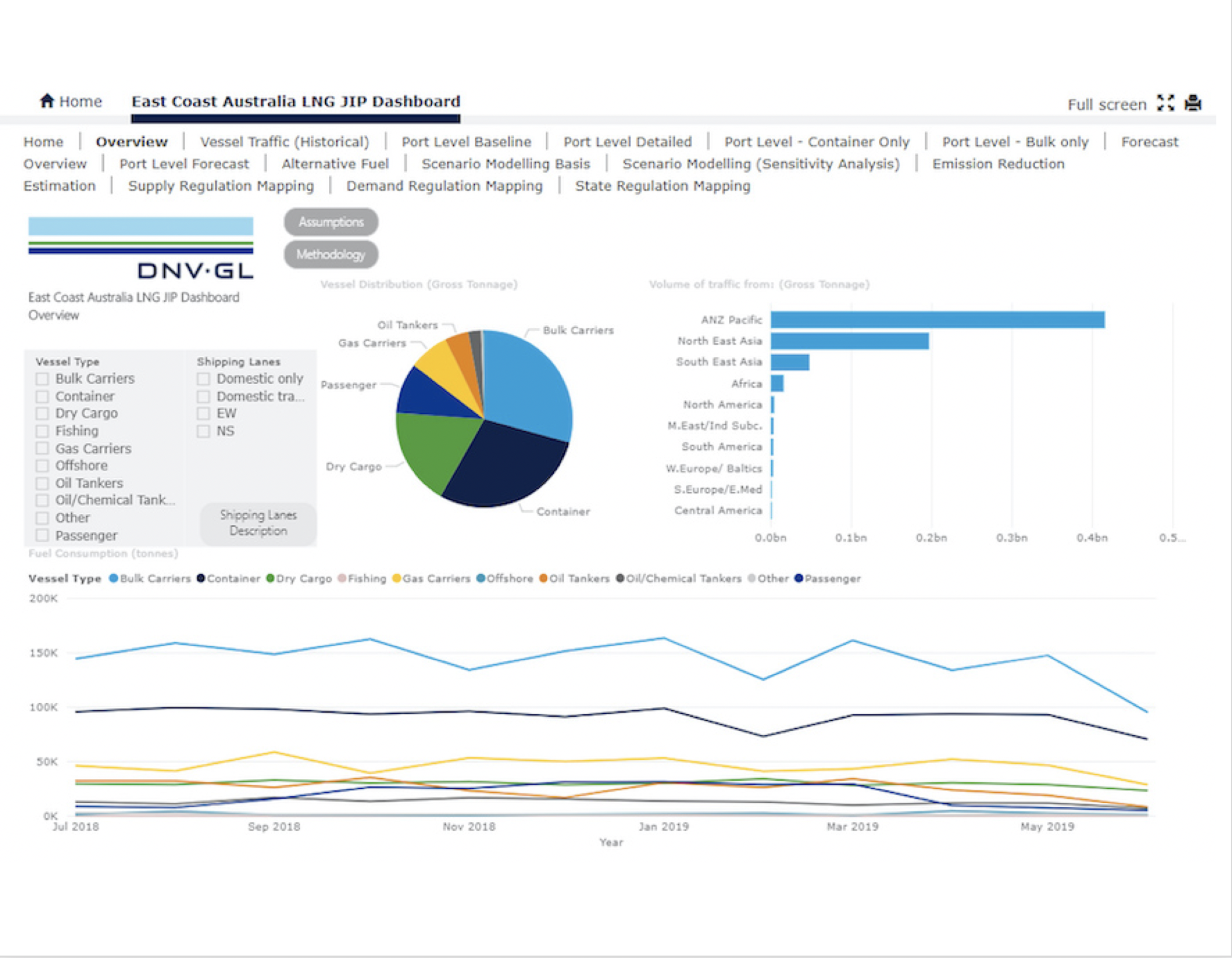
The results are presented in a unique dashboard. It incorporates vessel arrival information and fuel consumption data for 2018–2019 as the baseline and enables detailed analysis and forecasting based on ship type, size, age, port of origin, alternative fuel uptake and fleet development through to 2050. 

With LNG gaining momentum as an optimal fuel for low emissions shipping, the dashboard shows that there is a huge growth potential for Australia with the presence of abundant production facilities.

Ports identified as important facilities for LNG supply, namely Newcastle, Port Kembla and Hastings, should develop scalable infrastructures to support the growing demand for different ship types. 

“DNV GL is proud to have facilitated this project, which is modelled after the forecast methodology of our annual energy transition publication, the Maritime Forecast to 2050,” added Abrahams.

“With an interactive dashboard hosted on our open industry platform Veracity, it consolidates data from multiple sources onto a single interface and allows for constant iterations to reflect an up-to-date scenario model to support decisions on adopting LNG as a fuel.”

The interactive dashboard enables the forecasting of LNG demand on Australia’s East Coast based on historic fuel consumption data of various ship types, considering size, age, port of origin, alternative fuel uptake and fleet development through to 2050. 


Photo credit: DNV GL
Published: 25 November, 2020

Continue Reading

LNG Bunkering

PIL’s LNG dual-fuel boxship “Kota Elok” arrives in Singapore on maiden call

As the first of 13 new 13,000 TEU vessels joining its fleet, Kota Elok is equipped to operate on LNG and low-sulphur fuel oil that helps reduce our greenhouse gas emissions.

Admin

Published

on

By

PIL's LNG dual-fuel boxship “Kota Elok” arrives in Singapore on maiden call

Singapore-based Pacific International Lines Pte Ltd on Monday (20 July) said its first 13,000 TEU LNG dual-fuel container vessel, Kota Elok, recently made her maiden call to Singapore on 15 July.

As the first of 13 new 13,000 TEU vessels joining its fleet, Kota Elok is equipped to operate on liquefied natural gas (LNG) and low-sulphur fuel oil that helps reduce our greenhouse gas emissions. 

The vessel also incorporated energy-saving features and digital technologies to reduce fuel consumption and enhance operational performance, as well as a bow windshield to improve aerodynamics, contributing to improved fuel efficiency and lower emissions over the course of long-haul voyages.

“Following Singapore, Kota Elok will continue her voyage on our East Coast Service 1 (ES1) route to South America, calling at ports in Brazil, Uruguay, and Argentina before returning to Asia,” the company said in a social media post. 

Kota Elok also became PIL’s first vessel to receive Lloyd’s Register certification for compliance with the IACS UR E26 and UR E27 cyber security requirements.

Developed by the International Association of Classification Societies (IACS), UR E26 and UR E27 are mandatory cyber resilience requirements for newbuild vessels contracted from 1 July 2024. 


Photo credit: Pacific International Lines
Published: 21 July, 2026

Continue Reading

LNG Bunkering

CIMC SOE secures order for 12,000-cbm LNG bunkering vessel from Sinopec Clean Energy

Once operational, the vessel is expected to strengthen Sinopec’s domestic coastal LNG bunkering network and help address gaps in China’s alternative fuel bunkering infrastructure.

Admin

Published

on

By

CIMC SOE secures order for 12,000-cbm LNG bunkering vessel from Sinopec Clean Energy

China’s Nantong CIMC Sinopacific Offshore & Engineering Co., Ltd. (CIMC SOE) recently signed a contract with Sinopec (Beijing) Clean Energy Co., Ltd. to build a 12,000-cubic metre (m3) LNG bunkering vessel, according to Chinese maritime media.

The vessel is scheduled for delivery in 2028 and will support Sinopec’s efforts to expand its presence in the marine clean energy sector.

Once operational, the vessel is expected to strengthen Sinopec’s domestic coastal LNG bunkering network and help address gaps in China’s LNG bunkering infrastructure.

With this signing , CIMC Pacific Offshore Engineering’s LNG bunkering vessel orderbook is further strengthened, maintaining its leading position in the global market for small and medium-sized LNG bunkering vessels.

The contract also marked another milestone for CIMC SOE, which has seen a sharp increase in orders and business performance this year amid a surge in domestic LNG vessel demand.


Photo credit: Nantong CIMC Sinopacific Offshore & Engineering
Published: 21 July, 2026

Continue Reading

Alternative Fuels

ENGINE on Fuel Switch Snapshot: LSMGO surges to greater premium over biofuel

B100 discount to LSMGO widens to $541/mt in Rotterdam; Singapore’s B100 drops to $106/mt below LSMGO; Rotterdam LBM at $639-833/mt discounts to LSMGO.

Admin

Published

on

By

ENGINE on Fuel Switch Snapshot: LSMGO surges to greater premium over biofuel

Once a week, bunker intelligence platform ENGINE will publish a snapshot of alternative and conventional bunker fuel prices in the world’s two biggest bunkering hubs. The following is the latest snapshot:

20 July 2026

  • B100 discount to LSMGO widens to $541/mt in Rotterdam
  • Singapore’s B100 drops to $106/mt below LSMGO
  • Rotterdam LBM at $639-833/mt discounts to LSMGO

B100’s premium over HSFO in Rotterdam has narrowed by $50/mt over the past week to $64/mt, while its discount to VLSFO has widened by $83/mt to $105/mt.

B100 has become far more competitive against LSMGO in Rotterdam, with its discount widening by $180/mt over the past week to $541/mt, as a surge in conventional fuel prices left B100 broadly unchanged by comparison.

B100’s price has risen by $109/mt in Singapore, but its discount to LSMGO has still widened by $102/mt to $106/mt, as LSMGO surged by an even greater $211/mt.

Rotterdam’s LNG premium over VLSFO has widened by $35/mt to $201/mt for vessels with Otto medium speed (Otto MS) engines. For vessels with diesel slow speed (diesel SS) engines, LNG has flipped to a $15/mt premium over VLSFO, from a $22/mt discount the prior week.

Liquefied biomethane (LBM) discounts to VLSFO in Rotterdam have narrowed by $50-52/mt to $203-396/mt over the past week. Against LSMGO, LBM discounts have widened by $45-47/mt to $639-833/mt, depending on engine type.

In Singapore, LNG is now $42/mt cheaper than LSMGO for vessels with Otto MS engines, and $134/mt cheaper for vessels with diesel SS engines.

ENGINE on Fuel Switch Snapshot: LSMGO surges to greater premium over biofuel

Liquid fuels

HSFO and VLSFO prices in Rotterdam have jumped by $66/mt and $99/mt respectively over the past week, while LSMGO has surged by an even steeper $196/mt. A $9.69/bbl ($71/mt) rise in front-month ICE Brent futures, to $87.94/bbl ($645/mt), drove bunker prices sharply higher across the board.

Bunker fuel availability is tight for prompt delivery dates in the ARA ports, with buyers advised to enquire about stems between 5-7 days ahead to get good coverage, a trader said.

Rotterdam’s B100 price has risen by $16/mt over the past week. Dutch ZRE A ticket prices were unchanged at €107.50/mtCO2e.

Singapore’s HSFO and VLSFO prices have risen by $130/mt and $132/mt respectively, while its LSMGO price has gained an even steeper $211/mt over the past week.

VLSFO availability in Singapore has been tight, with several suppliers reporting low stock levels. Recommended lead times have widened from 13–17 days last week to 14–19 days now.

Liquid gases

Rotterdam’s LNG prices have surged by $134-136/mt over the past week, while its LBM prices have climbed by $149-151/mt.

LBM discounts to LNG in Rotterdam have narrowed by $15/mt to $404-411/mt.

Singapore’s LNG bunker benchmarks have surged by $196-197/mt over the past week.

By Erik Hoffmann


Photo credit and source: ENGINE
Published: 21 July, 2026

Continue Reading

Trending