Connect with us

Technology

INSIGHT & EXCLUSIVE: NUS creates ‘digital twin’ of Singapore’s next gen port

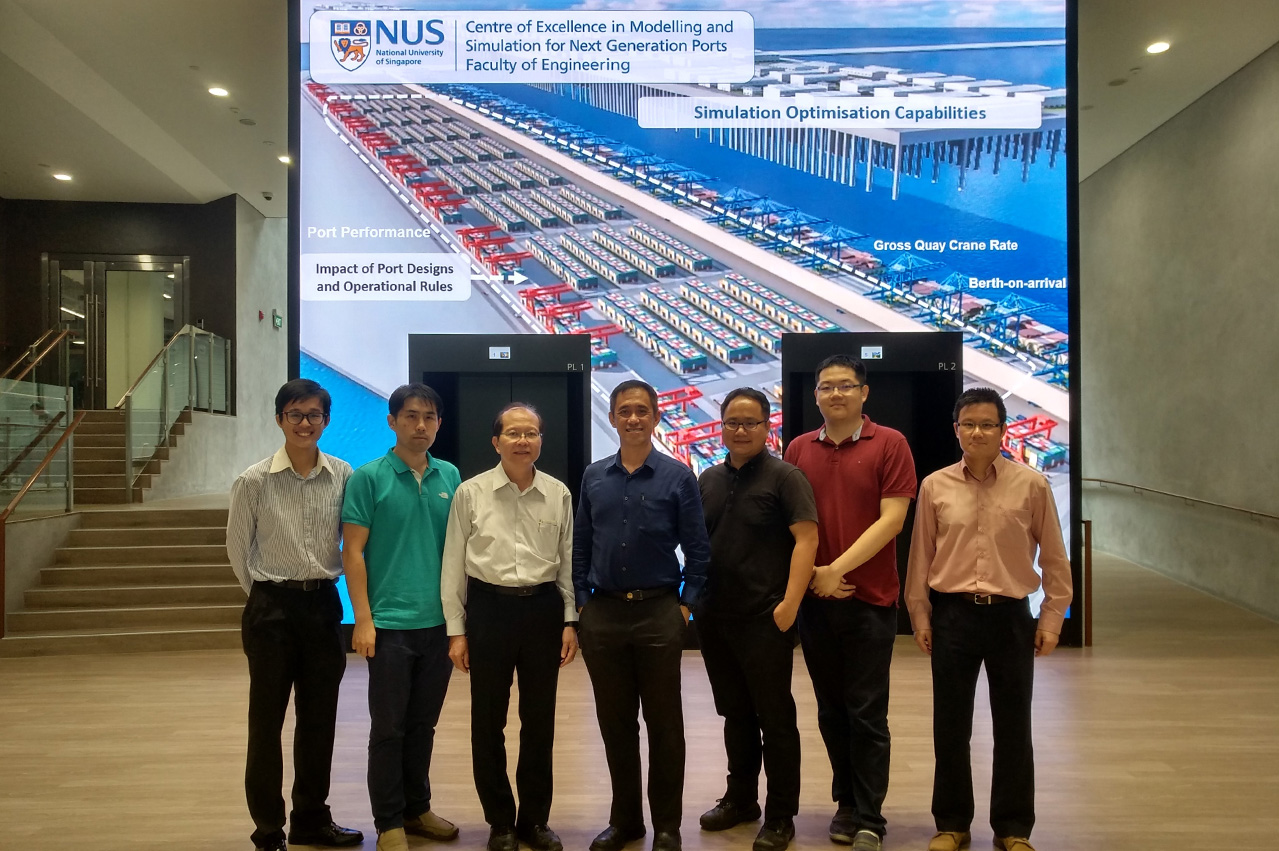
The team behind NUS’ Centre of Excellence for Modelling and Simulation of Next Generation Port speaks with Manifold Times on designing Singapore’s Tuas mega port.

Admin

Published

on

5b35a98a41f1c 1530243466

Today (Friday) marks the signing of an agreement between the National University of Singapore (NUS) and Singapore Maritime Institute (SMI) to establish the Centre of Excellence in Modelling and Simulation for Next Generation Port (C4NGP), a new SGD $18 million ($13.21 million) research centre located at NUS for enhancing the global competitiveness of Singapore’s maritime and port industries.
 
Tucked within C4NGP is research done by a team led by Associate Professor Chew Ek Peng and Associate Professor Lee Loo Hay from the NUS Department of Industrial Systems Engineering & Management to create the O2DES.NET (open-orientated discrete event simulation) platform, also simply known as the ‘digital twin’, for various maritime systems including the future 65 million twenty-foot equivalent units (TEU) capacity Tuas mega port.
 
The Tuas mega port is a major milestone in Singapore’s next generation container terminal project that is scheduled to open progressively from 2021 for completion in 2040; it combines all city terminals at Tanjong Pagar, Pasir Panjang, Keppel and Brani into a mega maritime complex.
 
The ‘digital twin’ project is able to transport the physical realm of the Tuas mega port into the digital world; it combines the artificial intelligence and simulation aspect of port operations components (e.g. automated guided vehicles (AGVs), port cranes, container movement, maritime traffic, etc) to create a virtual sandbox environment for running simulation models.
 
Professor Lee believes these simulations will offer PSA International, Jurong Port and other stakeholder companies of the Tuas mega port project a glimpse to forecast the efficiency of operational events even before construction.
 
“Imagine a crystal ball which allows you to see events unfolding,” he says while adding “it is like a scientific tool which commercial users can consult to make an educated guess before committing huge money.”
 
“Singapore’s Tuas mega port is going to be the biggest in the world and nothing of this scale has ever been done before. The challenge is not only building it, but also making sure the design of the whole port itself promotes effective operations.
 
“The volume of 65 million TEUs is going to introduce huge traffic in the terminal that will be complicated to handle; if you do not control the operational decisions and handling sequences wisely the capacity of the port will fall far below the projected capacity.
 
“Singapore, being a transhipment port, also means an incoming containership will likely contain boxes which has to be further processed and transhipped over 200 destinations, and with each finger at the Tuas port being a few kilometres long all AGVs will need to operate and transport their containers like clockwork to meet transfers on time.
 
“The massive amount of automation by AGVs means much work has to be done to fine tune the system’s artificial intelligence; a smart algorithm also needs to be developed to control how many AGVs simultaneously operates as we will see congestion with too many and a backlog if too few units operating.
 
“The simulations provided by our ‘digital twin’ project of the Tuas mega port will be able to help stakeholders make decisions on the mentioned and more.”
 
Other uses for the ‘digital twin’ simulation platform include the analysis of navigational channel capacity studies for developing systems to simulate and optimise incoming and outgoing marine traffic; the examination of land transport-related systems such as port gateway design systems and analysis of inter-terminal traffic movement between port terminals; automated guided vehicle optimisation, scheduling and charging strategies; container yard storage management strategies; and analysis of future port systems.
 
“There is none other like this in the world; the rest are simply simulation models, whereas NUS’ ‘digital twin’ model integrates advanced analytics and optimisations for arriving at conclusions to help stakeholders make commercial decisions,” highlights Professor Lee.
 
“Ours even allow adjustment of five hierarchical levels of detail, depending on user requirement, taking into account all the way down to the equipment component level.
 
“It is essentially a virtual sandbox image of the physical operations.
 
“In the long run, what we aim is to fully integrate the physical and digital aspects of the port operations at Tuas mega port by getting real time data from the physical world for feedback to the digital world so that both systems have mutual learning capabilities.”

C4NGP is part of the Sea Transport Industry Transformation Map (ITM) developed by the Maritime and Port Authority of Singapore (MPA) in partnership with the industry, unions and other government agencies to grow the sector’s value-add by SGD $4.5 billion and create more than 5,000 jobs by 2025.

As part of efforts to enhance productivity and innovation, Singapore is investing in new port capabilities that capitalise on emerging technologies to allow Tuas mega port to harnesses data analytics to optimise operations such as just-in-time vessel arrivals and the Maritime Single Window for quicker port clearance.

The AGVs have been introduced under a MPA-PSA Port Technology Research and Development Programme (PTRDP) to jointly step up R&D and capability developments in the areas of digitalisation, connected community systems as well as automation and robotics.

A fleet of 30 AGVs have been deployed in a trial with automated yard cranes and quay cranes in the Pasir Panjang Terminal.  Deployment of such automated systems are expected to be scaled up in the Tuas mega port. 

Photo credit: Manifold Times
Published: 29 June, 2018


Continue Reading

Mass Flowmeter

Hong Kong backs MFM adoption with voluntary scheme to boost bunkering competitiveness

Hong Kong’s Marine Department launched the Quality Bunker Operator Scheme to encourage bunker operators to install and use mass flow meter systems on their bunker vessels.

Admin

Published

on

By

RESIZED EH dual mfm setup

Hong Kong’s Marine Department (MD) on Wednesday (3 June) launched the Quality Bunker Operator Scheme to encourage bunker operators to install and use mass flow meter systems (MFM systems) on their bunker vessels.

MD said the scheme aims to enhance Hong Kong’s bunkering service quality and the competitiveness of Hong Kong ports, thereby further consolidating Hong Kong’s position as an international maritime centre and a major bunkering port.

Under the Scheme, bunker operators of traditional maritime fuel and biodiesel that install and use MFM systems on their bunker vessels, with the MFM systems inspected and certified by an accredited body in accordance with the International Organization for Standardization’s ISO 22192 Standard or equivalent requirements, can apply to the MD for inclusion in the scheme’s “List of Quality Bunker Vessels”, provided they meet the relevant technical and operational requirements. 

Details of the bunker vessels successfully included in the List will be published on a dedicated page on the MD’s website for reference by shipping companies and relevant stakeholders.

Participation in the Scheme is voluntary. In addition to receiving recognition from the MD, participating bunker operators will benefit from enhanced corporate image and competitiveness through the adoption of MFM systems, thereby boosting customers’ confidence and helping to create new business opportunities.

 A spokesman for the MD, said: “As an international maritime centre supported by our country, Hong Kong has a strategic location adjacent to major international fairways. Coupled with years of development in marine fuel bunkering, Hong Kong possesses rich experience and talent in the field. For many years, Hong Kong has consistently ranked as the seventh-largest bunkering port globally, the second-largest in our country, and the largest in the Greater Bay Area, providing reliable and competitive fuel bunkering services to ocean-going vessels from around the world. 

“As the international shipping industry has an increasing demand for accuracy and transparency in bunkering services, service quality and measurement precision in bunkering operations have become important indicators of a bunkering port’s competitiveness. The Scheme will enhance bunkering accuracy and transparency, further enhancing the quality of Hong Kong’s bunkering services.

The spokesman added that comprehensive port services are one of Hong Kong’s key advantages as an international maritime centre.

“We will also mandate the use of MFM systems on all methanol bunker vessels this year to ensure that Hong Kong continues to provide high-quality bunkering services in the era of green maritime fuels.” 

Note: The application form for the Scheme can be found on the MD’s website. Interested bunker operators can download the application form from the website or contact the MD’s Green Maritime Fuel Team via email ([email protected]) for details.


Photo credit: Manifold Times
Published: 4 June, 2026

Continue Reading

Emissions reporting

StormGeo and OceanScore link emissions data, compliance workflows

Cooperation combines StormGeo’s expertise in operational vessel and emissions data with OceanScore’s expertise in emissions compliance workflows across EU ETS, FuelEU Maritime and UK ETS requirements.

Admin

Published

on

By

StormGeo and OceanScore link emissions data, compliance workflows

Weather intelligence and decision support solutions provider StormGeo and Hamburg-based technology platform OceanScore on Wednesday (3 June) said they have deepened their ongoing cooperation through the signing of a collaboration agreement during Posidonia 2026 in Athens on 2 June.

The cooperation combines StormGeo’s expertise in operational vessel and emissions data with OceanScore’s expertise in emissions compliance workflows across EU ETS, FuelEU Maritime and upcoming UK ETS requirements.

Together, the companies aim to help shipping companies seamlessly navigate increasing regulatory complexity more efficiently — from emissions reporting and data validation to compliance exposure management, pooling and financial settlement.

As emissions regulation becomes an increasingly important part of commercial shipping operations, the need for reliable operational data and streamlined compliance processes continues to grow. The cooperation between StormGeo and OceanScore is designed to support shipping companies with more connected, transparent and actionable processes across operational and commercial teams.

“From the outside, companies like StormGeo and OceanScore may sometimes be perceived as competitors because both operate around emissions and compliance workflows,” said Albrecht Grell, Managing Director at OceanScore. 

“But in reality, the industry increasingly needs both perspectives working together: trusted operational emissions data on one side and commercial compliance execution on the other. Our cooperation reflects that shipping companies are no longer looking for isolated solutions — they need connected processes, automated across different systems and reliable decision-making throughout the full compliance chain.”

By connecting validated operational emissions data with commercial compliance management, the cooperation supports workflows across:

  • emissions reporting and validation 
  • compliance management across EU ETS, FuelEU Maritime and upcoming UK ETS requirements
  • exposure visibility and cost transparency
  • pooling, settlement and financial processes 

The cooperation also aims to improve commercial transparency and coordination across operational and commercial stakeholders.

“StormGeo plays a central role in helping shipping companies turn operational vessel and emissions data into trusted, decision-ready insights,” said Espen Martinsen, Chief Commercial Officer at StormGeo. 

“As emissions regulations become more complex, this data is essential for transparent and efficient compliance management. By working with OceanScore, we can help customers connect StormGeo’s validated operational data with commercial compliance processes, creating a more integrated and practical approach to emissions management.”

The signing ceremony took place at the StormGeo booth during Posidonia 2026 in Athens and was attended by representatives from both companies.

Both companies expect the cooperation to continue evolving alongside upcoming regulatory developments, including FuelEU Maritime, EU ETS, the upcoming UK ETS and future emissions-related frameworks affecting global shipping.


Photo credit: StormGeo
Published: 4 June, 2026

Continue Reading

Methanol

Seaspan and Hapag-Lloyd complete first of five methanol vessel retrofit

Following “Seaspan Yangtze”, the remaining vessels planned for retrofit under the methanol retrofit programme are “Seaspan Amazon”, “Seaspan Ganges”, “Seaspan Thames”, and “Seaspan Zambezi”.

Admin

Published

on

By

Seaspan and Hapag-Lloyd complete first of five methanol vessel retrofit

Seaspan Corporation (Seaspan) and Hapag-Lloyd on Wednesday (3 June) announced the successful completion of the first of the five vessel conversions under their methanol retrofit programme with the delivery of Seaspan Yangtze.

From the early SAVER (Seaspan Action for Vessel Energy Reduction) programme to today’s CleanBlue initiative, Seaspan has committed over USD 230 USD million across 86 vessels, executing more than 550 efficiency and retrofit projects.

Following Seaspan Yangtze, the remaining vessels planned for retrofit under the programme are Seaspan Amazon, Seaspan Ganges, Seaspan Thames, and Seaspan Zambezi. Each retrofit is expected to reduce well-to-wake CO₂e emissions by approximately 30,000 to 50,000 metric tonnes per vessel annually when operating on low-carbon methanol, while also extending vessel lifespan and enhancing fuel flexibility.

“Decarbonisation is not just about building the fleet of tomorrow, it is also about unlocking the full potential of the fleet we have today. Retrofitting and upgrades on existing fleets play a practical, immediate, and economical role in accelerating shipping’s decarbonization journey,” said Bing Chen, Chairman, President and CEO of Seaspan. 

“Project SAVER CleanBlue highlights Seaspan’s strong customer partnerships, deep technical expertise, and unique platform integrated with JV partners, such as WattSpan Maritime Technology, in executing complex and large-scale retrofit projects.”

“The successful conversion of the Seaspan Yangtze together with the planned retrofit of its four sister vessels is another important step on our ambitious path towards net-zero fleet operations by 2045,” said Silke Lehmköster, Managing Director, Fleet, Hapag-Lloyd. 

“Together with Seaspan, we are demonstrating that retrofitting existing vessels for low-carbon methanol can be a practical way to reduce emissions in shipping.”


Photo credit: Seaspan
Published: 4 June, 2026

Continue Reading

Trending