Connect with us

Alternative Fuels

Singapore: Experts discuss maritime decarbonisation, biofuel bunker transition at VPS seminar

Players within the marine fuels supply chain shared their opinions at the VPS Fuel Quality, New Fuels & Decarbonisation Challenges seminar in Singapore.

Admin

Published

on

MT IMG 20250919 WA0020 MT

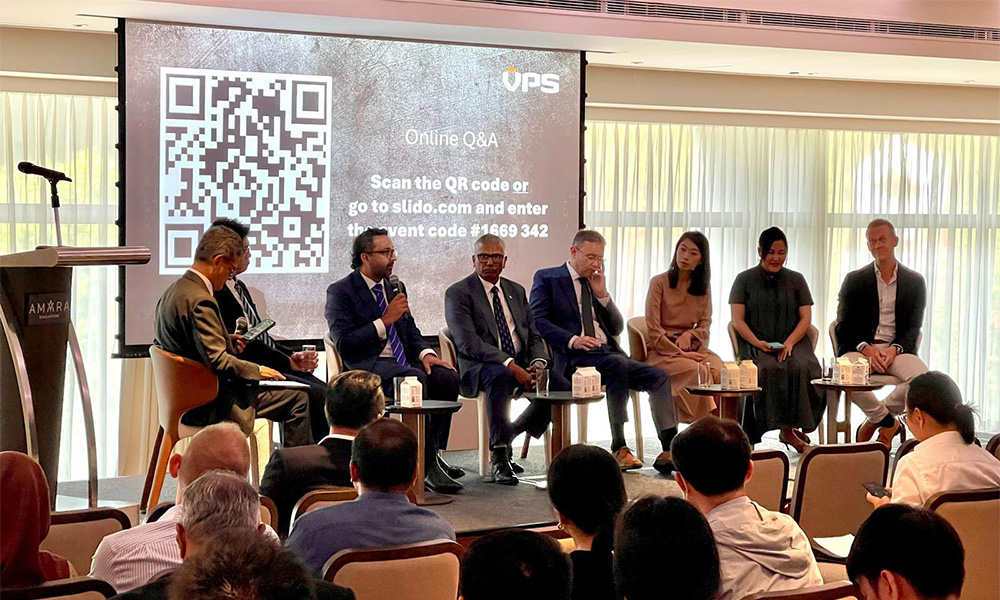
Industry experts representing various nodes within the marine fuels supply chain shared their opinions at the VPS Fuel Quality, New Fuels & Decarbonisation Challenges seminar in Singapore on Thursday (18 September).

The panel discussion was moderated by Captain Rahul Choudhuri, President Strategic Partnerships, VPS who asked the group on their views towards maritime decarbonisation and the transition towards biofuel bunkers:

Elane Ng, Senior Manager, Standards Development Org., SDO@SCIC – Singapore assisting with marine bio bunker fuel uptake

“The Singapore Standards Programme is based on a public and private partnership model where we invite various stakeholders to participate in the committees and they can contribute their expertise in helping us to review and develop standards,” she said.

“Other than developing national standards, we also leverage on international standards participation to align our national standards to international practice.”

“An example is WA2:2022 Specifications for marine biofuel which we have developed in Singapore. That was during the time when Singapore needed to conduct biofuel bunker deliveries, but we did not have a reference standard for the quality specifications while ISO 8217:2017 was also under revision. WA2:2022 was quickly developed with the relevant stakeholders over workshops to meet the urgent industry needs. Earlier this year, WA 2:2022 was revised and its latest edition, TR140:2025, included enhancements such as guidance on storage and handling on marine biofuel and the use of non-FAME products.”

Kasper Soerensen, Head of Marine Fuel Sourcing, East – Seascale Energy, HAFNIA – Transparency the endgame

Soerensen, whose organisation oversees the bunkering operations of 3,000 vessels worldwide, stated Seascale Energy prioritises bunker procurement in the order of quality, availability, and price.

“It doesn’t matter if it’s cheap – if the quality is bad or the product is not available at the right place at the right time in the right quantity, because at the end of the day we support functions for the shipping industry and we don’t want to delay the operations of our customers or our own fleet,” he said.

“However, we want to drive transparency across the bunker sourcing process and beyond. There are still opaque areas in this industry that almost never serves the customers true needs. Our model flips that by aligning our incentives in a very simple and efficient way.”

Jan-Paul de Wilde, Head of Decarbonization, RINA – ‘Change of mindset’ needed

“I have been attending and speaking at conferences for the last four years since I took up my current role and what you hear conference after conference is challenges of decarbonisation and the energy transition,” he stated.

“I’ve been guilty of that as well but what I think needs to be done is a change of mindset. It’s time we start to see more opportunities here than the roadblocks. People, stakeholders in the industry are often claiming uncertainty especially in the fields of availability and pricing.

“The uncertainty is in my opinion self-inflicted by the industry. If the industry collectively does not make a choice of the fuel of the future, the supply will not be there. I sincerely hope that mindset will change so we start to see more opportunities.”

Kai Cheong Wong, Senior Technical Manager, INTERTANKO – All stakeholders must pay for change

Wong emphasised that INTERTANKO’s policy is to “keep all options open” as the industry navigates the marine fuels transition.

“We recognise that not all fuel options are available to everyone, and implementing new regulations will require significant investment,” he said. “While shipowners must play their part, they cannot—and should not—bear the full burden of decarbonisation alone. The costs must be distributed fairly across the value chain, including charterers and other commercial stakeholders.”

He highlighted INTERTANKO’s work to develop standard clauses and guidance; and engage with charterers and other stakeholders to ensure that the costs and responsibilities of compliance are shared equitably.

“This collaborative approach is essential to ensure a smooth and effective transition for the entire industry,” Wong concluded.

Dr Prapisala Thepsithar, Director, Projects, GCMD – Project LOTUS confirms long term usability of biofuel bunkers

During the panel discussion, Dr Thepsithar unveiled findings of Project LOTUS which studied the long-term impact of continuous use of B24 bio Very Low Sulphur Fuel Oil (VLSFO) blend on vessel operations over a six-month period.

The trial was launched in partnership with NYK Line in May 2024. Using a structured monitoring framework, GCMD tracked fuel and lubricant quality at key sampling points across these systems, and inspected engines and fuel systems components throughout the trial.

“In the trial, we encountered no major issues—only manageable operational item like viscosity change and certain items that require constant observation and adjustments. The good news is, yes, biofuels look viable for long-term use, with no observed impact on shipboard systems so far.”

NYK SHIPMANAGEMENT, Mr. Anubhav Garg, Managing Director – NYK a forerunner in biofuel bunker ops

Garg confirmed the success of Project LOTUS; he shared NYK’s goal was to understand the long-term impact on engine components and systems while using biofuels as well as impact on quality of bio fuels during long term storage itself.

“NYK has been a frontrunner when it comes to biofuels. We started using biofuels in 2022 and annual uptake of biofuels was about 8,000 metric tonnes (mt),” stated Garg.

“Today, it’s close to 100,000 mt per year which is quite a big leap and I only this increasing by a much larger proportion in the coming years. Of course, we are still largely restricted to B24 for various reasons due to availability and supply chain restrictions. As we move on, I expect NYK to ramp up usage of biofuels to B30, B40 and higher blends in the near future.”

Andrew Morton, Managing Director, Asia Middle East & Africa, VPS – Gatekeeping the maritime biofuels transition

The last three months has presented a number of fuel related quality issues across several markets. It is clear from the statistics that there continues to be numerous off-spec bunker samples and challenges remain in the fuel space, shared Morton.

“We work with the major players across the shipping and bunkering sectors and VPS continues to lead the market in its testing and advisory space as well as the digital and decarbonisation part of the maritime sector,” he said.

“We have a good understanding of bunker fuels developed over 40 years and through our partnerships we continue to ensure that we work towards improvements in this space.”

Related: Singapore: VPS seminar presents global 2024/2025 marine fuel consumption & off-spec trends


Photo credit: VPS
Published: 24 September 2025

Continue Reading

Biofuel

BHP and GCMD trial multi-feedstock B100 bio bunker fuel on bulk carrier

Bio-blend in the BHP and GCMD pilot is being used on a BHP-chartered bulk carrier “Berge Lyngor”, which was bunkered in Singapore in early May.

Admin

Published

on

By

BHP and GCMD trial multi-feedstock B100 bio bunker fuel on bulk carrier

BHP and the Global Centre for Maritime Decarbonisation (GCMD) on Wednesday (3 June) said they have blended biofuels from two distinct feedstocks—used cooking oil and waste animal fats —and introduced the lower-emissions marine fuel into a BHP-chartered bulk carrier as part of a pilot project.

The bio-blend in the BHP and GCMD pilot is being used on a BHP-chartered bulk carrier Berge Lyngor, owned and operated by Berge Bulk, transporting BHP iron ore from Western Australia to China. When run on bio-blend, the vessel has the potential to reduce well-to-wake greenhouse gas emissions by approximately 79 per cent per voyage compared to sailing on very low sulphur fuel oil (VLSFO).

The vessel bunkered in Singapore in early May with a B100 bio-blend comprising 50 percent tallow-derived biodiesel, sourced and supplied by HAMR Energy, and 50 per cent used cooking oil (UCOME) supplied by Mitsui & Co Energy Trading Singapore (METS).

Mitsui also blended the fuel and Dan-Bunkering coordinated and executed the bunkering operation, which was performed by Global Energy’s barge MT Maple.

The BHP and GCMD pilot will assess how biofuels from multiple feedstocks can be blended, handled, and introduced under real-world operating conditions using existing used cooking oil bunkering infrastructure.

At the same time, insights from this pilot will help identify solutions to challenges related to fuel quality, handling, traceability, and onboard vessel performance.

Biofuels for global shipping today rely heavily on used cooking oil – a feedstock whose availability is approaching its projected limits. Biofuel from waste animal fats presents a promising option to expand the supply of lower-emissions marine fuels.

The outcomes of the pilot are expected to shed light on the practical steps to integrate biofuel blends from different feedstocks into existing supply chains. The diversity of biofuels will provide shipowners and operators with greater flexibility to optimise fuel procurement based on cost, availability, and lifecycle emissions performance.

Biofuels derived from different feedstocks can exhibit varying properties that may impact operations, including potential corrosion from oxidation, fuel system clogging caused by wax formation, which this pilot aims to assess.

The pilot will trace and verify the biofuel blend’s integrity aimed at bolstering confidence in emissions reductions reporting. The pilot will also provide insights into how robust tracing can support future marine fuel supply chains where biofuels from multiple feedstocks with varying lifecycle greenhouse gas emissions footprints are blended together.

This project is co-funded by the Maritime and Port Authority of Singapore under the Maritime Innovation and Technology Fund (MINT).


Photo credit: Global Centre for Maritime Decarbonisation
Published: 3 June, 2026

Continue Reading

Biofuel

NYK starts one-year B100 bio bunker fuel trial on car carrier

In this trial, NYK will operate a car carrier continuously on B100 for one year to evaluate the impact on engines, fuel supply systems, and operational practices.

Admin

Published

on

By

NYK starts one-year B100 bio bunker fuel trial on car carrier

Japanese shipping firm NYK on Tuesday (2 June) said it has commenced a one-year long-term trial involving the continuous use of 100% biofuel (B100) on an NYK-operated car carrier. 

In this trial, NYK will operate a car carrier continuously on B100 for one year to evaluate the impact on engines, fuel supply systems, and operational practices. High-purity biofuels such as B100 are known to be susceptible to degradation from oxygen, light, and heat, raising concerns about the stability of such fuels during long-term use.

In this trial, the biofuel primarily comprises FAME (Fatty Acid Methyl Ester) derived from used cooking oil and similar feedstocks.

The initiative is designed to evaluate the fuel’s effects on the vessel’s equipment and verify operational safety under real-world conditions. 

Through this effort, NYK seeks to accumulate technical expertise that will support the broader use of high-purity biofuels and further accelerate efforts to reduce greenhouse gas (GHG) emissions.

NYK has been advancing the use of biofuels through various initiatives. In 2024, the company conducted a trial using biofuel blend B24 and subsequently expanded practical usage to B30. However, the company said there remains limited global experience with the long-term continuous use of B100.

“By collecting long-term operational data through this trial, NYK aims to accumulate valuable technical insights to support both the safe operation of vessels and the wider adoption of high-purity biofuels,” it said. 


Photo credit: NYK
Published: 3 June, 2026

Continue Reading

Ammonia

AM Green plans to build green ammonia plant at Indian port

Initiative also includes development of green ammonia handling, storage and bunkering infrastructure, pilot bunkering operations, safety procedures and training programmes, says VOC Port Authority.

Admin

Published

on

By

india flag

VO Chidambaranar (VOC) Port Authority on Friday (29 May) said it has signed a Memorandum of Understanding (MoU) with India’s ammonia producer AM Green Ammonia to collaborate in the development of a green ammonia production plant.

The plant will have a capacity of one million tonnes per annum (MTPA) at Tuticorin.

The initiative also includes development of green ammonia handling, storage and bunkering infrastructure, pilot bunkering operations, safety procedures and training programmes. 

The project is expected to support the development of green fuel corridors connecting VOC Port with major ports in Europe and Asia, thereby strengthening India’s position in the global green fuels value chain.

VOC Port also signed a Memorandum of Understanding (MoU) with Bureau Veritas (India) Pvt. Ltd., to collaborate on Green Port certification, emissions accounting, ESG reporting, safety validation, development of green bunkering practices, and establishment of a Centre of Excellence for green fuels and sustainability.

The port also plans for an upcoming 750 m³ green methanol bunkering facility.


Photo credit: Naveed Ahmed on Unsplash
Published: 3 June, 2026

Continue Reading

Trending