Connect with us

Ammonia

OCI Global and Victrol to develop ammonia bunkering supply chain in Netherlands, Belgium

OCI’s subsidiary OCI Ammonia Distribution will lead the sourcing and import of clean ammonia from key global production hubs while Victrol will design, build, and operate a liquid ammonia bunker barge.

Admin

Published

on

OCI Global and Victrol to develop ammonia bunkering supply chain in Netherlands, Belgium

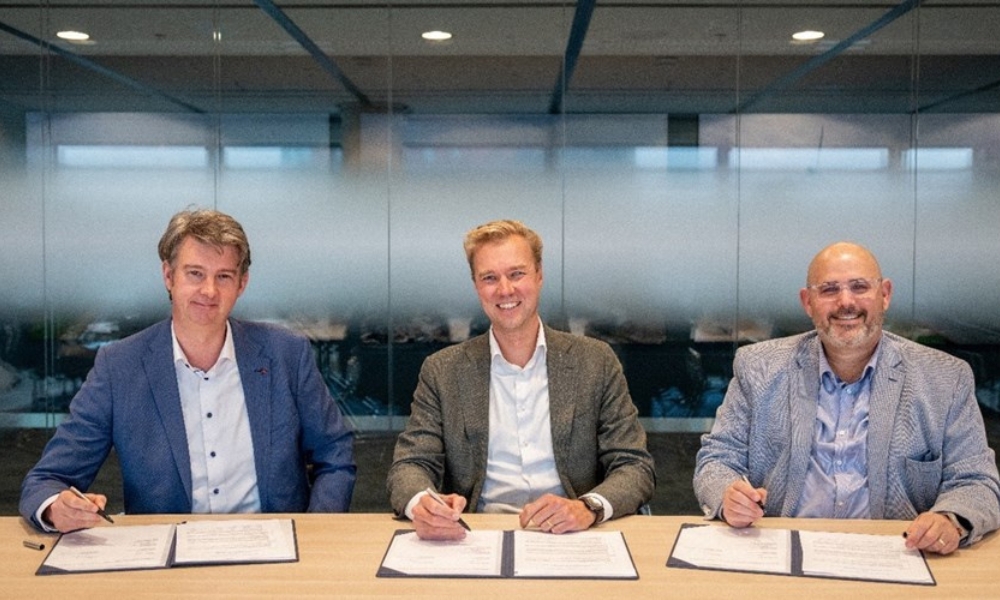
Bunker barge operator Victrol on Thursday (9 October) said it has signed a Memorandum of Understanding (MoU) with OCI Global (OCI) to jointly develop a safe, scalable and commercially viable supply chain for clean ammonia bunkering in the Netherlands and Belgium. 

Under the terms of the collaboration, OCI’s subsidiary OCI Ammonia Distribution will lead the sourcing and import of clean ammonia – both blue and green – from key global production hubs in the US, Middle East, North Africa, and Asia. 

The molecules will be transported by sea-going vessels to the OCI Terminal Europoort (OTE) ammonia import terminal in the Port of Rotterdam, where they will be safely stored, distributed, and made available for use as marine fuel. OCI is concurrently building partnerships with a growing network of shipowners and end-users who will adopt ammonia as a clean fuel for their fleets.

Victrol will design, build, and operate a liquid ammonia bunker barge. This critical piece of infrastructure will load refrigerated ammonia at OCI’s terminal and deliver it directly to ships in the ports, as well as to inland industrial off-takers. With expertise in barging and bunkering operations, Victrol will ensure safe last-mile delivery to vessels that will consume ammonia as a low- or zero-carbon fuel.

Through OTE, OCI owns and operates the only independent large-scale ammonia import terminal in the Port of Rotterdam. The port’s strategic location allows for seamless connection between overseas supply and European demand, enabling the continent to adequately address its anticipated future hydrogen deficit. 

With permits in place to expand OTE’s storage capacity from 30,000 metric tons to 90,000 metric tons and throughput up to 2 million tons per year in line with increasing market demand, OCI is positioning Rotterdam to be Europe’s leading hub for the distribution and storage of clean ammonia.

Both companies are working closely with the Port of Rotterdam and the relevant authorities to ensure all safety and regulatory frameworks are in place on time. 

The partnership builds on the port’s first-ever successful ammonia ship-to-ship bunkering pilot in April 2025, a significant milestone that raised Rotterdam’s readiness for ammonia fuel to level 7 under the International Port Readiness framework.

Related: Port of Rotterdam moves closer to ammonia bunkering after successful pilot


Photo credit: Victrol
Published: 15 October, 2025

Continue Reading

Bunker Fuel

Singapore: Bunker fuel sales drops by 6.8% on year in May 2026

4.55 million mt of various marine fuel grades were delivered at the world’s largest bunkering port in May, down from 4.88 million mt recorded during the similar month in 2025, according to MPA data.

Admin

Published

on

By

Singapore: Bunker fuel sales drops by 6.8% on year in May 2026

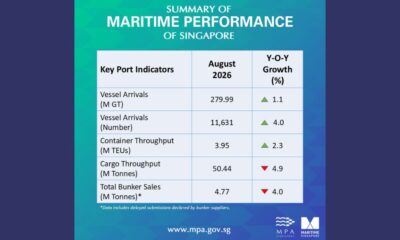
Sales of marine fuel at Singapore port dropped by 6.8% on year in May 2026, according to data from the Maritime and Port Authority of Singapore (MPA).

In total, 4.55 million metric tonnes (mt) (exact 4,548,000 mt) of various marine fuel grades were delivered at the world’s largest bunkering port in May, down from 4.88 million mt (4,878,100 mt) recorded during the similar month in 2025.

Deliveries of marine fuel oil, low sulphur fuel oil, ultra low sulphur fuel oil, marine gas oil and marine diesel oil in May (against on year) recorded respectively 1.79 million mt (-5.3% from 1.89 million mt), 2.29 million mt (-6.5% from 2.45 million mt), zero (-100% from 1,200 mt), 600 (35.2% from 1,700 mt) and zero (from zero).

Singapore: Bunker fuel sales drops by 6.8% on year in May 2026

Bio-blended variants of marine fuel oil, low sulphur fuel oil, ultra low sulphur fuel oil, marine gas oil and marine diesel oil in May, (against on year) recorded respectively 11,600 mt (-71.6% from 40,900 mt), 36,400 mt (-62.1% from 96,100 mt), zero (from zero), zero (from zero) and zero (from zero). B100 biofuel bunkers, introduced in February last year, recorded 12,800 mt (+573.7% from 1,900 mt). 

LNG and methanol sales were 70,300 mt (+56.2% from 45,000 mt) and zero (from zero) respectively. There were no recorded sales of ammonia for the month and so far since 2025.


Photo credit: Maritime and Port Authority of Singapore
Published: 15 June, 2026

Continue Reading

Alternative Fuels

DNV data shows shift in alternative-fuelled vessel ordering patterns

DNV says shipowners are adopting more varied fuel strategies, reflecting a growing emphasis on optionality, regulatory compliance and risk management in long-life vessel investments.

Admin

Published

on

By

DNV data shows shift in alternative-fuelled vessel ordering patterns

Latest data from classification society DNV’s Alternative Fuels Insight (AFI) platform showed a total of 36 new orders for alternative-fuelled vessels were placed in May 2026.

Activity was primarily driven by LPG/ethane carriers, which accounted for 26 of the orders. A further eight LNG-fuelled vessels were ordered, including six container vessels and two car carriers, alongside two ethanol-fuelled bulk carriers.

So far in 2026, a total of 119 orders have been placed for alternative-fuelled vessels. Of these, LNG-fuelled vessels (60) account for the largest share of the orderbook, with the majority of these (42) coming from the container segment, and a smaller share (12) from car carriers.  

A further 50 orders have been placed for LPG/ethane carriers, while activity in other fuel types remains limited, with orders for methanol/ethanol (4), ammonia (4), and hydrogen (1).  

By the end of May, the share of alternative-fuelled vessels in total tonnage was notably lower than over the same period in 2025.

DNV data shows shift in alternative-fuelled vessel ordering patterns

Jason Stefanatos, Global Decarbonization Director at DNV Maritime, said: “While the pace of alternative-fuelled contracting has varied compared to 2025, the industry continues to move forward in its transition, with owners advancing fuel and technology decisions against a backdrop of evolving regulatory and market conditions.  

“As in previous years, ordering of alternative-fuelled vessels has been led by the container segment, but dynamics are shifting. While activity remains strong, the focus has moved towards smaller vessels, with fewer very large container ships, which are historically more likely to adopt alternative fuels, being ordered. At the same time, we are seeing increased activity in tanker and bulker segments.  

“What is also becoming clearer is that fuel choice is no longer approached as a single bet. Owners are increasingly treating it as a portfolio decision, managing fuel optionality, timing of investment, and exposure to future regulation as they navigate long-life asset decisions.

“This is reflected in more varied ordering patterns, reinforcing that the transition is not progressing in a straight line.”


Photo credit: DNV
Published: 5 June, 2026

Continue Reading

Shipping Corridor

Industry partners launch Brazil-Belgium e-fuel green shipping corridor initiative

A new consortium facilitated by the Global Maritime Forum and RMI will work to establish a green shipping corridor between the Port of Açu in Brazil and the Port of Antwerp-Bruges in Belgium.

Admin

Published

on

By

RESIZED william william on Unsplash

A new consortium facilitated by the Global Maritime Forum and RMI will work to establish a green shipping corridor between the Port of Açu in Brazil and the Port of Antwerp-Bruges in Belgium, according to Global Maritime Forum on Thursday (4 June). 

In addition to the port teams on both ends of the corridor, the consortium includes HIF Global, Fuella, NYK Line, Höegh Autoliners, and Wallenius Wilhelmsen. 

The consortium will assess infrastructure, vessels, and business models to create a roadmap for transporting zero-carbon fuels produced in Açu, such as e-ammonia or e-methanol. The transport itself would also be powered by the same zero- or near-zero-emission fuels.

“We’re thrilled to be working with these partners to take these important steps towards Brazil’s e-fuel production and bunkering opportunity, whilst supporting the growing demand for e-fuels in Europe,” said Eleanor Wells, a senior project manager at the Global Maritime Forum.

The new consortium builds on a pre-feasibility study developed by RMI and the Global Maritime Forum in November 2025. 

The study highlighted the competitive projected costs of e-fuel produced in Açu, due to Brazilian policies supportive of green hydrogen production, the country’s largely renewable electricity grid, its abundance of renewable energy sources, and a relatively low cost of capital. A 2024 report from the same two organisations, Oceans of Opportunity, identified the Port of Açu as a high-potential e-fuel export hub.

Green shipping corridors are dedicated trade routes where the feasibility of zero-emission shipping is catalysed by public and private action. These routes are seen as central to delivering on the shipping industry’s goal of having zero-emission fuels account for 5% of all fuels by 2030. 

While green corridors have rapidly expanded in popularity worldwide, and a handful of initiatives have now reached the realisation stage, the most recent edition of the Annual Progress Report on Green Shipping Corridors warned that progress is being stalled by a ‘feasibility wall’ created by the cost gap between conventional and zero-emission fuels.

The Global Maritime Forum and RMI will continue to facilitate the realisation of the Açu-Antwerp green corridor, with work already moving at pace to progress beyond pre-feasibility and develop a feasibility analysis for the corridor. The feasibility analysis is expected to be published by the end of the year, with the consortium meeting regularly in the meantime.


Photo credit: william william on Unsplash
Published: 5 June, 2026

Continue Reading

Trending