Connect with us

Bunker Fuel

ENGINE: East of Suez Bunker Fuel Availability Outlook (28 May 2024)

HSFO supply is tight in Zhoushan; LSMGO and VLSFO availability is good across several Chinese ports; several South Korean ports could face weather disruptions.

Admin

Published

on

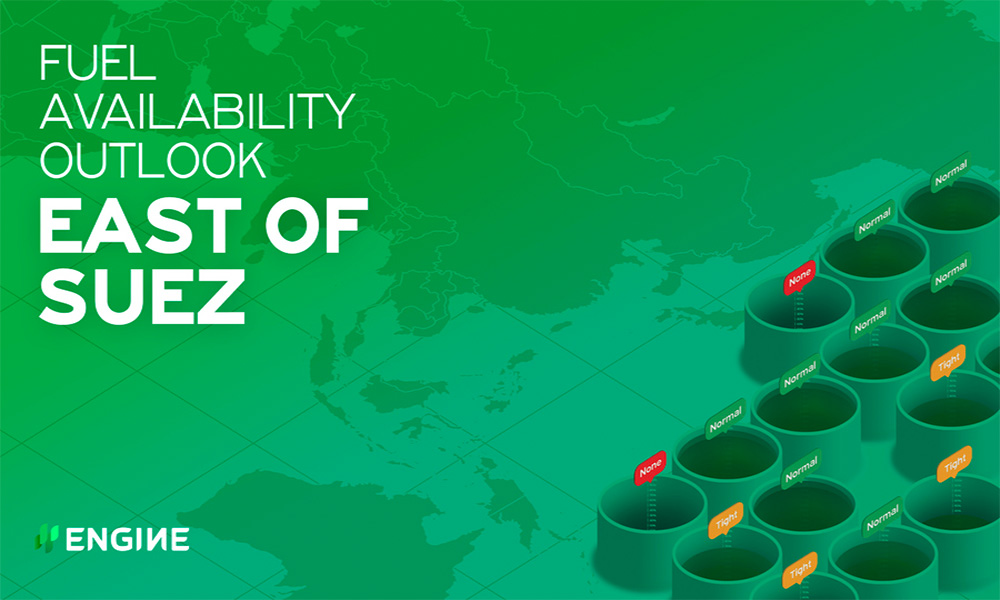
RESIZED ENGINE East of Suez

The following article regarding regional bunker fuel availability outlook for the East of Suez region has been provided by online marine fuels procurement platform ENGINE for publication on Singapore bunkering publication Manifold Times:

  • HSFO supply is tight in Zhoushan
  • LSMGO and VLSFO availability is good across several Chinese ports
  • Several South Korean ports could face weather disruptions

Singapore and Malaysia

Lead times for VLSFO in Singapore have experienced notable fluctuations recently. Most suppliers recommend lead times of up to nine days for this grade, while some can accommodate stems in as little as two days in port. This has improved from the week prior, when traders recommended longer lead times ranging between 5-10 days.

HSFO supply remains limited in the port, with recommended lead times unchanged at 9-12 days. Lead times for LSMGO vary widely, ranging between 2-8 days.

Singapore’s residual fuel oil stocks have averaged 7% lower so far in May compared to April, according to Enterprise Singapore. Despite a significant 25% increase in the port’s net fuel imports this month, Singapore’s fuel oil stocks have fallen below 19 million bbls. Fuel oil imports have increased by 1 million bbls, surpassing the 106,000-bbl growth in exports this month. The port’s middle distillate stocks have also declined, averaging 3% lower for the month.

In Malaysia’s Port Klang, VLSFO and LSMGO grades are readily available, with recommended lead times of 3-5 days. Some suppliers can provide even faster deliveries for smaller parcel sizes. However, HSFO availability remains constrained due to limited product availability.

In the Indonesian ports of Jakarta and Surabaya, the availability of VLSFO and LSMGO remains good. Additionally, the port of Balikpapan has an ample supply of VLSFO, with recommended lead times of around four days.

China, East Asia and Oceania

Prompt availability of VLSFO and LSMGO grades remains constrained in Zhoushan, with suppliers recommending lead times of 5-7 days, unchanged from last week. HSFO supply has tightened due to the suspension of operations at the Dading oil terminal after a recent oil spill incident. Most suppliers are advising lead times of over two weeks for HSFO there, according to a source.

In Northern China, the availability of VLSFO and LSMGO grades is said to be good in the Dalian port. Similarly, both grades are readily available in Qingdao and Tianjin, though HSFO supply is limited in these ports. In Shanghai, VLSFO and LSMGO availability remain normal, while HSFO supply has been scarce. In Fuzhou and Xiamen, VLSFO and LSMGO grades are readily available. In Guangzhou and Yangpu, prompt availability of both low-sulphur fuel grades remains limited.

In Taiwanese ports including Hualien, Kaohsiung, Taichung and Keelung, the availability of VLSFO and LSMGO remains good, with lead times remaining at 2-3 days.

In Hong Kong, all grades are readily available, with recommended lead times of 3-5 days, while certain suppliers can provide faster deliveries for smaller parcel sizes.

Strong wind gusts of 21-27 knots and swells of close to two metres are forecast to hit the port between Tuesday and Wednesday, which might impact bunker deliveries in Hong Kong.

In South Korean ports, bunker demand has seen an improvement compared to last week, according to a source. Lead times for VLSFO and LSMGO range between 3-10 days, contrasting with the shorter lead times of around four days observed last week. HSFO availability has become tighter, with most suppliers recommending lead times of 8-10 days – a significant increase from around four days last week.

Bunker operations in several South Korean ports, including Ulsan, Onsan, Busan, Daesan, Taean, and Yeosu, may experience intermittent bunkering disruptions throughout the week due to anticipated adverse weather conditions.

High bunker prices in Japanese ports continue to dent bunker demand in the country. Tokyo’s VLSFO was priced about $27-28/mt higher than VLSFO prices in Zhoushan and Singapore on Tuesday. Lead times varied widely across major Japanese ports, with approximately seven days in Tokyo, Chiba, Osaka, Kobe Nagoya, and Yokkaichi, and longer periods ranging from 11-15 days in Mizushima and Oita.

In Western Australia, suppliers in Kwinana and Fremantle ports can offer VLSFO and LSMGO, typically with lead times ranging from 7-8 days. In New South Wales, LSMGO is readily available in Sydney, while HSFO supply is mostly available upon enquiry. In Victoria, Melbourne offers good availability of VLSFO and LSMGO, with ample VLSFO supply also found in Geelong. However, prompt HSFO supply can be limited in both Victorian ports.

In Queensland, Brisbane and Gladstone ports maintain sufficient stocks of VLSFO and LSMGO, with lead times of 7-8 days. HSFO availability remains constrained in Brisbane.

In New Zealand, VLSFO supply in Tauranga and Auckland is ample, and LSMGO supply remains satisfactory in Auckland. Anticipated adverse weather conditions in Tauranga from Tuesday to Friday may impact bunker operations.

Likewise, rough weather is predicted in the Thai ports of Koh Sichang and Leam Chabang on Saturday, potentially posing challenges for bunker deliveries in these ports.

South Asia

In several Indian ports, including Mumbai, Kandla, Tuticorin, Chennai, Cochin, Visakhapatnam, and Haldia, availability of VLSFO and LSMGO has been limited due to supply shortages. One supplier in Paradip is nearly depleted of VLSFO and LSMGO stocks.

Vessel movements and cargo operations at Haldia resumed on Tuesday following the passing of cyclone Remal, which transitioned from a cyclonic storm on Monday to a deep depression by Tuesday, as reported by GAC Hot Port News.

Adverse weather conditions are expected intermittently throughout the week at Sikka, Kandla, and Cochin ports in India, potentially disrupting bunker operations.

The Sri Lankan port of Colombo offers abundant VLSFO and LSMGO supply, with lead times of around two days recommended there. Adverse weather conditions may impact bunker deliveries at the port between Tuesday and Friday.

Middle East

At the UAE port of Fujairah, bunker demand for all grades remains low. However, availability for immediate delivery is still limited, with most suppliers requiring lead times of 5-7 days.

Similarly, at the UAE port of Khor Fakkan, lead times of 5-7 days are common among suppliers.

In Saudi Arabia’s Jeddah port, there is enough supply of VLSFO and LSMGO. In Djibouti, some suppliers are facing shortages of VLSFO, although LSMGO remains unaffected.

LSMGO is easily accessible in Omani ports, including Sohar, Salalah, Muscat, and Duqm.

By Tuhin Roy


Photo credit and source: ENGINE
Published: 29 May 2024

Continue Reading

LNG Bunkering

PIL’s LNG dual-fuel boxship “Kota Elok” arrives in Singapore on maiden call

As the first of 13 new 13,000 TEU vessels joining its fleet, Kota Elok is equipped to operate on LNG and low-sulphur fuel oil that helps reduce our greenhouse gas emissions.

Admin

Published

on

By

PIL's LNG dual-fuel boxship “Kota Elok” arrives in Singapore on maiden call

Singapore-based Pacific International Lines Pte Ltd on Monday (20 July) said its first 13,000 TEU LNG dual-fuel container vessel, Kota Elok, recently made her maiden call to Singapore on 15 July.

As the first of 13 new 13,000 TEU vessels joining its fleet, Kota Elok is equipped to operate on liquefied natural gas (LNG) and low-sulphur fuel oil that helps reduce our greenhouse gas emissions. 

The vessel also incorporated energy-saving features and digital technologies to reduce fuel consumption and enhance operational performance, as well as a bow windshield to improve aerodynamics, contributing to improved fuel efficiency and lower emissions over the course of long-haul voyages.

“Following Singapore, Kota Elok will continue her voyage on our East Coast Service 1 (ES1) route to South America, calling at ports in Brazil, Uruguay, and Argentina before returning to Asia,” the company said in a social media post. 

Kota Elok also became PIL’s first vessel to receive Lloyd’s Register certification for compliance with the IACS UR E26 and UR E27 cyber security requirements.

Developed by the International Association of Classification Societies (IACS), UR E26 and UR E27 are mandatory cyber resilience requirements for newbuild vessels contracted from 1 July 2024. 


Photo credit: Pacific International Lines
Published: 21 July, 2026

Continue Reading

LNG Bunkering

CIMC SOE secures order for 12,000-cbm LNG bunkering vessel from Sinopec Clean Energy

Once operational, the vessel is expected to strengthen Sinopec’s domestic coastal LNG bunkering network and help address gaps in China’s alternative fuel bunkering infrastructure.

Admin

Published

on

By

CIMC SOE secures order for 12,000-cbm LNG bunkering vessel from Sinopec Clean Energy

China’s Nantong CIMC Sinopacific Offshore & Engineering Co., Ltd. (CIMC SOE) recently signed a contract with Sinopec (Beijing) Clean Energy Co., Ltd. to build a 12,000-cubic metre (m3) LNG bunkering vessel, according to Chinese maritime media.

The vessel is scheduled for delivery in 2028 and will support Sinopec’s efforts to expand its presence in the marine clean energy sector.

Once operational, the vessel is expected to strengthen Sinopec’s domestic coastal LNG bunkering network and help address gaps in China’s LNG bunkering infrastructure.

With this signing , CIMC Pacific Offshore Engineering’s LNG bunkering vessel orderbook is further strengthened, maintaining its leading position in the global market for small and medium-sized LNG bunkering vessels.

The contract also marked another milestone for CIMC SOE, which has seen a sharp increase in orders and business performance this year amid a surge in domestic LNG vessel demand.


Photo credit: Nantong CIMC Sinopacific Offshore & Engineering
Published: 21 July, 2026

Continue Reading

Nuclear

ABS awards AiP to Korean institute for SMR-powered container ship concept design

KRISO says AiP recognises the technical feasibility and safety of its concept design, marking an important milestone toward the development of next-generation nuclear-powered commercial ships.

Admin

Published

on

By

ABS awards AiP to Korean institute for SMR-powered container ship concept design

Korea Research Institute of Ships & Ocean Engineering (KRISO) on Thursday (16 July) received Approval in Principle (AiP) from the American Bureau of Shipping (ABS) for its concept design of a 15,000 TEU Small Modular Reactor (SMR)-powered container ship utilising Molten Salt Reactor (MSR) technology.

KRISO said the AiP recognises the technical feasibility and safety of its concept design, marking an important milestone toward the development of next-generation nuclear-powered commercial ships.

“This achievement demonstrates international recognition of KRISO’s technological capabilities in the rapidly evolving field of nuclear-powered shipping, supporting the transition toward low-carbon maritime transport,” it said. 

Building on this milestone, KRISO will continue advancing basic and detailed ship design, paving the way for future demonstration and commercialisation of SMR-powered vessels. 

Through continued R&D and international collaboration, KRISO remains committed to strengthening next-generation maritime technologies and contributing to the safe deployment of nuclear propulsion in the maritime industry.


Photo credit: Korea Research Institute of Ships & Ocean Engineering
Published: 21 July, 2026

Continue Reading

Trending