Connect with us

LNG Bunkering

East Coast Australia JIP unveils interactive dashboard that enables LNG bunkering forecast

Dashboard enables forecasting of LNG demand on Australia’s East Coast based on various data sets including alternative fuel uptake and fleet development.

Admin

Published

on

Screen Shot 2020 11 25 at 3.01.07 PM

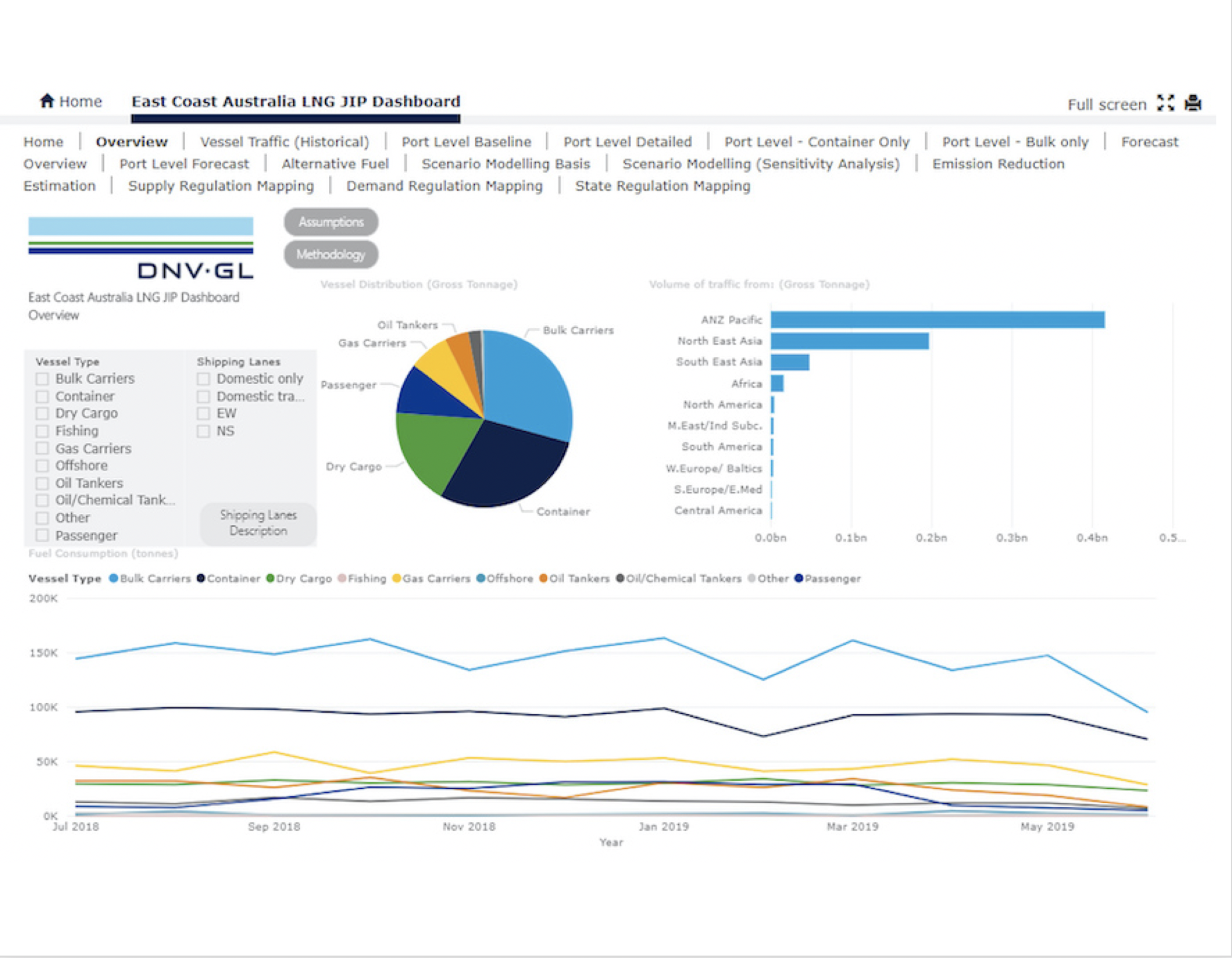
Classification Society DNV GL on Monday (23 November) said a comprehensive and interactive dashboard that predicts liquified natural gas (LNG) demand and enables scenario modelling in Australia was developed as a result of their participation in the East Coast Australia LNG Joint Industry Project (EC JIP). 

DNV GL said it facilitated the project and other partners included oil & gas suppliers, LNG infrastructure consultants, ship owners and operators, charterers, industry associations, governmental agencies and regulators.

The EC JIP was recently concluded in October and the dashboard will be made available to the public via subscription soon.

With increasingly stringent international regulations to decarbonize shipping and Australia’s unique position as the world’s largest LNG exporter, the EC JIP brought together key representatives in Australia from all parts of the logistics chain to explore the uptake of LNG on the continent’s East Coast as a transition to lower emission marine fuels.

Established in 2019, this project builds on the successful Green Corridor JIP in 2018, where major stakeholders examined the economic feasibility of LNG-fuelled bulk carrier designs for transporting iron ore and coal between Australia and China. 

“Reducing greenhouse gas emissions is crucial for the future of the shipping industry,” said Cristina Saenz de Santa Maria, Regional Manager for South East Asia, Pacific & India at DNV GL Maritime.

“By working together with supply chain partners, we hope that this project charts a way forward for the uptake of LNG as ship fuel in Australia, offering them clear insights on how to meet the challenges and opportunities ahead.”

“In the Green Corridor project, we saw that there are significant differences in the commercial and technical viability between the West Coast and the East Coast of Australia,” said Jonathan Abrahams, Head of Maritime Advisory, Australia & New Zealand at DNV GL – Maritime.

“For the latest East Coast LNG project, the partners focused on scrutinizing the demand for LNG as a marine fuel as well as looked into an expanded scope of multiple trade routes for bulk, container and passenger vessels, which are major segments trading in this part of Australia.”

Apart from assessing the business case for LNG as a marine fuel from 2022, the project also sought to address challenges faced by key stakeholders and to position Australia at the forefront of LNG fuelled shipping.

The project was carried out in two phases:

  • In Phase 1, the project concluded on a suitable scenario model structure to calculate key demand forecast.
  • The East Coast LNG project went on to develop infrastructure concepts for selected bunkering solutions in Phase 2, looking into specific technical and operational parameters.

The results are presented in a unique dashboard. It incorporates vessel arrival information and fuel consumption data for 2018–2019 as the baseline and enables detailed analysis and forecasting based on ship type, size, age, port of origin, alternative fuel uptake and fleet development through to 2050. 

With LNG gaining momentum as an optimal fuel for low emissions shipping, the dashboard shows that there is a huge growth potential for Australia with the presence of abundant production facilities.

Ports identified as important facilities for LNG supply, namely Newcastle, Port Kembla and Hastings, should develop scalable infrastructures to support the growing demand for different ship types. 

“DNV GL is proud to have facilitated this project, which is modelled after the forecast methodology of our annual energy transition publication, the Maritime Forecast to 2050,” added Abrahams.

“With an interactive dashboard hosted on our open industry platform Veracity, it consolidates data from multiple sources onto a single interface and allows for constant iterations to reflect an up-to-date scenario model to support decisions on adopting LNG as a fuel.”

The interactive dashboard enables the forecasting of LNG demand on Australia’s East Coast based on historic fuel consumption data of various ship types, considering size, age, port of origin, alternative fuel uptake and fleet development through to 2050. 


Photo credit: DNV GL
Published: 25 November, 2020

Continue Reading

Newbuilding

Yang Ming names 15,500 TEU LNG dual-fuel container vessel “YM Weight”

Yang Ming held a naming ceremony at the HD HHI shipyard in Ulsan, South Korea, for “YM Weight”, the fourth vessel in its series of five 15,500 TEU-class LNG dual-fuel container vessels built by HD HHI.
Admin

Published

on

By

Yang Ming names 15,500 TEU LNG dual-fuel container vessel “YM Weight”

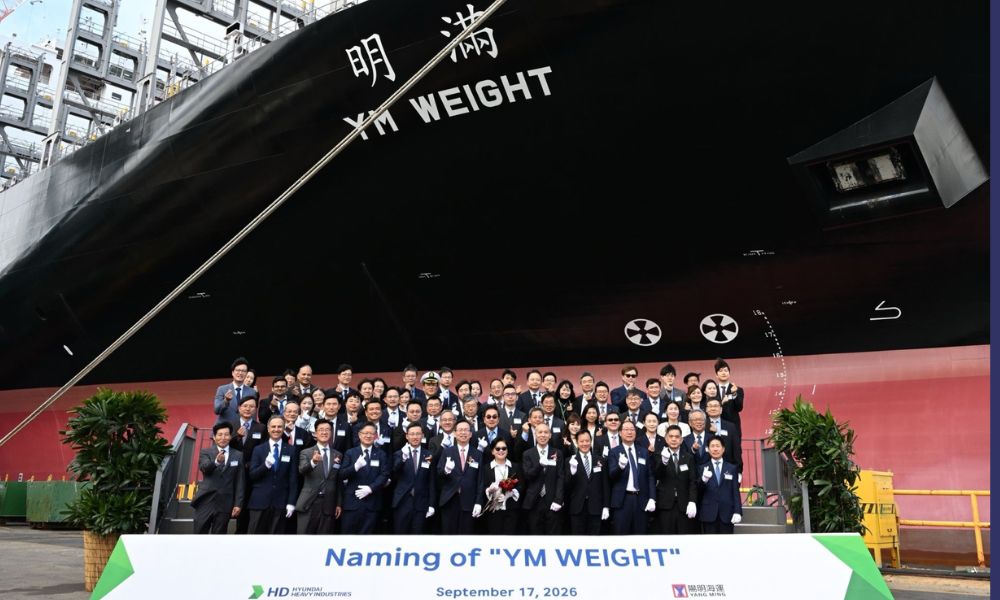
Taiwanese shipping firm Yang Ming Marine Transport Corporation (Yang Ming) on Thursday (17 September) held a naming ceremony at the HD Hyundai Heavy Industries (HD HHI) shipyard in Ulsan, South Korea, for YM Weight, the fourth vessel in its series of five 15,500 TEU-class LNG dual-fuel container vessels built by HD HHI. 

Mrs. Chiu-Lien Lin, the spouse of Administrative Deputy Minister of Transportation and Communications Mr. Kuo-Shian Lin, was invited as the Godmother to officially name the vessel and perform the ceremonial cord-cutting, wishing the ship smooth sailing and full loading on all future voyages. 

This series of vessels built by HD HHI has a length overall (LOA) of 364.97 meters, a breadth of 51 meters, and a capacity of approximately 15,600 TEU. 

The vessels are equipped with high-pressure dual-fuel main engines that run on both LNG and low-sulphur fuel oil, along with integrated navigational information, equipment monitoring, broadband maritime satellite systems, and multiple energy-saving systems to enhance operational efficiency and navigational safety. 

YM Weight, the fourth vessel in the series, is jointly classed by CR and the American Bureau of Shipping (ABS), bringing international classification expertise and capabilities to safeguard the safety and technical compliance of next-generation LNG dual-fuel vessels. 

Furthermore, following proactive underwater noise measurements, the vessel has achieved two industry firsts by receiving the Underwater Noise (UWN) notation from ABS and the Underwater Radiated Noise (URN) notation from CR. The dual recognitions underscore Yang Ming’s commitment to mitigate operational impact on marine life and sustainable development. 

In addition to expanding its next-generation fleet and strengthening its core shipping business, Yang Ming has continued to strengthen professional training for seafarers operating alternative-fuel vessels. 

Yang Ming’s senior Captain Ming-Yeong Pan will serve as the delivery captain of ‘YM Weight’. Captain Pan is the first seafarer in Taiwan to receive the Advanced Training Certificate under the International Code of Safety for Ships Using Gases or Other Low-flashpoint Fuels (IGF Code), Certificate No. 0001, issued by the Maritime and Port Bureau, MOTC. 

To date, 148 Yang Ming officers have completed advanced IGF Code training and will progressively undertake onboard training aboard LNG-fueled vessels and practical alternative-fuel bunkering training. 


Photo credit: Yang Ming Marine Transport
Published: 18 September, 2026

Continue Reading

LNG Bunkering

DNV awards AiP to HD HHI for 12K LNG bunkering ship design tailored to cruise ships

New concept has been specifically designed for bunkering cruise ships, including removal of bridge wings to avoid interference with cruise ships’ lifeboats during operations.
Admin

Published

on

By

DNV awards AiP to HD HHI for 12K LNG bunkering ship design tailored to cruise ships

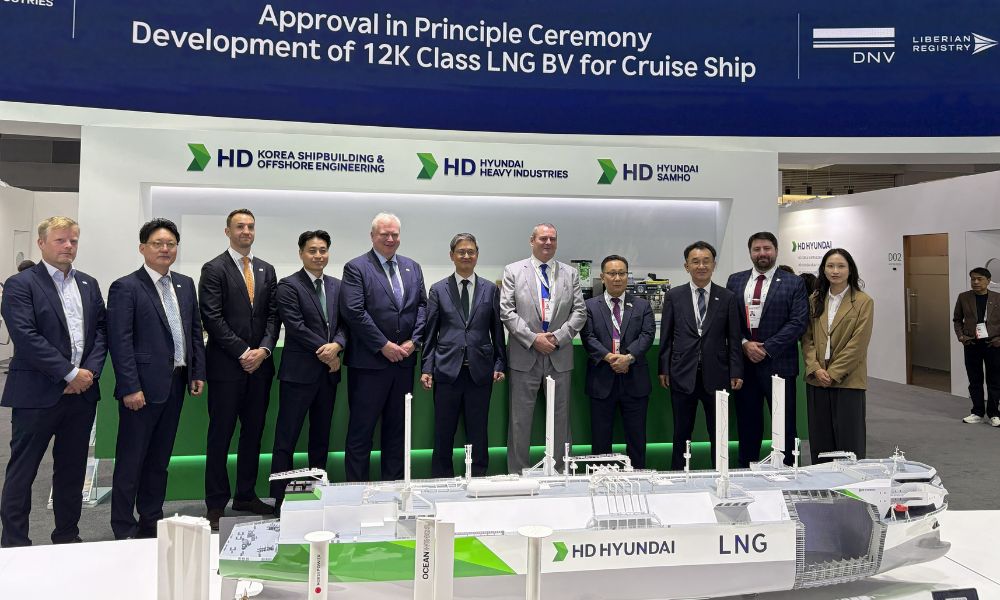
Classification society DNV and the Liberian International Ship and Corporate Registry (LISCR) on Tuesday  (15 September) have awarded an Approval in Principle (AiP) certificate to South Korea’s HD Hyundai Heavy Industries (HD HHI) for a new 12K LNG Bunkering Vessel design, tailored to the needs of cruise ships. 

The AiP was presented to Mr. Ryu Hong Ryeul, CTO / HD HHI, by Vidar Dolonen, Regional Manager for Korea & Japan at DNV, during a ceremony at Gastech 2026 yesterday.

The new concept, a dedicated LNG bunkering vessel (LNGBV) for the cruise segment, has been developed to address the unique operational challenges associated with refueling cruise ships. In particular, unlike conventional designs, the concept removes the bridge wings to avoid interfering with cruise ships’ lifeboats during bunkering operations.

To compensate for the reduced side visibility resulting from the removal of the bridge wings, the vessel is equipped with a CCTV system. In addition, side visibility safety and efficient bunkering operations have been enhanced through the addition of the HiNAS SVM (Hyundai Intelligent Navigation Assistant System Surround view monitoring system), which shows a 360-degree top-view AR image converted from inputs from multiple fish-eye cameras installed around the ship.

Mr. Ryu Hong Ryeul, CTO at HD HHI, said: “By enabling ship-to-ship (STS) LNG bunkering operations without the need for a floating pontoon, this 12K LNGBV bunkering vessel is expected to make LNG bunkering for cruise vessels more efficient and flexible. If this type of LNGBV becomes more widely adopted in the market, this could bring about significant changes in the demand structure and operating models of the LNGBV market because this new type of LNGBV is able to carry out bunkering more freely and flexibly, not only for cruise ships but also for conventional merchant vessels.”

Alfonso Castillero, Chief Executive Officer, Liberian Registry, said: “The Liberian Registry is pleased to support this Joint Development Project, which addresses the specific operational and safety considerations associated with LNG bunkering for cruise ships. The AiP represents an important milestone in advancing a practical and flexible vessel concept while maintaining a strong focus on safety, regulatory compliance and operational reliability.”

Vidar Dolonen, Regional Manager for Korea & Japan at DNV, added: “The transition to lower-emission shipping depends not only on vessels, but also on the supporting infrastructure that enables alternative fuels to be used safely and efficiently. With LNG continuing to play a leading role both the cruise sector and the maritime industry’s decarbonization efforts more broadly, this LNG bunkering vessel concept represents an important step toward building the capabilities needed for the maritime energy landscape.”

An Approval in Principle (AiP) is an independent assessment of a concept within a defined framework of requirements. It confirms the feasibility of the design and verifies that no significant technical barriers exist to its implementation.


Photo credit: DNV
Published: 17 September 2026

Continue Reading

Alternative Fuels

Hanwha Power obtains ABS AiP for 22,000-cbm LNG bunkering vessel concept design

A key feature of the concept design is its LNG-ammonia multi-cargo capability, which enables the vessel to transport not only LNG but also ammonia, an emerging next-generation bridge fuel.
Admin

Published

on

By

Hanwha Power obtains ABS AiP for 22,000-cbm LNG bunkering vessel concept design

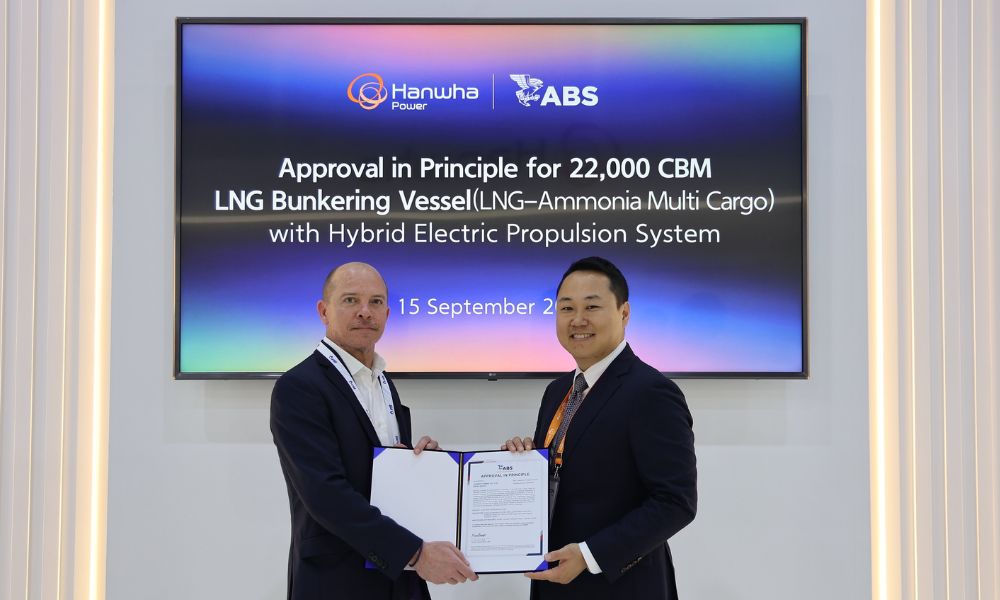
South Korea’s Hanwha Power on Wednesday (16 September) said that it has obtained approval in principle (AiP) from the American Bureau of Shipping (ABS) for the concept design of a 22,000-cubic-meter LNG bunkering vessel at Gastech 2026 held in Bangkok, Thailand.

The certificate presentation ceremony was held on September 15 local time, with Hanwha Power Marine Solution Business Division Head Hoon-min Kim, Vice President Jong-kyu Hwang, who oversees Technical Solutions, and key ABS representatives in attendance.

With the latest AiP, Hanwha Power has completed its lineup of medium- and large-scale LNG bunkering vessels, ranging from 7,500-cubic-meter to 22,000-cubic-meter.

A key feature of the concept design is its LNG-ammonia multi-cargo capability, which enables the vessel to transport not only LNG but also ammonia, an emerging next-generation bridge fuel. 

The design incorporates high-manganese steel cargo containment technology, Mc-C, allowing the vessel to adapt to the future transition to alternative fuels with minimal design modifications. This provides shipowners with greater long-term technological flexibility and competitiveness.

Considering the operating characteristics of bunkering vessels, which primarily operate in coastal waters, Hanwha Power has also applied a hybrid electric propulsion system that integrates an onshore power supply (OPS) system with an energy storage system (ESS). The system is designed to minimize harmful emissions while the vessel is berthed or operating in coastal areas, while also improving operational efficiency and economic performance.

In addition, Hanwha Power has incorporated the Group’s core technologies, including dual-fuel generator sets, ESS, electrical power system integration, integrated automation system, and cargo handling system. By integrating these technologies, the company aims to maximize the competitiveness and business synergies of its integrated engineering and procurement (EP) package, covering both engineering and procurement capabilities.

“This ABS AiP marks another important milestone demonstrating Hanwha Power’s technological reliability and commercial viability in the global eco-friendly vessel market,” said Hoon-min Kim, Head of Hanwha Power’s Marine Solution Business Division. 

“Building on the Hanwha Group’s differentiated clean-technology capabilities, we will continue to provide global shipowners with optimized integrated solutions for the transition to more sustainable marine transportation.”


Photo credit: Hanwha Power
Published: 17 September 2026

Continue Reading

Trending