Connect with us
DNV Decarbonization Insight Series August 2026 - What maritime professionals should know about AI Training

Technology

BunkerPlanner new feature includes TC rate and vessel speed for bunkering ports

‘Deciding on a port to bunker is a complicated calculation; interwoven are trade-offs related to Time Charter Rate, Speed/Consumption, Deviations and Price,’ it says.

Admin

Published

on

BunkerPlanner

[vc_row][vc_column][vc_column_text]BunkerPlanner, a bunker procurement optimisation tool developed by Scandinavian maritime technology firm BunkerMetric on Tuesday (12 May) said it has rolled out new functionality to assist vessel operators to reduce costs under any market combination of time charter (TC) rate and bunker prices.

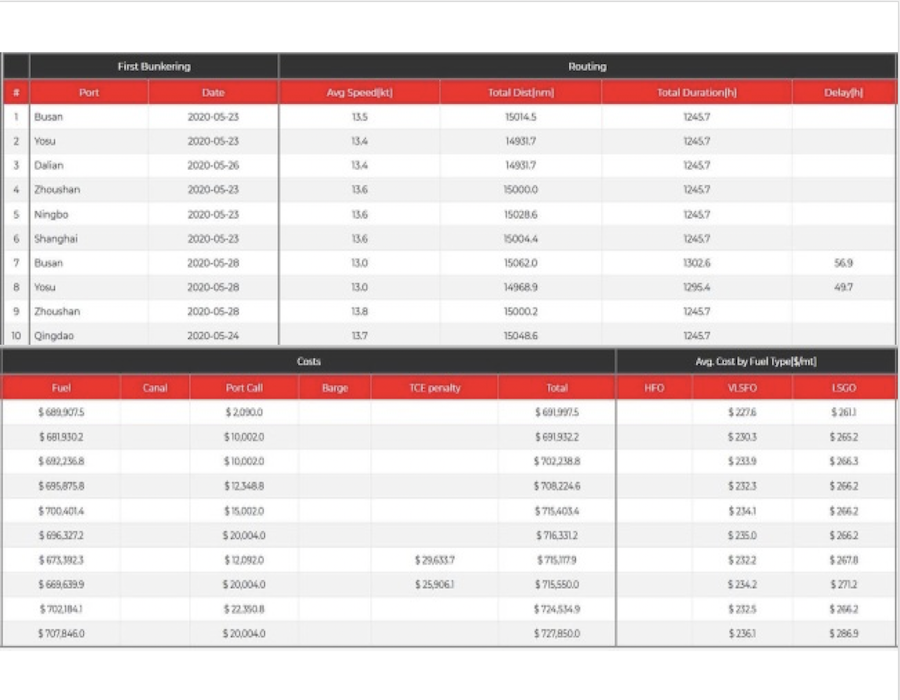
BunkerPlanner says it calculates attractive bunker port calls that can be induced on a voyage in relation to the costs of bunkers, port calls, barges, and deviations, while also taking into account a speed up of the vessel to meet a fixed ETA at next port call. 

The bunker price of any additional port call must justify any speed-up, considering the vessel’s bunker curve and extra distance to be sailed, it stated.

This makes good sense in most high TCE markets, where the expected TC rates exceed the extra bunker cost of speeding up. 

However, there is often an attractive tradeoff by adding a bunker port call and delaying scheduled ETAs while maintaining a fixed speed. 

With this approach a bunker buyer would attain a lower TC rate but would save handsomely on bunkers – a beneficial strategy in low TC environments, it explained. 

Consider an example: 

  • A capesize bulker sailing from Port Hedland, Australia to Qingdao, China and returning, at a sailing speed of 13 knots.
  • At TCEs below $10.000, the most attractive bunker port is Singapore. At very high TCEs, the optimal strategy is to avoid a bunker-only call and lift required bunkers in Qingdao during cargo operations. 
  • The total bunker costs change from $ ~460.000 at very low TCE rates to $476.000 at higher TCE rates. 
  • By identifying the correct strategy, an operator can potentially save more than $16.000, equivalent to over $200 TCE/day.

“Deciding on the cheapest port to bunker is a complicated calculation, which should not be reduced to choosing the lowest $/mt,” said Fernando Alvarez, Bunker Metric co-founder.

“Especially interwoven are the tradeoffs related to Time Charter Rate, Speed/Consumption, Deviations and Price, and are only possible to accurately overview with good system support. 

“With BunkerPlanner’s tool you can easily save hundreds of $ in TCE per day, especially in low TC markets.”

The company notes the bunker prices in the example were locked on the 8th of April 2020. 

It adds that in the current volatile bunker market this rapidly changes and early / mid May, South Korean ports would be preferable on this trade, depending on TC rate. 

Different loading ports in West Australia and discharge in North China, may also give markedly different final results. 

BunkerPlanner says its automated bunker planning tool is of great value in exploring such scenarios.

With this new functionality, which is already available to its customers, the program can even better assist vessel operators to attain significant bunker savings.

“By including TCE in BunkerPlanner’s calculations, advice can also be given bearing in mind the intricate interplay between the optimal speed for a specified voyage, the TC rate, bunker consumption, bunker costs, banal usage and ECA zones,” said Christian Plum, Bunker Metric co-founder.

“Considering all these factors together is powerful, and unique for a Maritime Digitisation tool.”

Related: Dataloy integrates with BunkerPlanner to optimise bunker procurement
Related: BunkerPlanner adds new IMO 2020 functionalities to assist users
Related: ‘BunkerPlanner’ is now available in Asia, says BunkerMetric Co-founder


Photo credit: BunkerPlanner
Published: 13 May, 2020[/vc_column_text][/vc_column][/vc_row][vc_row][vc_column][vc_gallery type=”image_grid” images=”9969″ title=”Additional Information”][/vc_column][/vc_row]

Continue Reading

Events

London forum to address critical bottlenecks holding back maritime decarbonisation

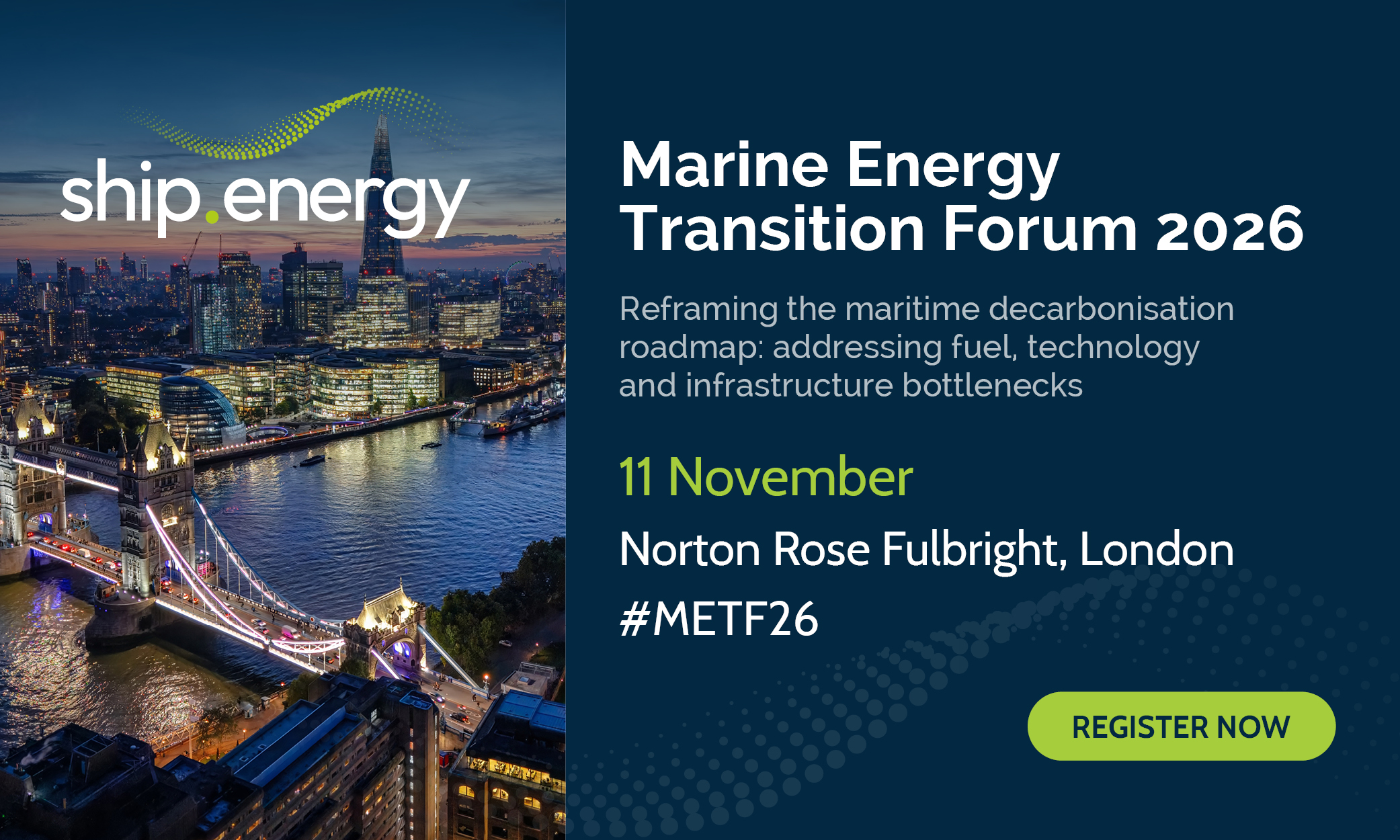
Marine Energy Transition Forum 2026 will be held on 11 November to address bunker fuel, technology and infrastructure barriers that continue to slow the industry’s transition to net-zero emissions.
Admin

Published

on

By

London forum to address critical bottlenecks holding back maritime decarbonisation

The Marine Energy Transition Forum (METF) 2026 will bring together leading voices from across the global maritime sector on 11 November 2026 at Norton Rose Fulbright, London.

The forum will tackle one of shipping’s most pressing challenges: how to overcome the fuel, technology and infrastructure barriers that continue to slow the industry’s transition to net-zero emissions.

Under the theme “Reframing the maritime decarbonisation roadmap: addressing fuel, technology and infrastructure bottlenecks,” the one-day forum will provide a platform for shipowners, fuel suppliers, technology developers, ports, policymakers and financiers to examine the practical steps needed to accelerate progress while maintaining commercial competitiveness.

As the maritime industry navigates an increasingly complex regulatory and commercial landscape, METF 2026 will focus on delivering practical insight into the challenges—and opportunities—shaping the next phase of the energy transition.

The conference programme will explore five key themes:

  • The effectiveness of current regulatory frameworks and policy measures, including regional and international initiatives driving maritime decarbonisation.
  • Progress in developing a resilient multi-fuel future, examining investment, fuel availability, supply chains and infrastructure.
  • The commercial readiness of emerging technologies, including alternative propulsion systems, vessel optimisation, batteries, carbon capture, wind propulsion and digital solutions.
  • Building a supportive business environment for energy transition companies, with discussions covering finance, innovation, scaling businesses and market development.
  • The evolving role of ports as critical enablers of shipping’s energy transition through new fuel infrastructure, shore power and energy cluster development.

METF 2026 is designed to encourage open discussion between every part of the maritime value chain, recognising that collaboration across fuel producers, shipowners, ports, technology providers, investors and policymakers will be essential if global decarbonisation ambitions are to be achieved.

The event will feature expert speakers, panel discussions and extensive networking opportunities, enabling delegates to exchange ideas, develop partnerships and gain practical insight into the strategies shaping the future of maritime energy.

Registration for METF 2026 is now open. Further information and registration can be found here


Photo credit: ship.energy
Published: 13 August, 2026

Continue Reading

LNG Bunkering

EXMAR to convert LNG carrier into floating transshipment unit for bunkering

Vessel will soon undergo a dry-dock including modifications to make the vessel suitable as a floating transshipment unit, dedicated to the LNG bunkering market.
Admin

Published

on

By

EXMAR to convert LNG carrier into floating transshipment unit for bunkering

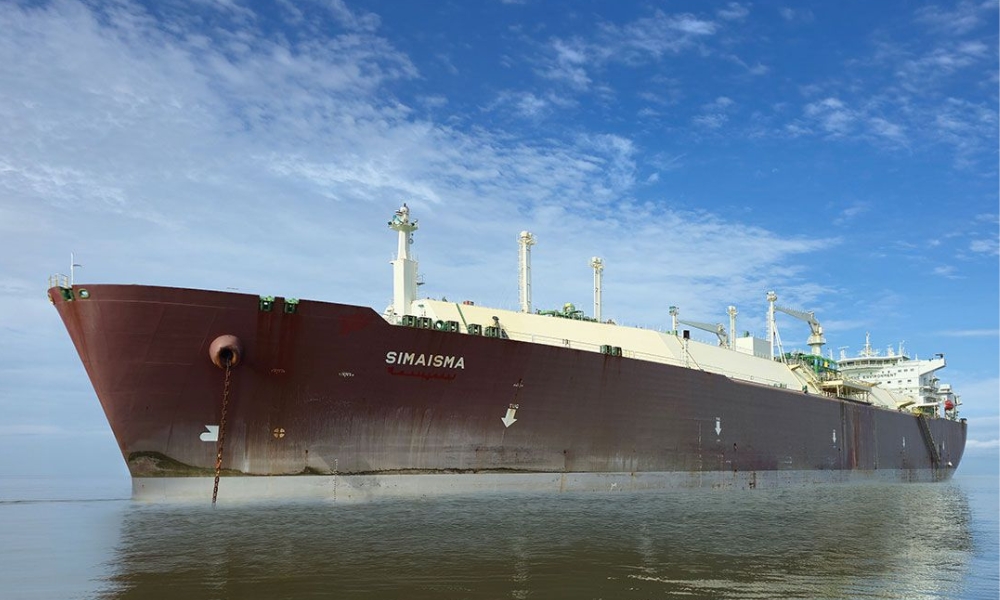
Ship owner EXMAR on Thursday (6 August) announced that it has taken delivery of the 146,000 m³ LNG Carrier SIMAISMA

The vessel is secured under an initial seven-year charter contract with a “first-class counterpart”. 

“The vessel will soon undergo a dry-dock including modifications to make the vessel suitable as a floating transshipment unit (FTU), dedicated to the LNG bunkering market,” it said in a statement. 

The FTU will receive large parcels of LNG from trading LNG carriers and specialised LNG bunkering vessels will load at the FTU before supplying it as a fuel to vessels that use this LNG as a bunker fuel.

EXMAR’s CEO, Carl-Antoine Saverys, said: “EXMAR is gladly assisting its client in further paving the way to unlock LNG as a fuel for the shipping industry. 

“The FTU is a smart solution with which our client brings down the costs of the logistics relating to the LNG bunkering. 

“With this solution, we are building upon EXMAR’s close to 50 years of LNG experience. We look forward to deploying more of these assets to unlock the full potential of LNG as a fuel for the maritime industry.”


Photo credit: EXMAR
Published: 7 August, 2026

Continue Reading

FuelEU

Skuld on FuelEU Maritime: Early lessons from first year of compliance

Joe Bettles of Mærsk Mc-Kinney Møller Center for Zero Carbon Shipping discusses the first FuelEU Maritime compliance results and what they indicate for the shipping industry.
Admin

Published

on

By

RESIZED Chris Pagan

With the first FuelEU Maritime compliance data emerging after the inaugural year of greenhouse gas (GHG) intensity reporting for ships trading in the EU, marine insurer Skuld spoke with Joe Bettles, Climate Policy Manager and author of the Countdown newsletter at the Mærsk Mc-Kinney Møller Center for Zero Carbon Shipping, to examine what the early results reveal: 

The first data on FuelEU Maritime compliance is now emerging, following the first year of reporting against greenhouse gas (GHG) intensity targets for shipping companies trading in the EU.

To better understand what the early results show, we spoke with Joe Bettles, Climate Policy Manager and author of the Countdown newsletter at the Mærsk Mc-Kinney Møller Center for Zero Carbon Shipping (Center). The Center recently published its analysis of the first reporting year in the article “What did we learn from the first year of FuelEU?”

Under the regulation, shipowners have several options for compliance, including:

  • The pooling mechanism, which allows vessels with a compliance surplus to trade it with other vessels.
  • The borrowing mechanism, which allows companies to defer a compliance deficit to the following year for a 10% surcharge.
  • Meet the target by using low GHG intensity fuels.
  • Pay the FuelEU penalty (penalty).

Pooling becomes the preferred option

The first year of reporting indicates that pooling has quickly become the preferred choice. According to data from the European Commission, 92% of vessels used the pooling mechanism, while only 2% used borrowing. The remaining vessels either paid the penalty or met the target by using LNG or other low-GHG energy sources.

Commenting on the findings, Joe Bettles says: “Our insights from the first year of reporting indicate that shipping companies were able to comply with the targets, with most using the pooling mechanism. This shows that FuelEU is working as intended. As we approach the IMO’s upcoming discussion on the Net-Zero Framework (NZF), FuelEU demonstrates that it is possible for the global fleet to comply with a GHG intensity regulation using existing fuels and providing incentives for the uptake of cleaner energy sources.”

A developing market for compliance surplus

The Center’s article also reviews the different pooling platforms available to shipping companies seeking to meet their obligations under the regulation. The price of compliance surplus, averaging around EUR 208/tCO₂eq, remained relatively stable, suggesting that the market matured early, with buyers generally able to find sellers.

On the development of the pooling market, Joe notes: “The prices for trading compliance surpluses remained well below the EUR 640/tCO₂eq penalty for VLSFO, making the pooling mechanism significantly more attractive than paying the penalty.”

Fuel choices remain central to compliance

The role of fuel choice is also important. Looking at fuels supplied to the FuelEU market, the Center estimates that 3.22 million tCO₂eq of reductions, relative to an all-VLSFO fleet, will be required to meet the 2% reduction target between 2025 and 2029. Based on analysis of previous years’ fuel consumption, the Center indicates that LNG may have contributed around one-third of the required reduction. Biofuel blends account for the remainder, with biodiesel and bio-LNG dominating the low-GHG fuel mix.

Joe highlights how the pooling mechanism can help extend the impact of lower-GHG fuels across the fleet: “Although LNG is not a drop-in replacement for VLSFO, the pooling mechanism under FuelEU allows an LNG-fuelled vessel to share its over-compliance with other vessels that cannot physically use LNG. Depending on the engine type in the ship, LNG can remain compliant with the 14.5% reduction target through 2039 and can further extend its compliance through banked surplus or by using liquified biomethane.”

Three early lessons from FuelEU Maritime

Drawing on the first year of reporting, Joe Bettles and the Center identify three lessons that may also be relevant for the IMO in the future.

First, the results indicate that a fuel standard for shipping can work. FuelEU’s first year has created incentives for the use of alternative fuels and a market for those who prefer to pay for emissions compliance.

Second, regulations should include mechanisms that support a broader mix of energy sources. Lower-maturity alternatives, such as wind-assisted propulsion, e-fuels and onshore power, still represented a limited share of the mix.

Third, policy stability and clear reduction pathways can help reduce uncertainty for shipping companies and support the business case for investment in cleaner alternatives.

Supporting knowledge sharing across the maritime value chain

Skuld is a Mission Ambassador to the Mærsk Mc-Kinney Møller Center for Zero Carbon Shipping, supporting its work as a platform for collaboration, knowledge sharing and practical insight across the maritime value chain.

“The Mærsk Mc-Kinney Møller Center for Zero Carbon Shipping is a highly valuable forum for us at Skuld. It provides access to a broad network of industry stakeholders and helps us stay close to the challenges shipowners face in meeting regulatory requirements and reducing emissions. Just as importantly, it serves as a platform for dialogue and knowledge sharing across the maritime value chain” – Matias Bøe Olsen, Decarbonisation and transition risk lead, Skuld.

Note: Read the full article on FuelEU’s first-year experiences here.


Photo credit: Chris Pagan on Unsplash
Published: 7 August, 2026

Continue Reading

Trending