Connect with us

Alternative Fuels

Argus Media: EU updates climate, energy laws to tackle emissions

European Commission outlines a range of legal proposals aligning climate and energy legislation with the bloc’s 55pc emissions-reduction target by 2030.

Admin

Published

on

5e16c2fc7aa8e 1578550012 1

Dafydd ab Iago of global energy and commodity price reporting agency Argus Media on Wednesday (7 July) published a report on the European Commission adopting a range of legal proposals to reduce carbon emissions:

The European Commission today outlined a range of legal proposals aligning climate and energy legislation with the bloc’s 55pc emissions-reduction target by 2030. They include a jet-fuel mandate, a marine-fuel emissions target and a ban on the sale of gasoline and diesel powered cars by 2035.

Sectors covered by the EU emissions trading system (ETS) will have to reduce their greenhouse gas (GHG) emissions by 61pc by 2030, and not 43pc as previously, compared with 2005 levels. Key technical changes include an increased annual rate of reduction of total EU ETS allowances of 4.2pc, up from 2.2pc, and a one-off reduction in total allowances by 117mn. The scope of the system will be widened to include maritime emissions.

Building and road transport sectors will fall under a “second” ETS from 2025. And the commission also intends to end free allocation for intra-EU flights by the end of 2026.

For non-ETS sectors, the effort sharing regulation (ESR) will increase the GHG reduction target for 2030 from 29pc to at least 40pc, again compared with 2005 levels. In addition to agriculture and waste, the ESR will continue to cover and push down emissions in road transport and buildings despite their inclusion in a new ETS. A carbon border adjustment mechanism will put a carbon price on certain energy-intensive goods coming into the EU.

The commission wants land, forestry, and agriculture sectors to achieve net GHG removals of 310mn t of CO2 equivalent (CO2e) by 2030, and climate neutrality by 2035.

The commission has increased the overall renewables target share of EU gross final consumption of energy in 2030 to 40pc from 32pc. There is a 13pc GHG intensity reduction target by 2030 for transport fuels, and the sub-target for advanced biofuels increases from at least 0.2pc in 2022 to 0.5pc in 2025 and 2.2pc in 2030. To support the EU’s hydrogen strategy, there will be a 2.6pc sub-target for renewable fuels of non-biological origin (RFNBOs), and a new 50pc target share for renewables in hydrogen used in industry.

Renewable hydrogen and ammonia, advanced sustainable biofuels and bio-LNG may benefit from a 10-year tax break. Increased tax rates based on energy content targeting fossil fuels are accompanied by removal of exemptions for marine and aviation fuels.

Sustainable aviation fuels (SAFs) receive a boost, with aircraft landing at EU airports required to full up with blended fuel with a mandated share of 2pc by 2025, 5pc by 2030, 20pc by 2035, 32pc by 2040 and 63pc by 2050. Synthetic aviation fuels, including hydrogen, should rise from 0.7pc by 2030 to 11pc by 2045 and 28pc by 2050.

The commission wants ships calling at EU ports to reduce the average GHG intensity of their fuels by 2pc by 2025, 6pc by 2030, 13pc by 2035, 26pc by 2040, rising to 59pc by 2045 and 75pc by 2050, all from 2020 levels.

Demand for traditional transport fuels will also fall as the CO2 standard for passengers cars drops by 55pc by 2030 from 2020-21 targets of 95g CO2/km​. From 2035, all new cars and vans need to reach zero emissions. EU countries will have to ensure charging and alternative fuel points at every 60km for electric vehicles and every 150km for hydrogen refuelling along major highways.

The commission is proposing an increased EU-wide energy efficiency savings target of 36pc, up from 32.5pc, compared to projected final consumption in 2030. Officials estimate policy measures reported by member states will only achieve a reduction of 29.4pc in final energy consumption by 2030. Public bodies must also reduce their total final energy consumption by at least 1.7pc/yr. Member states must increase, from 0.8pc to 1.5pc, the reduction in annual energy sales to final customers by volume, averaged over the most recent three-year period.


Photo credit and source: Argus Media
Published: 15 July, 2021

Continue Reading

LNG Bunkering

PIL’s LNG dual-fuel boxship “Kota Elok” arrives in Singapore on maiden call

As the first of 13 new 13,000 TEU vessels joining its fleet, Kota Elok is equipped to operate on LNG and low-sulphur fuel oil that helps reduce our greenhouse gas emissions.
Admin

Published

on

By

PIL's LNG dual-fuel boxship “Kota Elok” arrives in Singapore on maiden call

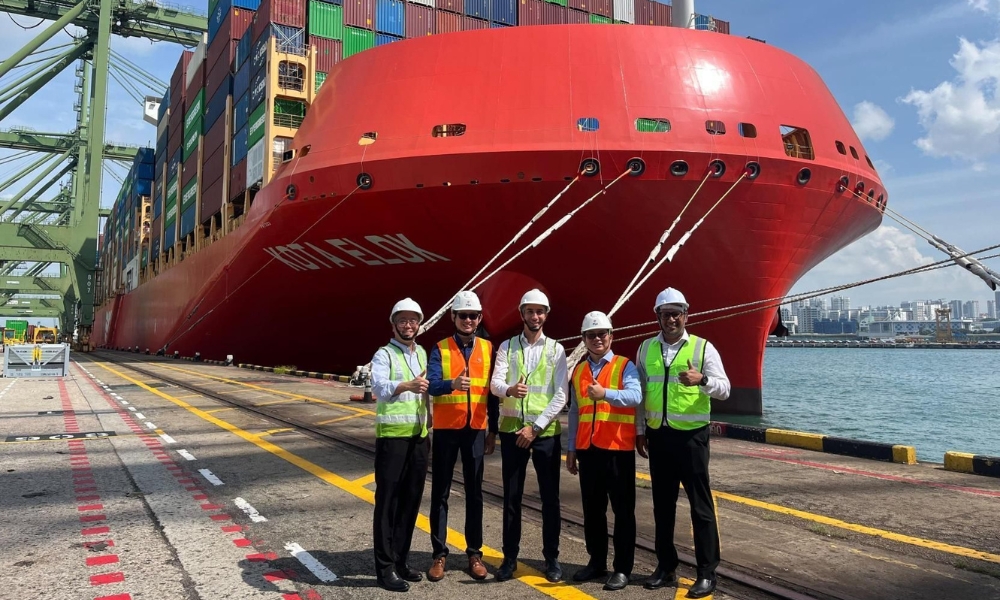
Singapore-based Pacific International Lines Pte Ltd on Monday (20 July) said its first 13,000 TEU LNG dual-fuel container vessel, Kota Elok, recently made her maiden call to Singapore on 15 July.

As the first of 13 new 13,000 TEU vessels joining its fleet, Kota Elok is equipped to operate on liquefied natural gas (LNG) and low-sulphur fuel oil that helps reduce our greenhouse gas emissions. 

The vessel also incorporated energy-saving features and digital technologies to reduce fuel consumption and enhance operational performance, as well as a bow windshield to improve aerodynamics, contributing to improved fuel efficiency and lower emissions over the course of long-haul voyages.

“Following Singapore, Kota Elok will continue her voyage on our East Coast Service 1 (ES1) route to South America, calling at ports in Brazil, Uruguay, and Argentina before returning to Asia,” the company said in a social media post. 

Kota Elok also became PIL’s first vessel to receive Lloyd’s Register certification for compliance with the IACS UR E26 and UR E27 cyber security requirements.

Developed by the International Association of Classification Societies (IACS), UR E26 and UR E27 are mandatory cyber resilience requirements for newbuild vessels contracted from 1 July 2024. 


Photo credit: Pacific International Lines
Published: 21 July, 2026

Continue Reading

LNG Bunkering

CIMC SOE secures order for 12,000-cbm LNG bunkering vessel from Sinopec Clean Energy

Once operational, the vessel is expected to strengthen Sinopec’s domestic coastal LNG bunkering network and help address gaps in China’s alternative fuel bunkering infrastructure.

Admin

Published

on

By

CIMC SOE secures order for 12,000-cbm LNG bunkering vessel from Sinopec Clean Energy

China’s Nantong CIMC Sinopacific Offshore & Engineering Co., Ltd. (CIMC SOE) recently signed a contract with Sinopec (Beijing) Clean Energy Co., Ltd. to build a 12,000-cubic metre (m3) LNG bunkering vessel, according to Chinese maritime media.

The vessel is scheduled for delivery in 2028 and will support Sinopec’s efforts to expand its presence in the marine clean energy sector.

Once operational, the vessel is expected to strengthen Sinopec’s domestic coastal LNG bunkering network and help address gaps in China’s LNG bunkering infrastructure.

With this signing , CIMC Pacific Offshore Engineering’s LNG bunkering vessel orderbook is further strengthened, maintaining its leading position in the global market for small and medium-sized LNG bunkering vessels.

The contract also marked another milestone for CIMC SOE, which has seen a sharp increase in orders and business performance this year amid a surge in domestic LNG vessel demand.


Photo credit: Nantong CIMC Sinopacific Offshore & Engineering
Published: 21 July, 2026

Continue Reading

Nuclear

ABS awards AiP to Korean institute for SMR-powered container ship concept design

KRISO says AiP recognises the technical feasibility and safety of its concept design, marking an important milestone toward the development of next-generation nuclear-powered commercial ships.
Admin

Published

on

By

ABS awards AiP to Korean institute for SMR-powered container ship concept design

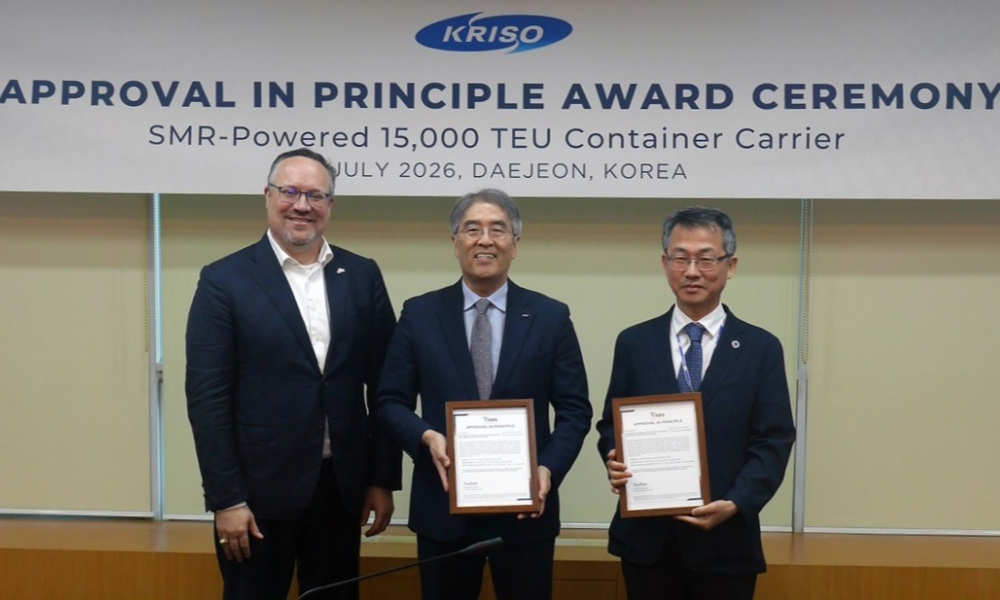
Korea Research Institute of Ships & Ocean Engineering (KRISO) on Thursday (16 July) received Approval in Principle (AiP) from the American Bureau of Shipping (ABS) for its concept design of a 15,000 TEU Small Modular Reactor (SMR)-powered container ship utilising Molten Salt Reactor (MSR) technology.

KRISO said the AiP recognises the technical feasibility and safety of its concept design, marking an important milestone toward the development of next-generation nuclear-powered commercial ships.

“This achievement demonstrates international recognition of KRISO’s technological capabilities in the rapidly evolving field of nuclear-powered shipping, supporting the transition toward low-carbon maritime transport,” it said. 

Building on this milestone, KRISO will continue advancing basic and detailed ship design, paving the way for future demonstration and commercialisation of SMR-powered vessels. 

Through continued R&D and international collaboration, KRISO remains committed to strengthening next-generation maritime technologies and contributing to the safe deployment of nuclear propulsion in the maritime industry.


Photo credit: Korea Research Institute of Ships & Ocean Engineering
Published: 21 July, 2026

Continue Reading

Trending