Connect with us

Alternative Fuels

ABS and partners launch hydrogen fuel cell harbour craft pilot study in Singapore

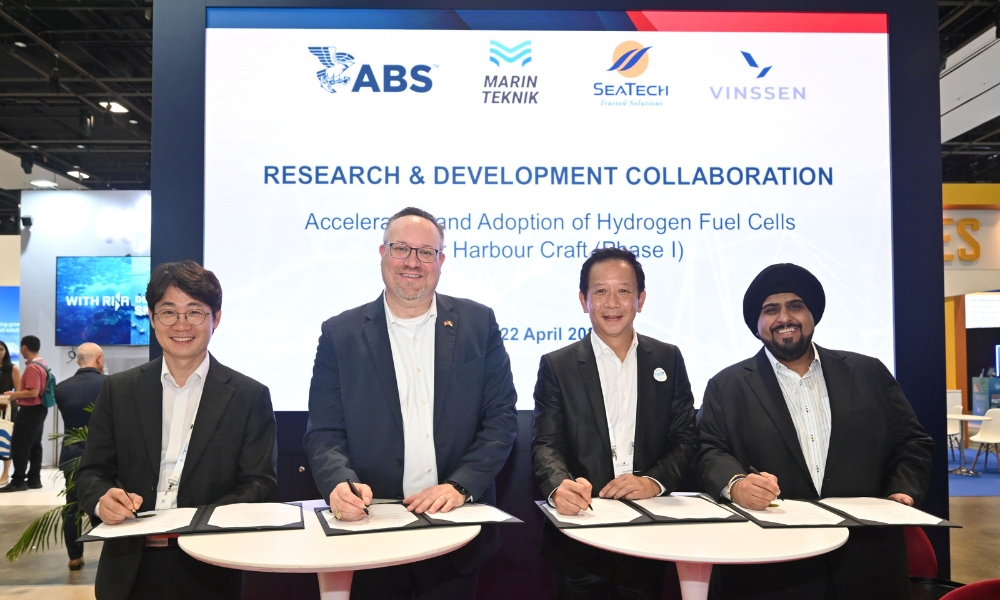
ABS, Marinteknik Shipbuilders, SeaTech Solutions International, and VINSSEN signed a research collaboration agreement to advance the development of a hydrogen fuel cell-powered harbour craft.

Admin

Published

on

ABS and partners launch hydrogen fuel cell harbour craft pilot study in Singapore

Classification society ABS recently said it signed a research collaboration agreement with Marinteknik Shipbuilders (S) Pte Ltd, SeaTech Solutions International (S) Pte Ltd, and VINSSEN to advance the development of a hydrogen fuel cell-powered harbour craft in Singapore.

The agreement brings together complementary expertise across vessel ownership, ship design, fuel cell propulsion and marine technology to advance hydrogen as a viable marine fuel for harbour operations.

Patrick Ryan, ABS Senior Vice President and Chief Technology Officer, said: “ABS is uniquely positioned to support this promising pilot. Our Singapore office is one of our largest, reflecting years of investment to deliver advanced technology and engineering services and survey operations in the Pacific. 

“This concentration of capability in Singapore makes ABS a true innovation teammate for a project of this ambition. We look forward to working with Marinteknik, SeaTech, VINSSEN and the MPA to help prove out hydrogen fuel cell technology as a viable pathway for harbour craft and the broader maritime industry,” said 

Ng Yi Han, Senior Director, Innovation, Technology and Talent Development/Chief Transformation Officer, Maritime and Port Authority of Singapore, said: “The Port of Singapore is home to about 1,600 harbour craft. Decarbonising the fleet requires solutions that can meet different vessel types and operating profiles. MPA is working with ABS and industry partners to develop and pilot new technologies under this project. 

“These efforts will build capabilities and support the adoption of practical, lower-emission solutions across the sector.”

In phase one, the consortium will conduct desktop studies covering the feasibility of implementing hydrogen-powered harbour craft in Singapore, including vessel concept design, design evaluation and optimization, techno-economic analysis, risk assessment and mitigation and commercial viability for broader adoption. Depending on the outcomes from phase one, a second phase could include construction and sea trials of the vessel.  

“Having delivered two fully electric harbour crafts, Marinteknik is thrilled to embark on this milestone project: the first hydrogen-powered vessel for the Singapore maritime sector. We are conducting in-depth studies with local harbour craft operators, analysing their specific operating profiles and requirements so that we can tailor our vessel’s design to meet the practical, real-world demands of the industry,” said Alex Wong, General Manager of Marinteknik.

ABS’ Singapore office is home to the global ABS Electrification Center to support and explore battery and hybrid sources of energy, as well as the ABS Singapore Innovation and Research Center. 


Photo credit: ABS
Published: 29 April, 2026

Continue Reading

Methanol

China: Chimbusco takes delivery of new methanol bunkering vessel in Zhoushan

Company says commissioning of “Zhong Ran LV Neng 85” will further enhance its service capabilities in green methanol bunkering in major domestic ports.

Admin

Published

on

By

Chimbusco takes delivery of new methanol bunkering vessel in Zhoushan

China Marine Bunker (PetroChina) (Chimbusco) recently took delivery of its first bunkering vessel in China to deliver methanol to dual-fuel ships.

The 8,500-dwt duplex stainless steel chemical tanker Zhong Ran LV Neng 85 was successfully delivered in Zhoushan.

The company said the commissioning of this new ship will further enhance Chimbusco’s service capabilities in green methanol bunkering in major domestic ports and expand its national marine new energy service and support network

During the delivery period, Chimbusco said it focused on safe operations and conducted special training for all crew members of the vessel.

The training covered methanol bunkering operation specifications, prevention of collisions between commercial and fishing vessels, daily vessel reporting, and voyage report filling standards.

Manifold Times previously reported the launching of the bunkering vessel at Taizhou Fangzhen Shipbuilding Wharf in Zhejiang.

The floating out of the ship comes after Chimbusco has obtained methanol bunkering licences for Shanghai Port and Ningbo Port.

Related: Chimbusco launches new methanol bunkering vessel in Zhejiang


Photo credit: China Marine Bunker (PetroChina) (Chimbusco)
Published: 16 June, 2026

Continue Reading

LNG Bunkering

CCEC and CMA CGM form joint venture to build and operate LNG bunkering vessel

Each party will hold a 50% ownership stake in the joint venture, which has been established for the purpose of constructing, chartering, and operating one 20,000 cbm dual-fuel LNG bunkering vessel.

Admin

Published

on

By

RESIZED scott graham

Capital Clean Energy Carriers Corp. (CCEC), an international owner of ocean-going gas vessels, on Friday (12 June) announced the formation of a joint venture company with CMA CGM. 

Each party will hold a 50% ownership stake in the joint venture, which has been established for the purpose of constructing, chartering, and operating one 20,000 cbm dual-fuel LNG bunkering vessel. 

The joint venture marks CCEC’s entry into the LNG bunkering segment, the company’s first vessel dedicated to marine fuel supply.

In connection with this transaction, the joint venture has entered into a shipbuilding contract with Nantong CIMC Sinopacific Offshore & Engineering (CIMC SOE) for the construction of the vessel at a contract price of USD 82.8 million, with delivery expected in the third quarter of 2028.

Incorporating the latest technologies, the vessel is designed to enable safe and reliable LNG transfers across a wide range of operating conditions. Advanced emissions reduction systems, combined with highly efficient dual-fuel power generation, are designed to help the vessel meet applicable environmental standards of the global shipping industry.

In addition, the joint venture is expected to enter into a 12-year time charter with a joint venture company formed between CMA CGM and TotalEnergies, commencing upon delivery of the vessel from the shipyard.

Jerry Kalogiratos, CEO of Capital Clean Energy Carriers, commented: “This joint venture marks CCEC’s entry into LNG bunkering — a natural extension of our gas platform from carriage into marine fuel supply. 

“Working alongside counterparties of the calibre of CMA CGM and TotalEnergies, we can help build the infrastructure that allows LNG to deliver a cleaner emissions profile, alongside security and diversity of supply, while opening a new, long-term contracted revenue stream for the Company through the Joint Venture.”

Christine Cabau, Executive Vice President Operations and Assets of CMA CGM, said: “Together with Capital Clean Energy Carriers and TotalEnergies, we are committed to building a reliable and high-performance LNG bunkering supply chain, which is essential to ensuring the availability and reliability of fuels such as LNG that represent the first step in the decarbonization of our industry.”


Photo credit: Scott Graham
Published: 16 June, 2026

Continue Reading

Nuclear

LR: Rotterdam study sets out pathway for nuclear-powered commercial ship port calls

New joint study has found that existing port safety and risk-management frameworks could provide a credible starting point for assessing nuclear-powered ship calls within a major European port environment.

Admin

Published

on

By

RESIZED Shaah Shahidh on Unsplash

A new joint study using the Port of Rotterdam as a case study has found that existing port safety and risk-management frameworks could provide a credible starting point for assessing nuclear-powered commercial ship calls within a major European port environment, according to Lloyd’s Register (LR) on Thursday (11 June). 

The desktop study, Enabling Nuclear-Powered Feeder Ships: A Joint Development Project on Port Call Feasibility and Regulatory Pathways, carried out through a joint development project involving LR, the Port of Rotterdam Authority, CORE POWER and A.P. Moller – Maersk, sets out the questions that ports, regulators and industry would need to answer in order to assess nuclear-powered vessels in a structured and responsible way. 

It also identified further work that would be required before routine operation could be contemplated, including regulatory alignment, emergency preparedness, security, liability and public engagement.

Its publication comes at a time of growing pressure on the shipping industry to identify even more scalable zero-emission technologies capable of meeting increasingly demanding decarbonisation requirements while preserving operational reliability, endurance and flexibility.

The report argued that maritime nuclear propulsion should be evaluated as part of the wider discussion around shipping decarbonisation, energy resilience and long-term industrial competitiveness.

While much of the current EU policy discussion has focused on alternative fuels such as hydrogen, ammonia and e-fuels, the report notes that segments of global shipping may ultimately require additional propulsion solutions capable of supporting endurance, reliability and operational flexibility at scale.

The Port of Rotterdam participated as a case study because it provides a real-world European port environment through which to examine how emerging energy and shipping technologies could interact with existing port safety frameworks, operations and regulatory processes.

Importantly, the study concluded that existing risk-based port safety frameworks already familiar to European ports could provide a credible starting point for assessing nuclear-powered vessels, provided nuclear-specific safety, security and operational considerations are systematically integrated and supported by appropriate national and international guidance.

The findings suggested that the real challenge for future maritime nuclear propulsion is likely to centre on regulatory alignment, governance, integration between nuclear and maritime safety regimes, and public and institutional preparedness.

The study identifies several key findings:

  • Existing port safety and risk-management frameworks provide a credible starting point for the assessment of nuclear-powered commercial vessels within the defined case study scenario.
  • Further work is needed on regulatory alignment, governance coordination, nuclear-specific safety and security, emergency preparedness, liability and insurance, operational integration and public engagement before routine commercial operation could be contemplated.
  • Current IMO provisions relating to nuclear-powered ships were developed for an earlier era and require modernisation to support any future civil commercial nuclear propulsion pathway.
  • Current European maritime decarbonisation discussions remain heavily focused on alternative fuels, with comparatively limited consideration of high-density, zero-emission propulsion systems capable of supporting long-range and high-utilisation shipping operations.
  • Major ports and maritime Member States may play an important role in shaping how nuclear propulsion is assessed and potentially integrated into future shipping strategies.


Photo credit: Shaah Shahidh on Unsplash
Published: 16 June, 2026

Continue Reading

Trending