Connect with us
DNV Decarbonization Insight Series August 2026 - What maritime professionals should know about AI Training

Bunker Fuel Availability

ENGINE: East of Suez Fuel Availability Outlook (11 August 2026)

Availability is tight across grades in Singapore; Zhoushan anchorages remain suspended since Thursday due to Typhoon Dolphin; bunker demand picks up in several South Korean ports.

Admin

Published

on

RESIZED ENGINE East of Suez

The following article regarding regional bunker fuel availability outlook for the East of Suez region has been provided by online marine fuels procurement platform ENGINE for publication on Singapore bunkering publication Manifold Times:

  • Availability is tight across grades in Singapore
  • Zhoushan anchorages remain suspended since Thursday due to Typhoon Dolphin
  • Bunker demand picks up in several South Korean ports

Singapore and Malaysia

VLSFO availability in Singapore remains tight, with suppliers now recommending lead times of 12–21 days, compared with 12–24 days last week. Supply continues to face pressure as the port’s fuel oil inventories have yet to recover to pre-conflict levels, while cargo inflows remain disrupted by fragile US-Iran peace talks, which continue to affect traffic through the Strait of Hormuz.

Enterprise Singapore data shows that Singapore’s fuel oil inventories fell from more than 23 million bbls in March, to below 18 million bbls in June. Although stocks recovered slightly to about 19 million bbls in July, they remain below 20 million bbls.

Several suppliers in Singapore are also grappling with tight delivery schedules, further contributing to the grade’s limited availability.

HSFO availability remains tight, with recommended lead times of 12–21 days, compared with 10–24 days a week earlier. LSMGO lead times have also increased to 4–12 days, from 2–11 days last week.

In Malaysia’s Port Klang, bunker fuel supply remains constrained. Prompt VLSFO availability is tight. LSMGO supply is limited, and HSFO continues to face supply pressure.

East Asia

VLSFO availability in Zhoushan remains under pressure, despite muted bunker demand. Suppliers are now recommending lead times of around 11 days, almost unchanged from last week. Lead times for both LSMGO and HSFO have also increased to about 11 days, from around 10 days previously.

The tighter availability is primarily due to the prolonged suspension of bunkering operations in Zhoushan following Typhoon Dolphin. Bunkering at the port’s outer and inner anchorages has been suspended since Thursday because of adverse weather conditions brought by the typhoon, according to a source.

Typhoon Dolphin weakened after making two landfalls along the coast of Zhejiang province on Sunday, according to China’s National Meteorological Centre (NMC). It moved deeper inland to the central Chinese province of Hubei on Tuesday.

However, suppliers remain uncertain about when bunkering operations in Zhoushan will fully resume, the source added.

Across northern China, bunker fuel supply conditions continue to differ by port. Dalian and Qingdao have adequate VLSFO and LSMGO availability, although HSFO remains tight in Qingdao. Supply of all three major bunker grades is constrained in Tianjin, while Shanghai continues to face limited VLSFO and HSFO availability. LSMGO supply in Shanghai remains relatively steady.

Supply pressures persist across southern China as well. Fuzhou continues to see tight availability of both VLSFO and LSMGO. Xiamen has sufficient VLSFO supply, but prompt LSMGO stems remain harder to secure. Both VLSFO and LSMGO availability are also constrained in Yangpu and Guangzhou.

Hong Kong’s bunker market remains largely unchanged, with suppliers continuing to recommend lead times of around seven days for all major fuel grades.

In Taiwan, VLSFO and LSMGO can be supplied within around two days at Hualien and Keelung, while deliveries at Kaohsiung and Taichung require around three days.

Availability in Keelung has also been affected by vessel maintenance issues. One bunker barge suffered a major technical failure, while another was undergoing dry dock maintenance. A bunker barge from Taichung has since been temporarily deployed to support operations and reduce waiting times. The damaged barge is expected to return to service later this week, according to a Taiwan-based trader.

South Korea’s southern ports, including Busan, Ulsan, Masan, Onsan, Yeosu and Kwangyang, have seen bunker availability improve despite demand seeing an uptick. Recommended lead times for VLSFO, LSMGO and HSFO stand at 4-6 days, from 3-7 days last week.

The same pattern is evident at the country’s western ports—Incheon, Daesan, Dangjin, Pyeongtaek and Taean—where lead times for all three fuel grades stand at 4-6 days, from 3-7 days a week ago.

Potential weather-related disruptions could impact Busan, Ulsan and Yeosu between 11-13 August, and Daesan during 11-12 and 15-16 August.

Supply conditions are tightening significantly across Japan. For VLSFO and HSFO, all refiners have implemented ex-wharf restrictions leading to a nationwide supply crunch.

Tight supply conditions continue across Japan’s major bunkering hubs, including Tokyo, Chiba, Kawasaki, Nagoya, Yokkaichi, Osaka, Kobe, Mizushima and Oita, where only a limited number of suppliers are offering VLSFO, LSMGO and HSFO. Kashima is also experiencing constrained availability of VLSFO and HSFO.

In Tokyo, Chiba and Kawasaki, earliest VLSFO and HSFO delivery requires 10-11 days.

Oceania

VLSFO availability remains stable across Western Australia, with suppliers in Kwinana and Fremantle continuing to recommend lead times of around seven days. Both ports depend on a single supplier, and all bunker deliveries are carried out by barge.

Supply conditions are more mixed along Australia’s east coast. In Port Kembla, VLSFO can be supplied by either truck or pipeline, while suppliers in Sydney maintain adequate stocks of both VLSFO and LSMGO. HSFO availability is relatively tighter in Sydney, with suppliers generally advising lead times of about seven days.

In Queensland, VLSFO and LSMGO remain readily available in Brisbane and Gladstone, where lead times continue to hover around one week.

Further south, Melbourne and Geelong also have comfortable VLSFO inventories. However, both ports rely on a single bunker barge, keeping recommended lead times at approximately seven days. HSFO supply has tightened further in Melbourne and Brisbane.

Meanwhile, one supplier is offering all major bunker grades in Brisbane, Sydney and Melbourne with lead times of roughly five days.

In Western Australia, pipeline-based bunker deliveries to Dampier Cargo Wharf (DCW) remain suspended until around the end of September due to ongoing repair work. Limited truck-based deliveries are still possible, subject to vessel size. During the disruption, the supplier has designated the Toll Supply Base (TSB) in Dampier as the preferred location for bunker operations, according to a source.

Across the Tasman, bunker fuel availability in New Zealand is broadly unchanged. VLSFO remains readily available in Tauranga and Auckland, with suppliers recommending lead times of about four days. At Marsden Point, both VLSFO and LSMGO can be delivered directly to vessels via pipeline.

Weather continues to pose the biggest operational risk in New Zealand. Bunker deliveries in Wellington and ports across the South Island remain particularly susceptible to delays during periods of adverse weather.

South Asia

VLSFO and HSFO availability is tight in India’s Visakhapatnam, Kakinada, Gangavaram, Krishnapatnam, Paradip, Haldia, Chennai, Tuticorin and New Mangalore. A supplier in Cochin can offer both VLSFO and LSMGO on firm enquiry, a source said.

Adverse weather is set to disrupt bunker operations at several Indian ports over the coming days. Sikka is forecast to experience operational disruptions between 12-15 August, while Mumbai, Visakhapatnam and Cochin from 11-15 August.

In Sri Lanka, bunker availability remains tight at both Colombo and Hambantota, with at least one supplier advising lead times of around 10 days, almost unchanged from last week.

Weather conditions are also expected to intermittently disrupt bunker operations in Colombo between 11-15 August and Trincomalee between 11-14 August, increasing the risk of delays to bunker deliveries.

Middle East

Renewed tensions between the US and Iran around the Strait of Hormuz have continued to strain bunker fuel supply in Fujairah. Availability of VLSFO and LSMGO remains tight, largely unchanged from last week, with only a limited number of suppliers able to offer LSMGO. HSFO supply also remains tight.

Supply conditions are more comfortable at the nearby UAE hub of Khor Fakkan, where both VLSFO and HSFO remain readily available. Demand for bunkers has nevertheless picked up at both Fujairah and Khor Fakkan, despite the latest regional escalation, a Middle East-based source said.

Saudi Arabia’s Jeddah, VLSFO and LSMGO supply remains steady, despite stronger demand. However, rough weather could interrupt bunker operations in Jeddah between 11-12 and on 15 August, and in Yanbu between 11-15 August.

Bunker availability remains constrained at Qatar’s Ras Laffan, where both VLSFO and LSMGO supplies are still limited.

“Middle Eastern ports remain generally operational, with LSMGO available across Oman… subject to port, quantity, vessel schedule and supplier confirmation,” an Oman-based trader said.

Across Oman’s key ports—including Salalah, Muscat, Duqm and Sohar—LSMGO availability remains stable, with recommended lead times of 2–3 days depending on the port and nomination. High waves forecast in Salalah between 11-15 August could, however, temporarily disrupt bunkering operations, according to a source.

Egyptian ports remain fully operational, but bunker inventories at Port Suez are critically low across all three conventional fuel grades.

Further south, availability of all major bunker fuel grades also remains limited in Djibouti.

By Tuhin Roy


Photo credit and source: ENGINE
Published: 12 August, 2026

Continue Reading

Bunker Fuel

Baltic Exchange: Bunker Report (13 August 2026)

Bunker report panellists include Island Oil Limited, Cockett Marine Oil Pte, Monjasa A/S and KPI OceanConnect, NSI Marine and Transparensea Fuels.

Admin

Published

on

By

Baltic Exchange logo

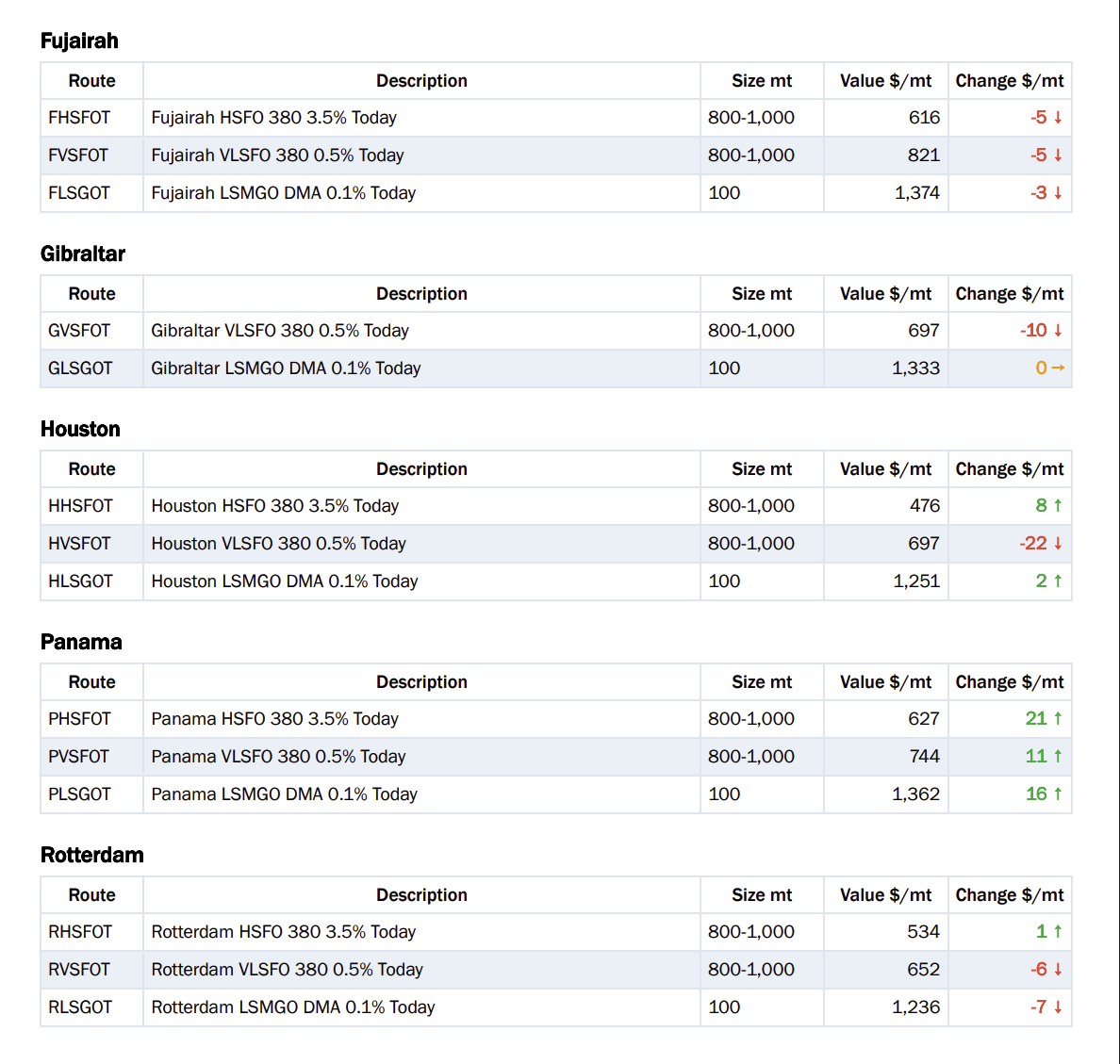
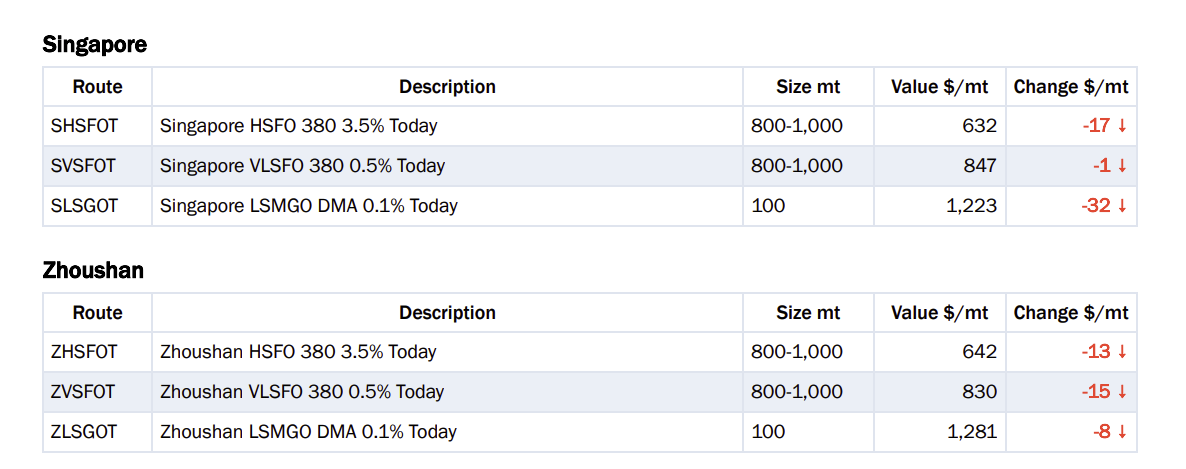
The following bunker report has been provided by freight market information provider Baltic Exchange for post on Singapore bunkering publication Manifold Times:

Screenshot 2026 08 14 at 1.23.10 PM

Screenshot 2026 08 14 at 1.23.22 PM

All values are in US$/metric ton, all-in (invoice price), delivered on board
Delivery in 7-10 days
ISO 8217:2010
IFO 380 3.5% Sulphur
IFO 380 0.5% Sulphur
DMA 0.1% Sulphur

Fujairah – Offshore Anchorage Area
Gibraltar – Anchorage area
Houston – Houston Harbor
Panama – (Pacific) dangerous cargo area, Balboa
Rotterdam – Waalhaven Maasvlakte range
Singapore – Anchorage, under SBA Scheme
Zhoushan – Southern anchorage area

Submitted weekly at Close of Business UK time Daily

Panellists:
Cockett Marine Oil Pte, Island Oil Limited, KPI OceanConnect, Monjasa A/S, NSI Marine and Transparensea Fuels


Photo credit and source: Baltic Exchange
Published: 14 August, 2026
Continue Reading

Bunker Fuel Availability

ENGINE: Americas Fuel Availability Outlook (13 August 2026)

Prompt fuel availability tight at Houston; VLSFO, LSMGO availability tightens in Santos; Zona Comun demand steady.

Admin

Published

on

By

RESIZED ENGINE Americas

The following article regarding bunker fuel availability in the Americas region has been provided by online marine fuel procurement platform ENGINE for post on Singapore bunkering publication Manifold Times:

  • Prompt fuel availability tight at Houston
  • VLSFO, LSMGO availability tightens in Santos
  • Zona Comun demand steady

North America

Bunker fuel demand in Houston is firm, with prompt availability tight across all three conventional fuel grades of HSFO, VLSFO and LSMGO.

Suppliers are recommending lead times of around 5–7 days, a bunker trader tells ENGINE.

Weather conditions across the US Gulf Coast are normal, with no major disruptions from the ongoing hurricane season.

In the nearby Bolivar Roads, limited prompt availability has been observed.

One supplier has been able to offer VLSFO stems within 4–6 days over the past week, and typical lead times in the area generally remain above five days, a trader said.

Deliveries at the anchorage continue to be subject to weather conditions and are currently being handled on a first-come, first-served basis.

In Mobile, the earliest delivery date for VLSFO is currently indicated between 18-19 August.

The Galveston Offshore Lightering Area (GOLA) is expected to face minor weather-related disruptions through 15 August due to strong wind gusts and high seas.

In New York, bunker demand is strong, and availability is decent for LSMGO and VLSFO deliveries, with lead times ranging between 4-7 days.

HSFO is expected to tighten a bit, and requires notice of at least seven days, this week, a trader said.

Weather conditions at the port are normal, and no congestion or weather-related disruptions are expected through the end of the week.

Across the US West Coast, bunker availability is a bit tight, with buyers advised to secure stems in advance to avoid delays, a bunker trader tells ENGINE.

In the ports of Los Angeles and Long Beach, HSFO and LSMGO typically have required around 7–9 days notice in the past week.

VLSFO is more constrained, with lead times of 9–11 days. The earliest delivery dates for VLSFO with most suppliers are currently indicated from around 21-22  August onwards.

Availability in Canada’s Vancouver is good for HSFO, VLSFO and LSMGO this week, a source said. Lead times for the three fuel grades are between 4-7 days.

Latin America and the Caribbean

In Panama, bunker demand is steady, and availability is normal, a trader tells ENGINE.

Recommended lead times at the ports of Balboa and Cristobal for VLSFO and LSMGO stand at around 3–6 days. HSFO availability is relatively tighter, with most suppliers requiring 5–7 days’ lead time.

In the Bahamas’ Freeport, at least one supplier is offering HSFO and LSMGO with lead times of around 6–7 days.

Off Trinidad, bunkering operations may face disruptions due to high wind gusts and rough seas through 15 August. Delays are expected and will depend on supply vessel conditions at the time of delivery, a source said.

In Colombia, bunker availability at the ports of Cartagena, Santa Marta and Barranquilla is good, with the earliest delivery dates for VLSFO and LSMGO indicated at 3–4 days, a trader said.

In Brazil, Santos is seeing tighter availability for both VLSFO and LSMGO, with suppliers recommending lead times of around 7–10 days to secure deliveries.

Across other key Brazilian ports, Rio de Janeiro, Rio Grande, Belém, Salvador and Vila do Conde, supply conditions are okay. Both grade require between 5–8 days of lead time, a source said.

Paranaguá continues to show tighter VLSFO and LSMGO availability, with lead times of about 6–8 days.

In Argentina’s Zona Comun, bunker demand is steady, with normal availability. Recommended lead times for VLSFO and LSMGO are around 5–7 days. However, delays are expected at the anchorage due to high wind gusts.

By Gautamee Hazarika


Photo credit and source: ENGINE
Published: 14 August, 2026

Continue Reading

Bunker Fuel Availability

ENGINE: Europe & Africa Bunker Fuel Availability Outlook (12 August 2026)

Prompt availability tight in the Gibraltar Strait; barge availability issues in Piraeus; 4-5 days of lead time required in Luanda.

Admin

Published

on

By

RESIZED ENGINE Europe and Africa

The following article regarding Europe and Africa bunker fuel availability has been provided by online marine fuel procurement platform ENGINE for post on Singapore bunkering publication Manifold Times:

  • Prompt availability tight in the Gibraltar Strait
  • Barge availability issues in Piraeus
  •  4-5 days of lead time required in Luanda

Northwest Europe

Bunker fuel availability is tight for prompt supplies in the ARA, with buyers advised lead times of 5-7 days to get good coverage from suppliers, a trader said.

The ARA’s independently held fuel oil stocks have averaged 10% higher so far in August compared to July, according to Insights Global data.

The ARA hub imported 457,000 b/d of fuel oil in the first week of August, a sharp increase from July’s monthly average of 159,000 b/d, according to Vortexa cargo data. Benin (35%) was the biggest import source, followed by Venezuela (19%) and Colombia (17%).

The region’s independent gasoil inventories – which include diesel and heating oil – dropped by 9% in the first week of August, compared to July, according to the Insights Global data. The gasoil inventories fell to their lowest level in just over four years.

The region has imported 228,000 b/d of gasoil this month, a considerable rise from 119,000 b/d imported across June, according to Vortexa data. The majority of volumes arrived from the US (23%), Sweden (21%) and France (10%).

Bunker availability is normal in Germany’s Hamburg, and supply of any fuel grade can be secured within five days, a trader told ENGINE.

Availability is tight off Denmark’s Skaw and in Sweden’s Gothenburg, with buyers recommended lead times of 10 days for any fuel grade, according to a trader.

Mediterranean

Availability is tight in Gibraltar Strait ports, with buyers recommended lead times of around 7-10 days to get competitive offers from a wide selection of suppliers, a trader said.

Buyers looking to bunker in Barcelona are advised to book a week ahead of delivery, a trader said.

In Las Palmas, fuel availability is tight for prompt supplies, and buyers are advised lead times of 10-12 days for HSFO, VLSFO and LSMGO deliveries, a trader told ENGINE.

VLSFO fuel availability is tight off Malta, with buyers recommended seven days of lead time, a trader said. ULSFO supply requires about six days of notice, while LSMGO is available with a more prompt lead time of 2-5 days.

Prompt fuel availability is tight in Greece’s Piraeus. Buyers looking for HSFO, VLSFO, LSMGO and ULSFO supplies are advised to book with a lead time of around 5-7 days, a trader said. Suppliers are facing tight barge availability in the port, a source told ENGINE.

Fuel availability is good in Türkiye’s Istanbul, a local supplier said. Buyers looking to bunker in the port are recommended a notice of four days for VLSFO and 1-3 days for LSMGO and ULSFO supplies, a trader said.

Africa

HSFO availability is tight in most African ports, with suppliers reporting very limited availability.

VLSFO and LSMGO availability is tight for prompt delivery dates in Lome and off Walvis Bay, a trader said. Buyers are advised to book deliveries at least seven days in advance, the trader told ENGINE.

VLSFO deliveries at the Lagos anchorage require 5-7 days’ notice, a local supplier told ENGINE.

In Angola’s Luanda, buyers are advised to book VLSFO and LSMGO supplies with a lead time of 4-5 days, a supplier said.

Prompt VLSFO availability is tight off Algoa Bay, with buyers advised at least 5-7 days’ notice, a trader said.

Bunker availability is tight in Port Louis, with suppliers quoting their earliest delivery dates 10-14 days out for VLSFO and LSMGO, a trader said.

By Nachiket Tekawade


Photo credit and source: ENGINE
Published: 13 August, 2026

Continue Reading

Trending