
Decarbonisation
VPS on IMO 2028: A new legislative measure for the decarbonisation of shipping
Steve Bee and Emilian Buksak break down what the newly approved IMO framework means for ship operators and how VPS can support compliance through fuel testing, emissions measurement, and strategic advisory.

Steve Bee, Group Marketing and Strategic Projects Director, and Emilian Buksak, Decarbonisation Advisor of marine fuels testing company VPS, on Wednesday (16 April) broke down what the newly approved IMO net-zero framework means for ship operators and how VPS can support compliance through fuel testing, emissions measurement, and strategic advisory:
On Friday 11th April 2025, the International Maritime Organization (IMO) achieved another important step towards establishing a legally binding framework to reduce greenhouse gas (GHG) emissions from ships globally, aiming for net-zero emissions by or around 2050.
The IMO Net-zero Framework is the first in the world to combine mandatory emissions limits and GHG pricing across an entire industry sector. Approved by the Marine Environment Protection Committee during its 83rd session (MEPC 83), the measures include a new fuel standard for ships and a global pricing mechanism for emissions.
These measures, set to be formally adopted in October 2025 before entry into force in 2027, will become mandatory for large ocean-going ships over 5,000 gross tonnage, which emit 85% of the total CO2 emissions from international shipping. This Net-Zero Framework will be included in a new Chapter 5 of MARPOL Annex VI.
With an estimated 900 renewable-fuel-ready vessels expected to be sailing the seas by 2030, it is felt necessary to implement global regulation to deliver renewable fuels at a commercially viable price, as current pricing for “green fuels” is 3-4 times the price of fossil fuels. Such regulations will make it possible for ships to operate on green fuels and also incentivise fuel and energy providers to invest in new production capacity.
Under the draft regulations, ships will be required to comply with:
Global fuel standard: Ships must reduce, over time, their annual greenhouse gas fuel intensity (GFI) – that is, how much GHG is emitted for each unit of energy used. This is calculated using a well-to-wake basis, meaning total emissions are measured from fuel production through to its use on board.
Global economic measure: Ships operating above GFI thresholds will need to acquire remedial units to balance their excess emissions, while those using zero or near-zero GHG fuels or technologies will be eligible for financial rewards for their lower emissions profile.
Two-tier Compliance Targets: Each ship will have to meet both a Base Target and a Direct Compliance Target for its annual GFI. Vessels that stay under the stricter Direct Compliance Target are eligible to earn surplus units, whereas those over the thresholds face a compliance deficit that must be remedied.
Data Collection & Reporting: Operators must calculate and report their attained annual GFI each calendar year, verifying it against their target annual GFI. This includes rigorous recordkeeping and submission to the IMO GFI Registry, which tracks each vessel’s emissions performance and any remedial or surplus units.
IMO Net-Zero Fund Contributions: Ships that exceed their GFI limits are required to make GHG emissions pricing contributions to the new IMO Net-Zero Fund. Collected revenues will be used to reward ships using zero/near-zero fuels, support research and technological innovation in cleaner shipping, and help ensure a just and equitable transition for the maritime sector.
Net-Zero Framework Implementation and Green Balance Mechanism
From 2028 to 2030, ships will be subject to a tiered levy linked to their well-to-wake (WtW) carbon intensity. Based on a 2008 baseline of 93.3 gCO₂eq/MJ (the industry average in 2008), operators will face no charge for fuel emissions at or below approximately 77.44 gCO₂eq/MJ, a moderate levy of $100/mtCO₂eq for emissions between 77.44 and 89.57 gCO₂eq/MJ, and a higher rate of $380/mtCO₂eq for emissions exceeding 89.57 gCO₂eq/MJ. These thresholds and levies align with the overarching goal of driving down overall carbon intensity by a minimum of 4% by 2028 and 17%for direct compliance targets—with further, more stringent reductions taking effect in subsequent years.
Surplus Units and Over-Compliance
A ship’s carbon intensity below the lower threshold (77.44 gCO₂eq/MJ) constitutes “over-compliance,” generating surplus units that can be banked or traded. Conversely, exceeding thresholds will require the purchase of remedial units to cover the compliance deficit.
Sustainable Fuel Certification Scheme (SFCS) and Fuel Lifecycle Label (FLL)
Under the new framework, all fuels must carry a Fuel Lifecycle Label (FLL), which documents their GHG intensity and other sustainability attributes on a well-to-wake basis. These values must be certified by a recognized Sustainable Fuel Certification Scheme (SFCS), ensuring accurate, transparent calculations and preventing any misrepresentation of environmental impact.
Zero or Near-Zero GHG Technologies, Fuels, and Energy Sources
Recognising the importance of incentivising advanced solutions, the regulation sets specific lifecycle emission thresholds for what qualifies as a zero or near-zero GHG (ZNZ) fuel or technology: Initial threshold (valid until 31 December 2034): ZNZ fuels must not exceed 19.0 g CO₂eq/MJ on a well-to-wake basis. Post-2035 Threshold: Starting 1 January 2035, the permissible GHG intensity tightens to no more than 14.0 g CO₂eq/MJ.
Ships adopting fuels and technologies below these thresholds can earn financial rewards through the IMO Net-Zero Fund, effectively offsetting some of the initial costs of transitioning away from conventional fossil fuels. By gradually lowering the allowable GHG intensity, the regulation encourages ongoing innovation, investment, and broader adoption of advanced, low-emission solutions across the global fleet.
Green Balance Mechanism
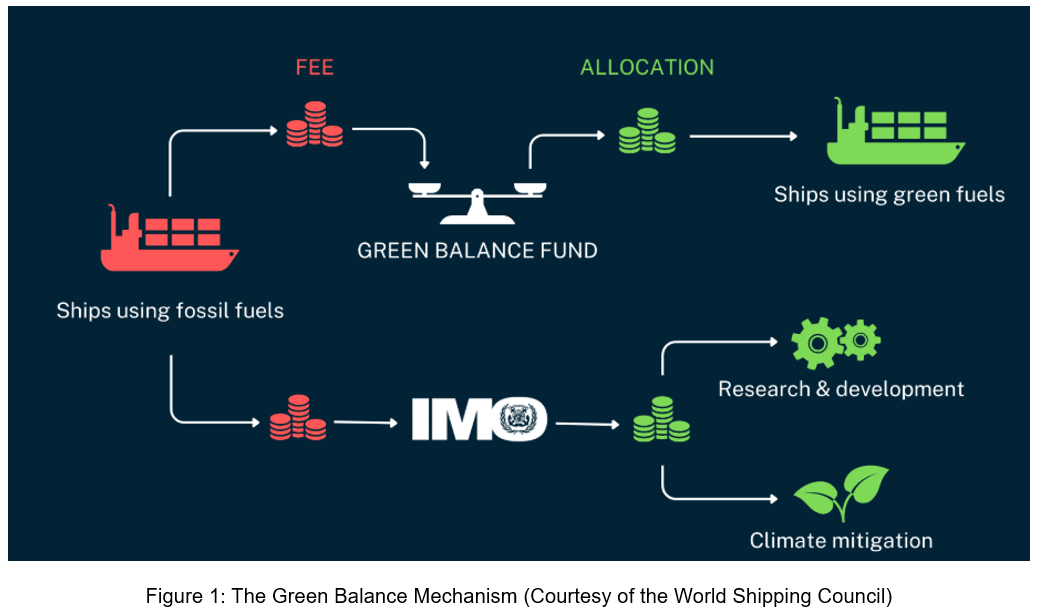
Central to this approach is the Green Balance Mechanism, which integrates closely with the GFI. In essence, it applies a fee on higher-intensity fossil fuels and allocates those proceeds to green fuels, balancing costs across a diverse energy mix. The greater the well-to-wake emission reductions a fuel delivers, the larger the financial allocation it receives—effectively levelling the playing field and stimulating a shift to sustainable alternatives.
Disbursement of Revenues
All revenues from levies and remedial unit purchases will be directed to the IMO Net-Zero Fund, which will then distribute the funds to:
- Reward low-emission ships
- Support innovation, research, infrastructure, and just-transition initiatives (particularly in developing countries)
- Fund training, technology transfer, and capacity-building aligned with the IMO GHG Strategy
- Mitigate impacts on vulnerable States, such as Small Island Developing States (SIDS) and Least Developed Countries (LDCs)
- By steadily lowering the permissible carbon intensity and introducing financial incentives for clean fuels, the new framework aims not only to reduce overall emissions but also to accelerate the maritime sector’s transition to sustainable energy solutions.
Note: The full article, including on how VPS can support compliance through fuel testing, emissions measurement, and strategic advisory, can be found here.
Related: IMO MPEC 83 approves net-zero regulations for global shipping
Photo credit: VPS
Published: 17 April, 2025
LNG Bunkering
Singapore-based EPS takes delivery of three LNG dual-fuel bulk carriers
Three vessels are the third, fourth and fifth in the company’s series of 14 Newcastlemaxes being built at the yard, and were delivered five months ahead of their contracted delivery dates.
Port & Regulatory
ISWG-GHG 22: IMO working group aims to present NZF text at MEPC 85
The Chair expressed his observation of a genuine willingness within the Group to make concrete further progress at the next ISWG-GHG meeting and work towards presenting text to MEPC 85.

Port & Regulatory
UCL on ISWG-GHG 22: Majority back GHG pricing, centralised fund in IMO NZF talks
A significant majority of IMO member states backed a centralised system for collecting revenues to reward early adopters and support a just transition, according to UCL.

OUR INDUSTRY PARTNERS

Singapore: Liquidators of Nan Ho Maritime, Nan Xin Maritime issue notices of dividend

Singapore-based EPS takes delivery of three LNG dual-fuel bulk carriers

ISWG-GHG 22: IMO working group aims to present NZF text at MEPC 85

UCL on ISWG-GHG 22: Majority back GHG pricing, centralised fund in IMO NZF talks

LR awards AiP to CSSC Huangpu Wenchong for 12,500 m³ LNG bunker vessel design

DNV at SMM: Chinese shipbuilders, European owners seek closer ties on alternative bunker fuels

Auramarine: Marine fuel flexibility will be key to shipping’s energy transition

Singapore-flagged tugboat “Kim Heng 3203” placed under Sheriff’s arrest

US targets five bunker companies in latest sanctions campaign against Iran

China’s bunker market reshaped by tax rebates, trade flows and refining changes, says economist

Hengli Petrochemical’s ex-Singapore trading arm faces winding up application

Rajah & Tann: Bunker disputes are won in the first 48 hours

Report: GCMD outlines practical approach to quantity assurance in marine biofuel supply chains

Singapore: Notices of annual meeting issued for Vroon Shipping Asia and related firms
-
 Vessel Arrest2 weeks ago
Singapore-flagged tugboat “Kim Heng 3203” placed under Sheriff’s arrest
-
 Sanctions2 weeks ago
US targets five bunker companies in latest sanctions campaign against Iran
-
 Interview1 week ago
China’s bunker market reshaped by tax rebates, trade flows and refining changes, says economist
-
 Winding up2 weeks ago
Hengli Petrochemical’s ex-Singapore trading arm faces winding up application
-
 Bunker Claim5 days ago
Rajah & Tann: Bunker disputes are won in the first 48 hours
-
 Biofuel2 weeks ago
Report: GCMD outlines practical approach to quantity assurance in marine biofuel supply chains
-
 Winding up1 week ago
Singapore: Notices of annual meeting issued for Vroon Shipping Asia and related firms
-
 Alternative Fuels2 weeks ago
GEA to provide global ethanol fuel data for DNV’s AFI platform