
Bunker Fuel Quality
VPS: Is your vessel fully protected from dangers of poor-quality bunker fuel?
VPS have issued 21 Bunker Alerts this year, which have highlighted witnessed quality issues with the three main fuel types of HSFO (6 alerts), VLSFO (9 alerts) and MGO (6 alerts), says Steve Bee of VPS.


Steve Bee, Group Commercial Director of marine fuels testing company VPS, on Tuesday (1 October) wrote about mitigating fuel quality risks and safeguarding vessel operations against poor-quality bunker fuels:
As the global marine fuel mix grows, becoming more varied and consequently more complex in terms of fuel management, there is a potential increasing risk to vessels, crew and the environment, from the possible impact of poor-quality fuels.
Yet, whilst shipping looks to decarbonise, with a view to introducing low-to-zero carbon fuels, such as biofuels and methanol, these fuels currently account for approximately 1% of the fuel mix. The more traditional fossil fuels are continuing to satisfy the day-to-day demand in terms of fuels supplied to vessels at this time, with almost 230 million MT of marine fuels being bunkered last year.
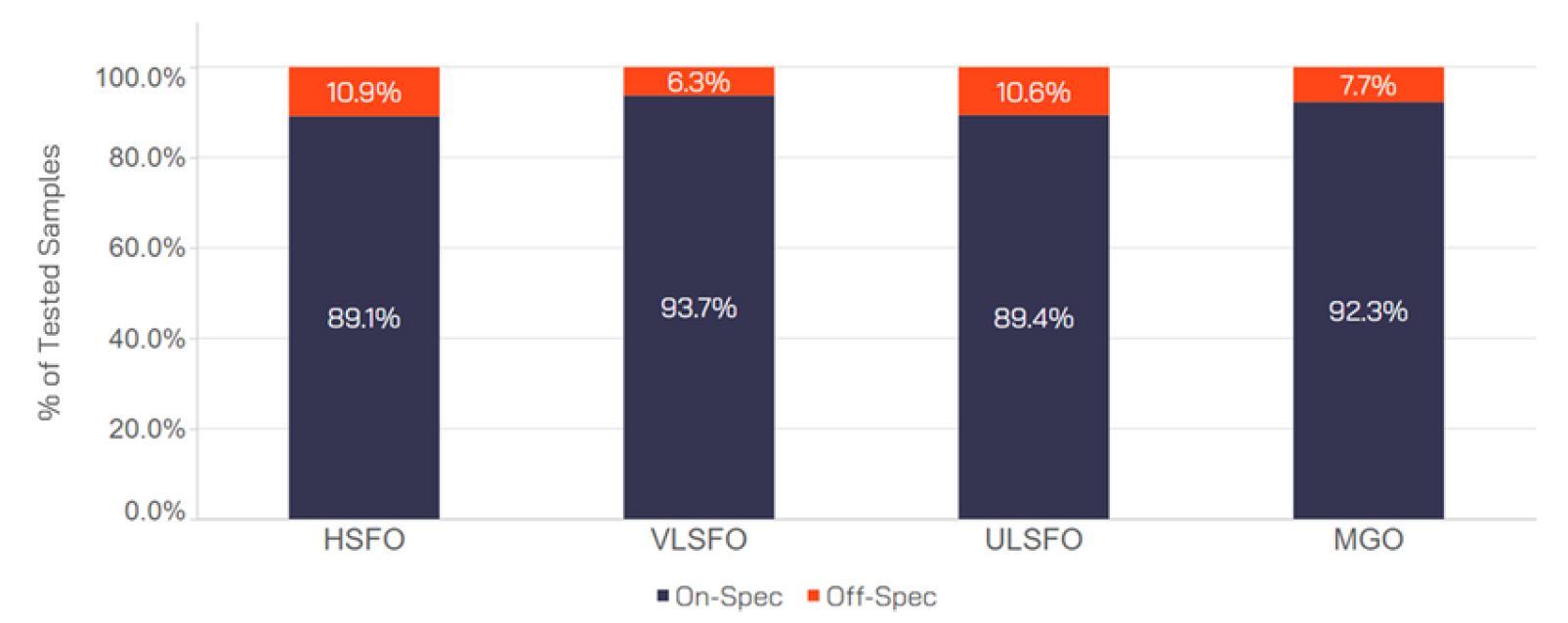
The VPS database shows for all fossil fuels tested the following current Off-specifications have been identified:
VPS Bunker Alerts, are also a good indication of current fuel quality and so far to date, VPS have issued 21 Bunker Alerts this year. These alerts have highlighted witnessed quality issues with the three main fuel types of HSFO (6 alerts), VLSFO (9 alerts) and MGO (6 alerts). The 2024 alerts show significant off-specifications for 8 different test parameters, from 11 different locations, across Europe, Middle-East, Asia and the Americas. This proves fuel quality issues can arise anywhere at any time, for any fuel type or test parameter.
June 2024, saw the 7th revision of the marine fuel standard ISO8217, released to the industry. ISO8217:2024 is seen as a major step forward in terms of setting specifications for marine fuel quality. This latest revision has moved from two fuel specification tables, to four. It now includes, for the first time, specifications for VLSFO and ULSFO fuels containing 0.50% or 0.10% sulphur respectively, plus biofuels containing FAME, HVO, GTL, BTL, bio-components.
Acknowledging that ISO8217:2024, is an improvement on previous revisions of the standard, it still does not cover enough of the further potentially problematic issues of chemical contamination, cold-flow properties, microbial-growth, plus wider bio-components such as Cashew Nut Shell Liquid (CNSL), to name but a few areas of concern.
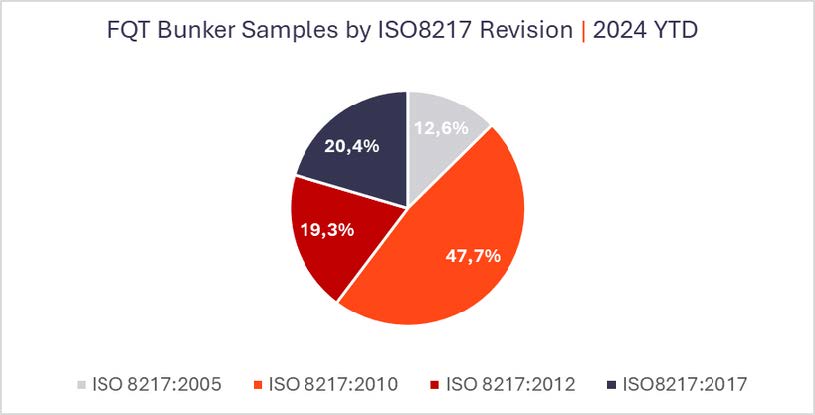
In addition, the industry has a very poor track record of purchasing fuel against the very latest revision of the ISO8217 standard. To date, VPS as the world’s largest marine fuel quality testing company, still see 12.6% of samples received for quality testing, being purchased against the 2005 revision of the standard. So, vessels are purchasing fuel against a standard which is actually only 3 months off being 20 years old? That revision has since been replaced by four further revisions of the standard over the years and it bears very little relevance to today’s fuels. Therefore, these vessels are really operating at a significantly increased level of risk, if they are relying on ISO8217:2005 to fully protect them.
The most common revision against which marine fuel is purchased today, is still ISO8217:2010. 48% of all fuel samples received by VPS, are being tested against this revision. Again, ISO8217:2010 is almost 15 years old, so why is almost half of the fuel being purchased to it? There is no consideration of VLSFO, or ULSFO fuels, with FAME also being classed as a contaminant.
The 2017 revision, still only accounts for 20% of the fuel samples VPS receive for testing, even though its nearly eight years old. However, it does consider the presence of FAME within certain distillate grades, but still offers no specification for the lower sulphur grades of residual-based fuels, where VLSFOs are the most widely purchased fuel type.
All this means is the global fleet is buying fuel and testing its quality against a standard which is between 8-20 years old?
To date, VPS have not received a fuel sample, fossil fuel, or biofuel, purchased to the 2024 revision. Based on past history it maybe sometime before such a sample is received? Even then ISO8217:2024, whilst a major improvement to previous revisions, is not an all-encompassing standard.
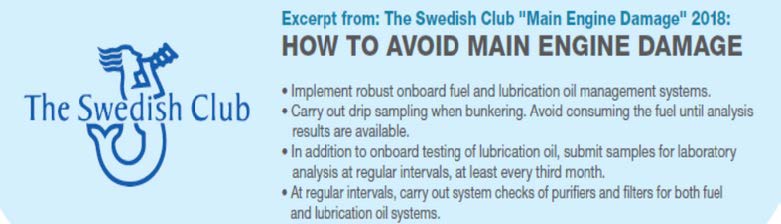
As far back as 2018, The Swedish Club released their independent report, “Main Engine Damage”. This report highlighted how to avoid engine damage, including information showing the average cost of a single fuel management incident onboard a vessel was $344,069. It also stated the average cost of a single lubrication failure was $763,320.
The Swedish Club’s advice and recommendations were:
Back in 2019, in the lead up to IMO2020 and the reduction in the global sulphur cap to 0.50%, VPS foresaw potential quality issues with the new incoming VLSFO fuels. These fuels would be of higher paraffinic content, leading to poorer cold-flow behaviour, potential wax precipitation and major stability issues. VPS recognised that the ISO8217 standard did not provide sufficient protection to a vessel, when using VLSFO, or even HSFO and MGO fuels.
Therefore, the VPS Additional Protection (APS) service was launched prior to 2020. This service offers the full ISO8217 test scope, plus a number of additional tests, in one package offering, at a significantly reduced price, in order to ensure a greater level of protection to vessels and enhanced peace-of-mind to the, now more informed operator, using this service.
The APS Package is customised by fuel type, to cover, HSFO, VLSFO, or Distillates. The additional tests included, will provide much more information and greater understanding of the fuel in relation to stability, chemical contamination, cold-flow properties, lubricity and microbial-activity. The package can also be further customised to individual customer requirements. Many VPS customers have used and continue to use APS, to mitigate the potential risks from poor quality fuel and benefit from the added-value and cost savings, the service delivers.
In 2022, the incoming range of marine biofuels, warranted VPS to research a number of different additional tests to assist in identifying biofuel management issues and understanding their behaviour and operational risks. As a consequence, VPS launched the APS-BIO packages. Once again, these include the ISO8217 as a base test slate, but also include additional tests to measure energy content, stability, renewable content, microbial-activity, corrosivity and cold-flow properties. The APS-BIO suite of test slates cover different bio-components such as FAME, HVO, CNSL, plus the fossil fuels used in a bio-blend, eg HSFO, VLSFO, MGO.
Once again VPS customers, are seeing real benefits and added-value, as they look to use biofuels as their decarbonisation option, knowing that in VPS they have an experienced, expert fuel management partner.
Photo credit: VPS
Published: 2 October, 2024
Bunker Fuel Quality
VPS: High bunker prices meet declining fuel quality
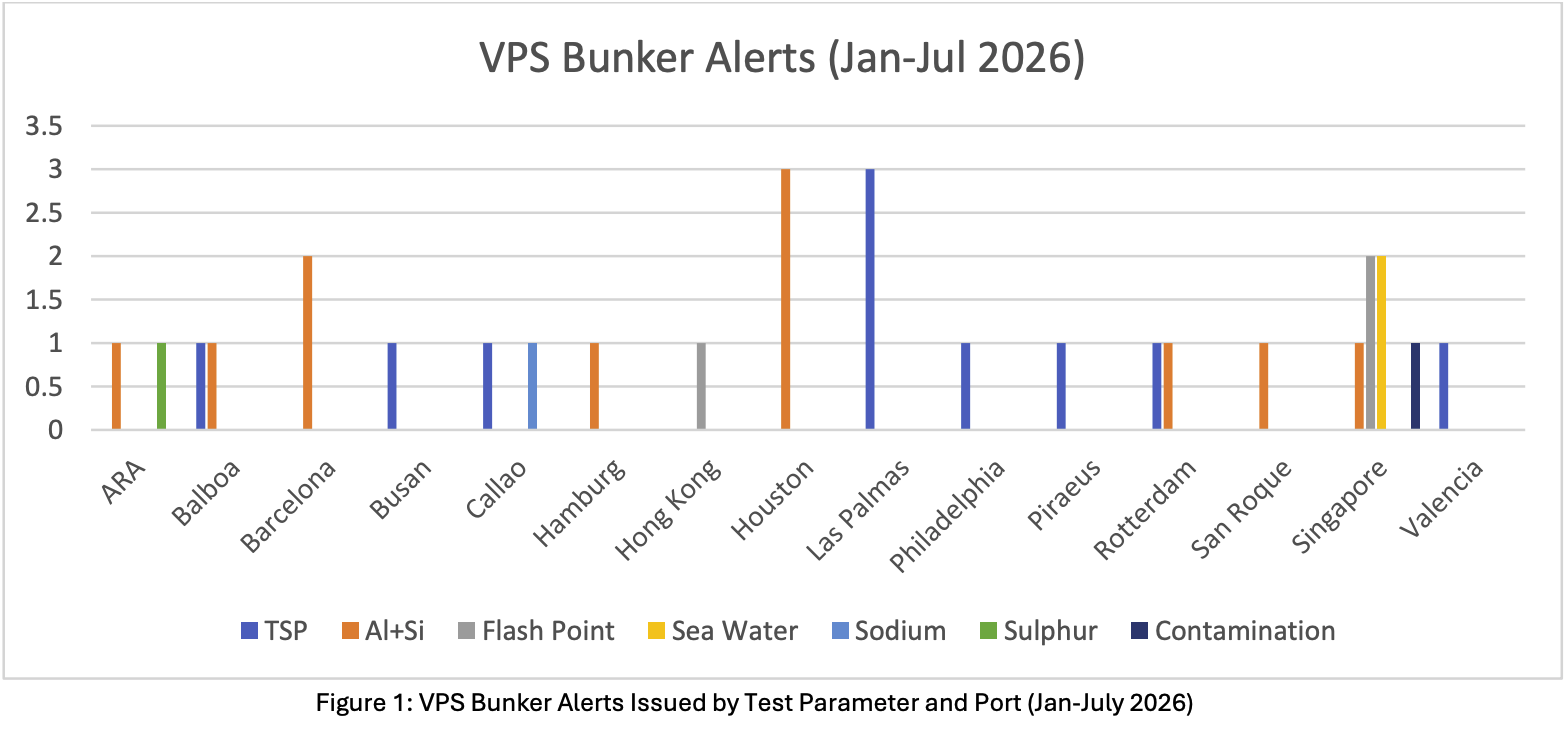
Of the current 29 Bunker Alerts issued by VPS from January to July 2026, the combination of abrasive issues due to elevated cat-fines, plus fuel stability issues, account for 72% of these alerts.
Steve Bee, Group Marketing and Strategic Projects Director of marine fuels testing company VPS, on Monday (24 August) reviewed 2026 marine fossil fuel quality to date and the high number of issues being witnessed:
Marine fuel buyers entered 2026 facing a perfect storm, suffering some of the highest bunker prices ever experienced, paired with a sharp and concerning decline in fuel quality. Across the traditional marine fossil fuel supply chain, VPS has seen a marked rise in fuel quality issues, with the Middle East conflict playing a major role in driving both price volatility and quality deterioration. For ship owners/operators, the message is clear, today’s fuel market is not only more expensive, it is also becoming more complex and unpredictable, with a higher degree of operational risk.
This deterioration is already showing itself in the test data VPS have produced. Between January and July 2026, VPS issued 29 Bunker Alerts, more than the total issued across the whole of 2024 and already closing in on the 37 alerts recorded throughout all of 2025. In just seven months of 2026, the scale and frequency of these alerts underline a clear, accelerating rise in fuel quality problems across the industry. Of the current 29 Bunker Alerts issued so far, Jan-Jul 2026, the combination of abrasive issues due to elevated cat-fines, plus fuel stability issues, account for 72% of these alerts. The ports requiring cat-fines and/or stability-related bunker alerts were, ARA, Balboa, Busan, Callao, Hamburg, Houston, Las Palmas, Philadelphia, Piraeus, Rotterdam, San Roque, Singapore and Valencia.
What is of additional interest is that marine gas oil does not account for a single Bunker Alert so far in 2026. It is HSFO and VLSFO dominating the fuels requiring such warnings.
Looking at the rate of off-specifications across each of the main marine fossil fuel types, HSFO is currently running at 8.87% of samples tested, being off-specification for at least one ISO8217 test parameter, whilst VLSFO has 9.88% off-specification level, MGO has 9.03% and ULSFOs is at 19.58%. ISO 8217 provides specification requirements for marine fuel as delivered to the ship. From a commercial perspective the fuel is only required to meet the specification at the point of custody transfer, ie at the ship’s manifold. However, compliance at this point, is not a guarantee of assurance that the fuel can be used without operational difficulties throughout its onboard lifecycle. This includes, how the fuel is stored, treat and consumed in main engines, generator engines, boilers, or other machinery. The condition of the fuel which ultimately reaches the machinery, is also strongly influenced by onboard fuel management, including storage and settling temperatures, settling time, purification temperature and throughput, purifier configuration and desludging arrangements, filtration, maintenance of the correct injection viscosity and other operational factors.
This is why knowing the characteristics of the bunkered fuel is critical to managing it correctly onboard. Appropriate testing can identify characteristics which, although not necessarily resulting in an ISO 8217 specification failure, may warrant additional operational attention. VPS therefore evaluates bunker fuels not only against the applicable specification requirements, but also provides operational advice where analytical findings indicate that additional precautions may be appropriate during storage, treatment or consumption.
VPS testing and observations, based on over 45 years of marine fuel testing experience and expertise, strongly align with a recent Linkedin post by marine and energy consultants, Brookes Bell. Their post highlighted a growing concern within the industry, stating a P&I Club had reported that bunker-related claims are up 50% this year, with many of the fuels involved having technically passed ISO8217 standard specification testing.
The same post noted that some ISO8217-compliant fuels have still caused operational damage. This has left shipowners to manage complex evidentiary disputes after problems arose. Its key warning was clear: Standard compliance testing alone isn’t catching the problem. If “passing spec” is not necessarily the same as being “safe-to-burn”, then the critical question becomes, “What additional testing is needed to identify the real operational risks?”
VPS have recognised that for some time, the ISO8217 standard is not an all-encompassing set of tests providing the highest level of asset, crew and environmental protection. For this reason, VPS offer a range of additional tests, as well as our Additional Protection Service (APS) test bundles. For example in the case of avoiding damages from cat-fines, the Fuel System Check (FSC) service, can provide valuable information in regard to monitoring purifier efficiency and the removal of cat-fines, protecting the engine to a higher degree. Whereas, Separability Number testing, is a key compliment to the hot filtration stability tests of TSP, TSA and TSE in mitigating stability risks. Should additional cold-flow information be required, the VPS proprietary Wax Appearance Temperature (WAT) testing provides key storage and fuel transfer temperature information. Whilst the VPS chemical screening services can identify potentially harmful chemicals within a fuel before the fuel is burnt. Then more detailed Gas Chromatography Mass Spectrometry (GCMS) forensic analysis provides key information to potentially support the fuel claims process.
VPS account managers and technical specialists can help shipowners and operators determine which laboratory tests are most appropriate for their fleet, based on the fuel characteristics, vessel operations and potential risk exposure. This guidance can support the mitigation of risks linked to engine damage, SOLAS compliance, legislative requirements and wider operational reliability.
The VPS Technical Advisory Team reviews bunker analysis results together with the vessel operational observations to provide practical advice on fuel storage, handling, purification and overall fuel management. Where appropriate, additional laboratory tests, or test bundles, may be recommended to further evaluate the fuel and assist in identifying the cause of an operational issue, supporting more informed decision-making.
VPS continues to monitor regional and global fuel quality trends through its laboratory network and customer feedback. Information received from vessels experiencing similar operational issues is valuable in helping VPS identify emerging trends and provide timely technical guidance to the wider shipping industry.
Photo credit: VPS
Published: 25 August, 2026
Bunker Alerts
Low flashpoint found in Indonesia bunker fuels, alerts Maritec-Naias
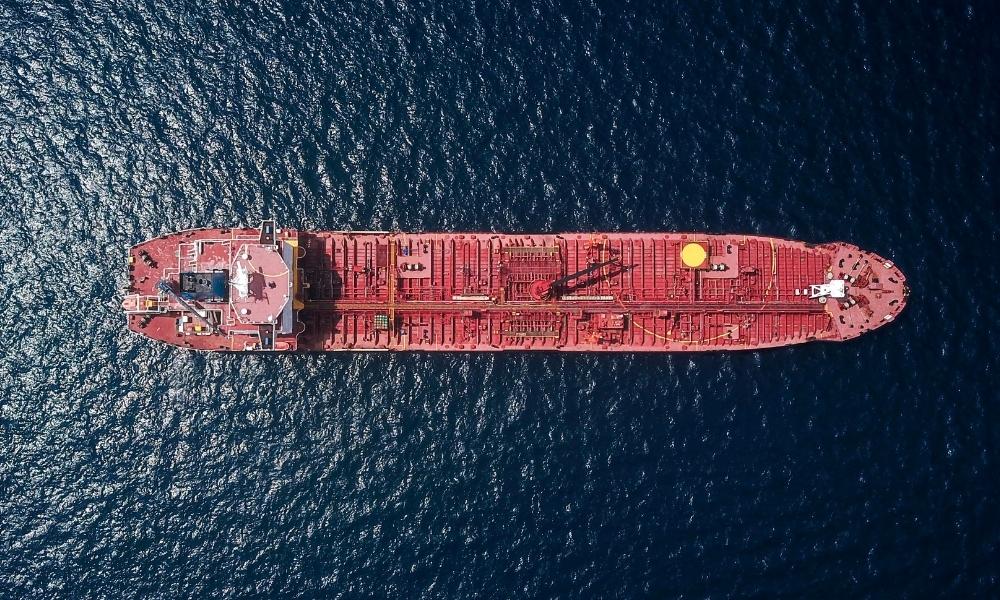
Firm tested eight bunker samples representing LSMDO and B40 fuel grade from vessels that took fuel oil /bunkered in Indonesia ports, which indicated flashpoints as low as 39.5°C.
Bunker Alerts
Maritec-Naias: High levels of Phenolic compounds in China bunker fuels
Firm tested multiple fuel oil bunker samples from vessels that took fuel/bunkered in China ports from 7 June to 28 July, which indicated the presence of high levels of Phenolic compounds.


OUR INDUSTRY PARTNERS

Yang Ming orders six LNG dual-fuel, ammonia-ready containerships from Hanwha Ocean

LR, China’s MARIC unveil tanker concept ready for three future bunker fuels

DNV: Alternative-fuelled vessel orders hit highest monthly level since October 2024

TFG Marine advances global MFM rollout with two US Gulf bunker barges

GENA Solutions: Total renewable and low-carbon methanol project pipeline increases from 61.8 to 62.2 Mt by 2032

Baltic Exchange: Bunker Report (3 September 2026)

ENGINE: Americas Fuel Availability Outlook (3 September 2026)

Singapore-flagged tugboat “Kim Heng 3203” placed under Sheriff’s arrest

US targets five bunker companies in latest sanctions campaign against Iran

Singapore bunkering community supports Living Hope Evangelism’s 7th anniversary outreach for residents in need

China’s bunker market reshaped by tax rebates, trade flows and refining changes, says economist

Hengli Petrochemical’s ex-Singapore trading arm faces winding up application

Rajah & Tann: Bunker disputes are won in the first 48 hours

Report: GCMD outlines practical approach to quantity assurance in marine biofuel supply chains
-
 Vessel Arrest1 week ago
Singapore-flagged tugboat “Kim Heng 3203” placed under Sheriff’s arrest
-
 Sanctions2 weeks ago
US targets five bunker companies in latest sanctions campaign against Iran
-
 Events2 weeks ago
Singapore bunkering community supports Living Hope Evangelism’s 7th anniversary outreach for residents in need
-
 Interview1 week ago
China’s bunker market reshaped by tax rebates, trade flows and refining changes, says economist
-
 Winding up2 weeks ago
Hengli Petrochemical’s ex-Singapore trading arm faces winding up application
-
 Bunker Claim4 days ago
Rajah & Tann: Bunker disputes are won in the first 48 hours
-
 Biofuel1 week ago
Report: GCMD outlines practical approach to quantity assurance in marine biofuel supply chains
-

 Winding up1 week ago
Singapore: Notices of annual meeting issued for Vroon Shipping Asia and related firms