Connect with us

Bunker Fuel

Silversea names LNG-fuelled hybrid cruise ship “Silver Nova” in Fort Lauderdale

It was previously reported that the ship operates with a propulsion system, a combination of LNG, fuel cell system and batteries; a fuel cell system will be used on board to supplement LNG machines.

Admin

Published

on

Silversea names LNG-fuelled hybrid cruise ship “Silver Nova” in Fort Lauderdale

Silversea on Thursday (4 January) said it named its newest LNG-fuelled hybrid cruise ship Silver Nova during a ceremony in Fort Lauderdale, honouring maritime traditions to welcome the ‘Ship of Light’ to its fleet. 

Silversea is one of five cruise brands owned by global cruise company Royal Caribbean Group.

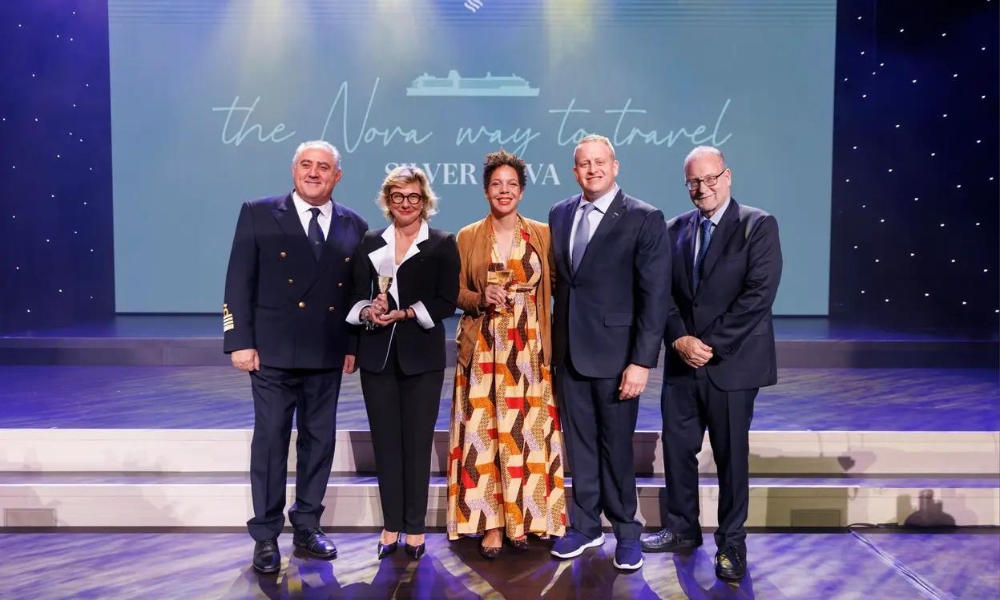
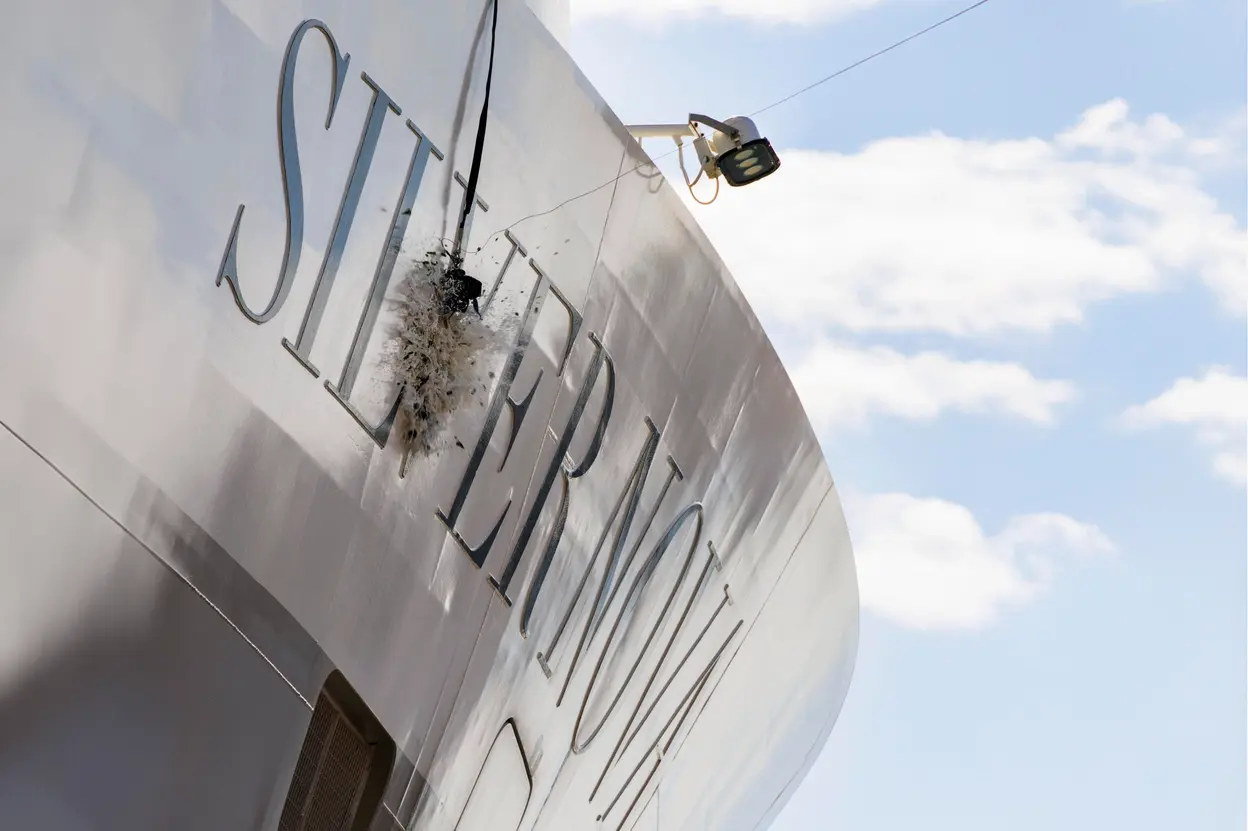
Reverend Sanford Sears and Rabbi Adam Watstein blessed Silver Nova. Barbara Muckermann, President of Silversea, and Jason Liberty, President and CEO of Royal Caribbean Group, addressed members of the Brand’s extended family and announced the ship’s Godmother: celebrated chef, restaurateur, and television personality Nina Compton. Rounding out the ceremony, Compton – accompanied by Captain Cosimo Pontillo – officially named Silver Nova and triggered a magnum-sized bottle of champagne to smash on the ship’s hull, before Liberty led guests in a toast to mark the momentous occasion.

“After years of research, development, and collaboration, we are all incredibly proud to officially welcome Silver Nova into Royal Caribbean Group’s fleet. Silver Nova is a game changer, a new vision for the ultra-luxury travel experience,” said Jason Liberty. 

“We will continue to push boundaries and innovate the vacation experience in 2024 with our three global brands that, together, turn the vacation of a lifetime into a lifetime of vacations for our guests around the world.”
Silversea names LNG-fuelled hybrid cruise ship “Silver Nova” in Fort Lauderdale

“It is fitting that we officially named Silver Nova – a truly pioneering ship – in the same year Silversea celebrates its 30th anniversary: the ship connects our history with our tomorrow, striking a perfect balance between our Brand’s refined heritage and the future of ultra-luxury cruise travel,” said Barbara Muckermann. 

“Launching this pioneering ship would not have been possible without the invaluable support of Jason Liberty, and all involved at Royal Caribbean Group, Silversea, and Meyer Werft. A strong expression of our brand positioning, Silver Nova will immerse guests into the world’s most enriching destinations, championing human connection and cultural discovery. For this reason, Chef Nina Compton is the perfect fit for the ship’s Godmother – her values perfectly align with those at the heart of our S.A.L.T. culinary program, and I have no doubt she will inspire our guests to engage meaningfully with the planet and its people.”

Manifold Times previously reported shipbuilder Meyer Werft handing over its newest cruise ship, Silver Nova, to Silversea Cruises.

Jan Meyer, Managing Director of Meyer Werft said with the propulsion system, a combination of LNG, fuel cell system and batteries, the ship has the best possible measures to reduce emissions.

A fuel cell system will be used on board to supplement the LNG machines and will later be able to supply the entire hotel operation. Pollutant emissions during berthing times in port are thus completely avoided. 

Related: Titan completes LNG bunkering operation of Silversea Cruises ship “Silver Nova”
Related: Meyer Werft delivers LNG-fuelled hybrid cruise ship “Silver Nova” to Silversea Cruises


Photo credit: Silversea
Published: 8 January, 2024

Continue Reading

Ammonia

HPA and MB Energy develop safety concept for STS ammonia bunkering

HPA says the Port of Hamburg will become “bunker ready” for ammonia, laying the groundwork for safe and reliable ammonia bunkering in the future.

Admin

Published

on

By

HPA and MB Energy develop safety concept for STS ammonia bunkering

The Hamburg Port Authority (HPA) and integrated energy company MB Energy on Tuesday (21 July) said they have completed a comprehensive risk analysis and developed a dedicated safety concept for ship-to-ship ammonia bunkering.

MB Energy said the analysis lays the groundwork for the safe introduction of ammonia as a future marine fuel.

“With our planned ammonia import terminal in Hamburg-Blumensand, MB Energy intends to provide the reliable land side supply infrastructure needed to support this transition across northern German ports,” it said in a social media post. 

Mabanaft Group was renamed to MB Energy last year and merged over 50 existing brands under one identity. 

Separately, HPA said the Port of Hamburg will become “bunker ready” for ammonia, laying the groundwork for safe and reliable ammonia bunkering in the future.

“The focus is in particular on container ships, cruise ships as well as RoRo and ConRo (Container/RoRo) ships,” it said. 

“We expect ammonia to establish itself as an alternative marine marine fuel in the coming years. With our preparatory work, we are already creating the conditions to welcome the first ammonia-powered ships in Hamburg and to bunker them safely.:

HPA added that the import terminal for ammonia planned by MB Energy from 2029 will make a decisive contribution to ensuring the reliable availability of ammonia as a bunker fuel in northern German ports in the long term. 

“The use of an ammonia bunker barge is considered a possible addition to the landside infrastructure to enable ship bunkering in the port and beyond in the future,” it said.

Related: Mabanaft Group renames as MB Energy, merging over 50 brands under one identity


Photo credit: Hamburg Port Authority
Published: 22 July, 2026

Continue Reading

Bunker Fuel

Alkagesta highlights key insights of Malta bunkering market in 2026

Darren Lee Axisa discusses the key trends influencing Malta’s bunkering market and the factors that will determine Malta’s long-term competitiveness as a regional bunkering hub.

Admin

Published

on

By

Alkagesta highlights key insights of Malta bunkering market in 2026

In an article published on Alkagesta Market Insights, Darren Lee Axisa, Malta Country Manager of Alkagesta, on Monday (20 July) discussed the key trends influencing Malta’s bunkering market and the factors that will determine Malta’s long-term competitiveness as a regional bunkering hub: 

Malta’s bunkering and energy market is moving through a period of structural adjustment. The disruptions that defined the first half of 2026 have accelerated shifts in product demand, terminal strategy, and the competitive dynamics of one of the Mediterranean’s most strategically positioned bunkering hubs. For Alkagesta, whose storage footprint on the island approaches 300,000 cubic metres, the period has tested operational flexibility while reinforcing the value of diversified infrastructure access.

A Market Shifting in Two Directions

Malta’s broader economy has remained resilient — GDP growth reached 3.9% in Q1 2026 — but the bunkering market has undergone a significant product mix shift, the roots of which predate the current geopolitical disruption.

The Mediterranean Emission Control Area, which came into force on 1 May 2025, triggered an immediate and measurable realignment in fuel demand across the region. VPS data covering the first six months post-ECA implementation shows that across the top ten Mediterranean bunkering ports, VLSFO volumes fell 23%, MGO more than doubled, ULSFO quadrupled, and biofuels increased fivefold. In Valletta specifically, the shift was even more pronounced: VLSFO dropped 57% from 111,641 mt to 47,732 mt, while MGO volumes more than tripled from 33,299 mt to 103,445 mt, and ULSFO rose from 2,821 mt to 34,535 mt over the same period.

This structural rotation has been further accelerated by the broader regulatory environment. FuelEU Maritime and EU ETS requirements are pushing shipowners toward cleaner, verifiable fuel options at every port call — a direction Alkagesta had already positioned itself ahead of, having been among the first movers in the Mediterranean to support the transition to 0.1% sulphur fuel oil following the ECA’s introduction.

Layered on top of this regulatory shift has been a period of reduced terminal capacity affecting bunkering market availability across the island. Fuel oil volumes dropped roughly 35% year-on-year between January and May 2026, falling from approximately 382,000 mt in 2025 to 247,000 mt. DMA demand moved sharply in the opposite direction, rising from around 150,000 mt in January to April 2025 to 247,000 mt over the same period in 2026 — a trend consistent with both the ECA-driven product mix shift and the disruption to heavier fuel availability during the constrained period.

Note: The full article can be read here


Photo credit: Alkagesta
Published: 22 July, 2026

Continue Reading

Bunker Fuel

ENGINE: East of Suez Fuel Availability Outlook (22 July 2026)

Availability tight across all grades in Singapore; bad weather keeps bunkering halted in Zhoushan’s outer anchorages; availability good across several Sri Lankan ports.

Admin

Published

on

By

RESIZED ENGINE East of Suez

The following article regarding regional bunker fuel availability outlook for the East of Suez region has been provided by online marine fuels procurement platform ENGINE for publication on Singapore bunkering publication Manifold Times:

  • Availability tight across all grades in Singapore
  • Bad weather keeps bunkering halted in Zhoushan’s outer anchorages
  • Availability good across several Sri Lankan ports

Singapore and Malaysia

VLSFO availability in Singapore remains tight, with recommended lead times at 14-19 days, largely unchanged from last week. Tightness persists because Singapore’s fuel oil inventories have yet to recover to pre-conflict levels, while cargo arrivals remain constrained due to renewed US-Iran hostilities disrupting traffic through the Strait of Hormuz.

According to the latest Enterprise Singapore data, fuel oil stocks dropped below 18 million bbls in June from more than 23 million bbls in March. Inventories have also remained below 20 million bbls so far this month.

The lower inventory levels have tightened VLSFO supply, lending support to the benchmark price.

HSFO availability also remains tight, with recommended lead times of 9-13 days, compared with 10-12 days a week ago. LSMGO supply has tightened further, with lead times widening to 9-11 days from 6-9 days last week.

In Malaysia’s Port Klang, bunker fuel availability remains tight. VLSFO supply is constrained for prompt stems, while LSMGO availability also remains limited. HSFO continues to face supply pressure.

East Asia

Despite softer demand, VLSFO availability in Zhoushan has tightened, with recommended lead times extending to around 12 days, up from about eight days previously. A source attributed the longer waiting times to limited refinery supply.

Lead times for both LSMGO and HSFO have also lengthened to around seven days, compared with about five days last week.

Meanwhile, bunkering operations at Zhoushan’s outer Tiaozhoumen and Xiazhimen anchorages have remained suspended since 7 July due to adverse weather. Most suppliers are still uncertain about when normal bunker operations across the port will fully resume, the source added.

Bunker fuel availability across northern China remains mixed. Suppliers in Dalian and Qingdao have ample stocks of VLSFO and LSMGO, although HSFO availability in Qingdao remains limited. In Tianjin, all major bunker grades continue to face supply constraints, while VLSFO and HSFO remain tight in Shanghai. LSMGO availability in Shanghai, however, is relatively stable.

Supply constraints also persist across several southern Chinese ports. Both VLSFO and LSMGO remain tight in Fuzhou. Xiamen has sufficient VLSFO availability but tighter LSMGO supply, while both grades remain constrained in Yangpu and Guangzhou.

Hong Kong’s bunker market remains steady, with recommended lead times for all major bunker grades holding at around seven days, broadly unchanged from recent weeks.

In Taiwan, state-owned bunker supplier CPC Corporation (CPC) has temporarily stopped accepting new LSMGO nominations for deliveries at Kaohsiung due to a tight barge schedule.

According to a source, LSMGO deliveries have been suspended since last Friday and will remain on hold until CPC clears its backlog of pending orders.

The disruption has also affected VLSFO supply in Kaohsiung, with recommended lead times increasing to 4-5 days from around three days last week.

Elsewhere in Taiwan, bunker availability remains stable. Recommended lead times for both VLSFO and LSMGO are around two days in Hualien, while Keelung and Taichung continue to record lead times of about three days, broadly unchanged from the previous week.

Bunker fuel availability has tightened across South Korea’s southern ports, including Busan, Ulsan, Masan, Onsan, Yeosu and Kwangyang. Recommended lead times for both VLSFO and LSMGO have increased to 9-16 days, from 4-12 days last week. HSFO has also tightened, with lead times extending to 9-16 days from 4-12 days a week earlier.

In South Korea’s western ports—including Incheon, Daesan, Dangjin, Pyeongtaek and Taean—recommended lead times for VLSFO and LSMGO remain at 9-16 days, largely unchanged from last week. HSFO availability has tightened, with lead times rising to 9-16 days from 4-12 days previously.

Weather-related disruptions are expected to affect bunker operations in Daesan on 21 and 23 July.

Supply remains constrained at major Japanese ports, including Tokyo, Chiba, Kawasaki, Kashima, Nagoya, Yokkaichi, Osaka, Kobe, Mizushima and Oita. VLSFO and LSMGO continue to be offered by only a limited number of suppliers, while HSFO is relatively more accessible, with recommended lead times of around 7-10 days.

In contrast, Indonesia’s bunker market remains comfortably supplied. VLSFO availability is stable across Jakarta, Surabaya, Balikpapan and Cigading, where suppliers are generally recommending lead times of around 2-3 days.

Oceania

VLSFO availability remains stable in Western Australia, with suppliers in Kwinana and Fremantle generally recommending lead times of around seven days. Bunkering at both ports is handled by a single supplier, with all deliveries carried out by barge.

Supply conditions are more mixed along Australia’s east coast. In Port Kembla, VLSFO can be supplied via truck or pipeline, while suppliers in Sydney maintain adequate stocks of both VLSFO and LSMGO. HSFO remains comparatively tighter in Sydney, where suppliers typically require around seven days of advance notice.

In Queensland, VLSFO and LSMGO availability remains good in Brisbane and Gladstone, with recommended lead times also holding at around seven days.

Further south, suppliers continue to maintain healthy VLSFO inventories in Melbourne and Geelong. However, bunker deliveries at both ports depend on a single barge, keeping lead times at about one week. HSFO supply has tightened further in both Melbourne and Brisbane.

Meanwhile, one supplier is offering all major bunker grades in Brisbane, Sydney and Melbourne with lead times of around five days. In Dampier, bunker deliveries continue to be conducted through truck-assisted pipeline operations, making advance planning and berth confirmation particularly important, according to a market source.

Across the Tasman Sea, bunker fuel availability remains broadly unchanged in New Zealand. VLSFO is readily available in Tauranga and Auckland, where suppliers recommend lead times of around four days. At Marsden Point, both VLSFO and LSMGO can be supplied directly to vessels through pipeline infrastructure.

Weather continues to present operational risks across New Zealand. Bunker deliveries remain particularly susceptible to disruption in Wellington and ports across the South Island, where adverse weather can periodically interrupt supply operations.

South Asia

Recommended lead times for VLSFO and LSMGO at India’s west coast ports of Kandla, Sikka, Pipavav, Dahej and Hazira remain at 3–4 days, according to a source.

The monsoon is expected to disrupt bunker operations at several Indian ports over the coming days, with weather-related delays likely to affect delivery schedules. Bunkering is forecast to face disruptions at Kandla and Sikka between 20–24 July, while rough sea conditions could hamper operations in Mumbai, Cochin and Visakhapatnam during the same period.

In Sri Lanka, bunker market conditions remain stable, with adequate stocks of all major bunker fuel grades in Colombo and Hambantota. One supplier is recommending lead times of around seven days, almost unchanged from last week.

Adverse weather could also intermittently disrupt bunker operations in Colombo between 20–24 July and in Trincomalee between 20–23 July, potentially delaying bunker deliveries.

Middle East

Despite escalating US-Iran hostilities in the Strait of Hormuz, bunker fuel availability has improved in Fujairah. VLSFO and LSMGO supply has eased, with several suppliers now able to accommodate prompt delivery requests. HSFO availability, however, has tightened and is largely being offered only on a firm enquiry basis.

Similar supply conditions are being reported at the neighbouring UAE bunker hub of Khor Fakkan.

In Jeddah, VLSFO and LSMGO availability remains relatively stable.

In Qatar’s Ras Laffan, VLSFO and LSMGO supply continues to be constrained.

At Port Suez in Egypt, HSFO inventories remain tight, while VLSFO stocks are close to depletion.

Further south, the availability of all major bunker fuel grades remains limited in Djibouti.

By Tuhin Roy


Photo credit and source: ENGINE
Published: 22 July, 2026

Continue Reading

Trending