
Alternative Fuels
DNV: Demand for greener supply chain boosts PCTC newbuild market in China
Recent deliveries prove the operability and efficiency of new technologies and alternative bunker fuels such as LNG; latest orders and designs invest in ammonia- and methanol-ready solutions.

Classification society DNV on Tuesday (7 March) released a Maritime Impact article regarding the pure car and truck carrier (PCTC) market booming again after a five-year drought in newbuild orders, with a majority contracted to Chinese shipyards.
According to DNV, recent deliveries prove the operability and efficiency of new technologies and alternative fuels such as LNG. Latest orders and designs invest in ammonia- and methanol-ready solutions too:
Data from Clarkson shows this niche area is outperforming the rest of the shipping market, with 38 newbuild PCTCs ordered in 2021 and 90 more in 2022. The rise rests on several factors: limited shipping capacity, an increase in trade of vehicles since late 2020, the quest for greener supply chain solutions, particularly from electric vehicle manufacturers, and demand to replace traditional-fuelled PCTCs with those that meet IMO’s environmental regulations.
China dominates global PCTC construction, with over 85% of orders placed
Most newbuild orders centre on eight Chinese shipyards: CSSC’s Jiangnan Shipyard, Guangzhou Shipyard International (GSI) and Shanghai Waigaoqiao Shipbuilding; China Merchants’ Nanjing Jinling, Jinling Weihai and Heavy Industry (Jiangsu) (CMHI) shipyards; Fujian Shipbuilding Group’s Xiamen Shipbuilding Industry Co. (XSI); and Yantai CIMC Raffles.
Technical requirements call for advanced engineering skills
The technical requirements for PCTC construction, such as proper control of weight and deformation and experience in LNG, methanol and ammonia fuel systems, have increased the entry barriers for shipyards.
William Zhou, GSI Vice President, explains that Chinese shipyards’ striving to improve technology and craftsmanship quality in preparation for these advanced ship orders enabled them to emerge as clear winners.
He says GSI has continually invested in research and innovation, grown its technical and engineering teams, and widened its expertise and experience in alternative fuels. GSI is now a leading shipyard building advanced green ships such as PCTCs, RoPax ferries, semi-submersibles and ice vessels propelled by new energies. Its order book has over 20 PCTCs, with delivery dates through to 2025.
Recent PCTC deliveries proved shipbuilding excellence
Zeng Zhi, DNV’s ship type expert for PCTCs in Greater China, says the proven quality of previously delivered PCTCs, such as Jinling’s 6700 series for Gram Car Carriers, XSI’s 8500 series for Höegh and Jiangnan’s DF 3600 series for UECC, have encouraged international shipowners to order new ships in China.
DNV’s expertise in PCTCs dates back to 1964 when the world’s first pure car carrier (499 grt, 725 dwt, 450 cars) was built by Norwegian shipyard Trosvik Verksted A/S. Since then, DNV has developed advanced technology and class solutions for PCTCs that are second to none. Today, DNV is the class of choice for over 60 per cent of new PCTC orders.
DNV supports all stakeholders during newbuilding process
Keng Chen, DNV Vice President and Area Manager for China South, notes that the fast-growing PCTC order book presents challenges for its shipyard clients, particularly new players, in terms of having sufficient qualified engineers and managers and maintaining quality levels.
DNV supports key stakeholders in PCTC construction with a focused approach to emerging issues and helps its partners build awareness of critical risk factors related to this type of vessel, allowing them to prepare timely mitigation actions.
Technologies, new fuels and cyber security are setting the training agenda
Several technical seminars have been rolled out to shipyards addressing hull, machinery, electrical and instrumentation, as well as specific topics on LNG such as fuel, battery systems and cyber security. Customer feedback has been exceptionally positive.
Mr Chen adds: “The advantage DNV has in leveraging its global expertise to generate added value for customers goes without saying. We have tremendous support, both in our plan approval network and advisory units, from our colleagues worldwide in Norway, Germany, Finland, Poland, Korea and Singapore. Together with our highly competent local project team, we are convinced our joint efforts will contribute positively to achieving industry-class quality levels for PCTC newbuilds.”
New generation of PCTC: Bigger, greener and safer
Due to the increasing number of electric vehicles as well as IMO environmental regulations, such as EEXI and CII, coming into force, designers are focusing more on developing greener features to meet the requirements of car manufacturers and consumers.
When the 3,600 CEU PCTC AUTO ADVANCE – the first of three vessels for UECC – sailed from Jiangnan Shipyard on 29 November 2021 to begin serving routes between North Europe and the Mediterranean, she became the world’s first LNG-powered battery hybrid solution PCTC. It incorporated major advanced technologies, such as an optimized hull line, a shaft generator and an energy-efficient management system.
DNV’s ammonia and methanol-ready notations future-proof PCTC newbuilds
In early 2022, Höegh Autoliners signed with CMHI’s Jiangsu yard for four fixed and eight optional 9,100 CEU PCTCs. According to the designer Deltamarin, the Aurora-class PCTCs will be powered by marine gas oil and LNG and prepared for operation on zero-carbon fuels once these become more widely available.
Combining economy of scale with an optimized and future-proofed ship concept results in the lowest greenhouse gas footprint per transported car in the industry, and a clear path to zero-emission operation. With DNV’s ammonia and methanol-ready notations making them zero-carbon-ready in due time, these ships represent the world’s largest and most environmentally friendly PCTCs.
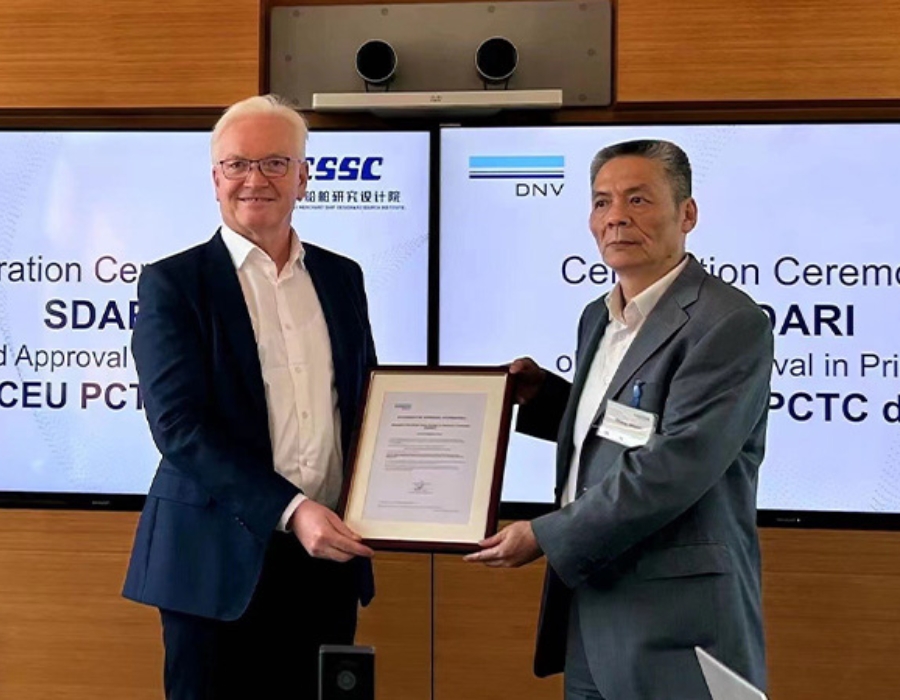
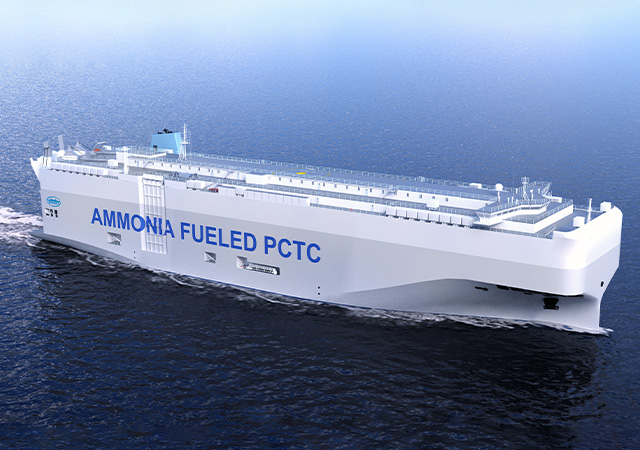
Chinese ship designer Shanghai Merchant Ship Design & Research Institute (SDARI) has also kept pace with research and innovation in developing the next-generation PCTC. Based on its popular LNG dual-fuelled 7,000 CEU PCTC, SDARI developed an ammonia-fuelled version and was awarded DNV’s Approval in Principle in early 2022.
Reducing transport costs and emissions per car
SDARI then developed a 9,400 CEU LNG-fuelled PCTC, boasting lower transport costs and carbon emissions per car as well as more competitive loading capacity and fuel economy. It also adopts a future-proof design and fully adapts to the needs of electric vehicle transport.
An “ammonia-fuel-ready” scheme, which can transform into blue ammonia and green ammonia fuel in the future, will provide a new carbon-neutral solution for the construction of international green shipping corridors. The vessel is also equipped with a larger-capacity lithium battery to provide clean electricity at ports, while the shaft generator can help achieve net zero carbon during the voyage. This design received DNV Approval in Principle in November 2022.
Launches of low-carbon PCTCs show that R&D efforts are bearing fruit
SDARI’s Chief Car Carrier Expert Zhang Minjian says: “Following market demand and emerging trends of PCTCs, SDARI has formed a strong professional team and devoted itself to the research and development of the latest generation of clean-fuel, large-sized PCTCs. It has achieved several technical advances and launched a series of excellent green and low-carbon ship types, providing many options for domestic and foreign automobile transport shipowners.”
SDARI’s long-term cooperation with DNV began in 2012 on the 6,700 CEU PCTC for Gram Car Carriers at Nanjing Jinling Shipyard, SDARI’s first large car carrier design for international owners. SDARI now has about 70 per cent market share of the current PCTC order book.
Mitigating the risks of fire accidents
Following recent fire accidents on several car carriers, fire safety is becoming increasingly vital for ship operators. There are four layers to address this concern:
– Mandatory SOLAS regulation updates. For example, the A30 fire insulation between car decks from 2014 and Reg.20-1 addressing gas-fuelled vehicles.
– Class societies’ additional notations, such as DNV’s voluntary F(C) class notation to enhance fire safety in cargo holds, targeting quick detection and confirmation of fire and ensuring fire extinguishing equipment reliability.
– Shipowners’ unique requirements in their newbuild technical specs, such as CCTV on car decks, thermal cameras etc.
– Operational measures like electric vehicle stowage plans, emergency handling procedures and enhanced fire patrols.
Zeng Zhi says: “DNV is also working with several major car carrier owners and operators to find cost-effective technical and operative measures to tackle the challenges of electric vehicle fires.”
Market outlook for PCTC
The rapid growth of Chinese car exports is a critical factor in the accelerated orders of new PCTCs. According to the China Association of Automobile Manufacturers, car exports in 2021 surpassed 2 million, a 100 per cent increase from 2020, and reached 3.1 million in 2022, a further 54 per cent increase.
Chinese shipping companies such as COSCO Shipping, China Merchants Energy Shipping and SAIC Anji Logistics are ramping up efforts to expand capacity by ordering new PCTCs to overcome a shortfall in shipping capacity and safeguard the supply chain. Major Chinese carmakers, like BYD and Cherry, are also ordering new PCTCs. DNV is selected as class for all these emerging PCTC owners.
Low-carbon fuels and energy efficiency will drive the future market
Hans Eivind Siewers, DNV’s global business director for PCTC and passenger ships, says the current boom probably has peaked, but that we still will experience many orders in 2023.
Siewers thinks greener and carbon-neutral fuel options will receive more attention beyond the current orders of LNG dual-fuel use and striking the right balance on fuel flexibility will be key. Other energy-saving technologies, such as battery hybrid, air lubrication systems and sails, will gain momentum as the PCTC green evolution advances.
Photo credit: DNV
Published: 14 March, 2023
Alternative Fuels
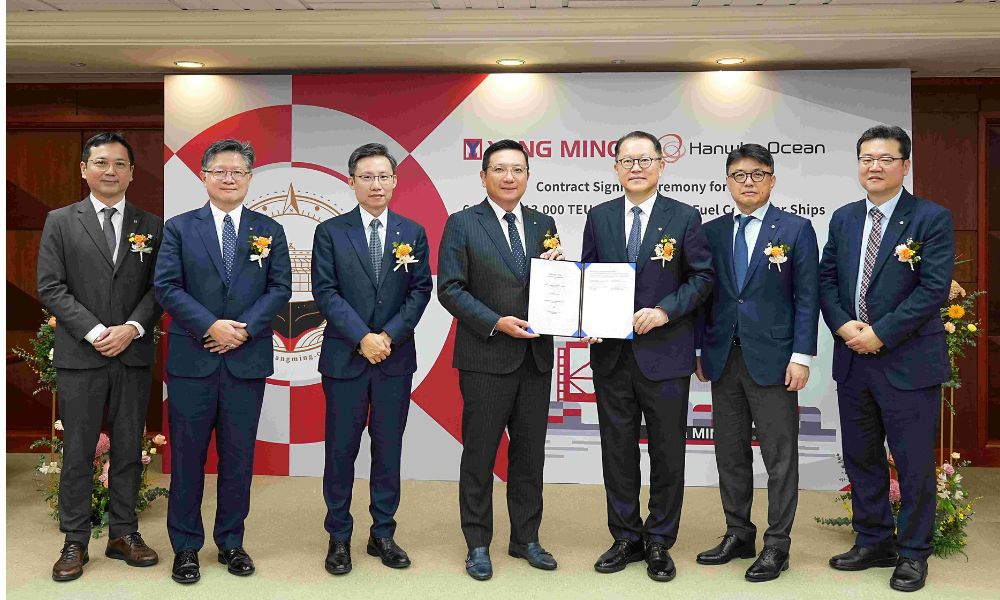
Yang Ming orders six LNG dual-fuel, ammonia-ready containerships from Hanwha Ocean
Each of the six new vessels will have a capacity of up to 13,650 TEU and feature LNG dual-fuel propulsion and Ammonia Fuel Ready specifications.
Alternative Fuels
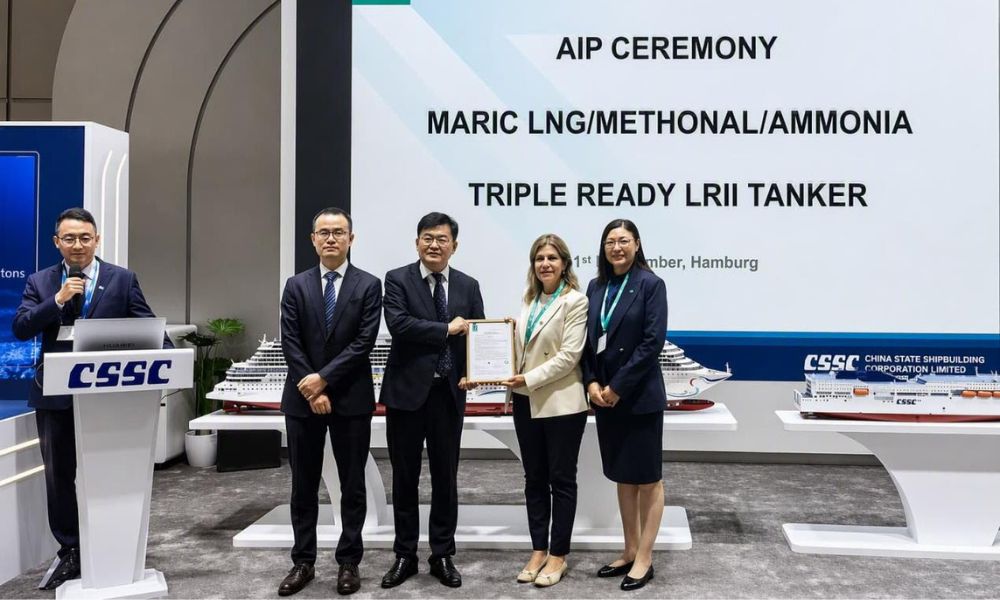
LR, China’s MARIC unveil tanker concept ready for three future bunker fuels
Both secured AiP for a new 114,000 DWT product and crude oil tanker designed to accommodate future conversion to LNG, methanol or ammonia.
Alternative Fuels
DNV: Alternative-fuelled vessel orders hit highest monthly level since October 2024
LNG-fuelled vessels accounted for the vast majority of August activity while the strong summer performance marked a significant acceleration in ordering activity after a relatively slow start to the year.
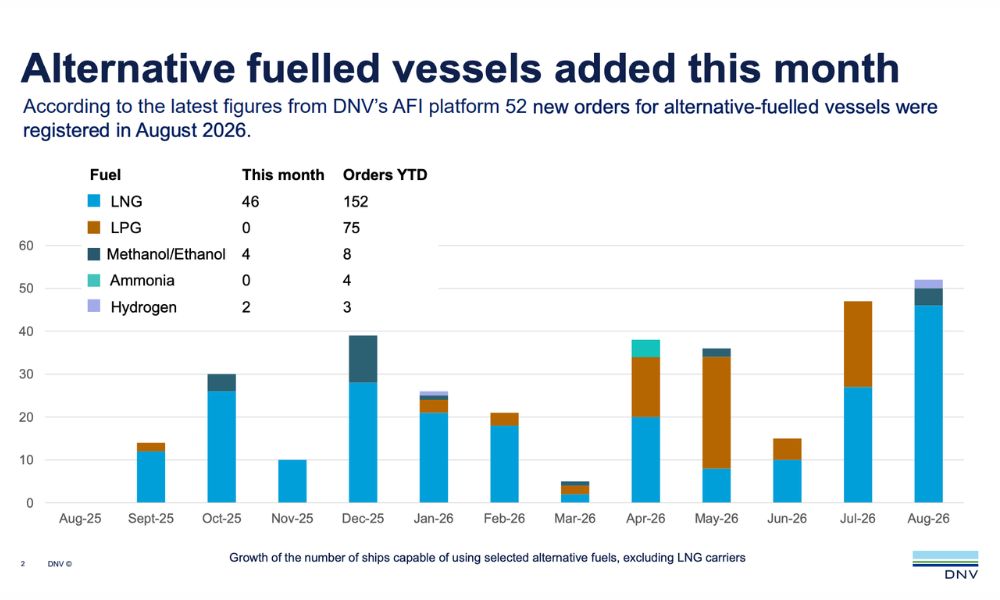
Latest data from classification society DNV’s Alternative Fuels Insight (AFI) platform alternative-fuelled vessel ordering was strong in August, with 52 new vessels added to the platform.
This is the highest monthly total since October 2024 and follows another active month in July, when 47 vessels were added to the database.
LNG-fuelled vessels accounted for the vast majority of August activity, with 46 orders recorded. The container segment led the way with 30 orders, while the car carrier segment contributed a further 12 LNG-fuelled vessels. In addition, four ethanol-fuelled bulk carriers and two hydrogen-powered bulk carriers were added during the month, as well as one LNG bunker vessel.
The strong summer performance marked a significant acceleration in ordering activity after a relatively slow start to the year. In total, 242 alternative-fuelled vessel orders have been placed in the first eight months of 2026, representing a 27% increase compared with the same period in 2025.
LNG remains the dominant fuel choice, accounting for 63% of all alternative-fuelled vessel orders registered so far this year. Container vessels represent the largest share of these LNG orders (59%), followed by car carriers (30%).
Jason Stefanatos, Global Decarbonization Director at DNV Maritime, said: “The past two months have been particularly strong for alternative-fuelled vessel ordering, with August recording the highest monthly total we’ve seen since October 2024. This has helped lift year-to-date orders to a level well above the same period last year.
“LNG remains the leading fuel choice, driven largely by activity in the container and car carrier segments. These sectors have been among the earliest adopters of alternative fuels, supported by predictable liner operations and increasing demand from cargo owners to reduce emissions across supply chains.
“For many owners, LNG offers a combination of emissions reductions, fuel availability and future flexibility while the longer-term fuel landscape continues to evolve.
“At the same time, the latest figures include orders for ethanol- and hydrogen-fuelled vessels, highlighting that owners continue to explore a range of decarbonization pathways. Different segments are making different fuel choices, but the overall level of activity demonstrates continued investment in lower-emission shipping.”
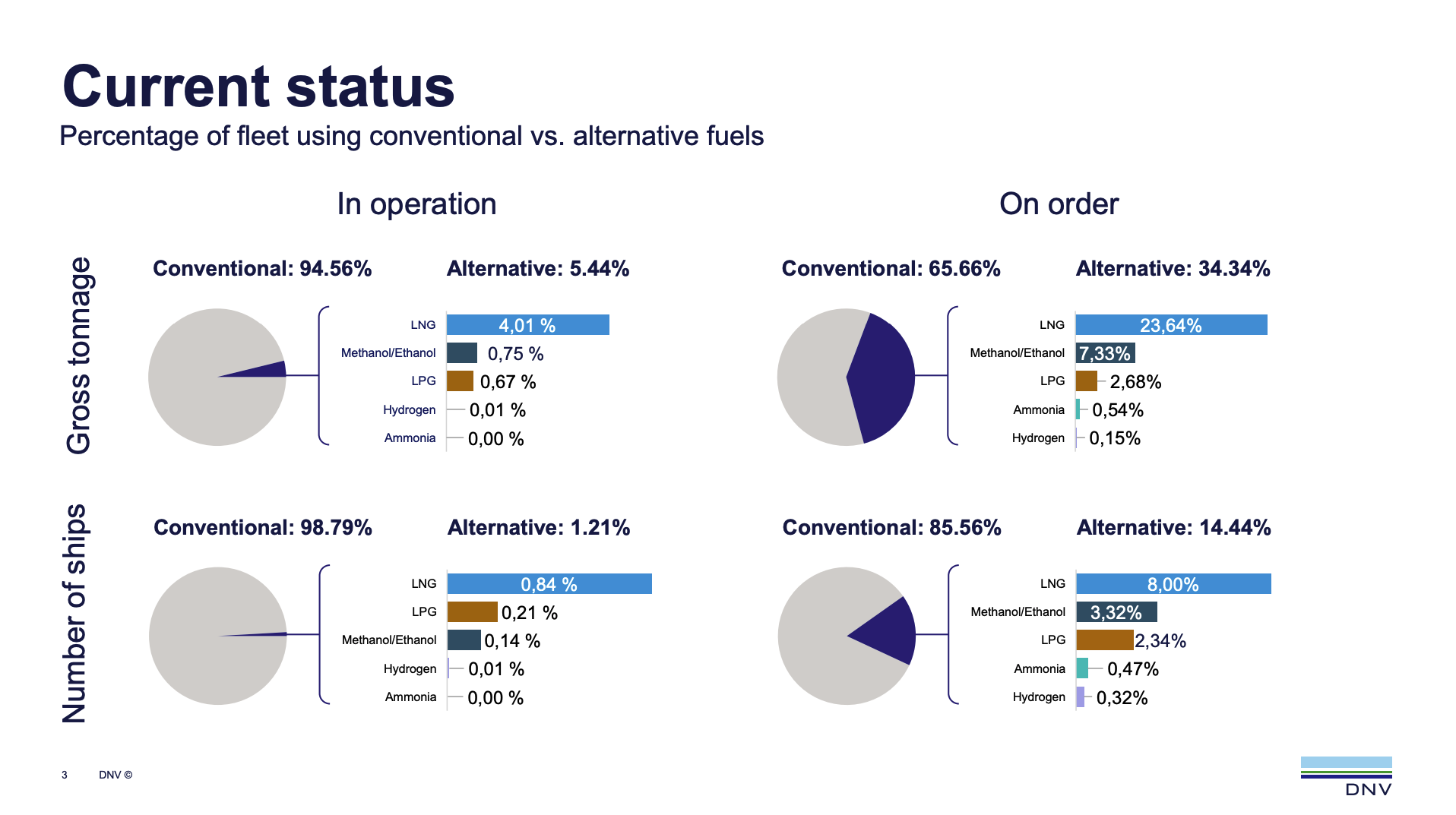
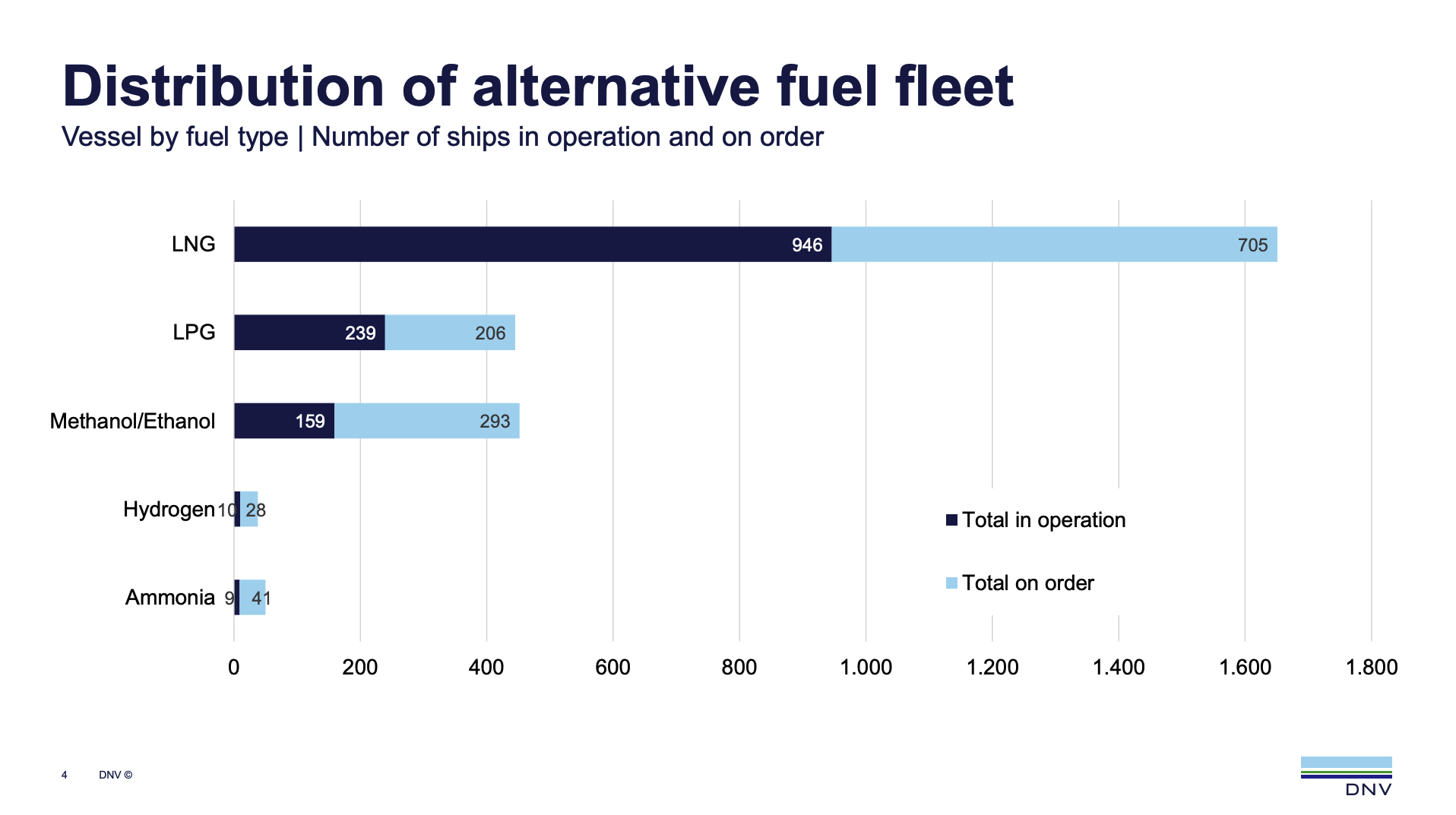
Photo credit: DNV
Published: 4 September, 2026

OUR INDUSTRY PARTNERS

Yang Ming orders six LNG dual-fuel, ammonia-ready containerships from Hanwha Ocean

LR, China’s MARIC unveil tanker concept ready for three future bunker fuels

DNV: Alternative-fuelled vessel orders hit highest monthly level since October 2024

TFG Marine advances global MFM rollout with two US Gulf bunker barges

GENA Solutions: Total renewable and low-carbon methanol project pipeline increases from 61.8 to 62.2 Mt by 2032

Baltic Exchange: Bunker Report (3 September 2026)

ENGINE: Americas Fuel Availability Outlook (3 September 2026)

Singapore-flagged tugboat “Kim Heng 3203” placed under Sheriff’s arrest

US targets five bunker companies in latest sanctions campaign against Iran

Singapore bunkering community supports Living Hope Evangelism’s 7th anniversary outreach for residents in need

China’s bunker market reshaped by tax rebates, trade flows and refining changes, says economist

Hengli Petrochemical’s ex-Singapore trading arm faces winding up application

Rajah & Tann: Bunker disputes are won in the first 48 hours

Report: GCMD outlines practical approach to quantity assurance in marine biofuel supply chains
-
 Vessel Arrest1 week ago
Singapore-flagged tugboat “Kim Heng 3203” placed under Sheriff’s arrest
-
 Sanctions2 weeks ago
US targets five bunker companies in latest sanctions campaign against Iran
-
 Events2 weeks ago
Singapore bunkering community supports Living Hope Evangelism’s 7th anniversary outreach for residents in need
-
 Interview1 week ago
China’s bunker market reshaped by tax rebates, trade flows and refining changes, says economist
-
 Winding up2 weeks ago
Hengli Petrochemical’s ex-Singapore trading arm faces winding up application
-
 Bunker Claim4 days ago
Rajah & Tann: Bunker disputes are won in the first 48 hours
-
 Biofuel1 week ago
Report: GCMD outlines practical approach to quantity assurance in marine biofuel supply chains
-
 Winding up2 weeks ago
Singapore: Notices of intended dividend issued for Ocean Bunkering Services, Hin Leong Marine