
Business
Integr8 Fuels publishes its first Bunker Quality Trends Report
Fuel with the highest incidence of off specification continues to be VLSFO at 1.7%, followed by HSFO at 1.2% and MGO at 1.0%, according to the 2022 report.

Integr8 Fuels, the bunker trading and brokerage arm of Navig8, on Wednesday (14 September) shared with Manifold Times its first Bunker Quality Trends where it examines and compares likelihood of off specification issues across all commercial grades of bunkers and key ports. An excerpt of the report is as follows:
This is the first Integr8 Fuels Bunker Quality Trends Report covering the last six months of supplies globally, where we dissect and compare the likelihood of off specification issues across all commercial grades of bunkers and key ports. Using data from approximately 35,000 deliveries, we will also assess fuel quality trends using our own Integr8 Quality Index which scores the proximity (or otherwise) of individual parameters within each sample to the relevant Table 1 or Table 2 specification limits within ISO 8217. We will also consider the availability of fuels in general, what specifications are being guaranteed, and the potential for hidden losses which must never be ignored when purchasing given the current commercial backdrop.
How likely are we to be faced with an off specification situation?
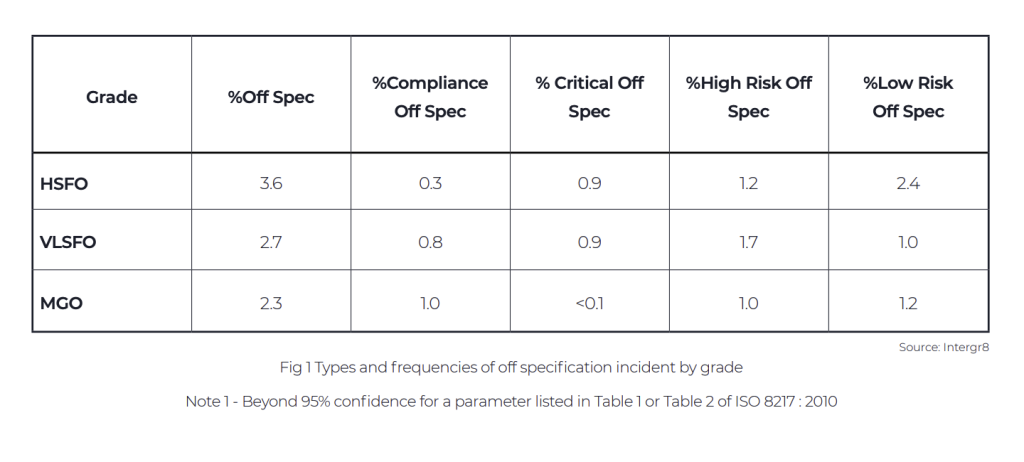
The last 180 days owners’ analysis available to Integr8 Fuels has highlighted that you are most likely to have an off specification issue (Note 1) with High Sulphur Fuel Oil (HSFO) followed by Very Low Sulphur Fuel Oil (VLSFO) and then Marine Gas Oil (MGO). (Fig. 1)
What is the likelihood of receiving non-compliant or critically off-spec bunkers?
It is important, however, to consider the context of the off-specification incidents. To do this it is essential to consider the likelihood of Marpol (Sulphur) or SOLAS (Flash Point) compliance and the likelihood of Critical Off Specification Incidents such as Cat-Fines, Total Sediment, Used Lubricating Oil, Sodium and Ash Content (High Risk) against routine and easily rectifiable off specification issues classified “low risk” such as high viscosity in HSFO.
Purely on likelihood of an off specification occurrence we are more likely to have one with HSFO than VLSFO or MGO however at least double these are considered low risk.
Turning our attention to compliance Low and Very Low Sulphur Fuels, these fare far worse with us being approximately three times more likely to have a Sulphur or Flash Point off Spec incident with VLSFO and MGO, than HSFO, which are only found to be non-compliant in three deliveries per thousand.
Critical off specification issues such as Metals and Sediment are seen to be just as likely in HSFO as VLSFO but are very unlikely in Marine Gas Oils.
Finally, when we combine both compliance and high risk off specifications, the fuel with the highest incidence of off specification continues to be VLSFO at 1.7%, followed by HSFO at 1.2% and MGO at 1.0%. There are many nuances, from geographical to port-to-port and even supplier-to-supplier. It therefore remains essential to consider these when buying bunkers and we will address some of the challenges later in the paper.
Availabilty of Products
Unsurprisingly, Marine Gas Oil is the most available product (567 ports) given the ability to substitute and supply higher quality inland or automotive grades and the ease of logistics to supply what are quite often small quantities.
VLSFO is also seen to be readily available across all continents but at 17% fewer ports (463). This is because of larger quantities being ordered and the storage and barges needed to support these supplies in general.
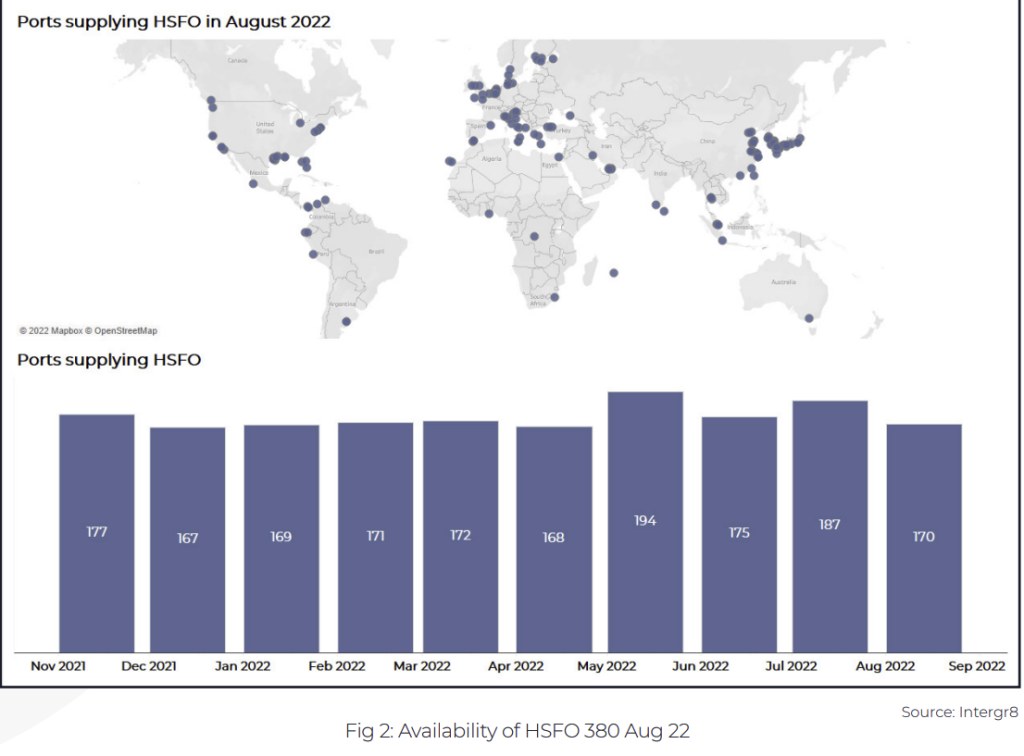
High Sulphur Fuel Oil is the only product which is not readily available with only 187 ports listed, as of August 2022 (Fig. 2). HSFO availability is concentrated around bunkering hubs and geographically key areas likely to receive passing trade from Very Large Crude Carriers (VLCC) and / or other scrubber fitted sectors. It is important, therefore, to plan bunkering carefully for HSFO and equally consider the type of scrubber fitted to the vessel and any local limitations in forthcoming voyages that may require a fuel switch to Low Sulphur Marine Gas Oil (LSMGO) for example.
Availability of Grades
The fact that four ISO 8217 grades are still being requested remains one of the greatest challenges for the industry to address. Which other industry would even allow a fuel to be supplied using a specification that is obsolete, twice since revised, and 17 years old?
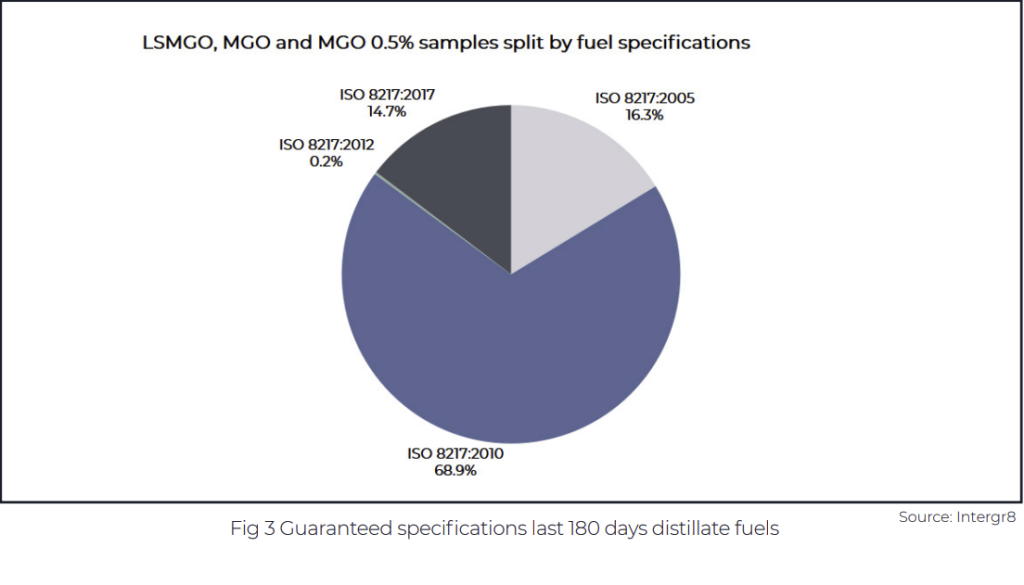
Indeed, during the period assessed for the report, 11.6% of all fuels supplied by Integr8 Fuels were still only guaranteed to 2005 specifications. Drilling into this further, it can be seen in the charts below that this is predominantly a distillate issue, with 16% of these fuels being still sold as 2005 (Fig 3) compared to only 2% of residual fuels. (Fig. 4)
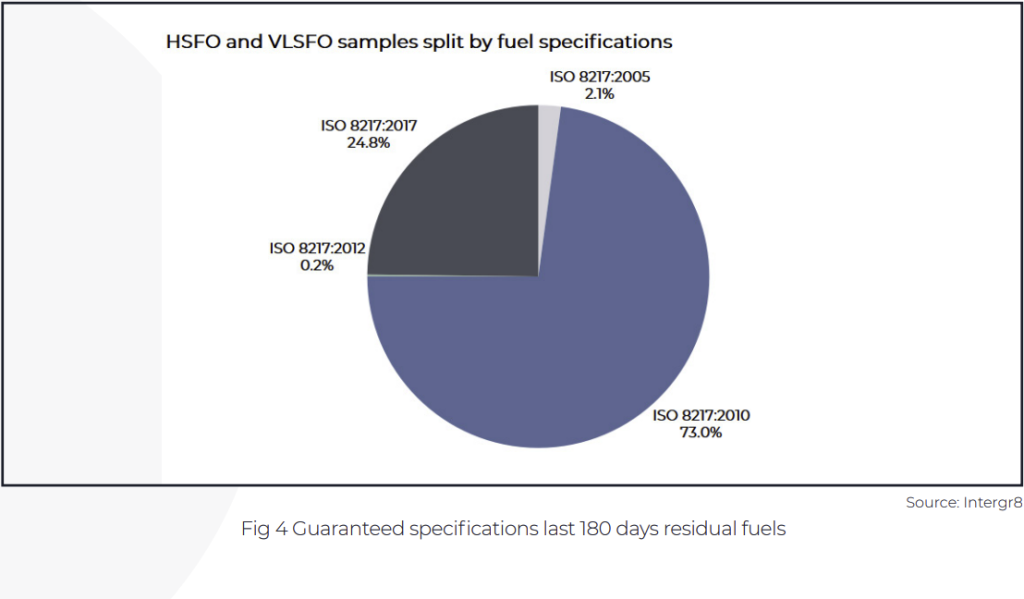
It is positive news that at least for residual fuels we are seeing 2005 specifications becoming virtually obsolete probably because of two main drivers. Firstly, fewer customers are now requesting 2005 specifications given the added protection afforded for critical parameters like Catalyst Fines (Aluminium and Silicon ) and Sodium with 2010 (or later) specifications, and secondly, suppliers have in general moved away from 2005 specifications because of their position being more problematic when faced with the inevitable notice relating to Clause 5 or chemicals and added substances.
The same, however, cannot be said for distillate fuels with almost a fifth of fuels still being sold to this 17-year-old specification, the supply of which is particularly prevalent in the Indian subcontinent with pockets noted elsewhere, one such area being the eastern seaboard of the United States.
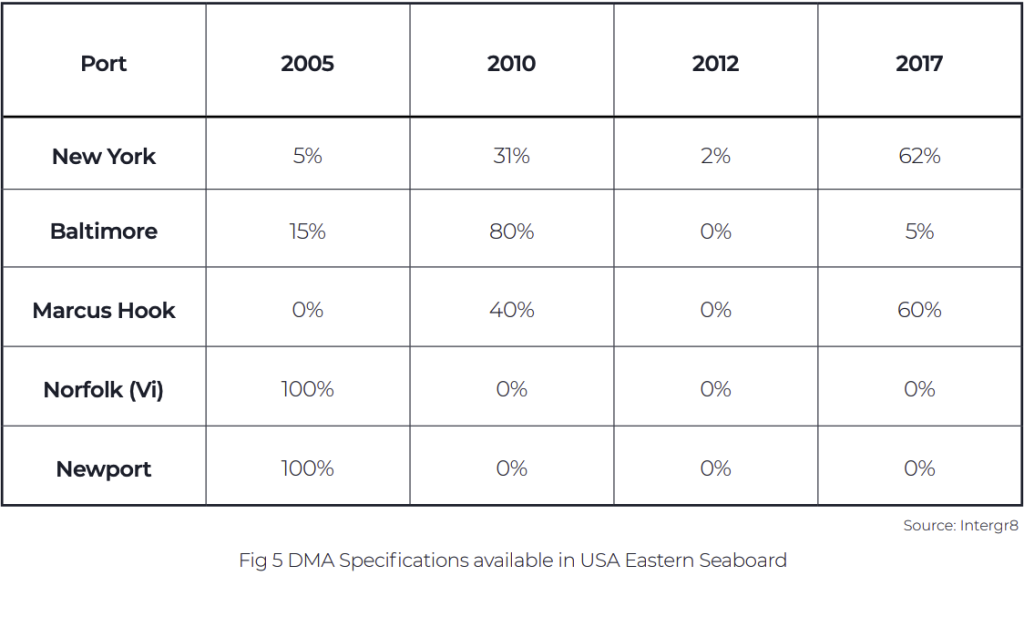
It is therefore important to consider what issues may arise because of only obtaining 2005 specification and where you may face this issue.
Firstly, 2005 specifications offer no guarantee for Lubricity, Oxidation Stability, Acid number or Hydrogen Sulphide and whilst it is rare that issues arise, the added cover for a fuel which may have aged afforded by the Oxidation stability parameter is an important one.
Of greater concern is the fact that a supplier is afforded more scope with regard minimum Viscosity guarantees which allows a minimum level of 1.5cSt rather than 2.0cSt for 2005 compared to 2010 specs and beyond. Such low levels can be particularly problematic to vessels which do not have the ability to cool the fuel given the need to inject the fuel at a minimum of 2cSt stipulated by most engine manufacturers and the possibility of fuel pump issues or even loss of propulsion as a result.
Cross referencing back to the eastern seaboard we note that around 25 percent of all samples testing below 2.0cSt in the last 180 days, this in a location where we may have no guarantee to protect us from this issue (Fig 5). Indeed in the port of Norfolk (Vi.) where only 2005 specifications are available, 65% of all samples have recently tested under 2cSt for Viscosity. Therefore, if bunkering in the USA and particularly the eastern seaboard it is highly recommended to purchase 2010 specification or higher.
Note: Manifold Times will be publishing part II of the Integr8 Bunker Quality Trends Report tomorrow.
Photo credit: Integr8 Fuels
Published: 15 September, 2022
Alternative Fuels
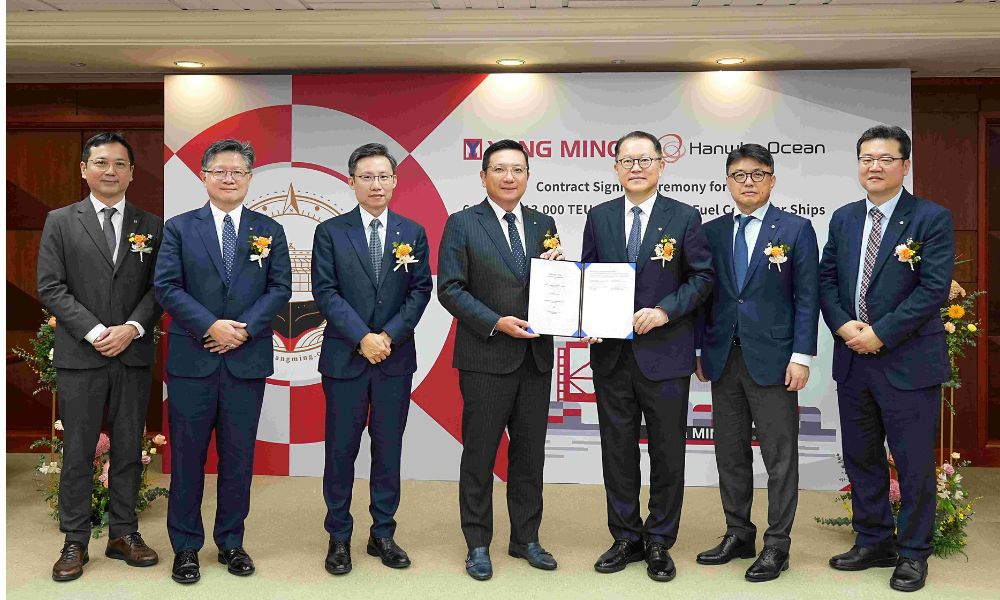
Yang Ming orders six LNG dual-fuel, ammonia-ready containerships from Hanwha Ocean
Each of the six new vessels will have a capacity of up to 13,650 TEU and feature LNG dual-fuel propulsion and Ammonia Fuel Ready specifications.
Alternative Fuels
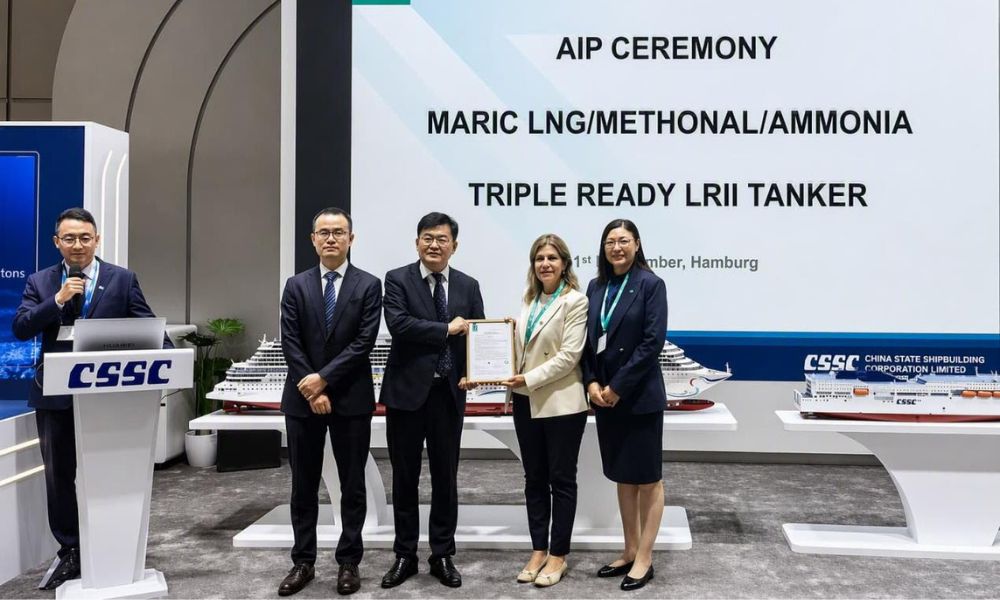
LR, China’s MARIC unveil tanker concept ready for three future bunker fuels
Both secured AiP for a new 114,000 DWT product and crude oil tanker designed to accommodate future conversion to LNG, methanol or ammonia.
Alternative Fuels
DNV: Alternative-fuelled vessel orders hit highest monthly level since October 2024
LNG-fuelled vessels accounted for the vast majority of August activity while the strong summer performance marked a significant acceleration in ordering activity after a relatively slow start to the year.
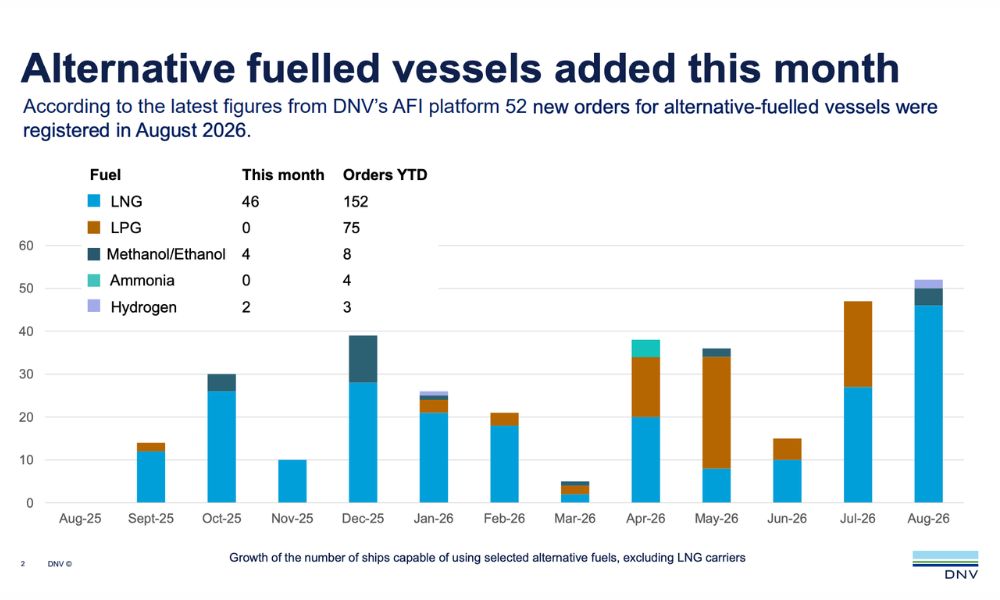
Latest data from classification society DNV’s Alternative Fuels Insight (AFI) platform alternative-fuelled vessel ordering was strong in August, with 52 new vessels added to the platform.
This is the highest monthly total since October 2024 and follows another active month in July, when 47 vessels were added to the database.
LNG-fuelled vessels accounted for the vast majority of August activity, with 46 orders recorded. The container segment led the way with 30 orders, while the car carrier segment contributed a further 12 LNG-fuelled vessels. In addition, four ethanol-fuelled bulk carriers and two hydrogen-powered bulk carriers were added during the month, as well as one LNG bunker vessel.
The strong summer performance marked a significant acceleration in ordering activity after a relatively slow start to the year. In total, 242 alternative-fuelled vessel orders have been placed in the first eight months of 2026, representing a 27% increase compared with the same period in 2025.
LNG remains the dominant fuel choice, accounting for 63% of all alternative-fuelled vessel orders registered so far this year. Container vessels represent the largest share of these LNG orders (59%), followed by car carriers (30%).
Jason Stefanatos, Global Decarbonization Director at DNV Maritime, said: “The past two months have been particularly strong for alternative-fuelled vessel ordering, with August recording the highest monthly total we’ve seen since October 2024. This has helped lift year-to-date orders to a level well above the same period last year.
“LNG remains the leading fuel choice, driven largely by activity in the container and car carrier segments. These sectors have been among the earliest adopters of alternative fuels, supported by predictable liner operations and increasing demand from cargo owners to reduce emissions across supply chains.
“For many owners, LNG offers a combination of emissions reductions, fuel availability and future flexibility while the longer-term fuel landscape continues to evolve.
“At the same time, the latest figures include orders for ethanol- and hydrogen-fuelled vessels, highlighting that owners continue to explore a range of decarbonization pathways. Different segments are making different fuel choices, but the overall level of activity demonstrates continued investment in lower-emission shipping.”
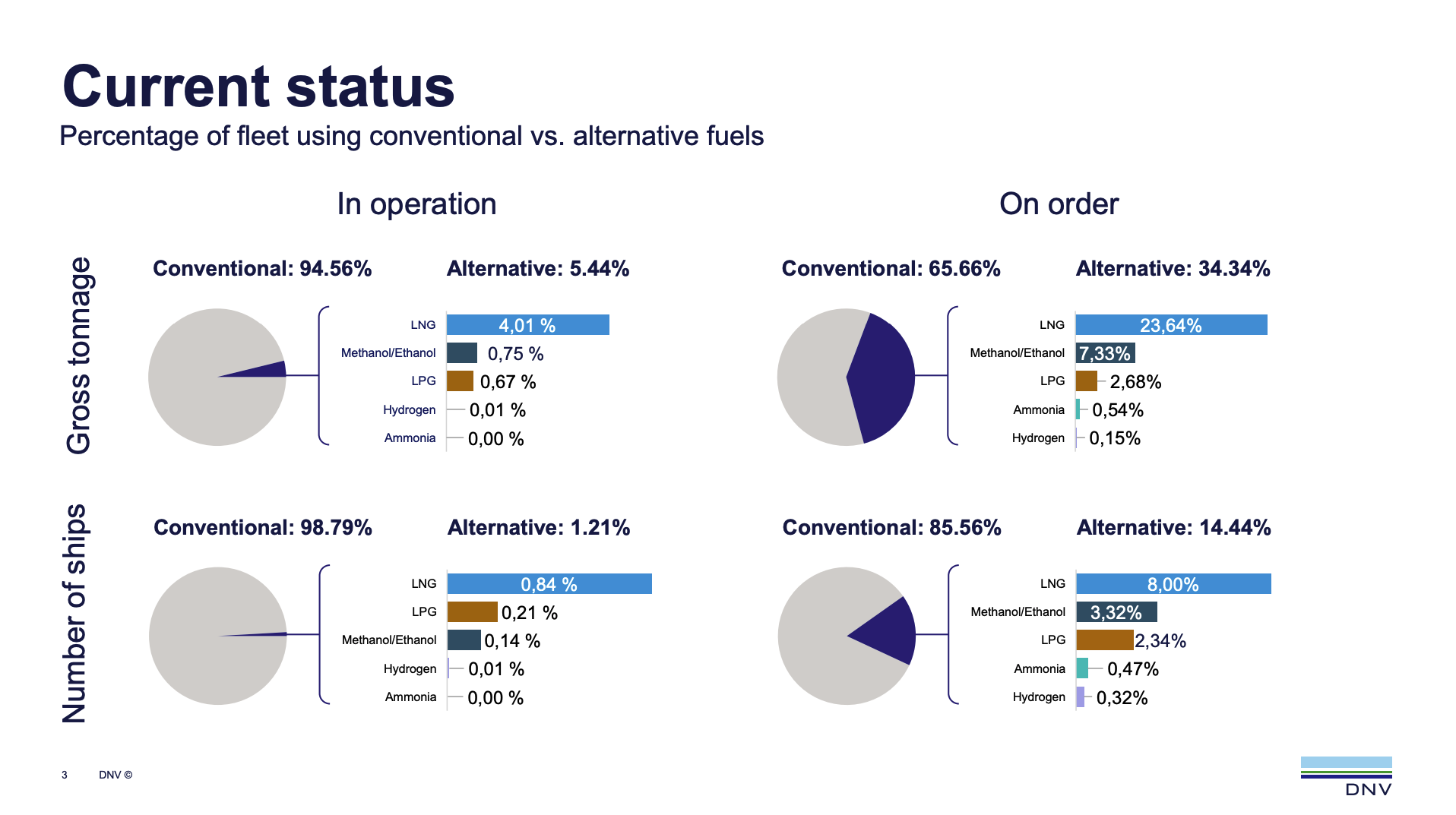
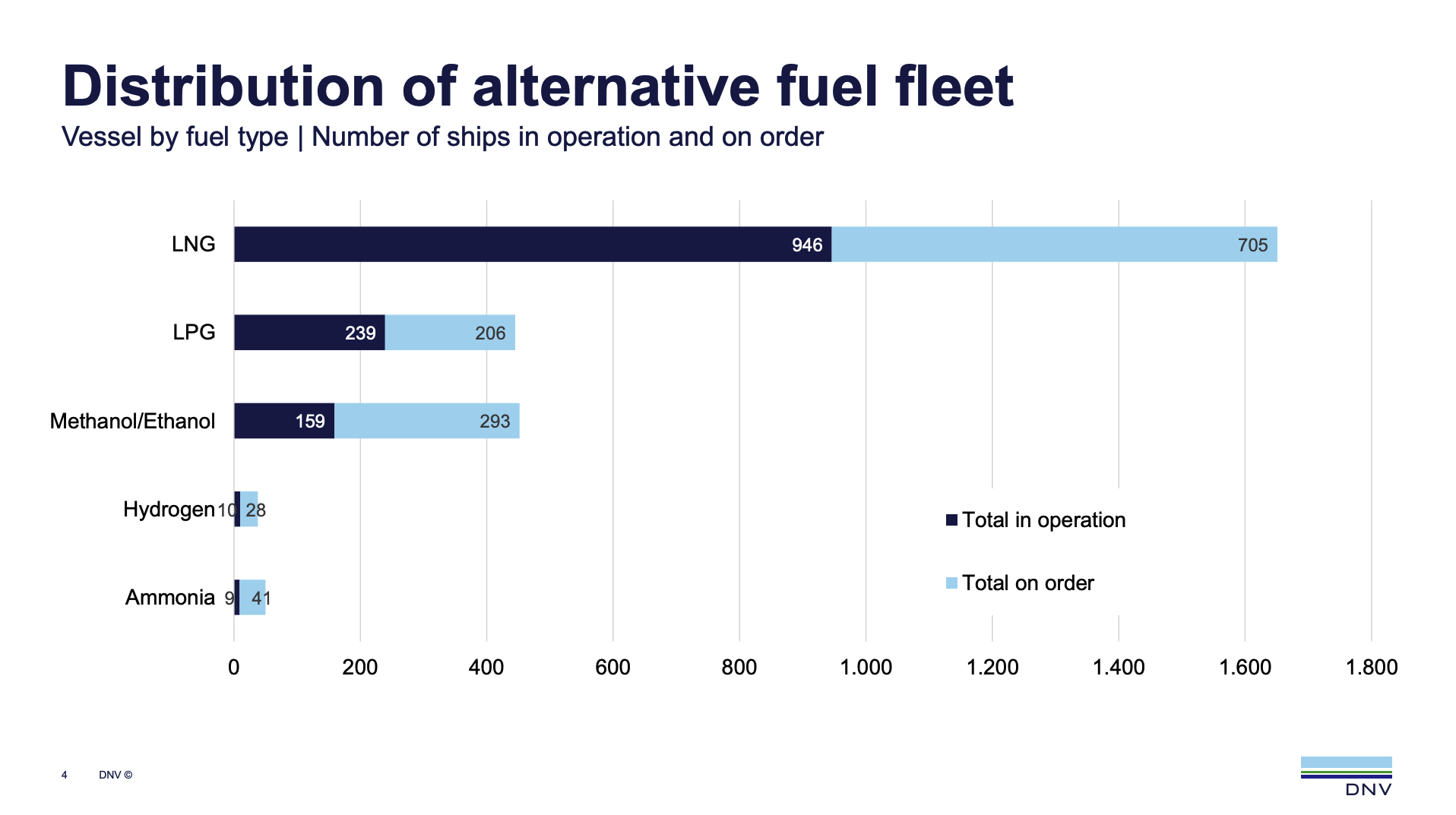
Photo credit: DNV
Published: 4 September, 2026

OUR INDUSTRY PARTNERS

Yang Ming orders six LNG dual-fuel, ammonia-ready containerships from Hanwha Ocean

LR, China’s MARIC unveil tanker concept ready for three future bunker fuels

DNV: Alternative-fuelled vessel orders hit highest monthly level since October 2024

TFG Marine advances global MFM rollout with two US Gulf bunker barges

GENA Solutions: Total renewable and low-carbon methanol project pipeline increases from 61.8 to 62.2 Mt by 2032

Baltic Exchange: Bunker Report (3 September 2026)

ENGINE: Americas Fuel Availability Outlook (3 September 2026)

Singapore-flagged tugboat “Kim Heng 3203” placed under Sheriff’s arrest

US targets five bunker companies in latest sanctions campaign against Iran

Singapore bunkering community supports Living Hope Evangelism’s 7th anniversary outreach for residents in need

China’s bunker market reshaped by tax rebates, trade flows and refining changes, says economist

Hengli Petrochemical’s ex-Singapore trading arm faces winding up application

Rajah & Tann: Bunker disputes are won in the first 48 hours

Report: GCMD outlines practical approach to quantity assurance in marine biofuel supply chains
-
 Vessel Arrest2 weeks ago
Singapore-flagged tugboat “Kim Heng 3203” placed under Sheriff’s arrest
-
 Sanctions2 weeks ago
US targets five bunker companies in latest sanctions campaign against Iran
-
 Events2 weeks ago
Singapore bunkering community supports Living Hope Evangelism’s 7th anniversary outreach for residents in need
-
 Interview1 week ago
China’s bunker market reshaped by tax rebates, trade flows and refining changes, says economist
-
 Winding up2 weeks ago
Hengli Petrochemical’s ex-Singapore trading arm faces winding up application
-
 Bunker Claim5 days ago
Rajah & Tann: Bunker disputes are won in the first 48 hours
-
 Biofuel2 weeks ago
Report: GCMD outlines practical approach to quantity assurance in marine biofuel supply chains
-

 Winding up1 week ago
Singapore: Notices of annual meeting issued for Vroon Shipping Asia and related firms