
Business
Gard: Look out for fuel leaks and unshielded hot spots in engine room
Gard warns shipowners that most fires onboard ships start in the engine room and the frequency of such fires is on the rise as well as gives their recommendations on how to prevent them.

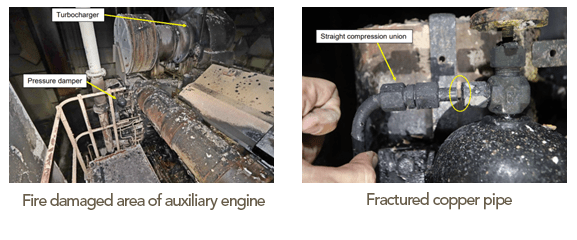
Norwegian maritime insurance company Gard on Wednesday (15 June) published an insight informing that the majority of fires onboard ships start in the engine room and the frequency of such fires is on the rise. An excerpt of the article is as follows:
Introduction
Every year fires on board ships lead to loss of lives and severe damage to the ships themselves. Most fires on board ships originate in the engine room where the three ingredients for a fire, namely fuel, oxygen and a source of ignition, exist in abundance. These do not only start the fire but also feed and intensify it further. Fire safety is not only about detecting and fighting a fire, but also about preventing it from igniting in the first place.
In this article we will focus on how these fires can be prevented. We will touch upon some of the main causes of engine room fires and explore insights from our claims data to understand the frequency of such fires before setting out some recommendations on how to mitigate the risks of these fires occurring.
How do most engine room fires start?
A review of Gard’s hull and machinery (H&M) claims for the years 2017-2021 related to fires and explosions on vessels, shows that nearly 60% of all such fires originated in the engine room. Nearly two thirds of these engine room fires occurred on the main and auxiliary engines or their associated components such as turbochargers. The majority of these incidents were caused by a failure in a flammable oil system, most often in the low-pressure fuel oil piping, allowing spray of oil onto an unprotected hot surface. Below is an example from our claims portfolio.
Case study
A copper pipe that was part of the fuel oil pressure gauge supply pipework for one of the auxiliary engines fractured. Due to a missing metal spray shield the fuel sprayed onto the unprotected hot surfaces of the nearby turbocharger and the exhaust system which had temperatures of more than 400 °C. The fuel ignited causing extensive damage to auxiliary engines and power distribution cables. The vessel was out of service for 40 days to carry out repair works.
Investigation by experts showed that the copper pipe that fractured did not match the original design and had a lower wall thickness. There was no record of any previous repairs carried out to the fuel system pipework. The pipe assembly on the other three auxiliary engines appeared to be of original installation comprising of a steel pipe. The spray shield was removed during maintenance and not re-installed. Insulation was also suspected to be inadequate since exposed sections around the exhaust manifold and turbocharger were noticed on other three auxiliary engines. The investigators concluded that the heat shielding arrangements on the fire damaged auxiliary engine did not meet the relevant SOLAS regulations, II-2/2.2.6.1.

In the above case, there are two main aspects which need to be highlighted.
First is the leakage of flammable oil; and
Second is the inadequate protection to prevent highly flammable fuel from coming in contact with a source of ignition.
Leakage or spray of fuel due to a failure in the oil system
Below we list some of the most commonly occurring causes of fuel spraying from low pressure piping systems. The list is by no means exhaustive, but a review of past Gard cases has shown that below listed failures occur frequently.
Piping, piping connections and other associated components, such as o-rings, were not original parts or of a type recommended by the manufacturer. In some cases, modifications had been done by the crew under existing management, whilst in others the crew were not aware of such modifications as they had been done under previous ownership or management.
Piping connection had not been tightened to the required torque and with time it loosened due to, for example, vibrations. Another reason may be incorrect assembly after maintenance.
Bolts for flanges or filters breaking due to fatigue caused by overtightening over a period of time. In some cases, securing bolts were also found loose or missing altogether.
Fatigue fracture of pipes. Such pipes are typically not well supported along their entire length, which causes excessive stress due to vibrations. Lack of support may be attributed to the design or failure to reinstall the holding brackets after maintenance.
Fuel oil filter covers coming loose and displacement of the spindle from the top cover for various reasons.
Rupture of rubberized hoses due to degradation caused by the heat generated from nearby machinery.
Oil coming in contact with hot surfaces
Shielding can either be by insulating hot spots with thermal insulation or anti-splashing tapes, and/or by using physical barriers such as spray shields. Some typical issues with insulation which we have seen in our claims portfolio are:
- the quality may differ from yard to yard,
- it can deteriorate with age,
- it may not have been fixed back properly after maintenance, and
- it can become soaked with oil over a period of time due to minor leakages.
As for physical barriers:
they may not have been part of the original design and therefore not fitted, or where fitted, they may not have been installed back in place after maintenance has been carried out on the oil system, as in our case study, and as time passes may even be misplaced.
Older vessels need more attention
One of the factors which must be considered when assessing fire risks in engine rooms is the age of vessels. The risk of leakages from machinery may increase as ships grow older. We discuss this further below but highlight here some of the main issues that can increase the risk of fire in the engine room on older vessels.
Protection of hot surfaces may degrade, with the quality of insulation may deteriorating thereby increasing the probability of ignition and risk of fires.
Older vessels can face cuts to their maintenance and safety budgets as they near the end of their service life.
A vessel may have changed ownership and management a number of times during its life, and this can have a direct impact on the consistency of maintenance in the engine room.
Typical hotspots in the engine room
Based on previous fire incidents handled by Gard, we have found that the below listed areas acted as a source of ignition in most cases. The temperature of these areas can easily exceed 500 °C which may be well above the oil’s auto ignition temperature.
- Exhaust manifold, pipes and associated flanges
- Exposed areas of boilers
- Turbochargers
- Indicator valves on cylinders
- Heater for purifier units
- Electrical wires/components and switchboards. Melting or smoldering of cables can also contribute to the transmission of heat
Data insights – do the numbers tell their own story?
In Gard, when analyzing trends, we, just like Cefor (The Nordic Association of Marine Insurers), follow closely the frequency trends of incidents over a given time period. This way we are also able to account for the growth in our portfolio from one year to the next. Over the five-year period, from 2017 – 2021, the frequency for the various Hull and Machinery (H&M) claims areas is showing a downward trend except for fires in engine room. This rise is largely due to fires occurring either on main engines or auxiliary engines which, as mentioned earlier, make up majority of all engine room fires.

Frequency of engine fires (GARD H&M data)
For the period 2017 – 2021, the average annual frequency of engine room fires is 0.13%, which means out of every 10,000 vessels, 13 vessels have had one such fire incident each year. This may not seem like a high number, but the consequences of such fires can be serious for human life, environment, and property causing significant business losses.
One of the main concerns is that the frequency of both main and auxiliary engine fires shows a rising trend. The highest frequency of fires on main and auxiliary engines is seen on passenger and container ships. It is almost twice the Gard 5-year average. Within the container ship segment, the frequency is the highest for feeders (<3,000 teu).
Cefor in its most recent ‘Fire Trend Analysis’ publication has made similar conclusions.
Note: The full Gard insight article written by the following authors can be found here.
Authors:
- Siddharth Mahajan, Senior Loss Prevention Executive, Singapore
- Svend Leo Larsen, Senior Claims Adviser, Bergen
- Kim Watle, Senior Business Analyst, Oslo
Photo credit and source: Gard
Published: 24 June, 2022
Alternative Fuels
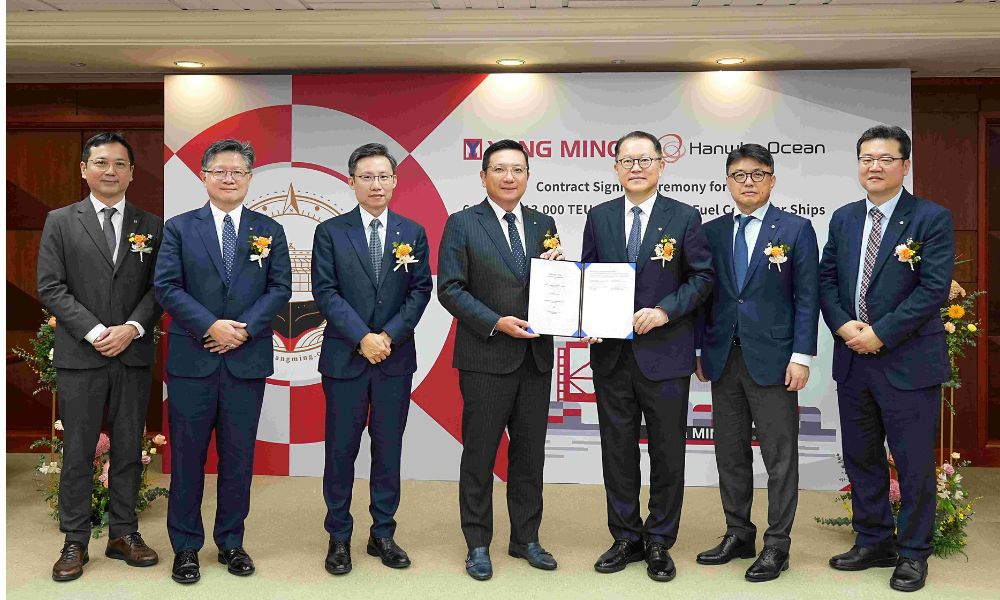
Yang Ming orders six LNG dual-fuel, ammonia-ready containerships from Hanwha Ocean
Each of the six new vessels will have a capacity of up to 13,650 TEU and feature LNG dual-fuel propulsion and Ammonia Fuel Ready specifications.
Alternative Fuels
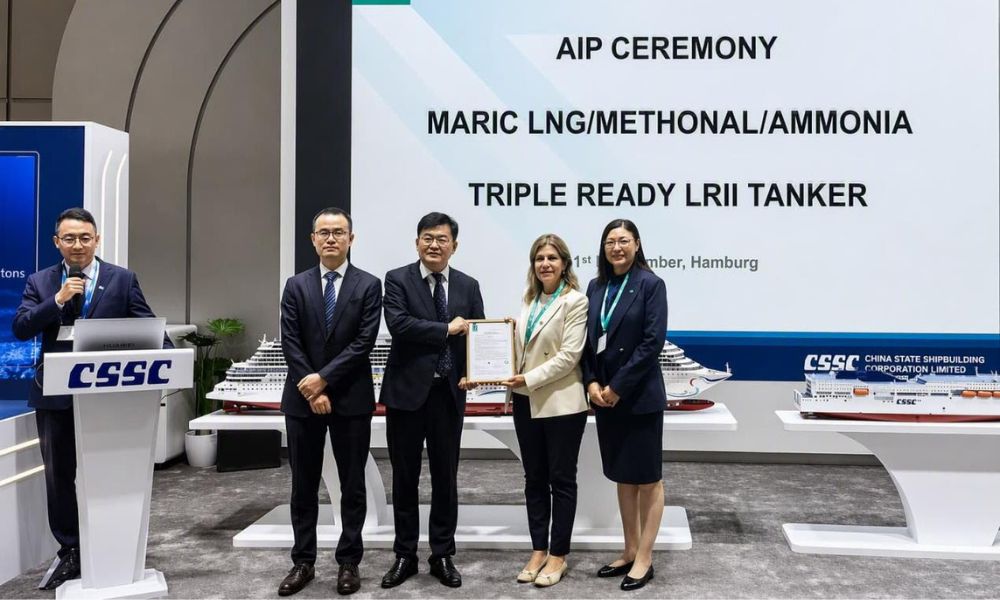
LR, China’s MARIC unveil tanker concept ready for three future bunker fuels
Both secured AiP for a new 114,000 DWT product and crude oil tanker designed to accommodate future conversion to LNG, methanol or ammonia.
Alternative Fuels
DNV: Alternative-fuelled vessel orders hit highest monthly level since October 2024
LNG-fuelled vessels accounted for the vast majority of August activity while the strong summer performance marked a significant acceleration in ordering activity after a relatively slow start to the year.
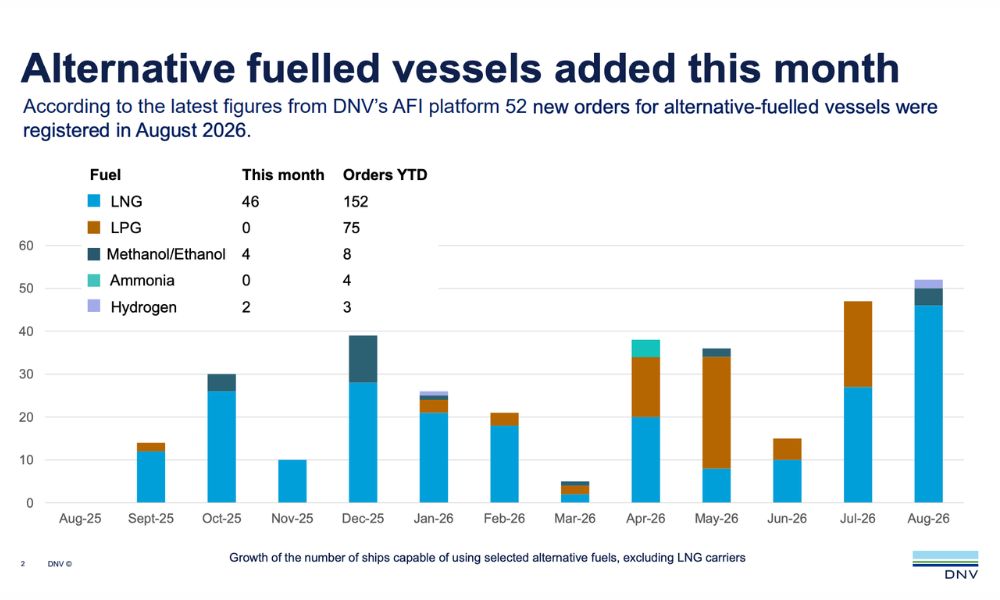
Latest data from classification society DNV’s Alternative Fuels Insight (AFI) platform alternative-fuelled vessel ordering was strong in August, with 52 new vessels added to the platform.
This is the highest monthly total since October 2024 and follows another active month in July, when 47 vessels were added to the database.
LNG-fuelled vessels accounted for the vast majority of August activity, with 46 orders recorded. The container segment led the way with 30 orders, while the car carrier segment contributed a further 12 LNG-fuelled vessels. In addition, four ethanol-fuelled bulk carriers and two hydrogen-powered bulk carriers were added during the month, as well as one LNG bunker vessel.
The strong summer performance marked a significant acceleration in ordering activity after a relatively slow start to the year. In total, 242 alternative-fuelled vessel orders have been placed in the first eight months of 2026, representing a 27% increase compared with the same period in 2025.
LNG remains the dominant fuel choice, accounting for 63% of all alternative-fuelled vessel orders registered so far this year. Container vessels represent the largest share of these LNG orders (59%), followed by car carriers (30%).
Jason Stefanatos, Global Decarbonization Director at DNV Maritime, said: “The past two months have been particularly strong for alternative-fuelled vessel ordering, with August recording the highest monthly total we’ve seen since October 2024. This has helped lift year-to-date orders to a level well above the same period last year.
“LNG remains the leading fuel choice, driven largely by activity in the container and car carrier segments. These sectors have been among the earliest adopters of alternative fuels, supported by predictable liner operations and increasing demand from cargo owners to reduce emissions across supply chains.
“For many owners, LNG offers a combination of emissions reductions, fuel availability and future flexibility while the longer-term fuel landscape continues to evolve.
“At the same time, the latest figures include orders for ethanol- and hydrogen-fuelled vessels, highlighting that owners continue to explore a range of decarbonization pathways. Different segments are making different fuel choices, but the overall level of activity demonstrates continued investment in lower-emission shipping.”
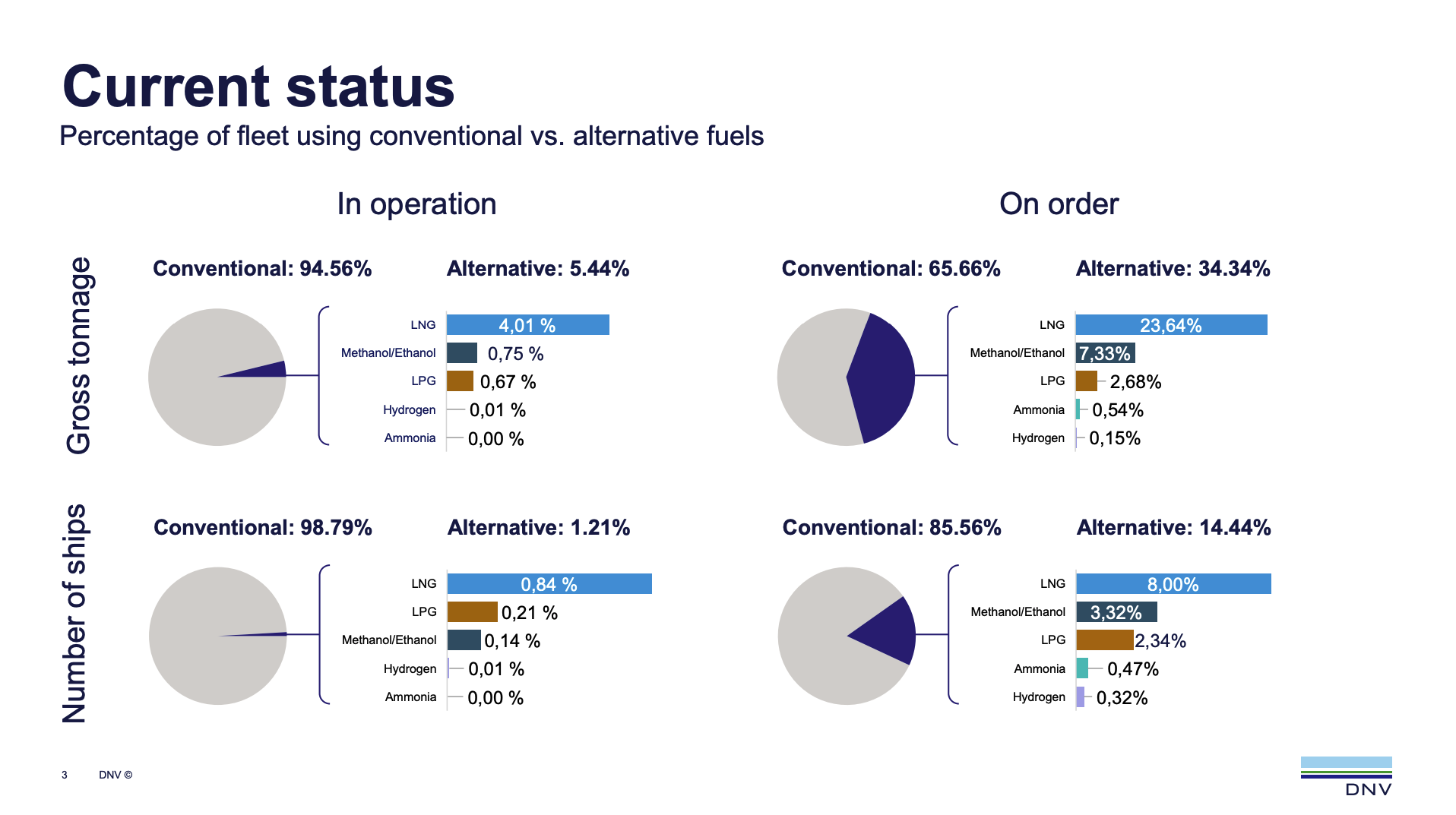
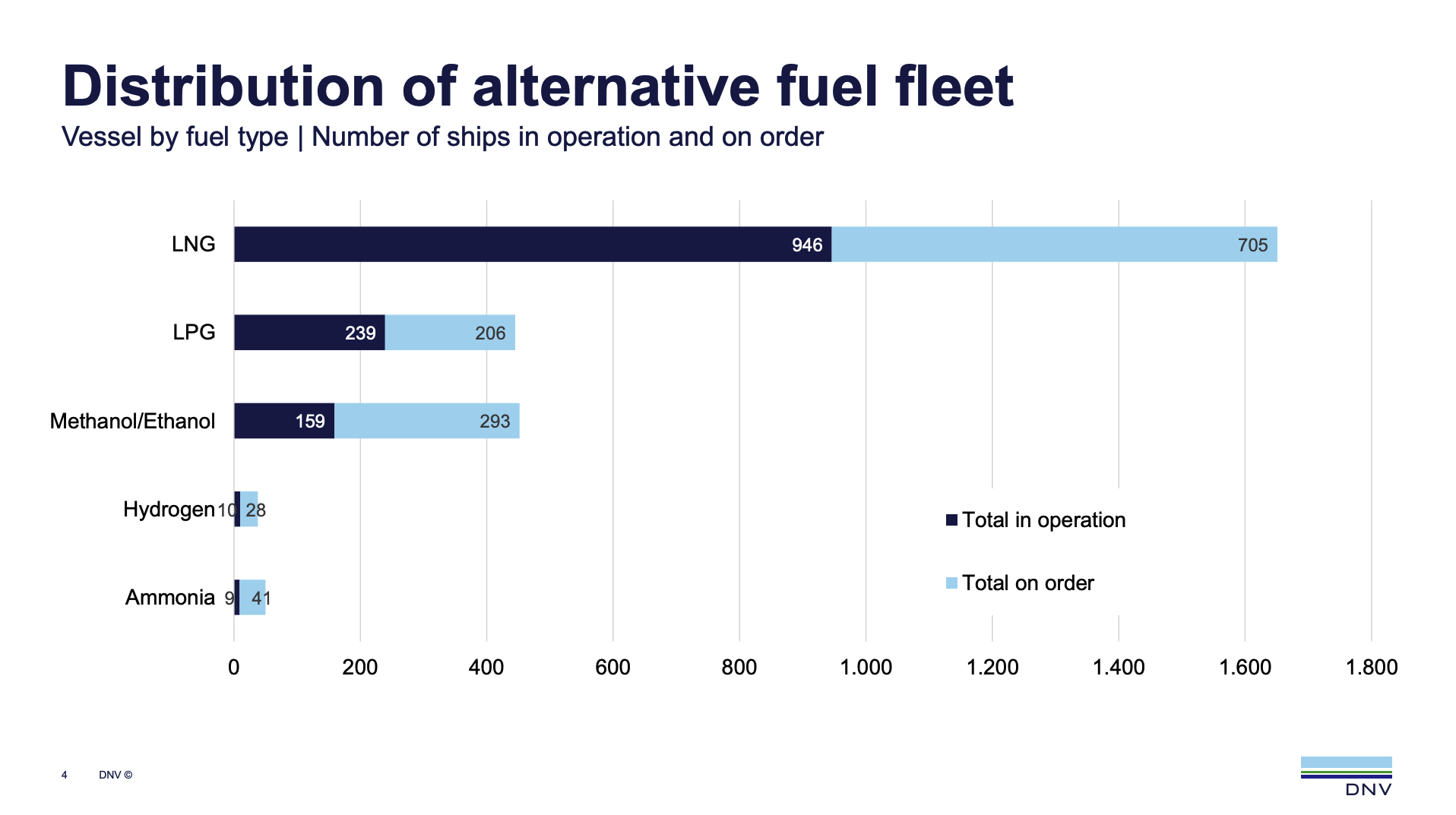
Photo credit: DNV
Published: 4 September, 2026

OUR INDUSTRY PARTNERS

Yang Ming orders six LNG dual-fuel, ammonia-ready containerships from Hanwha Ocean

LR, China’s MARIC unveil tanker concept ready for three future bunker fuels

DNV: Alternative-fuelled vessel orders hit highest monthly level since October 2024

TFG Marine advances global MFM rollout with two US Gulf bunker barges

GENA Solutions: Total renewable and low-carbon methanol project pipeline increases from 61.8 to 62.2 Mt by 2032

Baltic Exchange: Bunker Report (3 September 2026)

ENGINE: Americas Fuel Availability Outlook (3 September 2026)

Singapore-flagged tugboat “Kim Heng 3203” placed under Sheriff’s arrest

US targets five bunker companies in latest sanctions campaign against Iran

Singapore bunkering community supports Living Hope Evangelism’s 7th anniversary outreach for residents in need

China’s bunker market reshaped by tax rebates, trade flows and refining changes, says economist

Hengli Petrochemical’s ex-Singapore trading arm faces winding up application

Rajah & Tann: Bunker disputes are won in the first 48 hours

Report: GCMD outlines practical approach to quantity assurance in marine biofuel supply chains
-
 Vessel Arrest2 weeks ago
Singapore-flagged tugboat “Kim Heng 3203” placed under Sheriff’s arrest
-
 Sanctions2 weeks ago
US targets five bunker companies in latest sanctions campaign against Iran
-
 Events2 weeks ago
Singapore bunkering community supports Living Hope Evangelism’s 7th anniversary outreach for residents in need
-
 Interview1 week ago
China’s bunker market reshaped by tax rebates, trade flows and refining changes, says economist
-
 Winding up2 weeks ago
Hengli Petrochemical’s ex-Singapore trading arm faces winding up application
-
 Bunker Claim5 days ago
Rajah & Tann: Bunker disputes are won in the first 48 hours
-
 Biofuel2 weeks ago
Report: GCMD outlines practical approach to quantity assurance in marine biofuel supply chains
-

 Winding up1 week ago
Singapore: Notices of annual meeting issued for Vroon Shipping Asia and related firms