
Alternative Fuels
Argus Media: Alternative bunker fuels, Asian competition to shape Singapore’s future, shows poll data
Poll shows market participants think Singapore’s future as a bunkering hub in the near term will be impacted most by growth in alternative bunker fuels and intensifying competition from other ports in Asia.


Sammy Six, Deputy Editor, Marine Fuels (Singapore) on Thursday (16 December) published poll data from a recent survey of Singapore’s bunkering sector:
The market has spoken. A poll conducted by Argus shows market participants think that Singapore’s future as a bunkering hub in the near term will be impacted most by growth in alternative bunker fuels and intensifying competition from other ports in Asia.
Unsurprisingly, LNG was voted as the alternative bunker fuel that is likely to account for the largest market share by 2030 given its ready availability and relative price transparency. LNG accounted for 40pc of the votes. A close second was biofuels with 38pc. Biofuels are seen as a popular option because they are mostly drop-in fuels, thus requiring little retrofitting of current engines. Ammonia (8pc) and methanol (3pc) claimed the third and fourth spot respectively, quite far off from LNG and biofuels. These products are already used as fertilizers and petrochemicals, but they are not (yet?) competitive in terms of prices, mainly because of their low energy density. Interestingly, not a single vote went to hydrogen, which reflects that fuel’s relative underdevelopment. Hydrogen today is mostly used in oil refining and petrochemicals, but it still lacks a presence in the transport and shipping sectors.
Which alternative bunker fuel will account for the largest market share by 2030?

More than three in four think that Singapore is well-positioned to remain the world’s largest bunkering hub in a zero-carbon world, because of its location, infrastructure and regulatory framework. But a few said that this was contingent on the city-state keeping up with developing infrastructure to accommodate the growth in alternative fuels. Northern Europe and the US are currently taking the lead here, with Singapore mainly focusing on building up LNG bunkering infrastructure. Singapore will see its leadership position eroded by alternative fuels being traded closer to the source of production, according to 18pc of market participants polled.
Will Singapore remain the world’s largest bunkering hub in a zero-carbon world?

A clear majority, or about 62pc, think that Singapore will be impacted most by intensifying competition from other ports in Asia next year. Key ports in the region include Zhoushan in China, Busan in South Korea, Hong Kong and Fujairah. Closer to home, Indonesia and Malaysia are also eyeing a growing slice of the pie. Others think that the bunker landscape in Singapore will be changed mostly by intensifying competition among local suppliers (16pc), the ongoing Covid-19 pandemic (12pc), credit tightening (4pc), possible quality issues (2pc), the introduction of alternative fuels (2pc) and digitalisation (2pc).
Which factor will impact the Singapore bunker market most next year?

The poll also shows that the market is split on the future of high-sulphur fuel oil (HSFO) as a bunker fuel. Almost half of the respondents think that the price spread between HSFO and very low-sulphur fuel oil (VLSFO) will continue to support scrubber installations. A VLSFO premium of over $100/t to HSFO is typically seen as sufficient for shipowners to install scrubbers. Refining economics will indeed play a key role here, the poll indicated. But 50pc of those polled think that HSFO bunkering will become cost prohibitive as global supplies dry up and environmental regulations push the product out of the bunker pool. It will be interesting to see whether HSFO could then end up mainly in the power generation sector, if shipping would no longer provide a sink for the fuel.
What is the future of HSFO bunkering in the medium term?

An overwhelming majority of respondents, or 73pc, think that Singapore will see its total bunker demand equal 50mn t or more in 2022. Singapore sold a total of 49.83mn t of bunkers in 2020, a 5pc increase from the year before. The Covid-19 crisis sparked a flight to safety. With a lot of uncertainty still looming going into 2022, mainly because of the Covid-19 Omicron variant, this could once again prove beneficial to Singapore. But market participants do not think that Covid-19 will remain a dominant factor impacting logistics and bunkering at ports, based on the results of this poll. This could perhaps positively impact growth in other ports in the region and as such redistribute some of next year’s demand, which would help explain why most identify this as a key challenge for Singapore.
What will Singapore’s total bunker demand likely be in 2022?

Argus received a total of 51 anonymous submissions from a variety of bunker market participants. Thank you to all who cast their votes!
Photo credit: Argus Media
Published: 17 December, 2021
Alternative Fuels
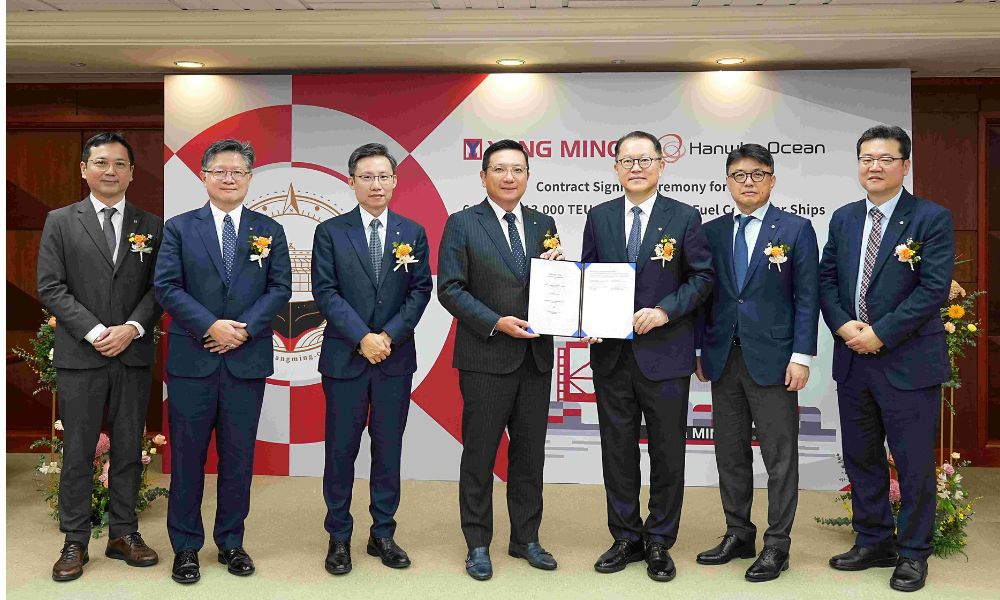
Yang Ming orders six LNG dual-fuel, ammonia-ready containerships from Hanwha Ocean
Each of the six new vessels will have a capacity of up to 13,650 TEU and feature LNG dual-fuel propulsion and Ammonia Fuel Ready specifications.
Alternative Fuels
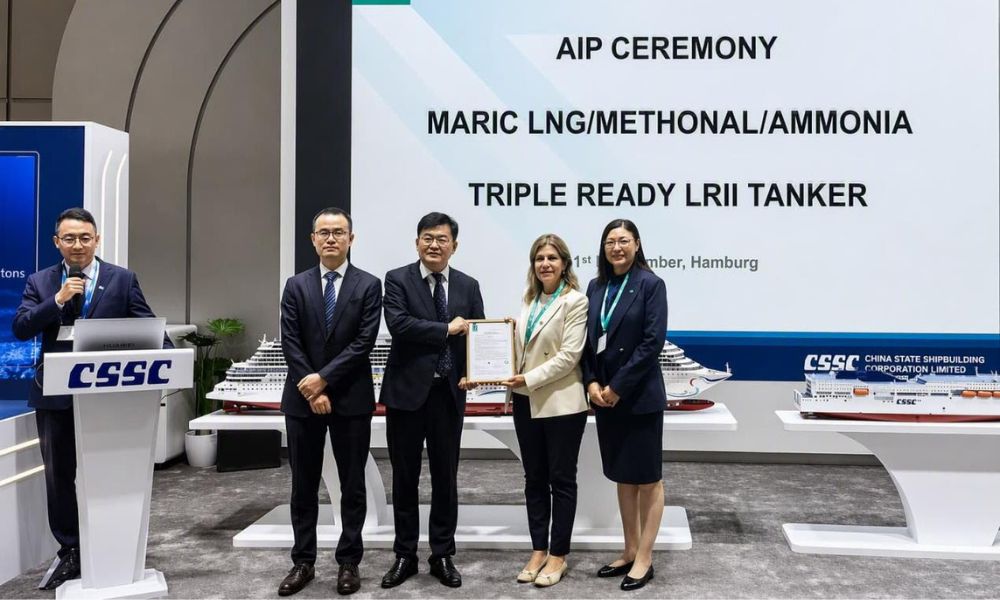
LR, China’s MARIC unveil tanker concept ready for three future bunker fuels
Both secured AiP for a new 114,000 DWT product and crude oil tanker designed to accommodate future conversion to LNG, methanol or ammonia.
Alternative Fuels
DNV: Alternative-fuelled vessel orders hit highest monthly level since October 2024
LNG-fuelled vessels accounted for the vast majority of August activity while the strong summer performance marked a significant acceleration in ordering activity after a relatively slow start to the year.
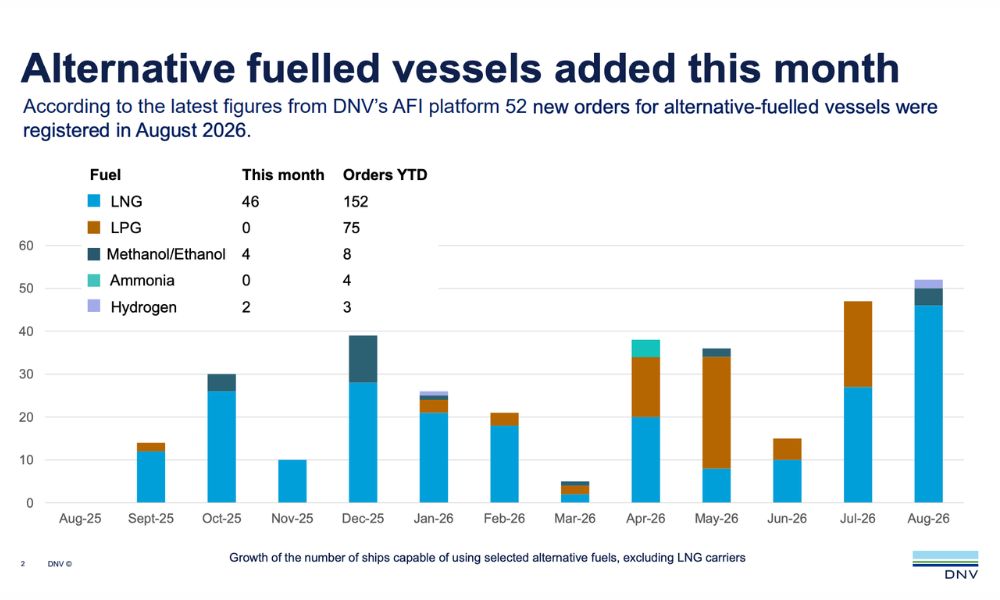
Latest data from classification society DNV’s Alternative Fuels Insight (AFI) platform alternative-fuelled vessel ordering was strong in August, with 52 new vessels added to the platform.
This is the highest monthly total since October 2024 and follows another active month in July, when 47 vessels were added to the database.
LNG-fuelled vessels accounted for the vast majority of August activity, with 46 orders recorded. The container segment led the way with 30 orders, while the car carrier segment contributed a further 12 LNG-fuelled vessels. In addition, four ethanol-fuelled bulk carriers and two hydrogen-powered bulk carriers were added during the month, as well as one LNG bunker vessel.
The strong summer performance marked a significant acceleration in ordering activity after a relatively slow start to the year. In total, 242 alternative-fuelled vessel orders have been placed in the first eight months of 2026, representing a 27% increase compared with the same period in 2025.
LNG remains the dominant fuel choice, accounting for 63% of all alternative-fuelled vessel orders registered so far this year. Container vessels represent the largest share of these LNG orders (59%), followed by car carriers (30%).
Jason Stefanatos, Global Decarbonization Director at DNV Maritime, said: “The past two months have been particularly strong for alternative-fuelled vessel ordering, with August recording the highest monthly total we’ve seen since October 2024. This has helped lift year-to-date orders to a level well above the same period last year.
“LNG remains the leading fuel choice, driven largely by activity in the container and car carrier segments. These sectors have been among the earliest adopters of alternative fuels, supported by predictable liner operations and increasing demand from cargo owners to reduce emissions across supply chains.
“For many owners, LNG offers a combination of emissions reductions, fuel availability and future flexibility while the longer-term fuel landscape continues to evolve.
“At the same time, the latest figures include orders for ethanol- and hydrogen-fuelled vessels, highlighting that owners continue to explore a range of decarbonization pathways. Different segments are making different fuel choices, but the overall level of activity demonstrates continued investment in lower-emission shipping.”
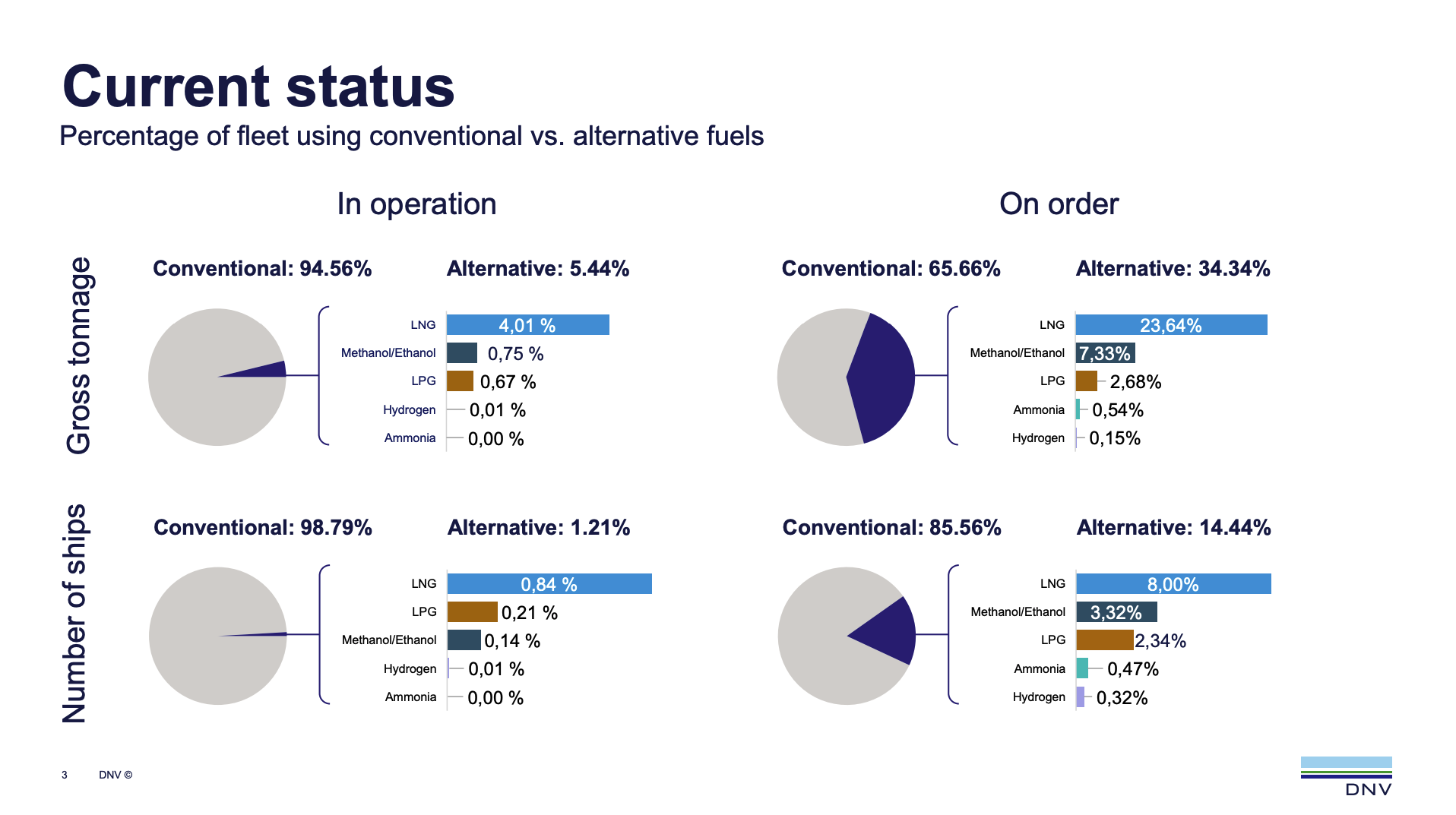
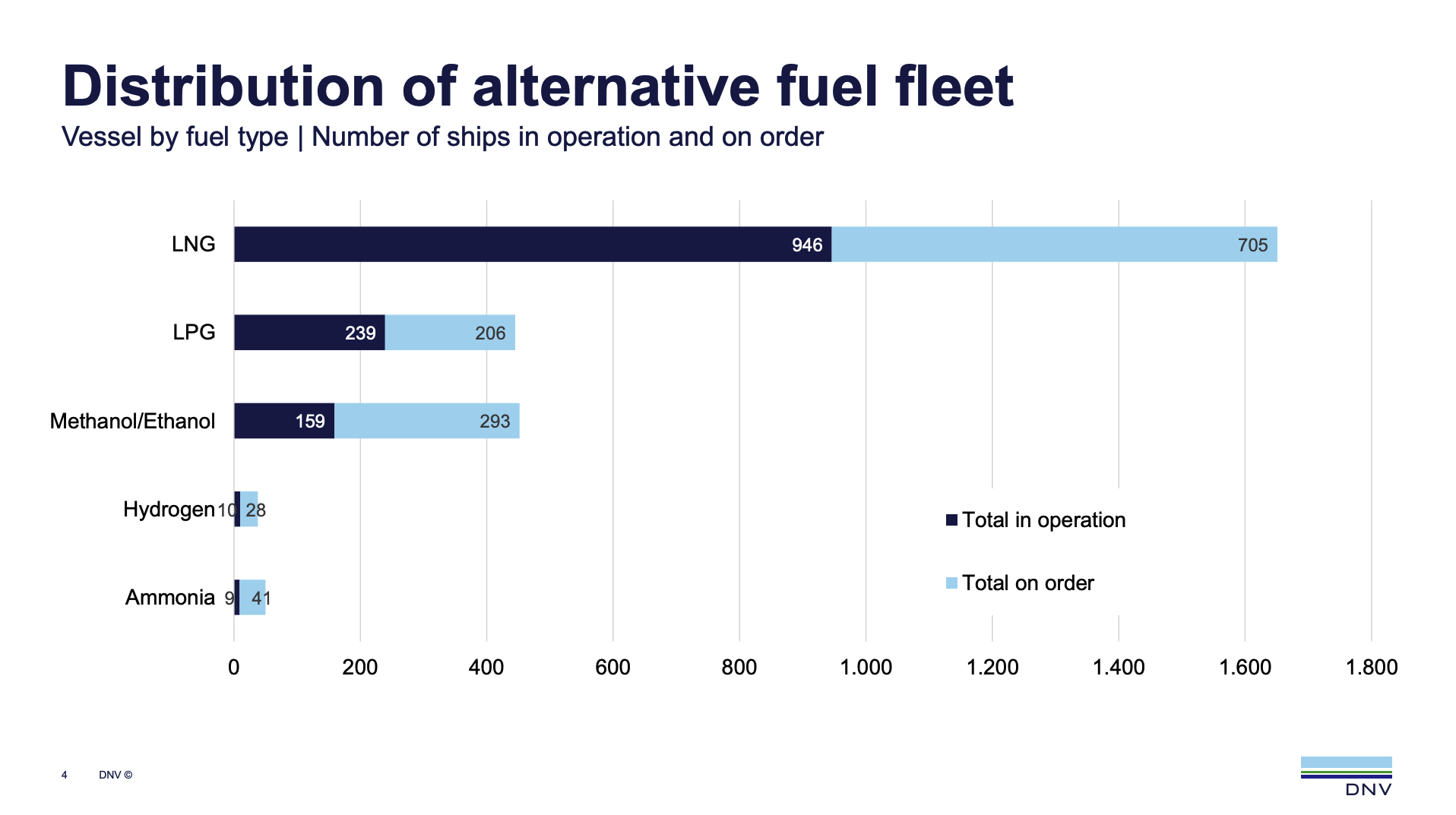
Photo credit: DNV
Published: 4 September, 2026

OUR INDUSTRY PARTNERS

Yang Ming orders six LNG dual-fuel, ammonia-ready containerships from Hanwha Ocean

LR, China’s MARIC unveil tanker concept ready for three future bunker fuels

DNV: Alternative-fuelled vessel orders hit highest monthly level since October 2024

TFG Marine advances global MFM rollout with two US Gulf bunker barges

GENA Solutions: Total renewable and low-carbon methanol project pipeline increases from 61.8 to 62.2 Mt by 2032

Baltic Exchange: Bunker Report (3 September 2026)

ENGINE: Americas Fuel Availability Outlook (3 September 2026)

Singapore-flagged tugboat “Kim Heng 3203” placed under Sheriff’s arrest

US targets five bunker companies in latest sanctions campaign against Iran

Singapore bunkering community supports Living Hope Evangelism’s 7th anniversary outreach for residents in need

China’s bunker market reshaped by tax rebates, trade flows and refining changes, says economist

Hengli Petrochemical’s ex-Singapore trading arm faces winding up application

Rajah & Tann: Bunker disputes are won in the first 48 hours

Report: GCMD outlines practical approach to quantity assurance in marine biofuel supply chains
-
 Vessel Arrest1 week ago
Singapore-flagged tugboat “Kim Heng 3203” placed under Sheriff’s arrest
-
 Sanctions2 weeks ago
US targets five bunker companies in latest sanctions campaign against Iran
-
 Events2 weeks ago
Singapore bunkering community supports Living Hope Evangelism’s 7th anniversary outreach for residents in need
-
 Interview1 week ago
China’s bunker market reshaped by tax rebates, trade flows and refining changes, says economist
-
 Winding up2 weeks ago
Hengli Petrochemical’s ex-Singapore trading arm faces winding up application
-
 Bunker Claim5 days ago
Rajah & Tann: Bunker disputes are won in the first 48 hours
-
 Biofuel1 week ago
Report: GCMD outlines practical approach to quantity assurance in marine biofuel supply chains
-

 Winding up1 week ago
Singapore: Notices of annual meeting issued for Vroon Shipping Asia and related firms