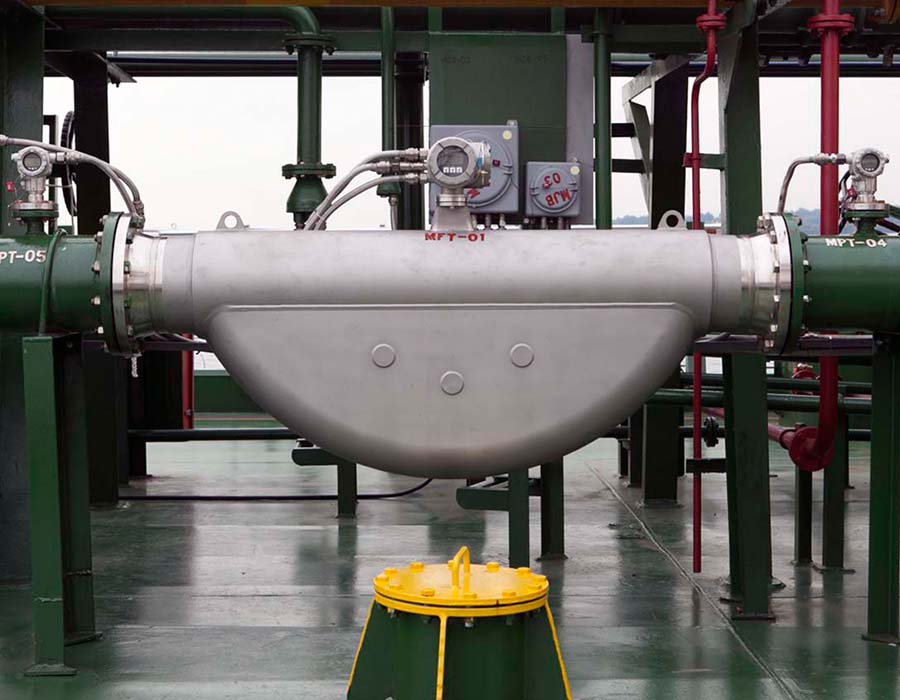
Singapore, also known as the world’s largest bunkering port, is completing its fifth anniversary of using mass flowmeter (MFM) technology for marine refuelling operations coming 1 January, 2022.
Since 1 January 2017, the local bunkering sector has been conducting MFM bunkering operations for all marine fuel oil (MFO) deliveries; the programme was extended to include distillate deliveries from 1 July 2019.
By the end of 2021, approximately more than 240 million metric tonnes (mt) of marine fuel would have flowed through MFMs installed onboard Singapore bunker tankers.
To date, use of MFM technology has enhanced transparency and integrity in the bunkering process; the system has acted as a deterrent to curb bunker malpractice and fraudulent results, while also securing the republic’s position as a trusted global bunkering hub, learns Singapore bunkering publication Manifold Times.
Singapore Shipping Association – MFMs Create a Level Playing Field
“Singapore’s MFM bunkering system has created a level playing field using smart technology. It has also removed unprofessional and unscrupulous operators,” says Caroline Yang, President of the Singapore Shipping Association (SSA).
“However, while process controls are important to ensure system integrity, the role of the bunker surveyor should not be ignored as man-made systems are prone to system default or manipulation.
“Combined with the rigorous implementation and governance from the MPA, MFMs have provided shipowners greater assurance when lifting fuels in the port of Singapore.”
The efficiency, productivity and transparency of bunkering operations has been greatly enhanced due to a combination of MFM installations onboard Singapore bunker tankers and mandatory written standards such as the Code of Practice for Bunker Mass Flow Metering (SS648), explains Yang, also the Chief Executive of Singapore bunker supplier Hong Lam Marine.
“Furthermore, with the robust monitoring, stern and swift enforcement by the MPA of suppliers who fall foul of the MFM regulation, ship owners are assured that the quantity ordered will be the quantity delivered,” she adds.
“This is exactly what sets apart the port of Singapore compared to other ports where MFMs are not being used.”
Use of MFM technology has also allowed for contactless bunkering operations to be conducted at the port of Singapore in order to minimise the possible spread of the Covid-19 virus.
“This means that shore personnel, such as bunker surveyors, do not come into direct contact with bunker tanker crew,” notes Yang.
“MFM has enabled contactless delivery with assurance to shipowners on the quantity on bunker order/delivered.
“Since MPA mandated the use of MFM in January 2017, bunkers lifted in the port of Singapore has been hovering around 50 million tonnes annually.”
International Bunkering Industry Association – Positive Paradigm Shift
“The mandatory implementation of MFMs for bunkering has brought about a positive paradigm shift for the Singapore bunkering industry,” shares Alex Tang, Regional Manager Asia for the International Bunkering Industry Association (IBIA).
“MFMs have not only allowed the local market to use a standardise and transparent methodology to quantify bunker sales, it has also resulted in a psychological shift in the mindset of buyers and sellers as confidence in the bunker trade has been established using technological means.”
The biggest advantage offered by MFM technology is of the measurement being directly calculated in mass, with no volume conversion required, according to Tang.
“This eradicates disputes derived from the traditional method of sounding measurement which entails a large amount of uncertainties from various permutations of parameters (i.e. density and temperature of the cargo, draft readings, tank calibration validity, etc.),” he says.
“Since quantity disputes have been largely reduced due MFMs, this also decreased the amount of time spent on administrative processes on claim settlements.
“As such, MFM implementation in Singapore has helped to drive efficiency in both commercial and operations aspects of the bunkering business.”
Moving forward, Tang believes the full potential of MFM technology can be achieved if every player within the bunker supply chain, including terminals, barge operators, vessel owners, and banks, integrate MFM data into their respective operations.
Lloyd’s Register – International Interest Picks Up
“Over the years, there have been a fair bit of interest in MFMs from operators in ARA, Marseille, UAE and Hong Kong,” informs Pang Jun Jie, Regional FOBAS & BQS Business Development Manager – Asia at Lloyd’s Register (LR).
“Since 2015, LR has accredited about 20 bunker tankers with MFM systems. Of course, one can argue the number is small compared to the hundreds of tankers accredited at Singapore but let’s not forget that these 20 bunker tankers were accredited on a voluntary basis as there was no local regulations complying them to do so.
“We also had some fruitful discussions with a few operators from Russia Far East and the Mediterranean who are contemplating installing and accrediting their MFM systems to support their own bunkering operations.”
MFM technology has even allowed a client of LR to complete more bunker deliveries, due to lesser time being spent on settling daily quantity disputes and conducting inventory checks (due to its bi-directional measurement capability), he notes.
According to Pang, SS648 and the Technical Reference for Bunker Mass Flow Metering (TR48) continues to remain as the most common standard within the bunkering industry.
“Prior to the launch of ISO 22192, SS648 and TR48 were the only specific guidelines available for MFM bunkering,” he states.
“These standards don’t just deal with the MFM itself but rather the overall bunkering system onboard the barge, from pipeline system integrity to operating procedures.
“Some of our clients also enquired about EU MID, which is a directive dealing with the accuracy of legal metrology across a wide range of trade sectors.
“But when you look at it from our industry point of view, it does not take into account the bunkering environment, operating procedures or pipeline integrity.
“While SS648 and TR48 may require our clients to do more work (i.e. conduct field trials) it does give that added assurance with regards to the overall measurement uncertainty.”
Metcore International – MFMs a ‘Proven’ Technology for Bunkering
“MFM systems have been proven to minimise measurement errors and disputes ever since its implementation in Singapore from 2017,” observes Darrick Pang, Managing Director of Metcore International, a Singapore-based Authorised Verifier and consultant for MFM systems.
“A proper and comprehensive MFM certification program that integrates continuous monitoring makes all the difference in reducing custody transfer risks.”
Improved accuracy of data recorded by the onboard MFM system, backed by expert consultants trained in scrutinising and interpreting the data to detect the possibility of malpractices, has resulted in major positive effects such as increased efficiency, contactless bunker operations and data-driven dispute resolution for Singapore’s bunkering sector, asserts Pang.
“Ultimately, the successful utilisation of MFM systems in preventing malpractices hinges on the effective management controls introduced through continuous monitoring, timely verifications and regular training of the crew’s competency in operating the MFM system during the custody transfer bunkering process,” he states.
“If correctly captured, the data MFM systems provide form a solid and trustworthy foundation to support digital transactions used by blockchain technology.”
Equatorial Marine Fuel Management Services – MFMs Promote Singapore Values of Transparency and Integrity
“The use of MFM technology for bunkering has been a boon for our business,” remarks Choong Zhen Mao, Executive Director at Singapore bunker supplier Equatorial Marine Fuel Management Services (EMF).
“On top of the well reported improvements, such as enhanced transparency and efficiency of operations, we find the technology also offers other benefits for our company, who is keen on embarking on the digital front.
“As such, we have further integrated the technology into our self-developed Online Tracking Tool in an effort to minimise the time customers spend on getting bunker delivery status updates.
“Data and figures are understood by everybody whether local or international and the robust system in place further augments the integrity of our bunkering process.”
The biggest value proposition offered by MFM technology, however, are perhaps the evident elevation of Trust and Reputation, believes Choong.
“Dealing in Singapore has always been about transparency and integrity, the implementation of MFM has definitely put the Singapore bunkering sector a step ahead in this regard,” he explains.
“I verily believe that the implementation of the MFMs for bunkering is one of the main reasons why the Singapore marine fuels sector continues to be an ideal port for vessel refuelling even till today.”
Endress+Hauser – MFMs to assist Singapore in the next era of cleaner fuels and digital transformation
Mohamed Abdenbi, Business Process Consultant – Bunkering & Fuel Supply Chain at Endress+Hauser, highlights MFMs have reinforced Singapore’s position as the number one bunkering port and has pushed others to follow the republic’s lead.
“In the past few years, we have seen the uptake of MFMs for bunkering in other areas like China, Hongkong, Europe, Russia, Middle east and even in South America,” shares Abdenbi.
“The main motivation was to enhance transparency, efficiency and increase the level of trust with their customers. In those countries, the use of MFMs for bunkering is not yet mandated by the government as it is in Singapore.”
Firms in countries picking up on the use of bunkering MFMs have referred to TR48 and subsequently SS648 as a guide; these Singapore Standards have helped bunker tanker operators understand the technology, the metrology and system integrity related aspects as well as the bunkering procedures when using the technology.
“We have also been approached by terminal operators for the installation of MFMs at their jetties to help them minimise their unaccounted losses. We are still also seeing ship operators equip their vessels with MFMs for bunkering and fuel consumption monitoring,” he adds.
MFMs installed onboard bunker barges have proven to be very accurate and reliable in the long-term – a fact which has been confirmed through the biannual MFM zero verification and annual verification against a master meter over the past two years.
Further, the digital communication capabilities of MFMs mean the units are able to provide a large amount of information about their health status, process conditions and measurement data.
“We can help our customer and the industry exploit this huge information potential while ensuring data security and integrity is still maintained. This is what we have been doing in the digitalisation of Singapore’s bunkering operations project led by MPA,” he states.
“In addition to that, for digitalisation to deliver all its potential, it must be integrated throughout the whole supply chain. This is where the installation of MFMs at various hotspots within the bunker fuel supply chain is important, in order to monitor fuel oil transfer in and out from the terminal.
“For this reason, the SS660 has been developed. It highlights quantity measurement requirements during bunker cargo delivery from an oil terminal to a bunker tanker using the MFM system.
“With this in place, the whole bunkering supply chain and their stakeholders will benefit not only from a more transparent eco-system that is built on reliable and accurate data that can be trusted but also a higher efficiency in their operations.”
Moving forward, Abdenbi is proud of Endress+Hauser’s participation in the development and successful implementation of the MFM solution for Singapore’s bunkering industry over the past decade.
“We remain fully committed in supporting our bunkering sector customers to ensure their success. The close cooperation with Singapore authorities has also helped us to continuously improve the bunkering system to meet new industry standards and requirements over time,” he states.
“We would like to thank our customers for their support and the authorities for their trust. As a family owned company, we are here for the long term and we will continue the development of new solutions to help the bunkering industry and our customers move into the next era of cleaner fuels and digital transformation.”
Photo credit: Manifold Times
Published: 6 December, 2021












 Alternative Fuels2 weeks ago