The planned introduction of having a master mass flow meter (MFM) to verify the traceability of bunkering duty MFMs operating at Singapore port has gathered international praise from shipping associations, learned Singapore bunkering publication Manifold Times.
The International Association of Independent Tanker Owners – INTERTANKO
“The use of a master meter to check on the accuracy of MPA-approved MFM systems installed on bunker tankers would be a good development as it may help to safeguard the interests of ship owners and bunker buyers that lift bunkers in Singapore,” says Elfian Harun, Environment Manager & Assistant Regional Manager Asia-Pacific at INTERTANKO.
“With the safeguards in place, INTERTANKO members could have greater confidence that they will be getting the bunker quantity they paid for.”
Baltic and International Maritime Council – BIMCO
The Manager, Marine Environment at BIMCO, believes the development will be beneficial to shipowners lifting fuel at Singapore port and is confident of the Maritime and Port Authority of Singapore (MPA)’s capabilities to regulate the local bunkering market.
“The use of mass flow metering provides a standard for measuring mass of bunkers delivered to the ship. Standardisation is crucial to ensure a level playing field for shipping. BIMCO hopes that the rest of the bunker ports around the world will follow the excellent example set by Singapore,” shares Christian Bækmark Schiolborg.
“The implementation of Mass Flow Metering cannot stand alone. Exactly as the Maritime and Port Authority of Singapore is doing, mass flow metering needs to be complemented by the implementation of a bunker licensing scheme and enforcement by the port authority to ensure transparency, standardised regular calibration, and discourage tampering with the mass flow metering.”
Singapore Shipping Association – SSA
The master MFM verification service operates on the principles of TR 80:2020 – Meter Verification using Master Mass Flow Meter; a recently launched technical reference at Singapore port.
“The TR 80:2020 which is the Technical Reference for Mass Flow Meter verification by Master Meter is another step to ensure that the duty meters continue to be accurate so that there is trust in this mass flow meter for the supply of accurate quantity to the ships that lift their bunkers in Singapore,” notes Caroline Yang, the President of Singapore Shipping Association (SSA).
“This TR has to work together hand in hand with the other Singapore Standards, such as SS 524 (Specification for Quality Management for Bunker Supply Chain), Codes of Practice SS 600 and SS 648 for Bunkering and Bunker Mass Flow Metering. All these standards provide transparency in the bunker supply chain.
“However, we need to understand that ‘standards’ are voluntary, it is in Singapore that these standards are mandatorily applied by our regulatory authority, MPA. Any non-compliance will attract penalties and revoking of licences, which MPA has indeed done so.
“All of the above will provide confidence to ship owners that when they buy bunkers in Singapore, on the basis of all these standards and upheld with rigour by the regulatory authority, that integrity of bunker supply is maintained.”
Singapore Standards Council – Technical Committee for Bunkering
The introduction of a master meter verification service to support the MFM bunkering infrastructure of Singapore will enhance its image as a trusted bunkering port for ship owners, highlights the Chairman of the Technical Committee for Bunkering.
“Singapore now has two frontline MFM bunkering standards, SS 648:2019 and SS 660:2020, specifying requirements and procedures for bunker fuel custody transfer from bunker tanker to vessel and from oil terminal jetty to bunker tanker respectively,” says Seah Khen Hee.
“The TR80 completes the trinity of MFM bunkering standards that cover the local bunker supply chain and provides ship owners the assurance that quality benchmarks are upheld throughout the bunker custody transfer process.
“Duty MFMs require regular periodic meter verification, in line with best practices for measuring instruments (e.g. annually), to check that they perform their role within the specified requirements of the two MFM bunkering standards over their service life. Measurement integrity and performance can also be interfered with through tampering or other means, violating the system integrity requirements of the two standards.
“TR 80:2020 which covers meter verification using the master MFM, serves the important function of verifying the frontline duty MFMs for compliance with the standards. The authorities can apply TR 80 for periodic checks and ‘spot checks’. Companies can also use meter verification as a means of assessment as part of inventory management.
“When enforced and/or applied, TR 80 helps to uphold trust and integrity of the Singapore bunkering eco-system and the bunker supply chain from the oil terminal to the vessel. Ship owners and charterers buying bunkers in Singapore will have better assurance of fair trade and encounter less dispute situations.”
Seah notes meter verification will benefit local bunker suppliers and operators of bunker tankers at Singapore.
“Under TR 80, meter verification provides an acceptable, accurate, less costly, less time consuming and more efficient method of verifying a duty MFM. Meter verification takes half a day to complete. Less downtime means more productive time especially for the bunker tanker,” he adds.
“Knowing that an MFM is properly doing its job is an important part of managing oil inventory at various transfer points along the bunker supply chain whether as a custodian or owner of the inventory. Oil loss control and minimization affect profitability in significant ways.
“With enhanced trust on the bunkering environment in Singapore, bunker suppliers and bunker tanker owners will also be able to benefit from more trade.”
Seah, meanwhile, explains the difference between zero verification and meter verification.
“Zero verification and meter verification serve separate and distinct functions, both of which are required when operating the MFM for custody transfer. MFMs, like all measuring instruments installed in the field, are affected by conditions in their operating environments over time. These conditions cause the MFM to drift,” he shares.
“Zero verification is a process to check the duty MFM if its meter zero is within acceptable limits under no flow conditions. Zero verification is conducted quarterly in the first year and half-yearly from the second year onwards. Results of zero verification will guide further action, if needed.
“Meter verification as applied to bunkering is a process to check the duty MFM if it is measuring bunker fuel correctly under stable flow conditions at operating flow rates between its Qmin and Qmax.
“When the meter verification result exceeds the specified limit, further investigation is warranted to identify and implement solutions. Regular periodic meter verification is necessary and over time, trends on any meter drift will be known and will guide further corrective action if necessary. Meter verification will help owners of duty MFMs to better manage inventory risk.”
International Bunker Industry Association – IBIA Asia
MFM verification via master meter is a scientifically proven approach to support Singapore’s MFM-equipped bunker tanker operators and the international shipping community, notes Alex Tang, Regional Manager Asia at IBIA Asia.
“Meter verification by using a master meter is a very interesting topic and it happens one of our IBIA members – Metcore International Pte Ltd – wrote about the subject in our upcoming IBIA Autumn- World Bunkering magazine on master meter introduction; I would highly recommend interested parties to read this,” Tang shares.
“If you need a copy, feel free to contact any IBIA regional representative for it. Meter verification via a master meter is deemed as a scientifically metrological and traceable approach to support bunker tanker operators and the shipping community.
“As technology evolves, bunker tanker owners and operators should consider verification technologies which are reliable, robust, effective, efficient in application, economical and traceable.”
Metcore International – owner and operator of the master meter
“It’s the right time. Having a traceable reference standard like the master meter to check on the accuracy of mass flowmeters, definitely enhances a bunker tanker owner and operator’s measurement integrity for bunker fuel delivery,” states Darrick Pang, the Managing Director of MFM consultancy Metcore International Pte Ltd.
“The master meter approach complements zero verification (ZV), which is performed frequently to check on the zero drift, especially to monitor the health of the MFM and in the change of bunker fuel grade.”
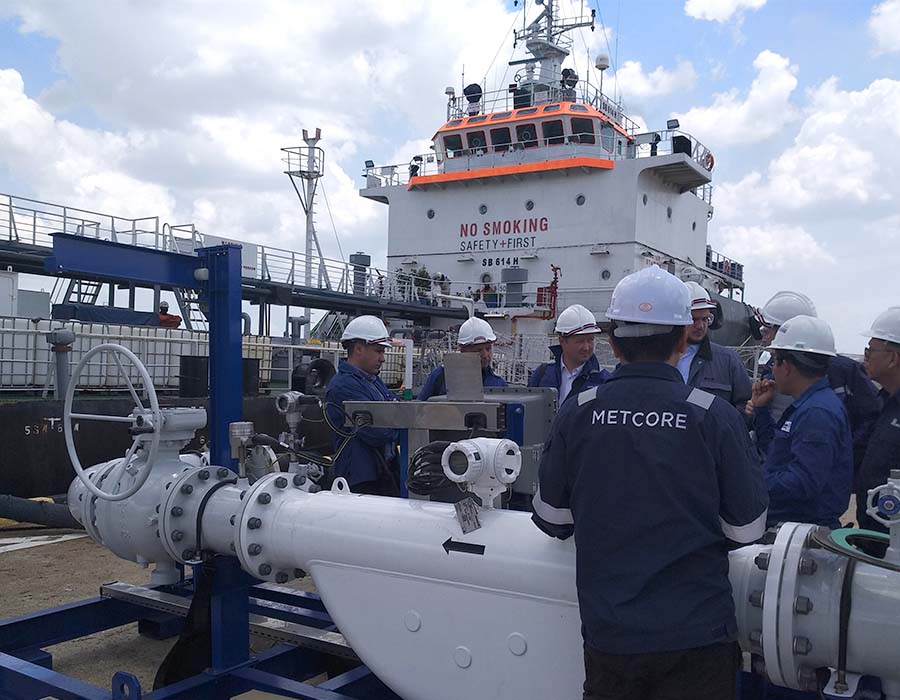
Metcore is the owner and operator of the master MFM which has undergone tests at Singapore port since early 2020; to date, the master MFM is pending approval from Singapore regulatory authorities.
Pang notes Singapore, as the world’s largest bunkering hub, recorded bunker fuel sales of 47.5 million metric tonnes (mt) worth approximately USD 30 billion in 2019.
“Even half a percent error results in huge amount of money unaccounted for, hence the stakes are very high,” he says while adding, “the equipment, process, mechanism used for the meter verification has to be sophisticated, traceable and reliable.”
According to Pang, there are tangible and intangible benefits of using the master MFM.
“One of the major tangible benefits include control of oil loss, which can help in significantly improving the mass balance of an end user’s asset,” he explains.
“The MFM verification operation becomes much faster using the master meter. As a result, the downtime of the board tanker is reduced substantially. Overall expenditure around the verification is also drastically cut down.
“Above all, embracing the traceable Master Meter verification will further enhance the credibility and trust of Singapore as an international bunkering port.”
Endress+Hauser – manufacturer of the master meter
The Endress+Hauser master MFM built for supporting Singapore’s bunkering sector is among the most accurate manufactured in the world, Mohamed Abdenbi, Business Process Consultant – Bunkering & Fuel Supply Chain points out.
“Endress+Hauser has put in a lot of efforts in conceptualising, designing, engineering and manufacturing this Master MFM system which will provide a reliable, sustainable MFM life cycle management infrastructure to support the whole bunkering industry,” he said.
“When producing a master meter at Endress+Hauser, utmost professional care is taken to manufacture the MFM with the tightest production tolerances. This is only possible under the supervision of most experienced Endress+Hauser quality control specialists.
“The master meter, during its manufacturing process has undergone rigorous calibrations, first a bidirectional calibration with water, at our ISO/IEC 17025 accredited calibration lab in Switzerland which has a best measurement uncertainty of 0.015%.
“It was then calibrated with its skid assembly using fuel oil of similar viscosity and properties at an internationally recognised, ISO/IEC 17025 accredited, independent hydrocarbon flow facility in Europe.
“During the hydrocarbon calibration the master MFM from E+H is linearized over achievable Reynolds number, a superior method providing the most accurate and traceable reference for the MFM in the field for custody transfer purposes.”
According to Abdenbi, although a duty meter installed on the bunker tanker (intended for custody transfer) and the master meter have similar components and design, both serve different purposes.
“The sole purpose of the master meter is meant to determine possible drift of the duty MFM during meter verification and is not supposed to be used for custody transfer measurement,” he highlights while adding the use of a master MFM for verification is a common practise in the world of custody transfer.
“Besides bunkering, other areas of the oil & gas industry which have been using Coriolis master meters for decades to prove duty MFMs include terminals with trucks, rail cars and ship loading stations as well as pipeline transfer stations.
“Besides the oil & gas industry, other industries which are using master meters for frequent verification with great success are food & beverage, life sciences, chemicals, and more.
“The reasons master meters are being used in these industries are accuracy, simplicity of operation, low operating costs, proven in use and its ability to fulfil the transparency requirement from regulatory bodies for audit purposes.
“Given the benefits and simplicity of MFMs in terms of operation and maintenance, more and more industries are using MFMs and master meters not only for the custody transfer points but also for the process applications as well.
“You cannot manage what you can’t measure accurately. If the data from the field is not accurate and reliable, even having a very sophisticated supervisory system will not help to achieve the desired efficiency in operations.”
Photo credit: Manifold Times
Published: 9 October, 2020












 Winding up1 week ago