Connect with us

Analysis

VPS, Maersk Line and SDE International discuss first 100 days of IMO 2020 at ICS webinar

Panellists covered several marine fuel related topics including bunker fuel quality testing, COVID-2019, and long term storage of VLSFOs experienced during the first 100-day period.

Admin

Published

on

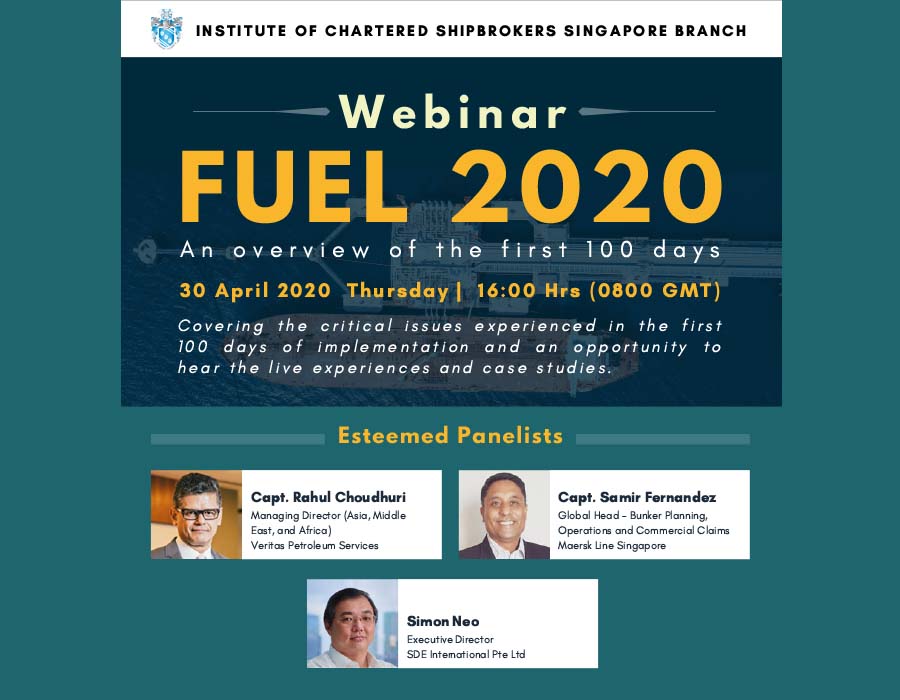
ICS fuel 2020 webinar cover photo

Representatives of Veritas Petroleum Services (VPS), Maersk Line and SDE International gathered at a webinar organised by the Institute of Chartered Shipbrokers (ICS) Singapore branch on Thursday (30 April).

The panellists discussed several marine fuel related topics, including bunker fuel quality testing, Coronavirus Disease 2019 (COVID-2019), and the long term storage of very low sulphur fuel oil (VLSFO) post IMO 2020.

The First 100 Days of IMO 2020

Captain Rahul Choudhuri, the Managing Director (Asia, Middle East, Africa) at international fuel testing and inspection company VPS, moderated the session by offering a solution to ongoing quality issues, such as the elevated levels of Total Sediment Potential (TSP), Catfines (Al+Si) and Wax content currently seen in the new generation of IMO 2020 compliant bunker fuels.

“I do feel going ahead, a potential solution is in the introduction of robust data analytics in marine fuel quality management and its role on how shipping manages marine fuels,” he suggests.

Simon Neo, Executive Director at marine fuels consultancy SDE International, shares the transition from traditional 3.5% sulphur limit bunker fuel to the lower 0.5% sulphur limit VLSFOs has been “very smooth” in terms of physical bunkering operations at Singapore port.

“But, on the quality part, we have seen some pour point issues since December 2019 till January 2020 where it is believed certain cargo traders may have used bunker blends containing waxy residues and components combined with an unsuitable pour point,” he explains.

“This has resulted in some debunkering cases taking place, where I have personally seen two.”

Neo further noted the sulphur content found within marine fuels delivered at Singapore port to be edging close to IMO 2020 limits – between 0.47% to 0.49% – and advised stakeholders to take note.

“The first 100 days were very interesting times due to the coronavirus, the closure of several ports, and the financial troubles faced by Hin Leong,” he says.

“It seems all the problems of the oil and shipping sectors are happening at the same time. This is not very good news for both industries but let’s hope they will be able to move forward when the market reopens.”

Captain Samir Fernandez, Global Head – Commercial Operations, Optimisation and Claims at Maersk Oil Trading Singapore, noted the 100-day timeline for IMO 2020 has recently passed.

“But for us at Maersk it has been two years in the making. The first batch of VLSFO bunkered by a Maersk Line vessel was carried out in March 2019 and this vessel continued to trail different batches right until the switchover date,” he said.

“We learnt from our mistakes and we corrected them. Our colleagues in Fleet Management developed ship implementation plans and tested them on 25 vessels while our colleagues at sea provided feedback on what fuel worked and what did not; including what every vessel had to do when it came to the switchover date.

“IMO 2020 was the perfect example of ‘One Maersk’ – we came together to achieve a seamless switch. With approximately 700 ships there are challenges and one of the biggest things we learnt during preparation is being far more careful when switching between two batches of VLSFOs. Previously, with heavy fuel oil, such issues were minimal.

“The preparation we spent on research and development truly paid off and allowed us to switch to IMO 2020 compliant fuels without any disruption whatsoever.”

Bunker suppliers pick up on quality testing, Maersk’s ‘Three Lines of Defence’

The session progressed to Captain Choudhuri enquiring with Neo and Captain Fernandez on respective actions taken by Singapore bunker suppliers and Maersk Line in preventing the delivery and acceptance of off-spec marine fuel.

Neo pointed out certain Singapore bunker suppliers taking an interest in testing their own bunker samples due to IMO 2020.

“A solution implemented by some physical suppliers was to test samples after loading in an effort to detect off-spec or contaminated fuel,” he said.

“This is not a fool proof solution due to the quick barge turnover times in the Singapore market. Occasionally, within a 24-hour period, the fuel will have already been delivered before test results are out so that is the challenge.

“If more suppliers continue to test samples to show quality is being delivered, ship owners will feel safer to take bunkers here in Singapore.”

Captain Fernandez, meanwhile, said Maersk has implemented a “3 lines of defence” to ensure that no oil is consumed without its quality being verified at multiple points across the bunker value chain as part of a company policy.

“Way back in October 2019, we decided any fuel consumed on a Maersk Line vessel has to be tested three times beforehand. The steps consist of test information from the COQ (Certificate of Quality), barge pretesting and post supply testing,” he said.

“It is this stringent system of testing that has allowed us to put about 3,000 stems of VLSO on our vessel without any major quality issues.”

Solution to role of bunker surveyors and cargo officers amidst COVID-2019

The webinar moved on to cover COVID-2019 and its effect on the Singapore bunkering sector.

An earlier Manifold Times article written in mid-April found bunker surveyors not being allowed to board some bunker tankers due to social distancing policies implemented by their bunker supplier owners/charterers – which contravened the procedures of SS600 and SS648.

Neo noted some bunker suppliers have since introduced a solution to overcome the problem.

“Quite a number of bunker suppliers have now set up a bunker station outside the accommodation area where the bunker surveyor, chief engineer and cargo officer can gather to inspect and witness activities on board the bunker tanker,” he shared.

“This arrangement allows all stakeholders to still observe social distancing measures as required by the port authority, while following proper bunkering procedures as required by SS600 and SS648.”

Long term storage of VLSFO

The panellists ended the session by answering questions from the audience where a member asked about the long term effects of VLSFO, a fuel well documented with stability and wax concerns, being stored on board vessels during a long term layup or storage situation.

The global imbalance between oil supply and demand due to COVID-19 has recently led to the increased use of oil tankers (which contain VLSFO in their bunker tanks) as temporary offshore storage facilities for crude oil.

“We do feel even one month of VLSFO storage can be too long. However, these are very early days and we are going into unknown territory,” said Captain Choudhuri, whose company recently introduced a service that tests and monitors marine fuels under long term storage conditions.

Captain Fernandez shared Maersk Line has earlier conducted tests to determine the useful life of VLSFO.

“It is important to know the blend mix before deciding whether the fuel should be stored. More than important is to make sure all recommendations of the fuel analysis report, such as storing the product at the right temperature well above the pour point and correct handling procedures, are followed,” he advised.

“Since this is a new development, the most important is to test and draw samples to verify that the fuel is still stable and the quality hasn’t deteriorated.”

Neo, noted current 0.5% sulphur VLSFO fuel blends were less stable when compared to past 3.5% sulphur HFO products consumed by vessels.

“A lot of the vessels in the past did not encounter issues when using HFO a month after picking up the fuel. Last time, there were no issues as HFO was only one product,” he said.

“Today, we do not know the components going in to reduce sulphur content of the fuel [VLSFO]. I agree with what Captain Samir says, where the stability for bunkers will need to checked and tested especially in layup conditions.”


Photo credit: Institute of Chartered Shipbrokers Singapore branch
Published: 6 May, 2020

Continue Reading

Interview

Interview: Alkagesta navigates risk from bunkering ops during turbulent times

As the industry navigates this period of uncertainty, the key question is no longer ‘what will fuel cost?’ but rather ‘will fuel be available?’, highlights Mithat Çiftçioğlu.

Admin

Published

on

By

Mithat MT

Mithat Çiftçioğlu, Marine Fuels Director at Alkagesta, shared his opinion on risk management for bunkering operations under current geopolitical tensions through the April edition of shipping magazine Deniz Ticaret.

The maritime publication, part of the Turkish Chamber of Shipping (İMEAK Deniz Ticaret Odası), has given Manifold Times permission to republish the article:

Fueling Ships in Turbulent Times

From Oil Shock to Fuel Access Crisis: A New Risk Map for Maritime 2026

The final weeks of the first quarter of 2026 mark one of the most complex periods in recent years for global energy and maritime markets. The sharp rise in oil and refined product prices since February 28 may look like a classic energy shock at first glance, but developments in the maritime sector point to a far deeper structural rupture.

What is being debated in the market today is no longer just oil prices. For traders and shipowners operating in the maritime sector and bunker market, the real issue is not the price of fuel — it is access to fuel. The fundamental question in the market has shifted: not what will the price of fuel be, but will fuel even be available?

In light of the Force Majeure cancellations at Asian ports over the past two weeks, another question must also be considered: Will pre-agreed bunker supply contracts actually be delivered?

From Oil Prices to Logistical Reality

Tensions in the Middle East have created a strong geopolitical risk premium in the oil market. Brent crude briefly surpassed the $100 per barrel mark, triggering a search for a new equilibrium across markets. This will inevitably bring inflation and recession back onto the global agenda in the months ahead.

But the rise in oil prices does not only reflect the risk of supply disruption — it also signals the return of one of the most fragile chokepoints in global energy trade:

The Strait of Hormuz

Approximately one-third of the world’s oil trade passes through this narrow waterway. Around 20 million barrels of oil and petroleum products transit Hormuz daily. Any disruption here would therefore affect not only oil prices, but also global refined product flows and the bunker market directly.

Why Strategic Oil Reserves Are Not the Solution

A commonly proposed solution in energy crises is the release of strategic petroleum reserves. However, releasing these reserves does not directly resolve a bunker crisis. Strategic reserves consist of crude oil. To produce bunker fuel, the following chain must be completed:

Crude oil → Refinery → Product logistics → Bunker port

This process takes time. Strategic reserves can temporarily stabilize oil prices, but they cannot solve the access problem in the bunker market in the short term.

Furthermore, the announced reserve release of 400 million barrels, to be drawn down at a rate of 2.5–3 million barrels per day, can only cover a small fraction of the estimated daily loss from the Middle East — optimistically 8–10 million barrels, pessimistically 18–20 million barrels per day.

A Historic Surge in Bunker Fuel Prices

The per-ton price of VLSFO (0.5% sulfur) bunker fuel has surpassed $1,000, reaching approximately double pre-war levels. This also represents some of the highest prices seen since July 2022.

While prices at bunker hubs such as Singapore and Fujairah are approaching $1,100 per ton, European markets have remained comparatively lower.

The Real Problem Is Not Price — It Is Fuel Access

Obtaining bunker quotes for April has become increasingly difficult, particularly at Asian ports. Even where shipowners and traders can secure quotes, the absence of supply guarantees makes pricing extremely challenging.

A senior executive at Oldendorff Carriers summarized the situation in these words:

“We cannot price cargo because we cannot calculate fuel costs; we cannot calculate fuel costs because there is no supply guarantee.”

The CEO of Maersk has compared the current situation to the pandemic era, stating that companies are attempting to source fuel through methods they have never tried before in order to keep global shipping networks supplied.

While supply is tight and prices are near their peak in Singapore and Fujairah, Rotterdam appears relatively more balanced. However, as the conflict drags on, risk perception in European markets is also rising.

The surge in bunker prices will not only increase costs — it will also affect global maritime transport capacity. Ships are expected to reduce their speeds to conserve fuel. This could lead to a reduction in effective carrying capacity, creating new logistical bottlenecks in global trade.

The importance of working with reliable, long-term partners has never been more apparent than during a crisis such as this.

The Widening Price Spread Between Fuel Types

A notable development in the bunker market in recent weeks is the rapid widening of price differentials between different fuel types. Two spreads in particular have expanded significantly:

  • Marine Gas Oil (MGO) – VLSFO
  • VLSFO – HSFO

Rising demand for distillate products, refinery production balances, and regional supply tightness are all contributing to this widening. As a result, bunker purchases have become not merely a matter of price level, but a strategic decision tied to product type and port selection.

An Unexpected Development: Biofuels Becoming Competitive

Another noteworthy development in the bunker market is that biofuels have remained at relatively competitive price levels. This creates two important opportunities for shipowners.

On one hand, biofuels remain competitively priced in certain markets. On the other, they offer a means of compliance with new regulations entering into force in Europe — particularly the FuelEU Maritime and EU ETS frameworks, which require reductions in carbon intensity. In this context, biofuels have become a strategic option for many shipowners.

Conclusion: Active Bunker Management Is The New Normal

The 2026 bunker market presents one of the most complex energy trading environments in recent years. The rise in oil prices, geopolitical risk at the Strait of Hormuz, tightness in physical fuel supply, and widening price spreads between fuel types have made bunker fuel management more critical than ever.

The prevailing view in energy markets is that as long as the risk at the Strait of Hormuz persists, turbulence in the bunker market will persist with it. As time passes, the depletion of commercial stocks may deepen the existing supply tightness further.

For this reason, the current situation is viewed not merely as an energy crisis, but as a new stress scenario testing the logistical infrastructure of global trade.

The view increasingly heard across energy markets is this:

“As long as Hormuz remains closed, it will not be oil prices but fuel access that constitutes the defining risk for global shipping.”

Finally, for shipowners and operators, bunker strategies are shifting away from a passive purchasing approach toward a model grounded in active risk management.


Photo and article credit: Deniz Ticaret
Published: 7 May 2026

Continue Reading

Analysis

T&E: Overreliance on traditional bunker fuels costs shipping USD 395 million a day due to Iran conflict

Development has made alternative fuels increasingly more competitive, states Eloi Nordé, shipping policy officer at T&E.

Admin

Published

on

By

The Hormuz crisis adds over 300 million a day to shippings fossil fuels bills

The European Federation for Transport and Environment (T&E) on 27 March highlighted the adoption of green marine fuels would reduce the shipping industry’s exposure to fuel price shocks in future.

It noted shipping companies are spending an extra €340 million (USD 394.74 million) a day in additional fuel costs as a result of the latest conflict in the Gulf.

As 99% of the global fleet runs on fossil fuels, the industry is directly exposed to fuel price volatility and supply disruptions. Efficiency measures, electrification and e-fuels would reduce the industry’s exposure to price fluctuations.

According to T&E, marine fuel prices have escalated rapidly, with VLSFO reaching €941 per tonne in Singapore, up 223% since the start of 2026. At the same time, LNG prices have risen by 72% since early March. Since February 28, shipping companies have incurred more than €4.6 billion in additional fuel costs.

The development has made alternative fuels increasingly more competitive. As fossil fuel prices reach record highs again, the cost gap with e-fuels is narrowing.

T&E’s research shows that the cost gap between marine gas oil – one of the more expensive fossil fuels – and e-fuels has shrunk to near parity (+5%) in some ports.

Hormuz oil crisis boosts potential e fuel competitiveness

While the trend may be temporary, it shows that the volatility of fossil fuel markets offsets much of the structural cost disadvantage of clean fuels.

“Chaos in the Strait of Hormuz is putting global maritime trade under the spotlight. But it’s on the oil markets where its impact will be felt the most. The war is costing the industry millions every day,” said Eloi Nordé, shipping policy officer at T&E.

“Some governments and parts of the industry have spent the last year bashing green maritime measures as being too expensive, yet those costs pale in comparison to this super-disruption.

“If anything, this crisis should be the catalyst for more investment in European e-fuels and greater uptake of energy efficiency measures to avoid fossil fuel shocks in the future.”


Photo credit: European Federation for Transport and Environment
Published: 2 April 2026

Continue Reading

Business

Interview: Nunchi Marine believes Iran war forces a reset in bunker cargo trading

Tomas Stacy, Managing Director of Bunker Trading at oil cargo and bunker trading company, Nunchi Marine, comments on volatility, supply disruption and survival in a fractured market.

Admin

Published

on

By

Tomas MT

The war involving Iran has pushed the global bunker market into one of its most turbulent periods in recent memory, with Singapore – the world’s largest bunkering hub – feeling the impact.

Once‑reliable supply chains have been disrupted, price volatility has surged to extreme levels, and bunker cargo traders are being forced to abandon long‑standing strategies in favour of defensive, risk‑driven decision‑making.

The sharp reduction in Middle Eastern supply flows has exposed structural vulnerabilities in the market, while suppliers and traders alike have tightened terms amid unprecedented uncertainty.

Against this backdrop, bunker cargo trading has shifted from margin optimisation to survival mode. In this executive interview, Tomas Stacy, Managing Director of Bunker Trading at Singapore-headquartered independent oil cargo and bunker trading company, Nunchi Marine shares how the conflict is reshaping bunker cargo trading, the challenges importers now face, and what it takes to navigate a market defined by scarcity, volatility and risk.

MT: How has the Iran war changed the bunker cargo trading landscape in Singapore?

TS: The change has been structural rather than cyclical. The market is now characterised by extreme price volatility, tighter availability, and far more defensive behaviour from both traders and physical suppliers. The conflict has disrupted a core supply artery into Asia, and that has exposed just how dependent Singapore has been on stable Middle Eastern flows. Trading today is less about optimising margins and more about managing risk and ensuring continuity of supply.

MT: What has been the most immediate impact on bunker cargo importers since the conflict began?

TS: Margin pressure and uncertainty have intensified almost overnight. The sharp drop in tanker movements through the Strait of Hormuz has effectively choked a primary supply source, and that has translated directly into price shocks. Since the war began, VLSFO prices in Singapore have more than doubled, while MGO prices have surged even more sharply. For importers, this has made forward planning extremely difficult and increased exposure on every cargo decision.

MT: Why has the market struggled to replace lost Middle Eastern barrels?

TS: The scale of the disruption is the key issue. The Middle East typically supplies around 1.2 million metric tons of fuel oil per month to Asia, and there is no simple replacement for that volume. Alternative supplies from the Americas or Russia exist, but they are constrained by high freight costs, sanctions, or limited availability. In practical terms, arbitrage opportunities into Singapore have become largely unworkable, leaving the market structurally tight.

MT: How has extreme price volatility changed trading behaviour and supplier relationships?

TS: Volatility has fundamentally altered risk appetite. At the onset of the conflict, prices were moving by as much as $100 to $150 per metric ton in a single day, which makes holding large cargo positions highly risky. In response, physical suppliers have become increasingly defensive—rationing volumes, prioritising long‑standing customers, and avoiding even short‑term term contracts. For traders, this has meant smaller position sizes, shorter, and a much greater emphasis on counterparty strength and reliability.

MT: Beyond price and supply, what risks are now top of mind for bunker cargo traders?

TS: Quality and logistics have moved sharply up the risk agenda. Recent alerts around off‑spec VLSFO in Singapore which were linked to engine damage, have added a new layer of concern for cargo procurement. At the same time, tight supply conditions are beginning to create logistical bottlenecks, with some vessels struggling to secure bunker slots and early signs of congestion appearing at major ports. In this environment, survival depends on disciplined risk management—avoiding long‑term fixed‑price exposure, strengthening supplier relationships, enforcing stricter quality controls, and building greater operational flexibility into voyage planning.


Photo credit: Manifold Times
Published: 31 March 2026

Continue Reading

Trending