Connect with us

LNG Bunkering

Wärtsilä: LNG marine fuel gets a push in the United States

Initiatives slowly setting the ball rolling on LNG as a major, viable source of marine fuel for the country.

Admin

Published

on

5c2c5a1d7291d 1546410525

The following ‘LNG marine fuel gets a push in the United States’ article was first published on the Wärtsilä magazine Twentyfour 7 in late 2018:

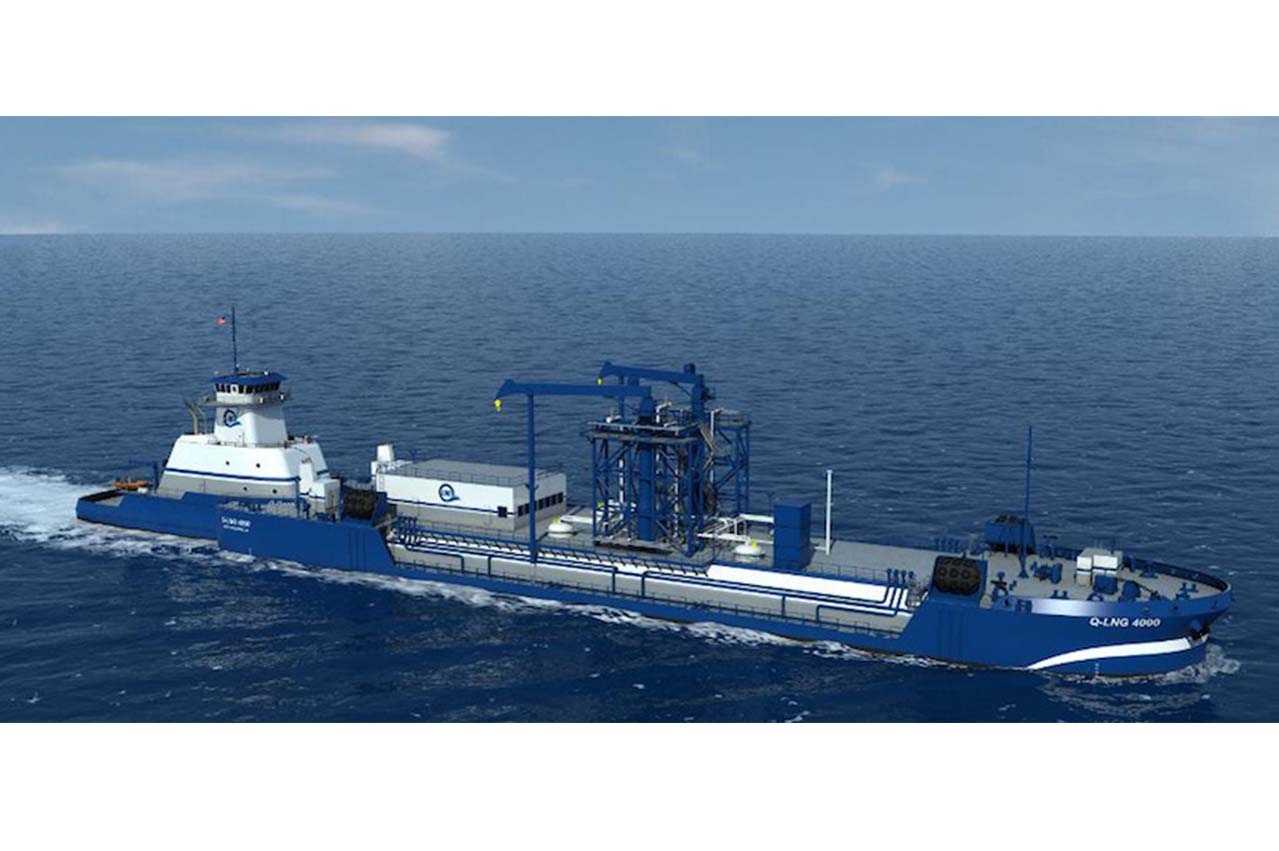
In November last year, energy supermajor Shell Global, Q-LNG, VT Halter Marine and Wärtsilä began work on an articulated tug barge (ATB). This, one commitment, managed two feats. One, Shell will soon be able to supply LNG fuel to cruise ships along the entire eastern coast of the US. More importantly, it has reaffirmed that LNG is quickly gaining a foothold as the future choice of fuel for the US marine industry.

“LNG has been developing in the Far East and Europe for some time. The development in the US has been lagging, the main reason being the lack of a reliable transportation link. The big question has always been – how am I going to get this fuel? The Q-LNG ATB is the missing link in the chain,” says Bill Amundsen, Sales Manager for Marine Solutions at Wärtsilä.

“It answers the question of where ship owners / operators are going to get the fuel. It provides a transport link from the liquefaction plant to the ship receiving the LNG, and therefore increases the viability of LNG as a fuel source,” he explains.

Shell will be taking the 4000 cubic metre ATB on long-term charter from Q-LNG. The LNG bunker barge fitted with LNG products and solutions from Wärtsilä is one in a host of recent initiatives seeking to solve the logistics and infrastructure challenges that have hindered the adoption of LNG as a marine fuel in the country.

In fact, commitments to using LNG as a marine fuel have increased in the United States in the past few years. In 2016, for example, Harvey Gulf International Marine, inaugurated its first LNG fuelling terminal in Port Fourchon, Louisiana that will service the Gulf of Mexico region. In another case, Eagle LNG, a bulk LNG provider, seeks to construct an LNG liquefaction facility in Jacksonville, Florida, from where ExxonMobil intends to supply fuel to vessels.

“I believe there is enough movement in the global market and in the use of LNG as a marine fuel today to propel people into making commitments more regularly. They’re now willing to make a capital investment because the market seems to be moving in that direction,” says Chad Verret, President of Q-LNG, and Chairman of the Board for industry body, SGMF.

So, what exactly is moving the market in this direction?    
 
Factoring in regulations and cost benefits

A key aspect is the looming International Maritime Organization (IMO) emission deadline in 2020. The IMO has set a stringent 0.5% sulphur cap on emissions from marine fuel as compared to the current 3.5%. While vessels can continue running on traditional fuel oils by employing scrubbers or exhaust gas cleaning systems, ship owners are switching to LNG instead.

“Ultra-low sulphur diesel (ULSD) is going to be very expensive because starting in 2020, the demand will increase, but the supply will be restricted as there are only so many refineries in the world that can produce it. While the price of ULSD is going to go up, at the same time, natural gas in North America is going to remain relatively flat since we have this huge amount of supply already. So we’re going to see diverging curves between the price of LNG and ULSD,” says Amundsen.

This could play out in LNG’s favour.

“The favourable cost differential plus the superior environmental factors will lead to increased demand for LNG in the North American market space. It’s a practically sulphur-free, clean, well-proven technology, easy to burn, and can lower engine maintenance costs. All of these factors make LNG much more viable as a marine fuel,” Amundsen adds.

In addition, with the help of right technology, LNG emits about 90% fewer nitrogen oxide emissions than conventional HFOs, according to industry coalition SEA/LNG. Its sulphur oxide and particulate matter emissions are next to zero, further making its case.  
  
Reduced tolerance towards pollutants

In the United States, particularly, there has also been movement on ground for the use of LNG.

In California (considered to have the worst air quality in the nation), the California Air Resources Board (CARB) has imposed a 0.1% sulphur cap on vessels operating within 24 nautical miles of its coast. In another instance, two of the busiest ports in the country, Long Beach and Los Angeles announced a USD 14 billion anti-smog plan primarily aimed at cutting greenhouse gas emissions by 80% by 2050.

“There is definitely a growing demand for LNG-powered vessels in the country. If you look at Hawaii, Pasha will be adding an LNG-powered container ship to its fleet. So yes, I believe that once there is a better understanding of the demand load in the West Coast (California especially), companies will start to put that infrastructure in place,” says Verret.

The US energy department predicts that LNG production in the country will quadruple by 2019, making it the third largest supplier of LNG in the world.

The current demand for LNG in the US stems from offshore supply vessels, container ships and passenger cruise vessels. Currently, there 13 vessels operating in the US run on LNG, with 15 more in the pipeline. Looks like there is no stopping the LNG wave.

Source and photo credit: Wärtsilä
Published: 2 January, 2019


Continue Reading

LNG Bunkering

PIL’s LNG dual-fuel boxship “Kota Elok” arrives in Singapore on maiden call

As the first of 13 new 13,000 TEU vessels joining its fleet, Kota Elok is equipped to operate on LNG and low-sulphur fuel oil that helps reduce our greenhouse gas emissions.

Admin

Published

on

By

PIL's LNG dual-fuel boxship “Kota Elok” arrives in Singapore on maiden call

Singapore-based Pacific International Lines Pte Ltd on Monday (20 July) said its first 13,000 TEU LNG dual-fuel container vessel, Kota Elok, recently made her maiden call to Singapore on 15 July.

As the first of 13 new 13,000 TEU vessels joining its fleet, Kota Elok is equipped to operate on liquefied natural gas (LNG) and low-sulphur fuel oil that helps reduce our greenhouse gas emissions. 

The vessel also incorporated energy-saving features and digital technologies to reduce fuel consumption and enhance operational performance, as well as a bow windshield to improve aerodynamics, contributing to improved fuel efficiency and lower emissions over the course of long-haul voyages.

“Following Singapore, Kota Elok will continue her voyage on our East Coast Service 1 (ES1) route to South America, calling at ports in Brazil, Uruguay, and Argentina before returning to Asia,” the company said in a social media post. 

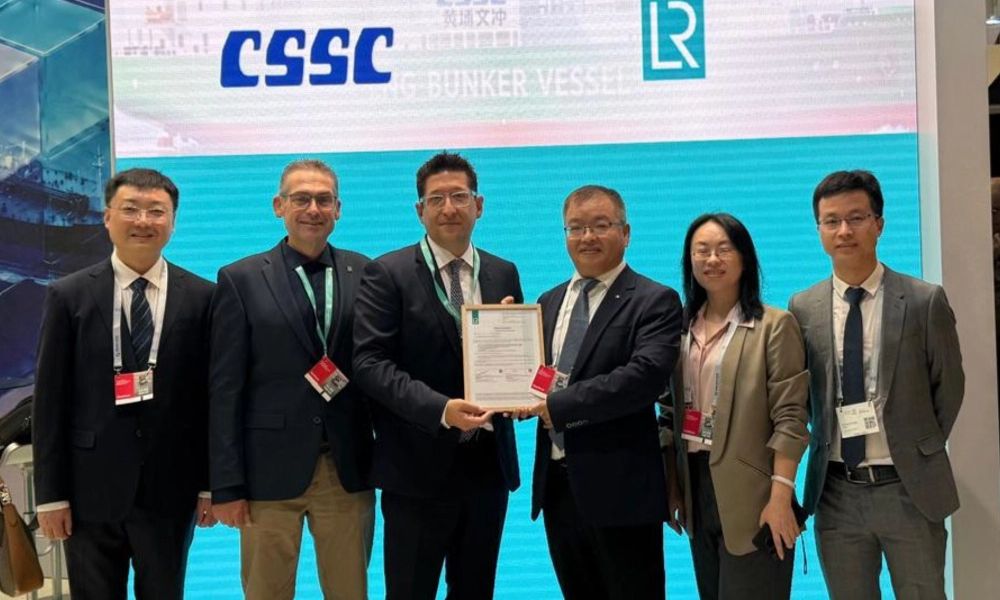
Kota Elok also became PIL’s first vessel to receive Lloyd’s Register certification for compliance with the IACS UR E26 and UR E27 cyber security requirements.

Developed by the International Association of Classification Societies (IACS), UR E26 and UR E27 are mandatory cyber resilience requirements for newbuild vessels contracted from 1 July 2024. 


Photo credit: Pacific International Lines
Published: 21 July, 2026

Continue Reading

LNG Bunkering

CIMC SOE secures order for 12,000-cbm LNG bunkering vessel from Sinopec Clean Energy

Once operational, the vessel is expected to strengthen Sinopec’s domestic coastal LNG bunkering network and help address gaps in China’s alternative fuel bunkering infrastructure.

Admin

Published

on

By

CIMC SOE secures order for 12,000-cbm LNG bunkering vessel from Sinopec Clean Energy

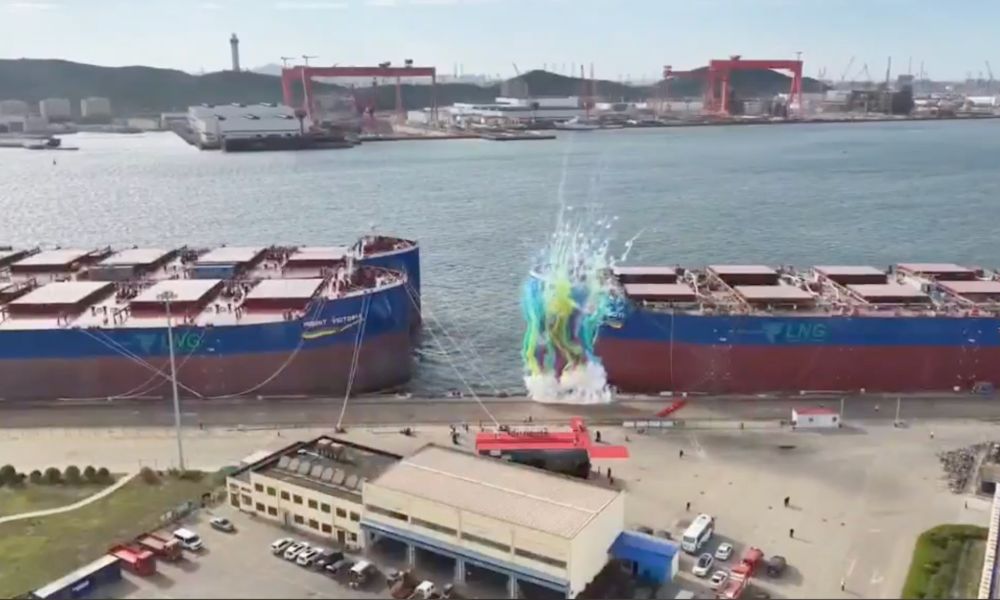
China’s Nantong CIMC Sinopacific Offshore & Engineering Co., Ltd. (CIMC SOE) recently signed a contract with Sinopec (Beijing) Clean Energy Co., Ltd. to build a 12,000-cubic metre (m3) LNG bunkering vessel, according to Chinese maritime media.

The vessel is scheduled for delivery in 2028 and will support Sinopec’s efforts to expand its presence in the marine clean energy sector.

Once operational, the vessel is expected to strengthen Sinopec’s domestic coastal LNG bunkering network and help address gaps in China’s LNG bunkering infrastructure.

With this signing , CIMC Pacific Offshore Engineering’s LNG bunkering vessel orderbook is further strengthened, maintaining its leading position in the global market for small and medium-sized LNG bunkering vessels.

The contract also marked another milestone for CIMC SOE, which has seen a sharp increase in orders and business performance this year amid a surge in domestic LNG vessel demand.


Photo credit: Nantong CIMC Sinopacific Offshore & Engineering
Published: 21 July, 2026

Continue Reading

Alternative Fuels

ENGINE on Fuel Switch Snapshot: LSMGO surges to greater premium over biofuel

B100 discount to LSMGO widens to $541/mt in Rotterdam; Singapore’s B100 drops to $106/mt below LSMGO; Rotterdam LBM at $639-833/mt discounts to LSMGO.

Admin

Published

on

By

ENGINE on Fuel Switch Snapshot: LSMGO surges to greater premium over biofuel

Once a week, bunker intelligence platform ENGINE will publish a snapshot of alternative and conventional bunker fuel prices in the world’s two biggest bunkering hubs. The following is the latest snapshot:

20 July 2026

  • B100 discount to LSMGO widens to $541/mt in Rotterdam
  • Singapore’s B100 drops to $106/mt below LSMGO
  • Rotterdam LBM at $639-833/mt discounts to LSMGO

B100’s premium over HSFO in Rotterdam has narrowed by $50/mt over the past week to $64/mt, while its discount to VLSFO has widened by $83/mt to $105/mt.

B100 has become far more competitive against LSMGO in Rotterdam, with its discount widening by $180/mt over the past week to $541/mt, as a surge in conventional fuel prices left B100 broadly unchanged by comparison.

B100’s price has risen by $109/mt in Singapore, but its discount to LSMGO has still widened by $102/mt to $106/mt, as LSMGO surged by an even greater $211/mt.

Rotterdam’s LNG premium over VLSFO has widened by $35/mt to $201/mt for vessels with Otto medium speed (Otto MS) engines. For vessels with diesel slow speed (diesel SS) engines, LNG has flipped to a $15/mt premium over VLSFO, from a $22/mt discount the prior week.

Liquefied biomethane (LBM) discounts to VLSFO in Rotterdam have narrowed by $50-52/mt to $203-396/mt over the past week. Against LSMGO, LBM discounts have widened by $45-47/mt to $639-833/mt, depending on engine type.

In Singapore, LNG is now $42/mt cheaper than LSMGO for vessels with Otto MS engines, and $134/mt cheaper for vessels with diesel SS engines.

ENGINE on Fuel Switch Snapshot: LSMGO surges to greater premium over biofuel

Liquid fuels

HSFO and VLSFO prices in Rotterdam have jumped by $66/mt and $99/mt respectively over the past week, while LSMGO has surged by an even steeper $196/mt. A $9.69/bbl ($71/mt) rise in front-month ICE Brent futures, to $87.94/bbl ($645/mt), drove bunker prices sharply higher across the board.

Bunker fuel availability is tight for prompt delivery dates in the ARA ports, with buyers advised to enquire about stems between 5-7 days ahead to get good coverage, a trader said.

Rotterdam’s B100 price has risen by $16/mt over the past week. Dutch ZRE A ticket prices were unchanged at €107.50/mtCO2e.

Singapore’s HSFO and VLSFO prices have risen by $130/mt and $132/mt respectively, while its LSMGO price has gained an even steeper $211/mt over the past week.

VLSFO availability in Singapore has been tight, with several suppliers reporting low stock levels. Recommended lead times have widened from 13–17 days last week to 14–19 days now.

Liquid gases

Rotterdam’s LNG prices have surged by $134-136/mt over the past week, while its LBM prices have climbed by $149-151/mt.

LBM discounts to LNG in Rotterdam have narrowed by $15/mt to $404-411/mt.

Singapore’s LNG bunker benchmarks have surged by $196-197/mt over the past week.

By Erik Hoffmann


Photo credit and source: ENGINE
Published: 21 July, 2026

Continue Reading

Trending