Connect with us

Alternative Fuels

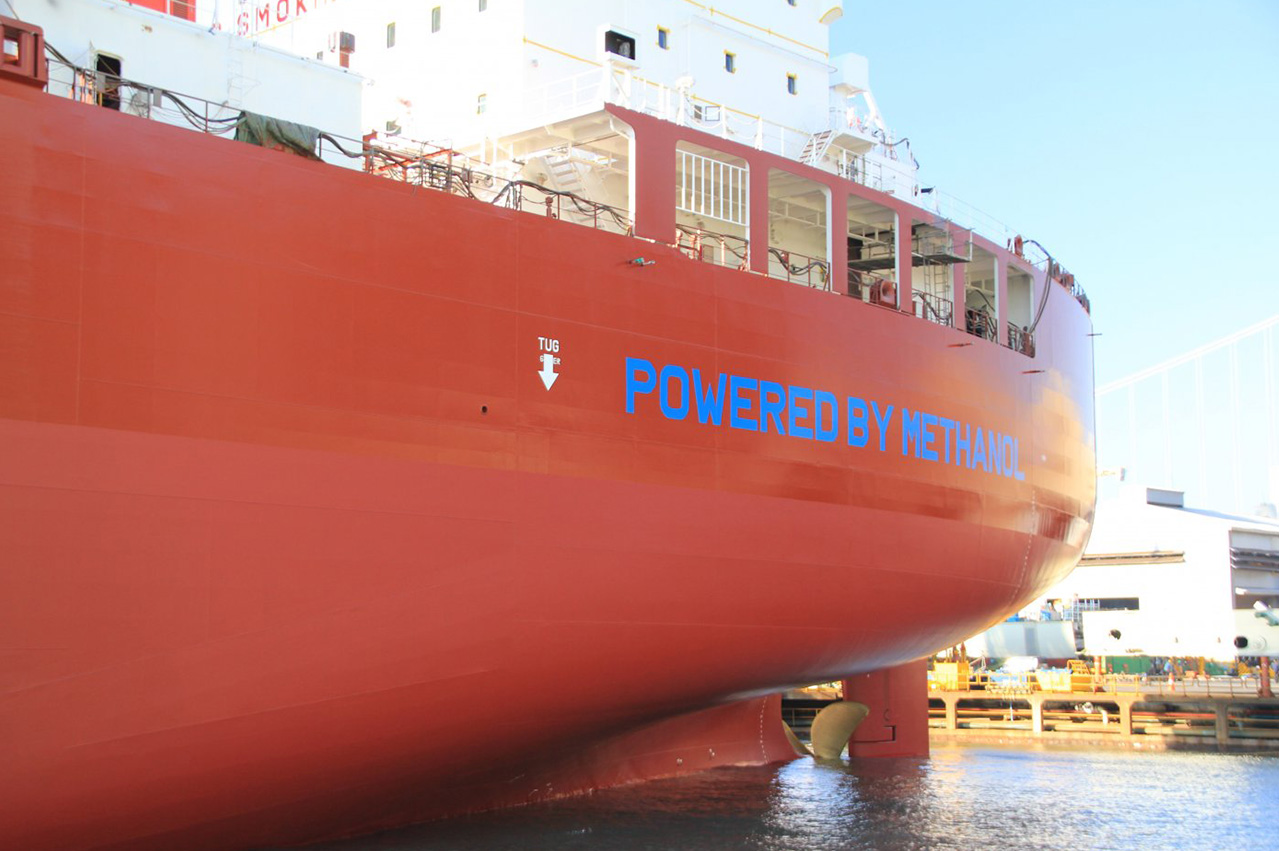
Methanol-fuelled newbuilds ordered at Hyundai Mipo

Waterfront Shipping, Marinvest, IINO Kaiun Kaisha, Mitsui, and NYK Group make investment for four vessels.

Admin

Published

on

5a852ae031203 1518676704

A total of four methanol-fuelled newbuildings have been ordered by Waterfront Shipping Company (WFS), Marinvest/Skagerack Invest (Marinvest), IINO Kaiun Kaisha (IINO), Mitsui & Co (Mitsui), and the NYK Group (NYK) on Wednesday.

The four 49,000 dead weighttonne vessels will be delivered in 2019 and built with MAN B&W ME-LGI two-stroke dual-fuel engines that can run on methanol, fuel oil, marine diesel oil or gas oil.

The four new vessels will be built in Korea at Hyundai Mipo Dockyard, where several of the first generation of methanol-fuelled vessels were built; they will join the existing seven methanol-fuelled ships chartered by WFS since 2016.

WFS will charter the four vessels to replace older vessels; two of the vessels will be owned in a joint venture between WFS and Marinvest, one will be owned by NYK and the fourth will be owned in a joint venture between IINO and Mitsui.

"Our seven methanol-fueled vessels have been operating safely and reliably since 2016, and we expect these new vessels to benefit from ongoing technological advances that will continue to optimize performance and efficiency,” says Paul Hexter, President, Waterfront Shipping.

“We are proud to see 40% of our fleet powered by methanol-fuel technology in the coming year.”

Patrik Mossberg, chairman of Marinvest, says his company is "very pleased" by the performance of the vessels delivered in 2016 and excited to be investing in another two.

“Our overall focus in the development of the dual-fuel system concept has been safety and engine reliability. We have found the technology for handling methanol is well developed and offers a safe dual-fuel solution for low-flashpoint liquid fuels," says Mossberg.

Koji Kondo, corporate officer at NYK, notes: "For over 130 years, we have been guided by our commitment to pioneering innovation. Investing in this proven groundbreaking and innovative marine technology exemplifies our commitment to using leading clean technology to meet the safe and dependable transportation needs of our global customers."

“With the growing demand for cleaner marine fuels to meet more stringent emission regulations, we’re seeking ways to reduce our environmental footprint. Investing in the next generation of fuels is one way we’ll continue to meet regulations while maintaining the efficiency of our operations," says Ryuichi Osonoe, director and managing executive officer at IINO.

“We are proud to be partnering with WFS to advance methanol as a sustainable marine fuel and be part of an innovative solution that meets the needs of the shipping industry and contributes to a more sustainable future”, says Takeshi Setozaki, chief operating officer, Mitsui.

Photo credit: Waterfront Shipping Company
Published: 15 February 2018
 

Continue Reading

Technology

Singapore: MPA working with industry on next phase of digital bunkering, says Deputy CE

‘We are now working with industry on the next phase, trialling capabilities to further strengthen the integrity and quality of bunker data shared between stakeholders and MPA,’ says David Foo.

Admin

Published

on

By

Swapnil Bapat on Unsplash

Secure systems, trusted data and reliable digital services are becoming as important to maritime operations as physical infrastructure, said Mr David Foo, Deputy Chief Executive (Operations & Technology), Maritime and Port Authority of Singapore (MPA), on Thursday (10 September). 

In his opening keynote speech at APPEC 2026 Shipping And Bunker Conference, Foo said OCEANS-X, Digital Bunkering and the Maritime Digital Twin are enabling trusted data sharing, better operational planning and the testing of new digital solutions.

Foo said since 2025, digital bunkering has strengthened the efficiency and transparency of bunker operations. 

“We are now working with industry on the next phase, trialling capabilities to further strengthen the integrity and quality of bunker data shared between stakeholders and MPA.” he said.

He also said MPA is taking a forward-looking approach to the energy transition.

“Over the coming decades, we are likely to see the most diverse marine fuel mix in shipping’s history. There may not be a single fuel of the future.”

“Our role as a global bunkering hub is therefore not to determine which fuel will prevail. Our role is to ensure that whichever fuels the industry adopts, Singapore is ready – with the infrastructure, standards and operational capabilities to support them.”

Foo said MPA is making concrete progress across the major alternative fuel pathways with the issuance of methanol bunkering licences and the commencement of methanol bunkering operations. 

“For ammonia, we are developing the regulatory and operational frameworks needed to support future commercial deployment. We are also facilitating greater use of sustainable biofuels,” he said.

At the same time, MPA continues to expand its LNG bunkering ecosystem, with additional licences issued this year. 

“This will broaden supply options as more LNG-fuelled vessels enter the global fleet. We have also just updated our LNG standards, while maintaining the high standards of safety and reliability that underpin Singapore’s reputation as a trusted bunkering hub,” Foo added.

Related: MPA Chief Executive: Port of Singapore begins digital bunkering initiative today
Related: Singapore: Golden Island, GET, and PetroChina to receive methanol bunkering licences
Related: Singapore: Equatorial Marine Fuel among eight selected for new LNG bunkering licences
Related: Singapore strengthens LNG bunkering framework with new SS 727 standard


Photo credit: Swapnil Bapat on Unsplash
Published: 10 September, 2026

Continue Reading

LNG Bunkering

DNV report: LNG bunker fleet may need to more than double by 2030 to meet demand

Global LNG bunker vessel fleet may need to more than double by 2030 as demand from LNG-fuelled ships grows faster than the infrastructure required to supply them, according to DNV white paper.

Admin

Published

on

By

DNV report: LNG bunker fleet may need to more than double by 2030 to meet demand

The global LNG bunker vessel fleet may need to more than double by 2030 as demand from LNG-fuelled ships grows faster than the infrastructure required to supply them, according to a new DNV white paper published on Wednesday (9 September). 

The report estimated that between 165 and 208 bunker vessels could be needed globally by the end of this decade.

As LNG-powered shipping continues to grow, demand for bunkering capacity is rising rapidly. Although the LNG bunker fleet is expanding steadily, demand from LNG-fuelled vessels is expected to grow even faster, placing increasing pressure on bunker vessels and the wider bunkering ecosystem. 

Without additional investment across this value chain, fuel supply could become a constraint on further LNG adoption in shipping. DNV’s white paper, Gas bunker vessels: facilitating the transition to alternative fuels, highlights how gas bunker vessels are evolving from specialist fuel delivery assets into critical infrastructure supporting shipping’s fuel transition.

Cristina Saenz de Santa Maria, CEO Maritime at DNV, said: “Shipping’s fuel transition depends on more than ships and fuel choices. It also depends on the infrastructure, supply chains, and operational capabilities needed to make alternative fuels available safely and at scale. As the fuel landscape continues to evolve, investment in flexible, reliable, and future-ready bunkering infrastructure will be essential.”

The white paper examined market developments, regulatory requirements, vessel design considerations, gas bunker vessel technical specialities, and operational best practices, while outlining the role gas bunker vessels will play in supporting both current LNG demand and the future adoption of alternative fuels.

The white paper also highlighted opportunities to accelerate market development through the conversion of suitable small-scale LNG carriers into bunker vessels. 

In addition, it examined the growing importance of operational readiness, structured safety management, and competence development as bunkering operations become more frequent and geographically widespread.

Martin Cartwright, Global Business Director, Gas Carriers & FSRUs at DNV, said: “LNG-fuelled shipping is growing faster than the bunkering network needed to support it. Closing this gap will require coordinated investment across the bunkering ecosystem, underpinned by robust safety standards, operational readiness and competence. These elements must advance together if gas bunkering is to scale safely and reliably, while also supporting future pathways, such as biomethane.”

While the white paper focused primarily on LNG, it also considers the emergence of ammonia as a potential marine fuel. The infrastructure, operational experience, and safety frameworks being developed for LNG bunkering today are expected to play an important role in supporting the future deployment of ammonia bunkering solutions.

Note: The report by DNV can be found here


Photo credit: DNV
Published: 10 September, 2026

Continue Reading

EU ETS

KPI OceanConnect on EUAs: September is the deadline, but strategy is the bigger story

With 100% EU ETS exposure for 2026 emissions, an alternative fuels strategy can no longer be treated separately from carbon management, says Jesper Sørensen.

Admin

Published

on

By

Jesper Sørensen, Global Head of Alternative Fuels and Carbon Markets at KPI OceanConnect

Jesper Sørensen, Global Head of Alternative Fuels and Carbon Markets of KPI OceanConnect, on Wednesday (8 September) wrote that while the 30 September deadline to surrender EUAs is approaching, managing exposure to EU ETS is about more than how and when allowances are purchased.

He said fuel choice and alternative fuels strategy should also form part of companies’ broader carbon-management approach: 

EUAs: EU ETS surrender deadline highlights rising maritime carbon costs, as higher compliance obligations and EUA exposure increase the strategic importance of biofuels, fuel procurement and integrated carbon management ahead of full shipping inclusion in the EU ETS from 2026.

As the 30 September EU ETS surrender deadline approaches, the immediate message for shipowners, operators and charterers is straightforward: make sure your verified emissions position is understood, your exposure is calculated, and your allowance needs are settled in good time.

But this year’s deadline should also be seen as something more than an annual compliance event. It is a reminder that carbon costs are becoming an increasingly important part of vessel operating economics, and that the most effective response is not only to buy EUAs but also to think more strategically about how fuel choices influence overall compliance exposure.

This matters because the cost of the same level of emissions is rising even before we consider market volatility in EUA prices. The reason is the phase-in of the maritime EU ETS. For 2024 emissions, shipping companies were required to surrender allowances for 40% of in-scope CO₂ emissions. For 2025 emissions, that rises to 70%. From 2026 emissions onwards, the obligation moves to 100%.

In other words, even if the EUA price were to remain unchanged, the compliance bill for the same emissions profile becomes materially larger. That is an important shift. It means carbon exposure is no longer something to address only at the end of the reporting cycle. It increasingly needs to be considered when making fuel procurement and voyage-planning decisions.

The EUA market itself reinforces that point. Price volatility remains a feature of the market, and that makes planned procurement more important than ever. The objective is not to predict the perfect entry point. It is to understand the exposure, settle the near-term obligation in a timely manner, and develop a strategy to reduce future risk. But managing EUA exposure is increasingly about more than how and when allowances are purchased.

Over recent months, the economics of biofuels, particularly B100, have become increasingly compelling in several trading scenarios. When assessed only on a headline fuel price basis, the picture can appear mixed. But when viewed through the lens of total compliance cost, the economics can look materially different.

Qualifying sustainable biofuels can help reduce EU ETS exposure by reducing the number of allowances that need to be surrendered, while also improving compliance under FuelEU Maritime. In other words, a well-structured biofuel strategy can support compliance across both regulatory regimes simultaneously.

It does not follow that biofuel is automatically the most efficient solution for every vessel, voyage or trading pattern. In many cases, purchasing EUAs will remain the right answer. In others, alternative fuels can reduce exposure across multiple regulatory frameworks and materially change the overall economics.

That is why the September surrender deadline should be viewed as both a compliance event and a useful point to look forward.

With 100% EU ETS exposure for 2026 emissions, an alternative fuels strategy can no longer be treated separately from carbon management. Fuel procurement, EUA procurement, and FuelEU compliance increasingly need to be considered together before the bunker decision is made, rather than after emissions have already occurred.


Photo credit: KPI OceanConnect
Published: 10 September, 2026

Continue Reading

Trending