Connect with us

Digital platform

Windward on dark fleet: What the Venezuela tanker seizure signals

Company highlighted US’ seizure of tanker “Skipper” and how this indicates that the dark fleet’s days of operating with impunity are numbered.

Admin

Published

on

RESIZED Shaah Shahidh on Unsplash

Maritime AI™ company Windward on Tuesday (16 December) wrote an article highlighting US’ seizure of tanker Skipper and how this indicates that the dark fleet’s days of operating with impunity are numbered: 

From Monitoring to Intervention

The dark fleet – tankers engaging in dark activities while moving sanctioned oil, cycling through false flags, and obscuring ownership – has continued to expand, reaching more than 1,900 vessels by the end of Q3. Governments had visibility into this activity. What was less consistent was how that intelligence translated into enforcement outcomes.

That changed with the seizure of Skipper.

When U.S. forces boarded and seized the large crude carrier off the coast of Venezuela, it marked a shift in how sanctions enforcement is being applied. The operation did not rely on a military escalation or a declared conflict. It was grounded in documented sanctions violations, false flagging, and the vessel’s lack of legitimate nationality.

For years, dark fleet vessels operated in the space between detection and consequence. The Skipper seizure shows that this space is narrowing. Vessels that rely on spoofing, false registries, and legal ambiguity are now facing direct intervention, not just continued monitoring.

What the Skipper Seizure Reveals About the Modern Dark Fleet

Skipper was not an outlier. It represented the dominant operating model of today’s dark fleet.

Sanctioned in 2022 for its role in an oil-smuggling network tied to Iran and Hezbollah, the vessel continued operating by exploiting systemic weaknesses. It broadcast AIS data that later proved inconsistent with its true movements.

At the time of the boarding, Skipper’s AIS placed the tanker more than 500 nautical miles away, off the coast of Guyana. Windward’s Remote Sensing Intelligence showed otherwise. Satellite-based detections confirmed the vessel was nowhere near its declared position and had been conducting GNSS manipulation since October 28, broadcasting false coordinates while covertly loading sanctioned crude at Venezuela’s José terminal.
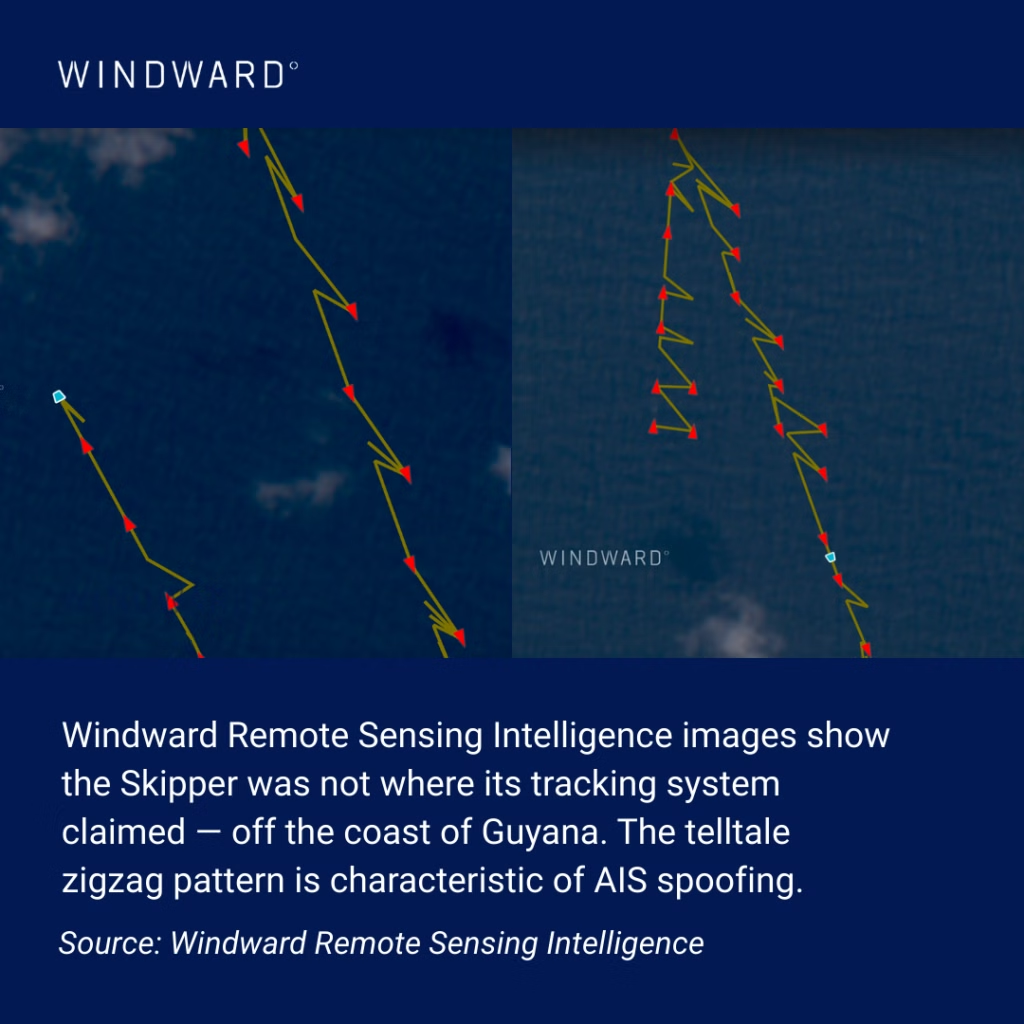
image 34 1024x1024.png

Its position reappeared more than 360 nautical miles from its last spoofed signal. It sailed under the flag of Guyana, a registry that has not existed since 2021, rendering the vessel effectively stateless.
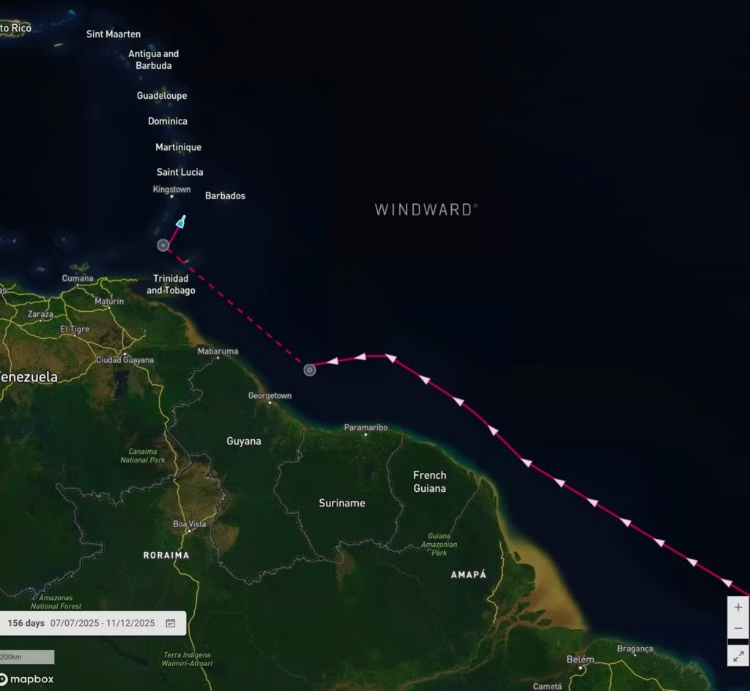
image 33.png

This combination – sanctions exposure, AIS manipulation, and false flagging – is now common. Roughly 400 tankers are currently broadcasting affiliation with fraudulent registries listed by the International Maritime Organization, with nearly 300 already sanctioned. Together, they form part of a broader dark fleet of around 1,000 tankers transporting sanctioned oil for Russia, Iran, and Venezuela.

What distinguishes Skipper is not its behavior, but the response it triggered.

What Has Changed in Enforcement Posture

The seizure of Skipper reflects a more direct application of existing sanctions authorities rather than a new legal framework.

The day after the seizure, the United States sanctioned six shipowners whose VLCCs had been transporting Venezuelan crude. According to the U.S. Treasury, four of those vessels manipulated AIS to conceal port calls and vessel movements. These practices were already well documented. What changed was how that information was acted upon.

In Skipper’s case, the vessel was sanctioned, falsely flagged, and effectively stateless. Those conditions removed many of the protections that dark fleet operators have historically relied on to continue trading despite enforcement pressure. The seizure did not require a military escalation or a new sanctions regime. It relied on existing legal authorities applied decisively.

This signals a narrower but more consequential shift: when sanctions violations, AIS manipulation, and false flagging converge, enforcement may no longer stop at designation alone. Physical intervention has become a viable outcome under specific, documentable conditions.

What Governments Should Expect Next

As enforcement accelerates, pressure will shift upstream.

Interdictions will increasingly rely on early detection rather than last-minute response. Authorities will need to identify which vessels are moving toward seizure-grade risk before they enter contested waters or complete cargo transfers. That requires more than static sanctions lists or AIS tracks viewed in isolation.

Dark fleet operations are networked. Vessels share ownership structures, registries, operational patterns, and deceptive behaviors across regions. AIS manipulation rarely occurs alone. It coincides with false documentation, implausible routing histories, and coordinated loitering patterns that only become visible when viewed as part of a wider system.

Governments that surface these connections early will be positioned to act decisively. Others will remain reactive.


Photo credit: Shaah Shahidh on Unsplash and Windward
Source: Windward
Published: 18 December, 2025

Continue Reading

FuelEU

Ahti Climate and DNV connect verified emissions data to FuelEU pooling platform

New integration connects Ahti’s FuelEU pooling platform with DNV’s verification services, Veracity, helping customers reduce manual administration and streamline compliance.

Admin

Published

on

By

Ahti Climate brings DNV-verified emissions data into FuelEU pooling platform

Ahti Climate on Monday (31 August) announced a new integration with Veracity, DNV’s independent industry cloud platform, enabling shipowners and operators to seamlessly transfer DNV-verified emissions data into Ahti’s FuelEU pooling platform. 

The integration simplifies emissions reporting by connecting operational data verification with FuelEU compliance workflows, helping customers reduce manual administration, improve data quality and confidently meet regulatory requirements.

For customers such as shipping company Bore Ltd, the integration streamlines the flow of emissions data between verification and compliance systems. Raw fuel consumption data is automatically converted into the required OVD format and submitted for DNV verification through Veracity. Once verified, the emissions figures are securely shared with Ahti’s FuelEU pooling platform, creating a more efficient workflow with less manual administration and greater confidence in reported emissions data.

“Being on one of the surplus generators of the pool, trust in the data is everything for us – we need to know the numbers we’re selling hold up to scrutiny. With verified emissions data flowing straight from Veracity by DNV into the Ahti Pooling Platform, we no longer have to manually cross-check figures before every transaction. It gives us confidence that what we’re bringing to the pool is accurate, and that our partners can rely on it too,” said Marcus Strand ICT Manager at Bore Ltd. 

The integration enables customers to:

  • Reduce manual data entry and administrative workload
  • Improve data quality and reduce the risk of reporting errors
  • Securely exchange verified emissions data across systems and stakeholders
  • Increase transparency and confidence in compliance reporting
  • Connect commercial, operational and compliance workflows
  • Reduce turnaround times for reporting and voyage settlements

“Every partnership we build comes back to the same question: does this make compliance easier for shipowners? With Veracity by DNV, the answer is clearly yes – verified data, connected systems, and one less thing for our customers to worry about,” said Risto-Juhani Kariranta, CEO of Ahti Climate. 

With connectivity to the majority of the world fleet, Veracity’s trusted partner ecosystem, combined with Ahti’s expertise in FuelEU pooling, gives shipowners a more connected approach to emissions verification and compliance. By enabling verified data to flow securely between systems, the partnership helps customers reduce complexity and get greater value from their data and access a growing network of digital solutions.


Photo credit: Ahti Climate
Published: 1 September, 2026

Continue Reading

Decarbonisation

NAPA: Why operational efficiency remains shipping’s golden ticket

With regulation tightening and alternative fuels still evolving, Pekka Pakkanen says operational efficiency offers shipping an immediate, scalable way to cut fuel use, emissions and costs.

Admin

Published

on

By

NAPA: Why operational efficiency remains shipping’s golden ticket

Shipping’s decarbonisation ambitions are clear but turning that ambition into commercially viable emissions reductions at scale remains a challenge.

As regulatory requirements tighten and fuel markets remain volatile, Pekka Pakkanen, Executive Vice President, Shipping Solutions, NAPA, says operational efficiency is emerging as one of the most immediate and scalable levers available to shipowners, with digital tools increasingly helping to maximise the benefits of energy efficiency technologies: 

The shipping industry’s decarbonization drive does not lack ambition – that is visible in the pace of innovation and research we see around us. But translating that ambition into action at scale and in a commercially viable way remains a different challenge altogether. The International Maritime Organization’s MEPC 84, which concluded in April 2026, reminded us of both how far we have come and how much complexity still remains.

Discussions around the Net-Zero Framework continued, with delegates agreeing to seek further consensus on key adjustments later in October 2026, while progress was made across several other fronts. Separately, the adoption of amendments designating the North-East Atlantic as a new Emission Control Area for Sulphur Oxides (Sox), particulate matter and nitrogen oxides (Nox) is a significant achievement. At the same time, the second phase of the review of the Ship Energy Efficiency Management Plan (SEEMP) and the Carbon Intensity Indicator (CII) began, focusing mainly on enhancing the SEEMP.

Progress, though incremental, is still being made in an environment defined by mounting regulatory obligations, volatile fuel markets, and a clean technology landscape still maturing. All these factors create a backdrop of uncertainty. It’s a word used often to describe shipping’s operating environment and still stands the test of time.

Why energy efficiency technologies remain key

Despite knowing this, the argument I want to put forward is a simple one that can help cut through the uncertainty. The single most accessible, most immediate, commercially viable and scalable lever available to shipping today for managing decarbonization is operational efficiency. Not instead of alternative fuels or new vessel technologies, but as the foundation on which everything else must be built.

Fuel price volatility has made efficiency a financial necessity as much as an environmental one. The European Union Emissions Trading System (EU ETS) and FuelEU Maritime are already in effect and tightening year on year. Add to this the second phase of the CII and SEEMP review, which MEPC 84 formally commenced, and all signs point to the need for operational performance data, optimization and reporting.

In today’s market, efficiency is both a sustainability metric and a margin protection strategy. Every tonne of fuel saved reduces exposure to volatile fuel prices, emissions costs, and operational uncertainty. The question for shipping executives is, therefore, is how to maximize the impact of efficiency.

The answer increasingly lies in the intelligent combination of digital tools and energy efficiency technologies. One development that has captured significant industry attention is the growing integration of wind-assisted propulsion systems (WAPS) with voyage optimization software. Harnessing the power of the wind is not just about installing sails, wings, or kites – it is also about navigating the inherent challenges that come with wind propulsion, from complex and fast-evolving weather patterns to training crew. Operating wind-assisted propulsion vessels requires both careful pre-planning and adjustments throughout a ship’s journey. Fast-evolving wind speed and direction, as well as waves and currents, must be assessed and constantly re-assessed throughout the voyage to determine the best possible route. Wind-assisted vessels need to catch winds at the right speeds and angles to make the most of their wings, rotors, or sails, which demands continuous route and speed modelling throughout the voyage not just before it. Relying on traditional means and manual methods alone risks leaving a lot of savings on the table. Instead, understanding changes in wind patterns and using this to the vessel’s advantage requires advanced digital tools.

Classification societies have also been responding to the increase in WAPS on the market and have included specific stability rule checks, which digital tools can help comply with. WAPS typically add weight to a vessel’s upper structure, shifting its center of gravity and creating additional stability considerations to be managed. Digital tools, within NAPA Design, can be used to calculate vessel stability characteristics and help users check their design’s performance against multiple classification society rules as well. These are all essential considerations to ensure the solution continues performing optimally.

Whether the technology is wind-assisted propulsion or air lubrication technology, digital technologies can help maximize the savings they deliver. Users can measure performance, adapt operations continuously and make decisions based on reliable data, which can then inform future investments in energy efficiency technologies.

MEPC 84 makes progress on the foundations underpinning global decarbonization 

The expansion of ECAs at MEPC 84 – including the newly designated North-East Atlantic zone – adds another layer of complexity. Research has consistently shown that ECA avoidance through route deviation is rarely the optimal commercial or environmental response; the fuel costs and schedule implications of detours frequently outweigh the cost of sailing through the zone with compliant fuel. Voyage optimization tools model these trade-offs in real time to help make better decisions than human assumptions alone.

MEPC 84 also progressed a review of the SEEMP framework, which remains central to how vessels document and demonstrate their carbon intensity management. The direction of travel is towards increased expectations around the quality, granularity, and integration of performance data. As regulatory frameworks increasingly rely on verifiable performance data, the quality of operational data becomes just as important as the technologies being measured. Poor data quality can undermine both compliance confidence and optimization efforts. Shipowners who have already invested in the digital infrastructure to capture and act on operational data will find themselves significantly better positioned, both for compliance and for commercial advantage.

The case for integrated data systems – platforms that bring together performance analytics, voyage planning, regulatory compliance, and reporting in a coherent interface – is a response to genuine operational needs. When data from signals, noon reports, and logbook entries can be brought together on one platform to produce clear, actionable insights, crews spend less time managing information and more time using it. The same shared source of operational truth also supports better ship to shore collaboration to support real-time route and speed optimization, continuous hull performance monitoring, and integrated compliance management.

None of this diminishes the importance of the longer-term energy transition. Alternative fuels, new energy efficiency technologies, and next-generation vessel design all have a critical role to play in reaching net zero by 2050. But those transitions take time, capital, and regulatory frameworks that are still being finalized. In the interim, and complementing those transitions, operational efficiency represents a proven, scalable, and commercially viable path to meaningful emissions reduction. The industry does not need to wait for its decarbonization ‘golden ticket’ to arrive from future technology. It already holds one. The challenge now is not identifying opportunities for efficiency but capturing them consistently across fleets and voyages.


Photo credit: NAPA
Published: 28 August, 2026

Continue Reading

Alternative Fuels

GEA to provide global ethanol fuel data for DNV’s AFI platform

Nathaniel Frithiof, Sales Lead Digital Products at DNV, says the company expects GEA’s new data intelligence to give AFI customers greater confidence when exploring new pathways for marine fuels.

Admin

Published

on

By

DNV AFI

The Global Ethanol Association (GEA) and DNV on Monday (24 August) announced the launch of a three-year Ethanol Data Intelligence Partnership, marking an important expansion of their activities in ethanol research and data intelligence. 

The collaboration will support the development of a structured global ethanol database together with ongoing research, data maintenance and regular updates throughout the partnership.

Under the agreement, GEA will develop and provide comprehensive ethanol fuel data intelligence which will be integrated and made available to users of DNV’s Alternative Fuels Insight (AFI) platform. This initiative is designed to improve visibility and transparency across the global ethanol industry by bringing together structured and traceable information on ethanol production facilities and their characteristics from a fuelgrade perspective.

 The research will progressively capture and map key information including production facilities and their locations, production capacities, feedstocks and raw materials, fuel and output categories, based on documented and traceable sources. The research framework places particular emphasis on data quality and source traceability, drawing on publicly available and other verifiable information.

“With Morten Jacobsen, our Secretary General, and on behalf of our association, we are very pleased to develop this new capability, which further reinforces our role as an international coordination and execution platform for the ethanol industry,” said Sylvain Zurcher, President of the Global Ethanol Association.

“Through this collaboration, we are establishing the research infrastructure needed to map ethanol production facilities globally from a fuel-grade perspective and transform fragmented information into structured and traceable market intelligence. By providing greater visibility into areas such as production capacity, feedstocks, fuel categories and other fields of research, our objective is to help reduce information asymmetries for market participants and support better-informed decisions across the ethanol value chain.”

“As we have expanded and added new assets to the AFI platform we have always looked to build around the provision of high quality, verifiable data. And from our first meeting with GEA we have been very impressed by their commitment to providing the industry with solid insights on ethanol and the way they have already been able to build a solid network within the industry. This is looking to be a very productive partnership, and we are positive that this new data intelligence from GEA will enable our AFI customers to explore new shipping fuel pathways with confidence,” said Nathaniel Frithiof, Sales Lead Digital Products, DNV.

By developing a dedicated ethanol research and data intelligence capability, GEA aims to strengthen the information infrastructure available to organizations who are looking to evaluate ethanol across both emerging and established markets and applications. This new activity complements GEA’s existing work across its marine and aviation sector initiatives, project groups, policy engagement, and market-development activities.


Photo credit: DNV
Published: 25 August, 2026

Continue Reading
Advertisement

OUR INDUSTRY PARTNERS


Trending
