Connect with us

Technology

Wärtsilä, Oshima Shipbuilding, DNV GL introduce IMO 2030 bulker

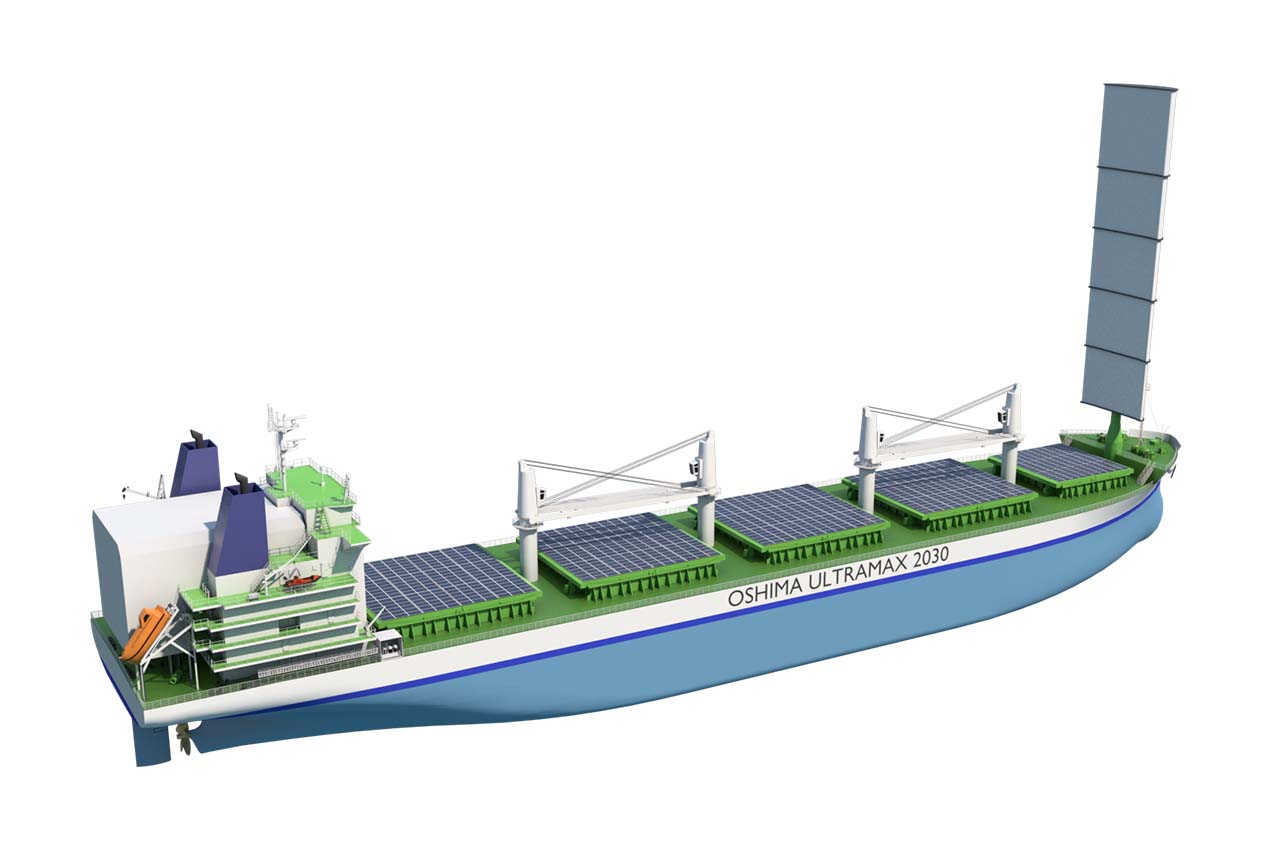
Design for next-generation 62,000 dwt Ultramax Bulk Carrier is able to meet IMO 2030 emission targets.

Admin

Published

on

5d1c2a046b772 1562126852

Technology group Wärtsilä, Japanese ship builder Oshima Shipbuilding, and classification society DNV GL on Tuesday (2 July) delivered the first results of their joint industry development project of a next-generation 62,000 dwt Ultramax Bulk Carrier design which is able to meet IMO 2030 environmental targets.

The project goals included the achievement of low emission levels, both at sea and in port, the fulfilment of the IMO’s requirements to reduce CO2 emissions per ship´s capacity-mile by at least 40% by 2030, and zero emissions during waiting time.

A further aim of the project has been to create a new standard that maximises the return on investment (ROI) for the owner. A key objective was to minimise greenhouse gas (GHG) emissions through the application of currently available technologies.

“Our smart marine initiative emphasises collaboration between the various stakeholders, and this project is a prime example of how effective such collaboration can be,” says Stein Thorsager, Director, Merchant and Gas Carrier, Wärtsilä Marine.

“The design is based on actual operating profile data from Ultramax bulk carriers and it incorporates an LNG-fuelled Wärtsilä 31DF dual-fuel main engine connected to a power take out (PTO) shaft generator and controllable pitch propeller (CPP), and the result out-performs all existing designs in terms of efficiency and sustainability.”

“To help the industry meet the ambitious GHG reduction targets set by the IMO, the industry needs to come together to advance ship design. This design halves the EEDI (Energy Efficiency Design Index) of comparable vessels, and sets a new standard for low emission bulk carriers,” says Trond Hodne, Director of Sales & Marketing at DNV GL.

“Greater efficiency and better environmental performance has been made possible through collaboration with Wärtsilä and DNV GL. Oshima alone could not have come up with this new innovative design, which includes optimised propulsion, energy storage and solar panels. It represents a future proof solution that will enable bulk carrier owners to comply with legislation while also lowering operating costs,” says Eiichi Hiraga, President at Oshima Shipbuilding.

The high efficiency of the propulsion solution reduces the EEDI by 50% compared to standard vessels of this size and type. The EEDI provides a specific figure for an individual ship design, expressed in grams of carbon dioxide (CO2) per ship's capacity-mile.

Other benefits include the ability to operate in an environmental mode while in port through the main use of solar panels, the installation of an LNG tank that is dimensioned based on the capacity needed for the operating profiles and the availability of LNG bunkering infrastructure, an optimized hull shape, and the option to also install a hard sail to generate extra propulsion.

The hard sail system is being developed jointly by Oshima Shipbuilding and Mitsui O.S.K. Lines.

Related: Oshima Shipbuilding and DNV GL enter strategic cooperation

Photo credit: Wärtsilä
Published: 3 July, 2019


Continue Reading

Milestone

GCMD: Project CAPTURED achieves two regulatory milestones for onboard captured CO2

CO2 captured onboard during the project has been formally recognised for compliance under the EU ETS while a proposal submitted to MEPC 84, based on the project, has received IMO’s in-principle support.

Admin

Published

on

By

RESIZED venti views

Global Centre for Maritime Decarbonisation (GCMD) on Wednesday (21 July) said Project CAPTURED has achieved two regulatory milestones that strengthen the commercial case for onboard carbon capture and storage (OCCS).

This comes following its world’s first demonstration of an end-to-end value chain for onboard captured and liquefied CO2 (LCO2).

Completed in June 2025, the pilot showed that CO2 captured onboard a vessel can be offloaded ship-to-ship, transported overland and permanently bound through carbon mineralisation—a process that converts captured CO₂ into stable materials for industrial use.

The CO2 captured onboard during Project CAPTURED has been formally recognised for compliance under the European Union Emissions Trading System (EU ETS). This means the verified tonnage of captured CO2 can be deducted from emissions requiring the surrender of EU Allowances (EUAs).

To qualify for this recognition, the CO2 must be chemically bound permanently in eligible products. Project CAPTURED demonstrated that CO2 captured onboard vessels can meet this requirement through carbon mineralisation.

The data and learnings from the same demonstration formed the basis of a proposal submitted to MEPC 84. This proposal received in-principle support from the International Maritime Organization (IMO) for recognising carbon mineralisation as a form of permanent CO₂ storage.

Complementing geological sequestration, which is already accepted by the IMO, this recognition broadens the downstream options for CO2 captured onboard vessels, and supports the development of maritime carbon value chains. Beyond providing a permanent storage pathway, carbon mineralisation also creates the potential for captured CO2 to serve not only as a waste stream requiring permanent storage, but also as a feedstock for industrial applications through carbon mineralisation, extending emissions reductions beyond the shipping value chain.

Professor Lynn Loo, CEO, GCMD, said, “Project CAPTURED has moved OCCS beyond technical demonstration. The acceptance of the EU ETS deduction gives captured CO₂ a compliance value. At the same time, IMO’s in-principle support for carbon mineralisation will help clarify how captured CO2 can be treated after it leaves the vessel. Together, these milestones turn a pilot into a verified reference case for maritime carbon logistics, one that links regulatory recognition, commercial value and emissions impact.”


Photo credit: Venti Views on Unsplash
Published: 22 July, 2026

Continue Reading

Technology

Singapore: Ofiniti, ONE trial direct platform integration to streamline bunker workflows

Ofiniti started a trial in Singapore, integrating FuelBoss directly with a bunker buyer’s own platform, with Ocean Network Express as its first buyer-side integration partner.

Admin

Published

on

By

Singapore: Ofiniti, ONE trial direct platform integration to streamline bunker workflows

Ofiniti, the digital platform for maritime fuel operations, on Tuesday (21 July) said it has started a trial in Singapore, integrating FuelBoss directly with a bunker buyer’s own platform.

The company announced Singapore-headquartered container shipping firm Ocean Network Express (ONE) as its first buyer-side integration partner. 

“It is no coincidence we start in Singapore, as the Maritime and Port Authority of Singapore (MPA) remains at the forefront of digitalisation of all things bunkering,” the company said in a social media post.

In November 2023, MPA launched its digital bunkering platform, becoming the world’s first port to implement e-BDN. 

Ofiniti said every bunker delivery still runs on retyped data. 

“The buyer’s system says one thing, the supplier says another, and someone reconciles the gap by email, phone, or PDF. On every stem,” the company said. 

“We built FuelBoss to change this reality.”

With the integration, operational data now flows without manual re-entry, fewer reconciliation errors and faster processing and data, instead of documents, are readily available for procurement and claims workflows. 

“One connection will not transform the industry on its own, but digitalisation gets built one integration at a time. We are grateful to ONE for being willing to go first,” Ofiniti added.

Manifold Times previously reported ONE completing its successful trial of the electronic Bunker Delivery Note (e-BDN) with Shell. 

The e-BDN trial, using the digital bunkering solution developed by Angsana Technology, was conducted on 9 September 2023 at the Port of Singapore, with support from the MPA.

In March 2025, Ofiniti acquired Singapore-based Angsana Technology, with the entire Angsana team joining Ofiniti as part of the acquisition.

Related: MPA Chief Executive: Port of Singapore begins digital bunkering initiative today
Related: Singapore set to become first port in the world to debut electronic bunker delivery notes
Related: ONE completes e-BDN adoption trial with Shell in Port of Singapore
Related: Ofiniti acquires Singapore-based Angsana Technology to advance digital bunkering solutions


Photo credit: Ofiniti
Published: 22 July, 2026

Continue Reading

Technology

Genevos and Koedood Marine Group team up on maritime hydrogen fuel cell deployment

Collaboration will explore how ready-to-use marine fuel cell systems can support shipowners and shipyards in the transition towards zero-emission operations.

Admin

Published

on

By

Genevos and Koedood Marine Group team up on maritime hydrogen fuel cell deployment

Marine fuel cell systems provider Genevos recently said the company signed a Letter of Intent (LOI) with engine supplier Koedood Marine Group to explore the deployment of hydrogen fuel cell systems for inland and coastal maritime transport. 

The LOI was signed by Phil Sharp, co-founder and CTO of Genevos, and Mühlheim, Business Development Director of Koedood Marine Group during the 2026 Advanced Maritime Technology Show in Amsterdam.

Building on Koedood’s proven experience in hydrogen maritime projects – including its ongoing work with Mitsubishi Heavy Industries and TNO on hydrogen engine development – the collaboration will explore how ready-to-use marine fuel cell systems can support shipowners and shipyards in the transition towards zero-emission operations. 

“Koedood has a strong reputation in the maritime sector and a deep understanding of vessel operators’ needs. This LOI is an important step in exploring how Genevos’ hydrogen fuel cell systems can be deployed more widely across inland and maritime applications, helping shipowners reduce onboard emissions with robust, practical and scalable clean power solutions,” said Sharp.

The collaboration aligns with growing market demand for rapidly deployable hydrogen solutions and the wider need to accelerate the adoption of zero-emission technologies across the maritime sector. 

“With this collaboration, we are further strengthening our portfolio of maritime energy solutions. Together with Genevos, we are exploring how we can support our customers in the adoption of hydrogen technology,” said Mühlheim.


Photo credit: Genevos
Published: 20 July, 2026

Continue Reading

Trending