Connect with us

Business

Newport Shipping: Tackling the fuel conversion conundrum

Upgrading ships in line with new environmental rules will be considered a dilemma for the industry due to commercial and technical risk factors.

Admin

Published

on

NEWPORT 1

Newport Shipping, a provider of drydocking services for ship repair works, on Tuesday (20 July) released an article Tackling the fuel conversion conundrum discussing the challenges of decarbonisation within the maritime sector:

The need to upgrade ships in line with new environmental rules represents a billion-dollar dilemma for the industry as it faces a range of commercial and technical risk factors that will determine whether retrofits for alternative fuels will be worth the investment.

It is estimated that investments of as much as $182 billion will be required on ship machinery and onboard storage for ships to run on low-carbon fuels, both for retrofits and newbuilds, between 2030 and 2050 in order to halve greenhouse gas emissions from global shipping, according to a study by consultancy UMAS and the Energy Transitions Commission for the Getting to Zero Coalition.

This is about 13% of estimated cumulative investments over the same period of up to $1.4 trillion, of which the remainder would be required for land-based infrastructure and production facilities for low-carbon fuels.

Doing nothing is not a real option for shipowners, but it would also be foolhardy to throw money at the problem without knowledge of the most optimal alternative fuel that can secure their fleets for the long haul and ensure payback under a green shipping regime.

A multitude of fuel options are now on the industry’s radar screen to replace more pollutive fossil fuels such as heavy fuel oil (HFO), very low-sulphur fuel oil (VLSFO) and marine gas oil (MGO) currently used by much of the global fleet.

Among these are low-carbon liquefied natural gas (LNG), as well as carbon-neutral fuels including ammonia, methanol and hydrogen produced from sustainable sources such as biomass, to give biofuels, and renewable electricity, to give electrofuels.

Price must be right

These alternative fuels are all at different stages of maturity in terms of availability, cost and performance, with carbon-neutral fuels mostly still at a relatively early stage of development.

These fuels also presently lack the regulatory framework, production capacity, acceptable safety protocols, and bunkering infrastructure for widespread adoption across deepsea shipping.

In determining which fuel is most economically viable, shipowners must consider the fuel price and cost of implementing it onboard vessels through retrofits to adapt engine systems and provide onboard storage.

In addition, the fuel must have sufficient energy content, or calorific value, to power a large vessel such as a VLCC. It must also be available and abundant, as well as technically feasible and safe for storage onboard.

Planning for fuel flexibility will be a key consideration in upgrading the fleet to ensure it remains competitive as regulations tighten in future and carbon-neutral fuels become available, given an average vessel lifetime of around 20 years.

Aside from other fossil fuels, LNG already satisfies these criteria given there are abundant natural gas reserves of around 7177 trillion cubic feet – more than 700 times the size of proven oil reserves. There is also an existing bunkering network for this fuel, which is presently available in at least 93 ports, while price-wise LNG can be cheaper than both VLSFO and HFO in certain periods and regions, according to a study by consultancy Ocean Dynamex.

Reduced emissions

LNG has a much lower emissions footprint than other fossil fuels as it emits zero SOx and negligible amounts of particulate matter and NOx, cutting emissions by between 20% and 30%.

There has been concern over methane slip from gas-fuelled engines, whereby unburned methane gas can escape at the exhaust into the atmosphere, but this type of leakage has been drastically reduced with modern high-pressure engines.

Gas is a much cleaner fuel with excellent combustion and no need for fuel heating, offering technical benefits such as no sludge and less wear-and-tear on engine parts, thereby cutting maintenance costs.

Furthermore, LNG has sufficient energy content, or calorific value, to power vessels and is technically feasible to carry onboard ships, while LNG fuel systems can be easily adapted for carbon-neutral drop-in fuels such as bio-LNG and synthetic LNG to make this a sustainable solution also in the longer term.

A DNV case study showed the use of a dual-fuel LNG engine on a Panamax bulk carrier was the most commercially robust solution compared with other alternative fuel technologies due to cost, reduced tank-to-wake emissions and flexibility in regard to future decarbonisation options.

Transition fuel

Consequently, DNV sees a significant part of the global fleet adopting LNG as fuel towards 2040, with carbon-neutral fuels gaining ground around mid-century.

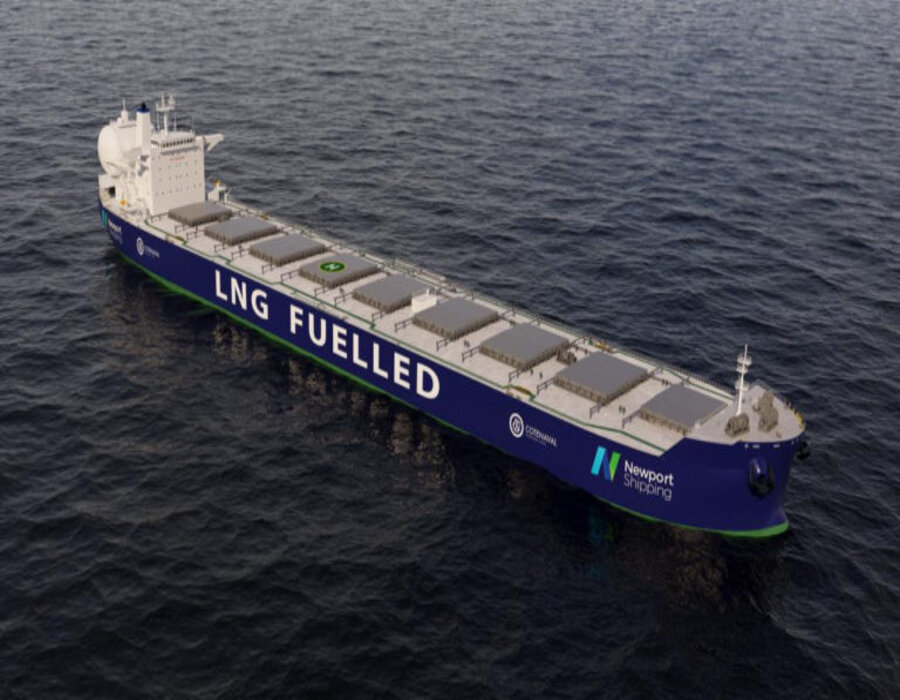
LNG is seen as an important transition fuel towards a net-zero future and such retrofits of existing vessels can be implemented with minimal modifications to the engine system and hull structure, according to Newport Shipping Managing Director, Lianghui Xia.

“LNG is presently the most expedient and practical solution for the industry to meet immediate emissions targets, as the perfect solution may not be available for some years,” he says.

The UK-based ship repair and retrofitting group has now gained a key approval-in-principle from DNV for its unique low-cost LNG retrofit concept for VLCCs and Capesize bulkers as it targets this emerging market.

But Xia believes collective action is also needed to facilitate the shift to LNG through measures such as tax incentives for such conversions, wider bunkering access, and lower production and delivery costs for the fuel from energy companies.

“Apart from agreeing on the optimum fuel option, the speed of implementation of the environmental agenda will be governed by financial metrics.” adds Mr. Xia.


Photo credit: Newport Shipping
Published: 23 July, 2021


Continue Reading

Legal

Singapore withdraws remaining 127 charges against Hin Leong founder OK Lim

Lim Oon Kuin, also known as OK Lim, was issued a stern warning and a district court granted him a discharge amounting to an acquittal for these charges on 17 July.

Admin

Published

on

By

RESIZED Sora Shimazaki on Pexels

Founder of collapsed oil trader Hin Leong Trading, Lim Oon Kuin, also known as OK Lim, has had the remaining 127 charges against him withdrawn, according to The Straits Times on Monday (20 July). 

OK Lim was issued a stern warning and a district court granted him a discharge amounting to an acquittal for these charges, including those for cheating, on 17 July. The discharge means Lim cannot be prosecuted again for the same offences.

Lim, 84, is currently serving a 13½-year prison sentence after the High Court reduced his original 17½-year jail term in March 2026. He was convicted in 2024 on two cheating charges and one count of abetting forgery in a case prosecutors described as one of Singapore’s most serious trade finance frauds.

Lim was convicted in May 2024 of two charges of cheating the Hongkong and Shanghai Banking Corporation (HSBC) and one count of abetting forgery that proceeded to trial out of a total of 130 criminal charges.

He was first charged in court on 14 August 2020, and was subsequently handed further charges in court on 25 September 2020, 30 April 2021 and 24 June 2021 for his role in perpetuating fraud on various financial institutions. 

A total of 130 charges were eventually brought against him for cheating and forgery-related offences.

Related: Singapore: Hin Leong Founder OK Lim gets jail term slashed to 13.5 years


Photo credit: Sora Shimazaki
Published: 21 July, 2026

Continue Reading

Winding up

Singapore: Coastal Logistics Pte Ltd to be wound up voluntarily

Coastal Logistics was reportedly affiliated with troubled Singapore bunker player Coastal Oil (Singapore) Pte Ltd.

Admin

Published

on

By

RESIZED Drew Beamer

Several resolutions for Coastal Logistics Pte Ltd were made during an extraordinary general meeting held on 14 July, according to a notice in the Government Gazette on Friday (4 July).

The following resolutions were duly passed during the meeting:

As Special Resolution

  • That it has been proved to the satisfaction of the meeting that the Company cannot by reason of its liabilities continue its business and accordingly the Company be wound up voluntarily pursuant to Section 160(1)(b) of the Insolvency, Restructuring and Dissolution Act 2018 (No. 40 of 2018);

As Ordinary Resolutions

  • that Mr. Wong Pheng Cheong Martin and Ms. Koay May Yee, both care of FTI Consulting (Singapore) Pte Ltd, One Raffles Quay, #27-10 South Tower, Singapore 048583 be appointed as the joint and several Liquidators of the Company for the purpose of such winding up; and
  • that the Liquidators be at liberty to open, maintain and operate any bank account(s) or account(s) for monies received by them as Liquidators with such bank(s) as they deem fit; and
  • that a Committee of Inspection will not be formed.

Manifold Times previously reported Nicholas James Gronow, director of Heng Tong Fuels & Shipping and Coastal Logistics, filed statutory declarations for both companies stating the firms cannot continue their businesses due to liabilities.

Both companies were reportedly affiliated with troubled Singapore bunker player Coastal Oil (Singapore) Pte Ltd. 

In 2019, several vessels owned by both firms entered the sale & purchase (S&P) market in Singapore.

Related: Singapore: Director declares Heng Tong Fuels & Shipping’s inability to continue business
Related: Heng Tong Fuels & Shipping in court over DBS Bank bunker tanker loan
Related: Singapore: Bunker tanker “Coastal Neptune” arrested
Related: Heng Tong Fuels & Shipping, Coastal Logistics tankers enter S&P market


Photo credit: Drew Beamer
Published: 21 July, 2026

Continue Reading

LNG Bunkering

PIL’s LNG dual-fuel boxship “Kota Elok” arrives in Singapore on maiden call

As the first of 13 new 13,000 TEU vessels joining its fleet, Kota Elok is equipped to operate on LNG and low-sulphur fuel oil that helps reduce our greenhouse gas emissions.

Admin

Published

on

By

PIL's LNG dual-fuel boxship “Kota Elok” arrives in Singapore on maiden call

Singapore-based Pacific International Lines Pte Ltd on Monday (20 July) said its first 13,000 TEU LNG dual-fuel container vessel, Kota Elok, recently made her maiden call to Singapore on 15 July.

As the first of 13 new 13,000 TEU vessels joining its fleet, Kota Elok is equipped to operate on liquefied natural gas (LNG) and low-sulphur fuel oil that helps reduce our greenhouse gas emissions. 

The vessel also incorporated energy-saving features and digital technologies to reduce fuel consumption and enhance operational performance, as well as a bow windshield to improve aerodynamics, contributing to improved fuel efficiency and lower emissions over the course of long-haul voyages.

“Following Singapore, Kota Elok will continue her voyage on our East Coast Service 1 (ES1) route to South America, calling at ports in Brazil, Uruguay, and Argentina before returning to Asia,” the company said in a social media post. 

Kota Elok also became PIL’s first vessel to receive Lloyd’s Register certification for compliance with the IACS UR E26 and UR E27 cyber security requirements.

Developed by the International Association of Classification Societies (IACS), UR E26 and UR E27 are mandatory cyber resilience requirements for newbuild vessels contracted from 1 July 2024. 


Photo credit: Pacific International Lines
Published: 21 July, 2026

Continue Reading

Trending