Connect with us

Alternative Fuels

MARINTEC – ABS, MAN, SDARI to develop ammonia-fuelled 2,700 TEU vessel

Project aims to produce designs for a low-emission Chittagongmax container carrier of 2,700 TEU capacity.

Admin

Published

on

5de9d5f12ab0a 1575605745

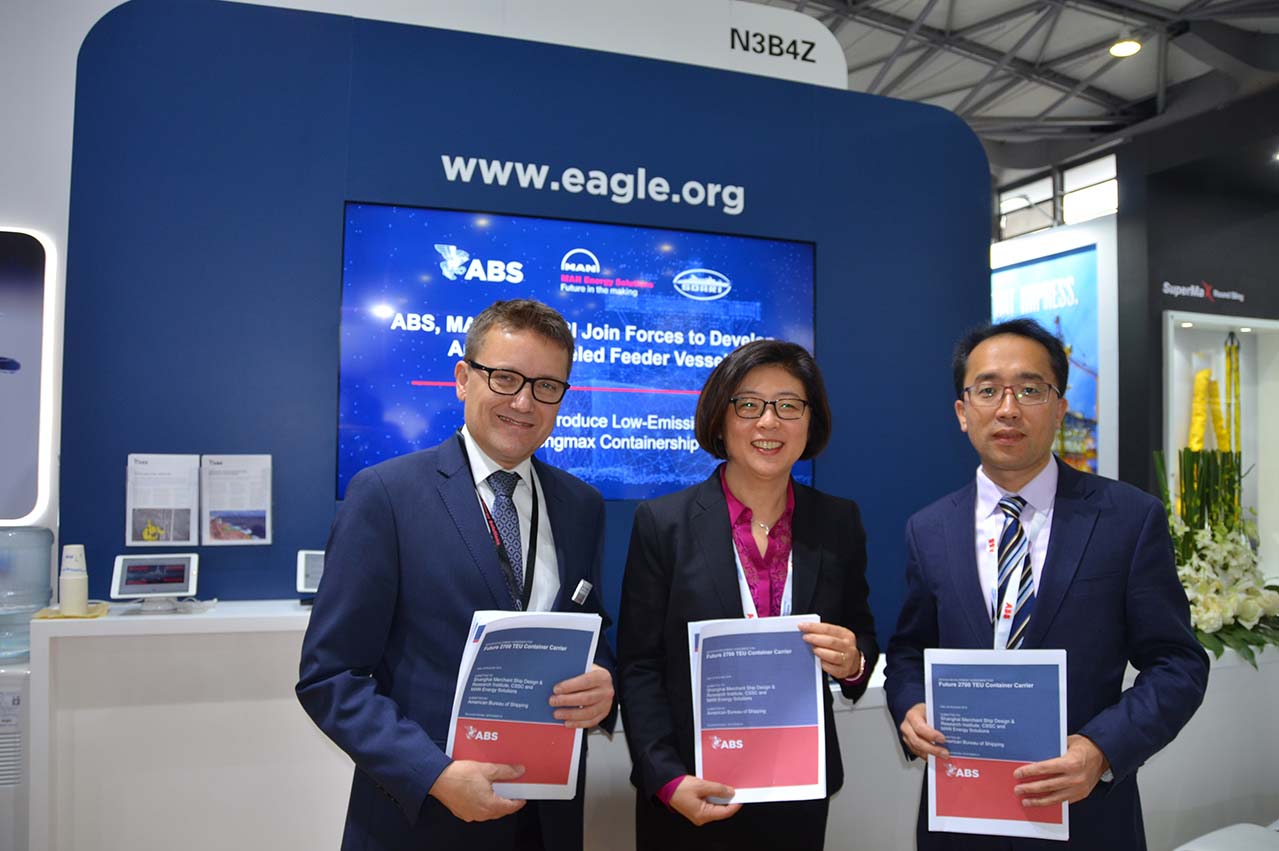
Classification society ABS on Thursday (5 December) entered into an agreement with MAN Energy Solutions (MAN) and the Shanghai Merchant Ship Design & Research Institute (SDARI) develop designs for a low-emission feeder container vessel.

Signed in a ceremony held at Marintec China, the joint development project aims to produce designs for an ammonia-fuelled Chittagongmax container carrier of 2,700 TEU capacity. 

“Ammonia is an energy source with significant potential to help the industry meet IMO 2030 and 2050 emission targets but will require stringent new safety standards to be developed in order to support its adoption,” said Dr. Xiaozhi (Christina) Wang, ABS Vice President, Global Marine.

“This innovative project is typical of how ABS is working with leading partners across the world to support the development of next generation fuel solutions for shipping.”

SDARI will develop the ship design and engineering, which will utilise MAN’s dual fuel technology and ABS will assess safety-related issues and contribute to the development of rules and standards in relation to ammonia as a fuel.

Conceptual design development is the initial phase of the JDP, with the second phase moving to engagement with owners to develop designs tailored to their specific operational requirements.

“Building upon SDARI’s experience in feeder container vessels, we are actively seeking to develop next generation designs that incorporate strategies to meet IMO 2030 and 2050 targets,” said Zhiyong Zhou, SDARI Vice President.

Bjarne Foldager, Senior Vice President, Head of Two-Stroke Business at MAN Energy Solutions, said: “The development of ships with low greenhouse-gas emissions fits well with the strategy of MAN Energy Solutions’ two-stroke portfolio, which has offered engines that can burn low- or zero-carbon fuels for many years.”

“As such, low-speed marine engines are already the most efficient propulsion system for trans-oceanic shipping, making them the de-facto, standard powertrain for commercial vessels. Ammonia can be seen as a potential future energy-carrier of renewable primary-energy sources such as wind, hydro or solar.”

Ammonia, when generated by renewable energy sources, has no carbon footprint and emits almost no CO2, SOx or particulate matter when burned in engines.

Photo credit: ABS
Published: 6 December, 2019


Continue Reading

LNG Bunkering

PIL’s LNG dual-fuel boxship “Kota Elok” arrives in Singapore on maiden call

As the first of 13 new 13,000 TEU vessels joining its fleet, Kota Elok is equipped to operate on LNG and low-sulphur fuel oil that helps reduce our greenhouse gas emissions.

Admin

Published

on

By

PIL's LNG dual-fuel boxship “Kota Elok” arrives in Singapore on maiden call

Singapore-based Pacific International Lines Pte Ltd on Monday (20 July) said its first 13,000 TEU LNG dual-fuel container vessel, Kota Elok, recently made her maiden call to Singapore on 15 July.

As the first of 13 new 13,000 TEU vessels joining its fleet, Kota Elok is equipped to operate on liquefied natural gas (LNG) and low-sulphur fuel oil that helps reduce our greenhouse gas emissions. 

The vessel also incorporated energy-saving features and digital technologies to reduce fuel consumption and enhance operational performance, as well as a bow windshield to improve aerodynamics, contributing to improved fuel efficiency and lower emissions over the course of long-haul voyages.

“Following Singapore, Kota Elok will continue her voyage on our East Coast Service 1 (ES1) route to South America, calling at ports in Brazil, Uruguay, and Argentina before returning to Asia,” the company said in a social media post. 

Kota Elok also became PIL’s first vessel to receive Lloyd’s Register certification for compliance with the IACS UR E26 and UR E27 cyber security requirements.

Developed by the International Association of Classification Societies (IACS), UR E26 and UR E27 are mandatory cyber resilience requirements for newbuild vessels contracted from 1 July 2024. 


Photo credit: Pacific International Lines
Published: 21 July, 2026

Continue Reading

LNG Bunkering

CIMC SOE secures order for 12,000-cbm LNG bunkering vessel from Sinopec Clean Energy

Once operational, the vessel is expected to strengthen Sinopec’s domestic coastal LNG bunkering network and help address gaps in China’s alternative fuel bunkering infrastructure.

Admin

Published

on

By

CIMC SOE secures order for 12,000-cbm LNG bunkering vessel from Sinopec Clean Energy

China’s Nantong CIMC Sinopacific Offshore & Engineering Co., Ltd. (CIMC SOE) recently signed a contract with Sinopec (Beijing) Clean Energy Co., Ltd. to build a 12,000-cubic metre (m3) LNG bunkering vessel, according to Chinese maritime media.

The vessel is scheduled for delivery in 2028 and will support Sinopec’s efforts to expand its presence in the marine clean energy sector.

Once operational, the vessel is expected to strengthen Sinopec’s domestic coastal LNG bunkering network and help address gaps in China’s LNG bunkering infrastructure.

With this signing , CIMC Pacific Offshore Engineering’s LNG bunkering vessel orderbook is further strengthened, maintaining its leading position in the global market for small and medium-sized LNG bunkering vessels.

The contract also marked another milestone for CIMC SOE, which has seen a sharp increase in orders and business performance this year amid a surge in domestic LNG vessel demand.


Photo credit: Nantong CIMC Sinopacific Offshore & Engineering
Published: 21 July, 2026

Continue Reading

Nuclear

ABS awards AiP to Korean institute for SMR-powered container ship concept design

KRISO says AiP recognises the technical feasibility and safety of its concept design, marking an important milestone toward the development of next-generation nuclear-powered commercial ships.

Admin

Published

on

By

ABS awards AiP to Korean institute for SMR-powered container ship concept design

Korea Research Institute of Ships & Ocean Engineering (KRISO) on Thursday (16 July) received Approval in Principle (AiP) from the American Bureau of Shipping (ABS) for its concept design of a 15,000 TEU Small Modular Reactor (SMR)-powered container ship utilising Molten Salt Reactor (MSR) technology.

KRISO said the AiP recognises the technical feasibility and safety of its concept design, marking an important milestone toward the development of next-generation nuclear-powered commercial ships.

“This achievement demonstrates international recognition of KRISO’s technological capabilities in the rapidly evolving field of nuclear-powered shipping, supporting the transition toward low-carbon maritime transport,” it said. 

Building on this milestone, KRISO will continue advancing basic and detailed ship design, paving the way for future demonstration and commercialisation of SMR-powered vessels. 

Through continued R&D and international collaboration, KRISO remains committed to strengthening next-generation maritime technologies and contributing to the safe deployment of nuclear propulsion in the maritime industry.


Photo credit: Korea Research Institute of Ships & Ocean Engineering
Published: 21 July, 2026

Continue Reading

Trending