Connect with us

Bunker Fuel

ENGINE: East of Suez Bunker Fuel Availability Outlook (14 April 2026)

Zhoushan facing weather-related disruptions; availability good across several Sri Lankan ports; operations continue despite war in most Middle East ports.

Admin

Published

on

RESIZED ENGINE East of Suez

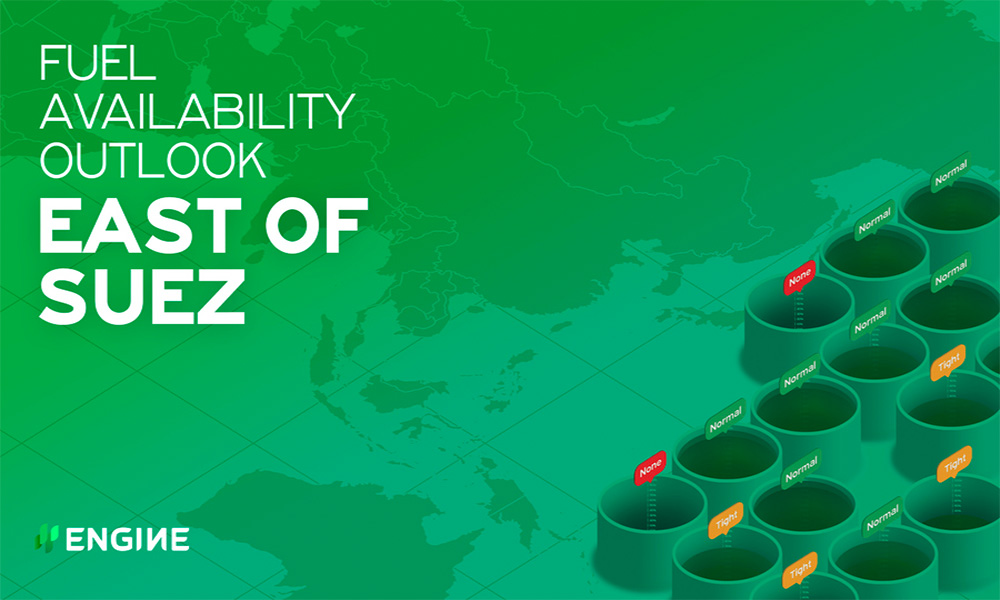
The following article regarding regional bunker fuel availability outlook for the East of Suez region has been provided by online marine fuels procurement platform ENGINE for publication on Singapore bunkering publication Manifold Times:

  • Zhoushan facing weather-related disruptions
  • Availability good across several Sri Lankan ports
  • Operations continue despite war in most Middle East ports

Singapore and Malaysia

Bunker prices in Singapore have remained firm despite muted demand and been supported by the war in the Middle East. The war has choked off most oil flows through the Strait of Hormuz, a key artery for global oil trade.

In Singapore, VLSFO lead times now range widely between 4–13 days, compared to 6–11 days last week. HSFO lead times have widened to a 3–12-day range, versus 7–10 days previously.

The wide spread in lead times is a sign that some suppliers are still able to offer prompt delivery dates, a source said.

Recommended lead times for LSMGO stand at 2–7 days, broadly unchanged from last week.

Singapore’s residual fuel oil stocks have averaged 9% lower so far in April compared to March, according to data from Enterprise Singapore. Total fuel oil inventories have fallen below 22 million bbls, following a sharp 57% decline in net fuel oil imports so far this month. Imports have dropped by 2.73 million bbls, while exports have edged lower by 34,000 bbls.

Meanwhile, the port’s middle distillate inventories have averaged 7% higher so far this month, reaching their highest level since November.

At Port Klang, VLSFO availability remains relatively stable, especially for smaller prompt stems. However, LSMGO supply has tightened, while HSFO availability remains constrained, making both grades increasingly difficult to secure.

East Asia

Bunkering at Zhoushan’s Tiaozhoumen and Xiazhimen outer anchorages was halted for nearly a week due to rough weather, before resuming on Tuesday, a source said. In contrast, operations continued without interruption at the more sheltered Xiushandong anchorage and the inner anchorage at Mazhi.

The disruption has created a backlog of 50–60 vessels waiting to refuel, a trader noted. Suppliers are now recommending lead times of 5–7 days for all grades as they work through the congestion, compared to last week’s 7–10 days for VLSFO and 5–10 days for both LSMGO and HSFO.

However, bunkering could be suspended again by thick fog across all anchorages later on Tuesday, another source added.

Across northern China, supply conditions remain mixed. Dalian and Qingdao have sufficient VLSFO and LSMGO availability, although HSFO remains limited in Qingdao. Tianjin is experiencing tight supply across all grades, while in Shanghai, VLSFO and HSFO stocks are constrained, with LSMGO availability relatively steady.

Further south, tighter conditions persist. Fuzhou is facing limited availability of both VLSFO and LSMGO. Xiamen has adequate VLSFO supply but restricted LSMGO volumes. In Yangpu and Guangzhou, both grades remain under pressure.

In Hong Kong, bunker supply is largely stable, with lead times for all grades holding at around seven days in recent weeks.

In Taiwan, supply has to some extent been impacted by the Middle East war, although price volatility has been more pronounced. Fluctuations in crude prices have significantly influenced bunker markets, a Taiwan-based trader said.

Recommended lead times remain around two days for VLSFO and LSMGO in Keelung, Taichung and Hualien, while Kaohsiung requires about three days.

In South Korea’s southern ports – including Busan, Ulsan, Masan, Onsan, Yeosu and Kwangyang – advised lead times for all fuel grades have been extended to around 4–6 days, largely unchanged from 4–5 days the previous week.

At western ports such as Incheon, Daesan, Dangjin, Pyeongtaek and Taean, lead times stand at about 2–7 days, compared to around four days last week. However, availability across both coasts remains dependent on cargo availability.

Weather conditions continue to disrupt operations, with potential delays expected in Busan and Ulsan between 14–17 April, and in Yeosu between 16–19 April.

In Japan, tight conditions for bonded bunkers persist, driven by ongoing crude procurement constraints and the Middle East war. Spot supply remains virtually unavailable.

For HSFO, limited availability continues to emerge due to refinery operations and isolated issues. VLSFO supply is restricted to small spot parcels of 100–300 mt, while MGO availability remains critically tight.

Most Japanese suppliers are quoting discreetly, with transactions requiring private, one-on-one negotiations rather than open market inquiries, according to a Japan-based trader.

All confirmed offers are limited to small parcels of under 300 mt. One supplier can offer HSFO volumes of up to 2,000 mt, but only for exclusive, targeted inquiries. Small spot VLSFO parcels (100–300 mt) are still available through some suppliers, the source added.

As a result, availability across all fuel grades in major Japanese hubs – including Tokyo, Chiba, Yokohama, Kawasaki, Nagoya, Yokkaichi, Mizushima, Kashima, Tokuyama and Oita – is now being assessed strictly on a case-by-case basis.

Oceania

Bunker prices across several Australian ports remain elevated, largely underpinned by the ongoing Middle East war, an Australia-based trader said.

In response, the Australian government halved fuel excise duties on petrol and diesel for a three-month period from 1 April.

Supply pressures are beginning to surface, with ports such as Dampier, Darwin, Kwinana and Melbourne nearing depletion of LSMGO stocks, the trader added.

In Western Australia, VLSFO supply at Kwinana and Fremantle typically requires about one week’s notice, with deliveries carried out by barge through a single supplier.

In New South Wales, VLSFO deliveries at Port Kembla can be arranged via truck or pipeline. Suppliers in Sydney hold ample VLSFO and LSMGO inventories, although HSFO remains tight, with lead times of around seven days advised.

In Queensland, ports including Brisbane and Gladstone are offering VLSFO and LSMGO with lead times of roughly seven days. HSFO in Brisbane is available on request. Deliveries of VLSFO and LSMGO are handled by two barges operated by separate suppliers, while HSFO availability is only given depending on the enquiry.

In Victoria, VLSFO stocks remain strong in both Melbourne and Geelong, while HSFO availability is limited for prompt supply. Bunkering in these ports relies on a single barge, with recommended lead times of close to seven days.

In New Zealand, bunker supply conditions are stable. VLSFO is readily available in Tauranga and Auckland, with some Tauranga berths connected by pipeline. At Marsden Point, both VLSFO and LSMGO can be supplied via pipeline to vessels.

South Asia

Supply of VLSFO and LSMGO remains constrained across several Indian ports. In Mumbai and New Mangalore, availability of both grades is tight and subject to firm enquiry, a source said.

In Sri Lanka, supply conditions at Colombo and Hambantota remain healthy across all grades, with one supplier quoting lead times of around five days, slightly up from three days last week.

Middle East

“Things are starting to improve slightly [in the Middle East] following recent news after the temporary ceasefire in the Middle East, oil flows have partially resumed and market pressure has eased,” a local trader said.

Bunkering at the Port of Fujairah continues without interruption despite ongoing regional tensions, though supply remains tight.

Last month, authorities in Fujairah and Khor Fakkan issued navigational warnings following reports of intermittent GPS spoofing and signal jamming offshore. According to Inchcape Shipping, such disruptions can result in inaccurate positioning, erratic vessel movements and misleading navigation data, prompting mariners to treat the area as high risk.

Nevertheless, most terminals and anchorages remain operational.

“Avails [are] ok as off now, all offers are subject to firm inquiry,” another trader said.

Bunkering is ongoing, but some suppliers are loading barges only in line with actual demand rather than at full capacity. Demand in Fujairah remains subdued, the trader added.

Elsewhere in the UAE, operations at Jebel Ali, Hamriyah and Sharjah continue as normal. Petroleum terminals in Abu Dhabi, including Ruwais, are also functioning without disruption.

Ship-to-ship (STS) operations at the Dubai anchorage have resumed with tug assistance. Each operation is being assessed on a case-by-case basis, Inchcape Shipping agency said.

“However, the situation is still fragile, as the recent conflict and disruptions in the Strait of Hormuz had previously tightened supply and pushed prices up sharply, so the market remains sensitive to any new developments,” a Middle East-based trader warned.

Ports in Ras Al Khaimah remain fully operational. However, in March, RAK Ports introduced a marine risk surcharge for all vessels calling at its ports, harbours, anchorages and approaches, according to Inchcape Shipping.

In Kuwait, both Shuaiba and Shuwaikh continue to operate normally.

In Saudi Arabia, no formal alerts have been issued, although bunker availability remains tight in Jeddah, particularly for VLSFO and LSMGO.

In Qatar, port operations and vessel movements remain steady at Hamad, Doha and Al Ruwais, with activity also continuing at Mesaieed and Ras Laffan. However, VLSFO and LSMGO supply is tight in Ras Laffan, while in Al Ruwais it is limited to smaller vessels such as dhows and barges.

In Oman, all ports remain fully operational. Availability, including LSMGO, is good in Muscat, Duqm and Sohar, with prompt lead times, the source added.

In Bahrain, vessel movements are gradually resuming, although operations remain limited under current conditions. The Suez Canal and all Egyptian ports continue to function normally, while conditions remain stable in Jordan. Ports in Iraq, Cyprus, Pakistan and Lebanon are also operating as usual.

Meanwhile, Israeli ports – including Eilat, Ashkelon, Ashdod, Hadera and Haifa – are operating at full capacity, Inchcape Shipping said.

By Tuhin Roy


Photo credit and source: ENGINE
Published: 15 April, 2026

Continue Reading

Methanol

China launches methanol shipping supply chain alliance to accelerate green transition

Marine fuel suppliers in the alliance include Sinopec Fuel Oil Sales, China Marine Bunker (PetroChina), SIPG Energy (Shanghai), and Shenzhen Port Energy Development.

Admin

Published

on

By

China Flag

China Waterborne Transport Research Institute under the Ministry of Transport and China Transport News recently jointly launched a Methanol Fuel Shipping Supply Chain Innovation Alliance with 20 organisations spanning the shipping, port, energy, equipment, research and industry association sectors.

The alliance was officially announced during the main event of China Maritime Day 2026 on 11 July, where members also released a joint initiative to develop a collaborative methanol-fuelled shipping supply chain.

The alliance aims to implement China’s national strategy for green economic transformation and support the Ministry of Transport’s “One Network, Four Modernisations” initiative by building a safe, efficient, economical and reliable methanol marine fuel supply chain

Under the joint initiative, alliance members pledged to align with China’s national decarbonisation strategy by promoting methanol as a key pathway for the shipping sector’s green transition and optimising the industry’s energy mix.

The members also pledged to strengthen collaboration across the supply chain to improve coordination between bunker fuel production, transportation and end users while advancing technological innovation.

Lastly, the alliance will support the development of policies, planning and technical standards, promote resource sharing and joint research, and accelerate the large-scale adoption of methanol as a marine fuel.

The alliance brings together companies and organisations representing the entire methanol shipping supply chain.

Members include shipping and port members such as China Changjiang National Shipping (Group) Corporation, COSCO Shipping Bulk Co., Ltd., Shandong Port Group, and Wuhan Chuangxin Jianghai Shipping Co., Ltd.

Energy companies in the alliance include Sinopec Chemical Commercial Holding Company Limited and Methanex Corporation.

Marine fuel suppliers including Sinopec Fuel Oil Sales, China Marine Bunker (PetroChina), SIPG Energy (Shanghai) Co Ltd and Shenzhen Port Energy Development Co Ltd are also part of the alliance. 

Equipment manufacturers in the alliance are CSSC 711th Research Institute, CSSC Power (Group) Corporation Ltd and Chongqing Hongjiang Machinery Co Ltd.

Research, media and industry organisations participating in the alliance include the China Waterborne Transport Research Institute, China Transport News, and the Methanol Institute.

The Methanol Institute said methanol is moving beyond individual projects towards coordinated action across the entire value chain. 

“And China continues to play a leading role in advancing methanol as a marine fuel,” it said in a social media post.  

“We’re proud to work alongside our fellow alliance members to help strengthen the methanol supply chain and support the continued growth of methanol as a marine fuel.”


Photo credit: David Yu from Pixabay
Published: 17 July, 2026

Continue Reading

Alternative Fuels

KR, HD Hyundai tap first ammonia dual-fuel sea trial to develop vessel operating standards

Trial generated data on the vessel’s fuel supply system and engine, which will provide a technical foundation for KR’s future development of domestic guidelines for ammonia-fuelled ships.

Admin

Published

on

By

KR, HD Hyundai tap first ammonia dual-fuel sea trial to develop vessel operating standards

Korean Register (KR) on Tuesday (14 July) said it is collaborating with HD Hyundai Heavy Industries (HHI) to establish a domestic operating environment for ammonia-fuelled vessels under the Ministry of Oceans and Fisheries’ Green Shipping Corridor Construction Support Project. 

The initiative supports the development of ammonia as one of the most promising next-generation marine fuels.

HHI recently conducted a sea trial of Korea’s first ammonia dual-fuel propulsion vessel. The trial generated operational data on the vessel’s fuel supply system and engine, which will provide a valuable technical foundation for KR’s future development of domestic guidelines for environmentally friendly vessel operations and supporting wider maritime decarbonisation efforts.

A spokesperson for HD Hyundai, said: “Drawing on our group’s R&D capabilities and on-site technical expertise, we have made meaningful progress in advancing the application of ammonia as a marine fuel. We expect this to help enhance a sustainable maritime ecosystem while strengthening the competitiveness of Korea’s shipbuilding industry.”

Kim Daeheon, Executive Vice President of KR’s R&D Division, added: “The close collaboration between KR and HD Hyundai has enabled us to build the technical foundation for introducing ammonia-fueled vessels in Korea. We will continue to drive national projects forward together with HD Hyundai and establish technical standards befitting the era of Green Shipping Corridors.”


Photo credit: HD Hyundai Heavy Industries
Published: 17 July, 2026

Continue Reading

Alternative Fuels

SEA-LNG: LNG, biomethane bunkering continue to grow despite geopolitical uncertainty

The industry coalition says LNG-fuelled vessels, LNG bunker vessels, and LNG bunkering volumes, as well as biomethane bunkering and production, all continue to grow in 2026.

Admin

Published

on

By

SEA-LNG: LNG, biomethane bunkering continue to grow despite geopolitical uncertainty

Industry coalition SEA-LNG on Thursday (16 July) published its 2026 Mid-Year Market Review. 

It provides a snapshot of the current market conditions facing the methane pathway, with particular focus on the growth of liquefied biomethane (LBM/bio-LNG). This report comes as SEA-LNG celebrates its tenth anniversary and gains provisional consultative status at the International Maritime Organization (IMO).

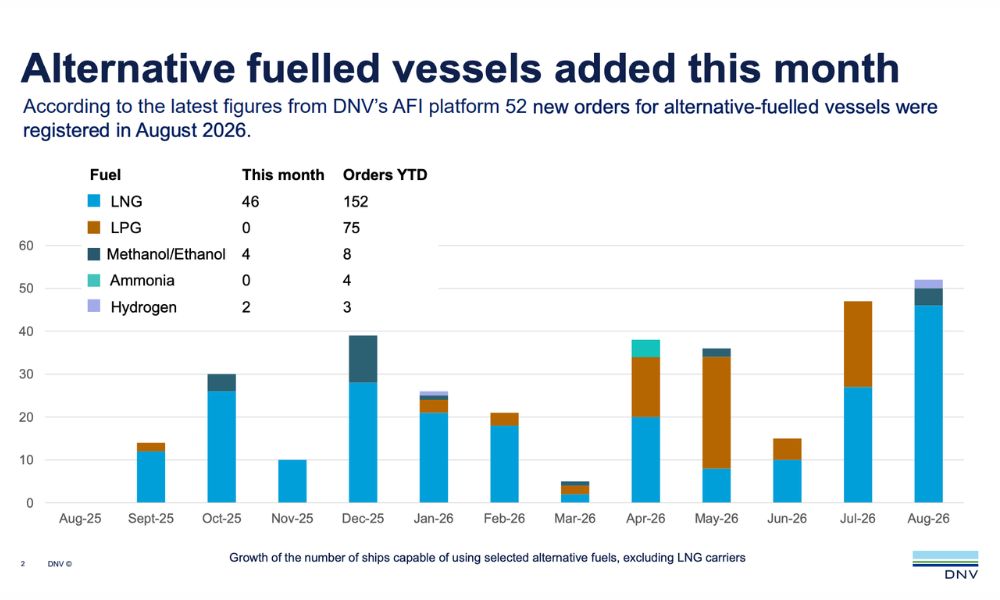
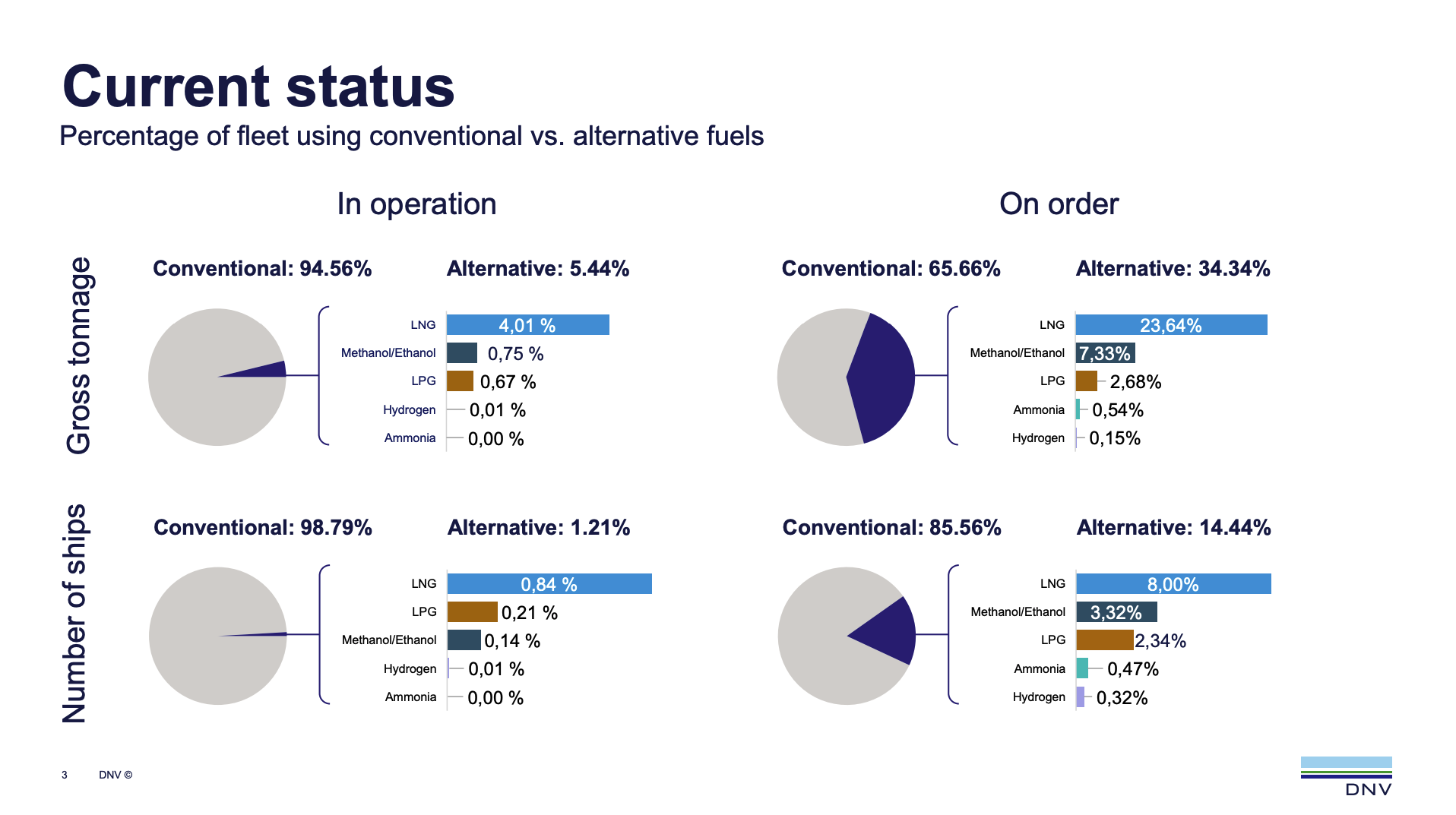
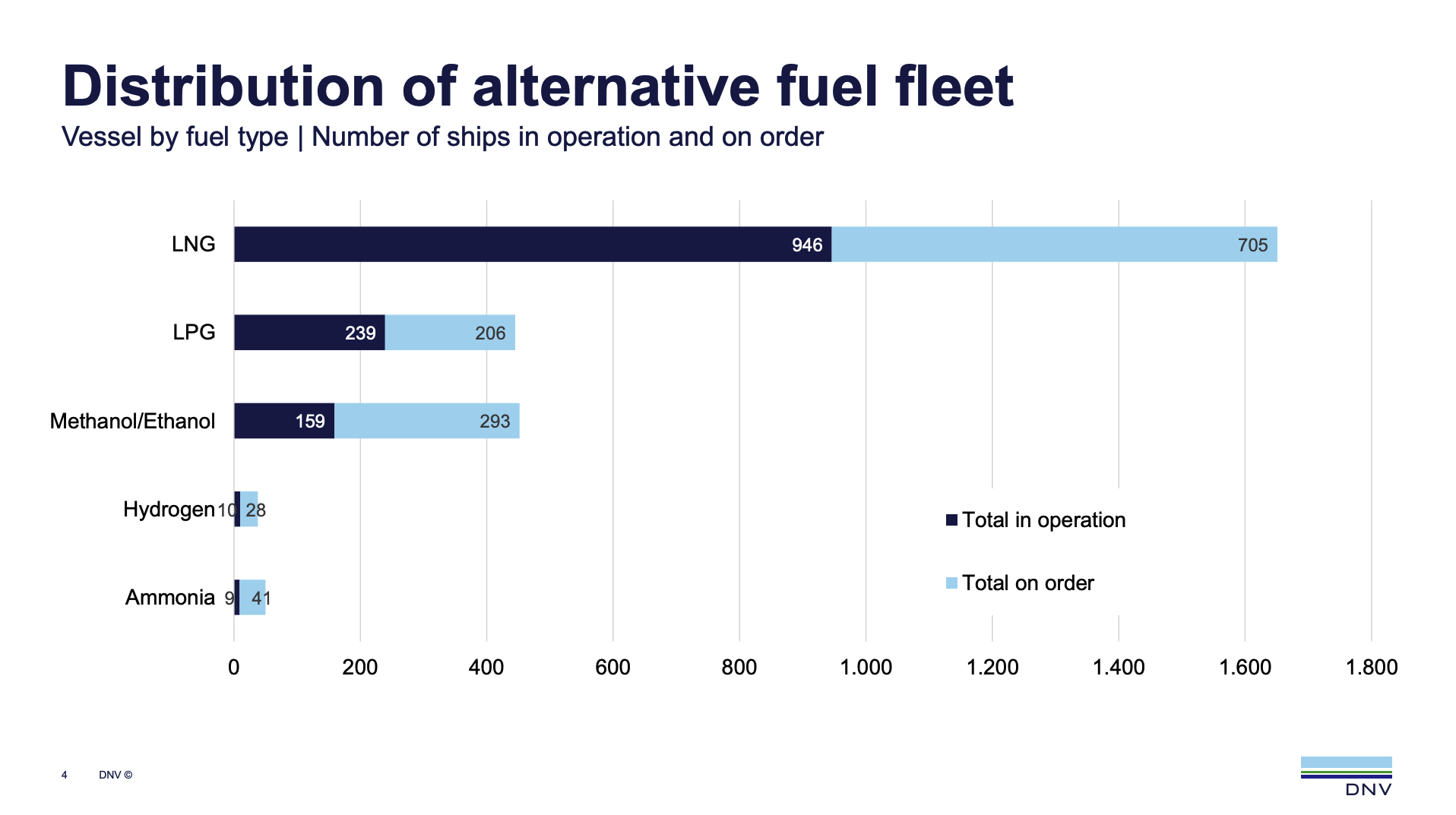
According to analysis of vessel orders from January to June 2026 from SEA-LNG member DNV, LNG dual-fuel orders remain robust at 73 vessels, accounting for almost 90% of the alternatively fuelled order book, when compared with ammonia, hydrogen and methanol. Additionally, there are now 67 LNG bunker vessels in operation, plus 42 more on order.

The LNG order book continues to be dominated by vessels serving liner trades especially container vessels and pure car and truck carriers (PCTCs). This is consistent with recent analysis by the World Shipping Council which shows that LNG remains the preferred fuel for container ship owners, accounting for 58% of total tonnage ordered versus conventional fuels at 36%.

There was also an increase in bunkering volumes and infrastructure. According to analysis by Kpler, global LNG bunker volumes were around 770,000 cubic meters (m3) per month in the period January to May 2026. This represents an increase of about 13% on the same period in 2025 as more LNG fuelled vessels have entered into operation together with favourable LNG and conventional fuel prices.

Liquefied biomethane is bunkered routinely today, and liquefied e-methane is in development. Since the introduction of regulations like FuelEU Maritime, LBM supply and demand have grown significantly. Data from the European Biogas Association show biomethane production capacity reached 8.2 bcm a year by the end of Q2 2026. This represents an additional 1 bcm in a single year, or growth of 17%. The number of operational biogas plants rose from 1,678 to 1,975 plants with €36 billion of allocated capital investment driving the sector.

Steve Esau, SEA-LNG COO, said: “Despite geopolitical and regulatory uncertainties in 2026, the industry is maintaining momentum on the methane decarbonisation pathway. This year’s mid-year review confirms that methane is the practical and realistic solution for shipping decarbonisation. 

“This is reflected in the growing numbers of LNG-fuelled vessels, LNG bunker vessels, and LNG bunkering volumes, as well as biomethane bunkering and production growth. As we look ahead, with e-methane also materialising, we are confident in the trajectory of the methane pathway to decarbonisation.”

SEA-LNG is active at the IMO and EU to underline the importance of goal-based and technology-neutral decarbonisation regulations, and ensure a global market for low and net zero fuels. As the methane pathway continues to mature, efforts have shifted from raising awareness to sharing members’ collective expertise on important technical details that will, for example, further reduce global well-to-wake emissions and scale up bio- and e-methane development and deployment.

As part of these efforts, last week SEA-LNG was granted provisional consultative status at the IMO. This status will enable SEA-LNG to engage directly with Members States as it advocates for practical and realistic regulations to help move the maritime industry forward.

Peter Keller, SEA-LNG Chairman, said: “I have been with SEA-LNG since we founded it 10 years ago, and what strikes me is how methane has ramped up from a pathway to a clear runway for shipping decarbonisation. When building the first LNG-powered containership, I didn’t imagine that within ten years over 10% of the global fleet by deadweight could be powered by methane. 

“What started as a solution to reduce harmful local emissions has cemented itself as the practical and realistic option for reducing greenhouse gas emissions today and into the future. As I look ahead, the fundamentals are strong, the orderbook is growing, the bunkering infrastructure is expanding at a record pace, and biomethane and e-methane are building on LNG’s foundation. Just as we expected.”

Note: SEA-LNG’s Methane Pathway – 2026 mid-year market review can be viewed here.


Photo credit: SEA-LNG
Published: 17 July, 2026

Continue Reading

Trending