Connect with us

Business

BIMCO: Shipping is increasingly caught in the crosshairs of a trade war

Dry bulk, container and tramp segments most affected.

Admin

Published

on

5b9a2254314a3 1536827988

The already long list of tariffed goods is expected to grow even longer if the US and China implement tariffs on a further USD 200 and USD 60 billion worth of goods respectively.  And the casualties in this trade war are the dry bulk, container and tramp segments.

BIMCO’s chief shipping analyst Peter Sand in a report Wednesday said the dry bulk shipping industry would be most affected in terms of volumes and that 2,002 Handymax loads are now affected.  This is equal to the impact on the container shipping industry which also sees 1.9% of total containerized seaborne trade affected.

With the trade war constantly developing andan end not in sight, the shipping industry is trapped between a rock and a hard place in an already troubled market place, Sand said.

Here is his analysis:

The US: Container shipping will be seriously hit by the next crossfire

From 23 August 2018, the second part of the USD 50 billion list, worth USD 16 billion, originally announced in late May, has been tariffed with commodities such as plastics and oil products targeted. The first list, worth USD 34 billion came into force on 6 July 2018 and targeted mainly machinery and electronic goods.

The US also published a list of goods worth USD 200 billion which it planned to add 10% tariffs to. They have later raised the proposed tariff levels to 25%. This list covers more consumer goods than previously seen varying from bicycles to fish and Christmas lights, and will undergo further review before a decision is made about possible implementation.

Of the goods which already face tariffs, namely the targeted steel and aluminium commodities and the USD 34 billion worth of goods, most are dry bulk and container goods. 23.3 million tonnes of the affected steel and aluminium commodities were imported by the US via the sea in 2018.

Dry bulk commodities will also be affected if the USD 200 billion list is implemented, with 4.1 million tonnes of the targeted commodities imported to the US from China in 2017, these goods include wood commodities and cements. In total the dry bulk goods affected by US tariffs are equivalent to 548 Handymax loads (50,000 DWT).

While containerized goods have already been targeted, by the USD 50 billion round, the biggest impact on these will come if the proposed USD 200 billion are implemented. So far, the tariffed goods total to 6.6 million tonnes of seaborne trade from China to the US in 2017.This is equivalent to 660,000 TEU (10 tonnes per TEU/global average), which amounts to 5.9% of US West Coast container imports in 2017.  If you assume a lighter/heavier cargo per transported TEU or FEU, naturally the number of containers change accordingly.

A further 22.4 million tonnes of seaborne containerized goods would be impacted by the US 200 billion list, which amounts to a further 20.1% of USWC imports in 2017, or 2.24 million TEU. In total, if this latest round of tariffs were also to be implemented, 1.5% of the global seaborne container trade would be affected.

China: Running out of Ammunition

The Chinese USD 16 billion list also came into force on 23 August 2018, a modified list compared to the original publication, with the removal of crude oil an important development. This revised list contains wood commodities as well as some coals and metals.

Following the publishing of the USD 200 billion list by the US, China responded by releasing four lists worth in total USD 60 billion, to be tariffed between 5% and 25%.

However, the trade war has now reached a stage where China is unable to respond equally as it imports much less from the US than it exports.

The dry bulk shipping industry remains by far the most affected by Chinese tariffs in terms of volumes. The largest ‘one commodity’ targeted by the trade war are US soybeans which as of 6 July 2018 face 25% tariffs when imported into China, but the impact of these on Chinese buyers may be limited.

A fall in the price of US soybeans since the tariff’s implementation, has resulted in US soybeans being 21% cheaper than Brazilian soybeans (Source: Bull Positions), the second largest exporter of soybeans to China, thus eroding much of the added costs brought about by the tariffs.

The proposed USD 60 billion would also affect the dry bulk industry the most, with 10.5 million tonnes of listed dry bulk commodities shipped from the US to China. In 2017, 72.2 million tonnes of the involved commodities (both with tariffs implemented and proposed) were imported via the sea by China from the US. This represented 1.4% of total seaborne dry bulk trade in 2017 and is equivalent to 1,454 Handymax loads (50,000 DWT).

In the tramp shipping market, uncertainty about where the next cargo will come from makes it very difficult to reposition your ship after discharge. For the liner shipping market, matching deployed capacity on trade lanes with actual demand becomes even harder.

Photo credit: Pixabay
Published: 13 September, 2018

Continue Reading

Winding up

Singapore: Liquidator of Da Xin Tankers, Nan Chiau Maritime issues notices of dividend

Da Xin Tankers’s second interim dividend and Nan Chiau Maritime’s third interim dividend are payable from 17 September, according to Government Gazette notices.

Admin

Published

on

By

Resized benjamin child

Notices of dividend for Da Xin Tankers Pte Ltd and Nan Chiau Maritime Pte Ltd, which are currently in creditors’ voluntary liquidation, were published on the Government Gazette on Thursday (17 September). 

The following are the details of the notice for Da Xin Tankers:

Name of Company : Da Xin Tankers (Pte) Ltd (In Creditor’s Voluntary Liquidation)
Unique Entity No. / Registration No. : 198400895W
Address of Registered Office : c/o Grant Thornton Singapore Private Limited, 8 Marina View, #40-04/05 Asia Square Tower 1, Singapore 018960
Amount per centum (US$) : 5.00 cents to a dollar of admitted unsecured claims
First and Final or otherwise : Second Interim Dividend
When payable : 17 September 2026
Where payable : Entitlements will be made either by way of telegraphic transfer or by cheque, to be collected from the Company’s registered address as above

The following are the details of the notice for Nan Chiau Maritime:

Name of Company : Nan Chiau Maritime (Pte.) Ltd. (In Creditors’ Voluntary Liquidation)
Unique Entity No. / Registration No.: 200814296Z
Address of Registered Office : c/o Grant Thornton Singapore Private Limited, 8 Marina View, #40-04/05 Asia Square Tower 1, Singapore 018960
Amount per centum (US$) : 7.00 cents to a dollar of admitted unsecured claims
First and Final or otherwise : Third Interim Dividend
When payable : 17 September 2026
Where payable : Entitlements will be made either by way of telegraphic transfer or by cheque, to be collected from the Company’s registered address as above.


Photo credit: Benjamin Child
Published: 18 September, 2026

Continue Reading

Alternative Fuels

GCMD, BCG: Engine choices today to shape shipping’s fuel pathways through 2050

New fuels could reach around 60% of fleet energy consumption under a sufficiently strong carbon price signal, modelled at USD 700/tCO2e by 2050.
Admin

Published

on

By

GCMD, BCG: Engine choices today to shape shipping’s fuel pathways through 2050

With vessels operating for 25 to 30 years and only around 4% of the fleet renewed annually, newbuild decisions made over the coming decade will establish much of the engine capacity available in 2050, Global Centre for Maritime Decarbonisation said on Thursday (17 September). 

Yet having the capacity to consume a new fuel does not guarantee its uptake. Dual-fuel engines allow shipowners to switch between conventional fuels and the selected new fuel as economics and regulations evolve; continued fuel competitiveness is therefore critical to what vessels ultimately consume.

These are among the findings of Navigating the maritime fuel transition: How fuel economics, regulations, and fleet decisions shape the future bunkering landscape, based on a model jointly developed by the GCMD and Boston Consulting Group (BCG).

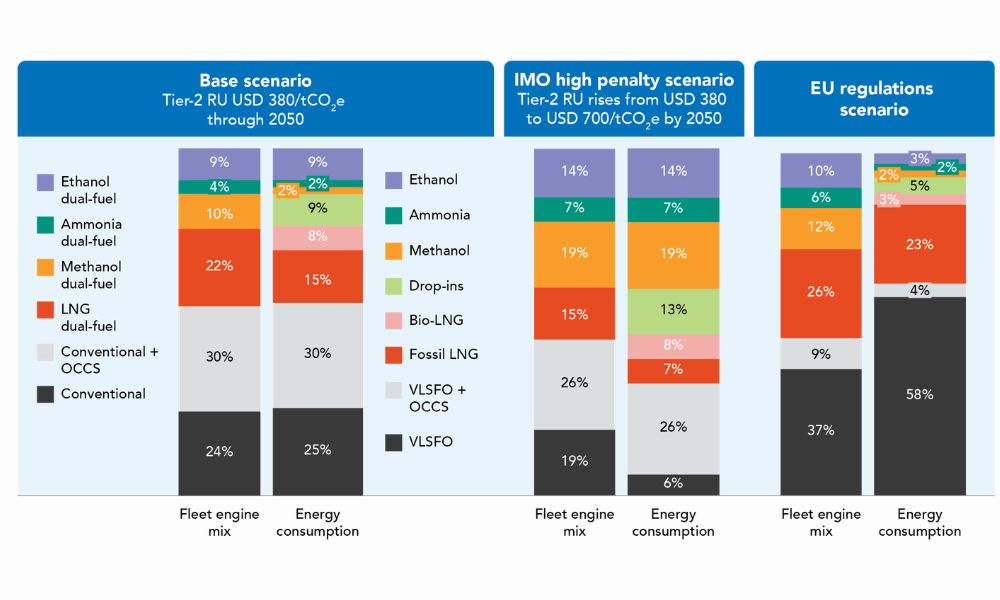
The model illustrates this dynamic in its base scenario. With the Tier-2 penalty under the IMO Net-Zero Framework held at USD 380/tCO2e through 2050, methanol dual-fuel engines account for around 10% of fleet engine capacity in 2050, but methanol represents just 2% of fleet energy consumption. With conventional fuels remaining more economical under this regulatory regime, methanol dual-fuel vessels continue to operate on fuels cheaper than methanol (Figure 1).

A global carbon price of USD 700/tCO2e materially changes the transition

The base scenario demonstrates how fuel economics can limit uptake even when vessels have the capacity to use new fuels. This picture changes if the IMO Tier-2 penalty rises to USD 700/tCO2e by 2050, at which point new fuels, including dropins, reach approximately 61% of fleet energy consumption (Figure 1).

By contrast, EU regulations alone will not drive a marked global shift, as they cover only around 20% of international shipping’s energy demand.

Overall cost of using e-methanol and e-ammonia is near parity

While a stronger global carbon price can accelerate the shift towards new fuels, the model does not point to a clear cost winner between e-methanol and e-ammonia.

E-ammonia’s production cost advantage is largely offset by higher logistics costs arising from its toxicity, including specialised crew training, larger exclusion zones, and more complex bunkering. As a result, the overall cost (Figure 2) of using e-ammonia and e-methanol is near parity through to 2050.
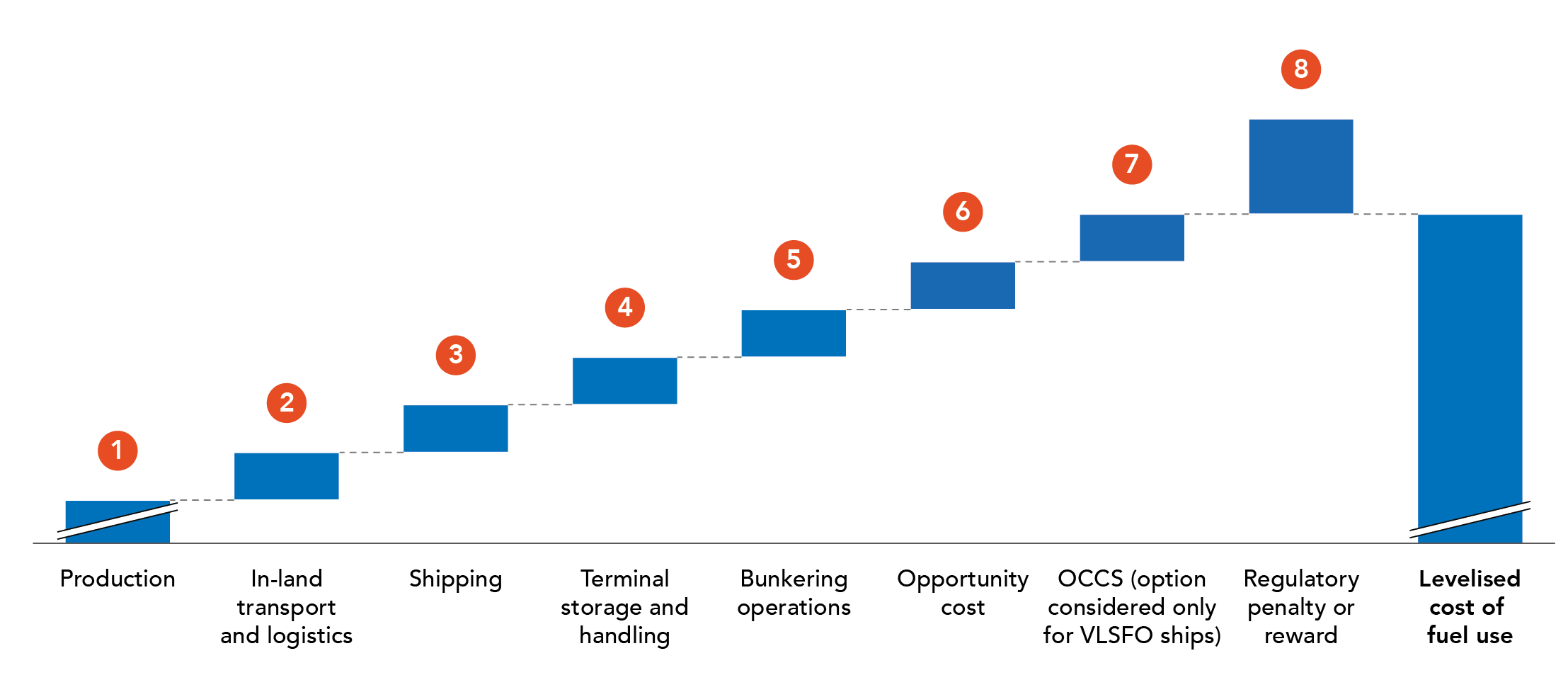
Fig 2 Constituents of levelised cost of fuel use

Professor Lynn Loo, CEO of GCMD, said: “Many vessels ordered over the coming decade will still be operating in 2050. Shipowners are therefore making long-lived engine choices before the relative economics of future fuels are clear. 

“Our modelling puts into perspective just how difficult closing the cost gap between new and conventional fuels will be. The carbon price required to close this gap is substantial. And achieving it will be particularly challenging in today’s geopolitical environment. Understanding the signposts that could change these economics will be critical to the decisions the industry makes today.”

Anand Veeraraghavan, Managing Director & Senior Partner at BCG, said: “The maritime fuel transition is being shaped as much by policy and cost uncertainty as by technology readiness. 

“Rather than offer a single prediction, our approach with GCMD maps how sensitive each fuel pathway’s competitive position is to a handful of critical variables — policy scenarios, key cost drivers, and potential restrictions. Our hope is that this gives shipowners, fuel suppliers, port operators, and infrastructure investors a practical tool to stress-test their own fuel strategies as conditions change.”


Photo credit: Global Centre for Maritime Decarbonisation
Published: 18 September, 2026

Continue Reading

Newbuilding

Yang Ming names 15,500 TEU LNG dual-fuel container vessel “YM Weight”

Yang Ming held a naming ceremony at the HD HHI shipyard in Ulsan, South Korea, for “YM Weight”, the fourth vessel in its series of five 15,500 TEU-class LNG dual-fuel container vessels built by HD HHI.
Admin

Published

on

By

Yang Ming names 15,500 TEU LNG dual-fuel container vessel “YM Weight”

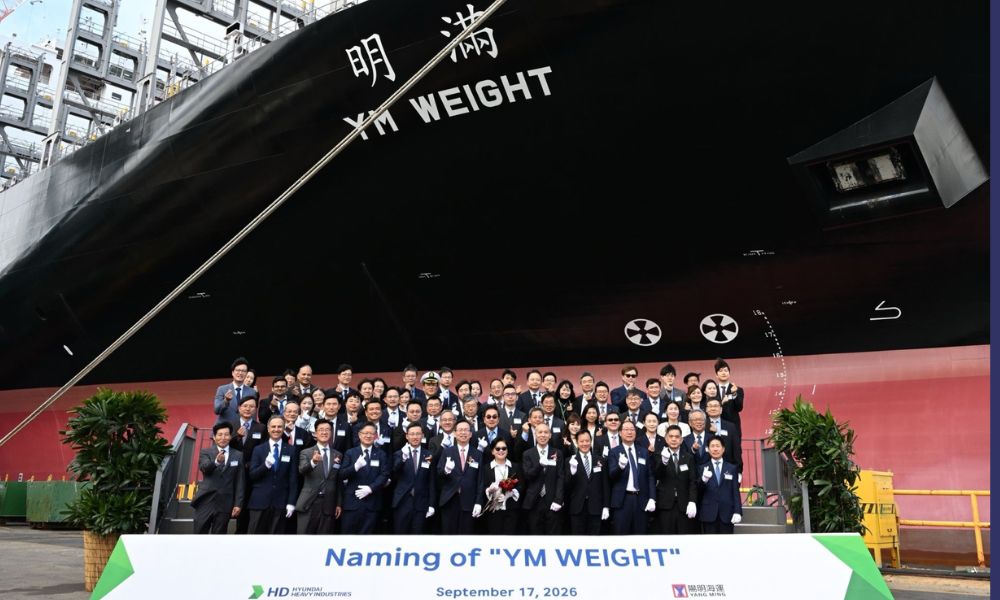
Taiwanese shipping firm Yang Ming Marine Transport Corporation (Yang Ming) on Thursday (17 September) held a naming ceremony at the HD Hyundai Heavy Industries (HD HHI) shipyard in Ulsan, South Korea, for YM Weight, the fourth vessel in its series of five 15,500 TEU-class LNG dual-fuel container vessels built by HD HHI. 

Mrs. Chiu-Lien Lin, the spouse of Administrative Deputy Minister of Transportation and Communications Mr. Kuo-Shian Lin, was invited as the Godmother to officially name the vessel and perform the ceremonial cord-cutting, wishing the ship smooth sailing and full loading on all future voyages. 

This series of vessels built by HD HHI has a length overall (LOA) of 364.97 meters, a breadth of 51 meters, and a capacity of approximately 15,600 TEU. 

The vessels are equipped with high-pressure dual-fuel main engines that run on both LNG and low-sulphur fuel oil, along with integrated navigational information, equipment monitoring, broadband maritime satellite systems, and multiple energy-saving systems to enhance operational efficiency and navigational safety. 

YM Weight, the fourth vessel in the series, is jointly classed by CR and the American Bureau of Shipping (ABS), bringing international classification expertise and capabilities to safeguard the safety and technical compliance of next-generation LNG dual-fuel vessels. 

Furthermore, following proactive underwater noise measurements, the vessel has achieved two industry firsts by receiving the Underwater Noise (UWN) notation from ABS and the Underwater Radiated Noise (URN) notation from CR. The dual recognitions underscore Yang Ming’s commitment to mitigate operational impact on marine life and sustainable development. 

In addition to expanding its next-generation fleet and strengthening its core shipping business, Yang Ming has continued to strengthen professional training for seafarers operating alternative-fuel vessels. 

Yang Ming’s senior Captain Ming-Yeong Pan will serve as the delivery captain of ‘YM Weight’. Captain Pan is the first seafarer in Taiwan to receive the Advanced Training Certificate under the International Code of Safety for Ships Using Gases or Other Low-flashpoint Fuels (IGF Code), Certificate No. 0001, issued by the Maritime and Port Bureau, MOTC. 

To date, 148 Yang Ming officers have completed advanced IGF Code training and will progressively undertake onboard training aboard LNG-fueled vessels and practical alternative-fuel bunkering training. 


Photo credit: Yang Ming Marine Transport
Published: 18 September, 2026

Continue Reading

Trending