Connect with us

Alternative Fuels

Artemis Technologies receives GBP 60 million funding to build zero emissions ferries

A maritime consortium led by the Belfast-based company won a GBP 33 million UK Government grant that almost doubled the total project investment.

Admin

Published

on

Artemis Technologies

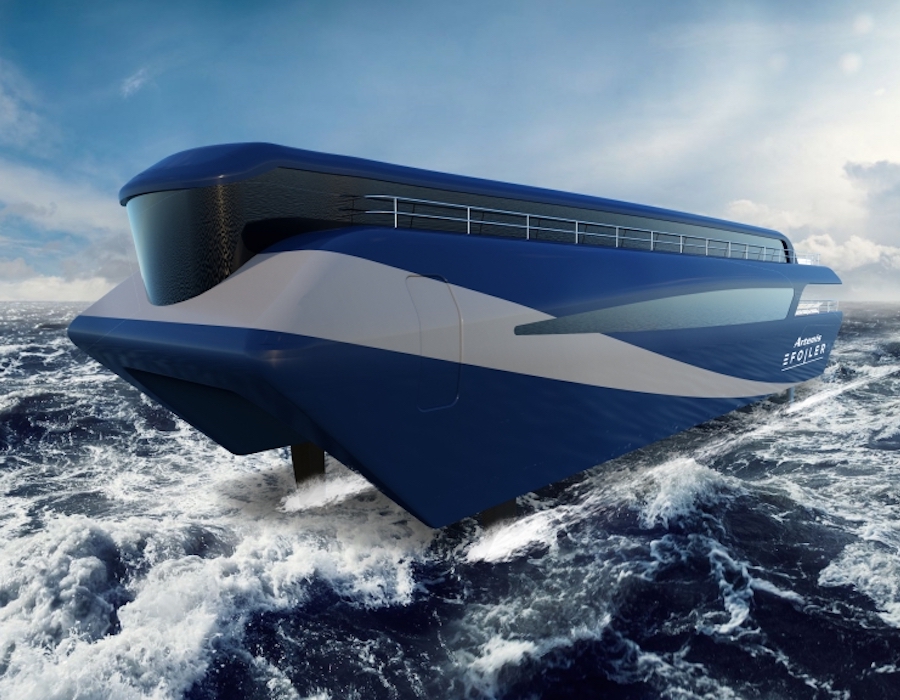
Artemis Technologies, a Belfast-based applied technology company, on Friday (26 June) announced their maritime design project to build zero emissions ferries has accumulated a total project investment close to GBP 60 million.

A Belfast Maritime Consortium led by Artemis Technologies has won a £33 million UK Government innovation grant to develop zero emissions ferries in the city, it said. 

The official statement revealed with further investment from consortium partners, the total project investment will reach close to GBP 60 million over the next four years, creating an initial 125 research and development jobs, and leading to more than 1,000 in the region over the next 10 years.

The 13 partner syndicate –  a mix of established and young companies, including Belfast Harbour and Bombardier, academia and local public bodies – is the only Northern Irish or maritime recipient of the UK Research and Innovation flagship Strength in Places Fund.

 A spin-off from the America’s Cup sailing team, Artemis Racing, Artemis Technologies is led by double Olympic gold medallist Iain Percy OBE.

“When we launched Artemis Technologies, we decided to base ourselves in Belfast because of the incredible aerospace and composite engineering talent available,” said Artemis Technologies Founder Iain Percy OBE.

“Belfast’s local expertise coupled with the city’s rich shipbuilding heritage, and our own America’s Cup yacht design experience, will ensure Belfast is the global lead in zero emissions maritime technology.

“For years, we’ve been designing low energy, high performance solutions for some of the fastest yachts on the planet, and we will now utilise that knowledge, and along with our partners, apply it to build the world’s most environmentally friendly high-speed ferries, capable of carrying up to 350 passengers.”

Percy added that the concept for an electric hydrofoil propulsion system is totally unique and will enable vessels of the future to operate with up to 90% less energy, and produce zero emissions during operation.

“We are all proud of Belfast’s maritime and shipbuilding heritage. However, it is even more exciting to look towards a future which can see Northern Ireland once again leading the way with world-class manufacturing and cutting-edge technology,” said First Minister Arlene Foster.

“I pay tribute to all those involved in the project which demonstrates so clearly the benefits of collaboration between business, academia and government at all levels. 

“This investment can support economic growth locally, but its impact could be felt globally through solutions to more sustainable transport,” she added.

Foster revealed that The Belfast consortium brings together a range of established and young firms, academia and public bodies, including: Belfast Harbour, Bombardier Belfast, Northern Ireland Advanced Composites Engineering (NIACE), Creative Composites, Energia, Catalyst, Invest Northern Ireland, Ulster University, Belfast Met, Queen’s University, Belfast, Ards and North Down Borough Council, and Belfast City Council.

“As we continue to develop Belfast Harbour as a key economic hub and centre for innovation, we are pleased to partner with Artemis Technologies in this cutting-edge maritime design project which keeps our city firmly on the shipbuilding map,” said Belfast Harbour Chief Executive Joe O’Neill.

O’Neill commented ambitious collaborative partnerships such as this are key enablers to help unlock groundbreaking technical innovations and this project fully aligns to Belfast Harbour’s vision to become one of the world’s greenest and best regional ports.

“Belfast Harbour is already home to a diverse range of businesses and this collaboration will only see that expand while also creating new pathways to employment and economic growth opportunities within Belfast and beyond,” he concluded.

“This investment will help our economy recover more quickly, creating jobs and economic prosperity for the city – both key objectives of the Belfast Agenda,” said Belfast City Council Chief Executive Suzanne Wylie.

“Belfast has a long history of innovation and it’s hugely exciting to know that once again, we’re on the cusp of a significant engineering breakthrough – one which will position us as pioneers in advanced manufacturing, resilience and transitioning to a low carbon economy,” she concluded.

“As the largest manufacturer in Northern Ireland, Bombardier Belfast is a centre of excellence for the design, manufacture and aftermarket support of complex metallic and advanced composite aerostructures and therefore can provide a depth of experience, capability and capacity in support of Artemis Technologies,” said Bombardier Aviation Aerostructures Chief Operating Officer Michael J Ryan CBE.

Ryan stated that Bombardier Belfast is keen to expand into markets that exploit their capabilities/advanced technology and where there are synergies with novel technologies. 

He shared his view that the Artemis Technologies project, represents a credible technology path that could provide a technological ‘step-change’ to the maritime sector and passenger transportation.”

“UK Research and Innovation funding through the Strength in Places Fund will bring researchers, industry and local leadership together in outstanding collaborative programmes that will catalyse regional excellence and economic growth across the UK,” said UK Research and Innovation Chief Executive Professor Sir Mark Walport.

“UK Research and Innovation’s flagship Strength in Places Fund is distinctive in specifically targeting investment to foster the local research and innovation ecosystems that can support sustained growth,” said Research England’s Executive Chair David Sweeney.

Sweeney highlighted that all of these projects have the potential to deliver research and innovation that will transform activity within their target industries, in a way that is deeply rooted in local strengths and well linked to wider local economic plans. 

He concluded that with a second wave of Strength in Places funding already in the pipeline, they look forward to broadening the reach of that impact to further projects in other areas of the country in future.


Photo credit: Artemis Technologies
Published: 29 June 2020

Continue Reading

LNG Bunkering

PIL’s LNG dual-fuel boxship “Kota Elok” arrives in Singapore on maiden call

As the first of 13 new 13,000 TEU vessels joining its fleet, Kota Elok is equipped to operate on LNG and low-sulphur fuel oil that helps reduce our greenhouse gas emissions.

Admin

Published

on

By

PIL's LNG dual-fuel boxship “Kota Elok” arrives in Singapore on maiden call

Singapore-based Pacific International Lines Pte Ltd on Monday (20 July) said its first 13,000 TEU LNG dual-fuel container vessel, Kota Elok, recently made her maiden call to Singapore on 15 July.

As the first of 13 new 13,000 TEU vessels joining its fleet, Kota Elok is equipped to operate on liquefied natural gas (LNG) and low-sulphur fuel oil that helps reduce our greenhouse gas emissions. 

The vessel also incorporated energy-saving features and digital technologies to reduce fuel consumption and enhance operational performance, as well as a bow windshield to improve aerodynamics, contributing to improved fuel efficiency and lower emissions over the course of long-haul voyages.

“Following Singapore, Kota Elok will continue her voyage on our East Coast Service 1 (ES1) route to South America, calling at ports in Brazil, Uruguay, and Argentina before returning to Asia,” the company said in a social media post. 

Kota Elok also became PIL’s first vessel to receive Lloyd’s Register certification for compliance with the IACS UR E26 and UR E27 cyber security requirements.

Developed by the International Association of Classification Societies (IACS), UR E26 and UR E27 are mandatory cyber resilience requirements for newbuild vessels contracted from 1 July 2024. 


Photo credit: Pacific International Lines
Published: 21 July, 2026

Continue Reading

LNG Bunkering

CIMC SOE secures order for 12,000-cbm LNG bunkering vessel from Sinopec Clean Energy

Once operational, the vessel is expected to strengthen Sinopec’s domestic coastal LNG bunkering network and help address gaps in China’s alternative fuel bunkering infrastructure.

Admin

Published

on

By

CIMC SOE secures order for 12,000-cbm LNG bunkering vessel from Sinopec Clean Energy

China’s Nantong CIMC Sinopacific Offshore & Engineering Co., Ltd. (CIMC SOE) recently signed a contract with Sinopec (Beijing) Clean Energy Co., Ltd. to build a 12,000-cubic metre (m3) LNG bunkering vessel, according to Chinese maritime media.

The vessel is scheduled for delivery in 2028 and will support Sinopec’s efforts to expand its presence in the marine clean energy sector.

Once operational, the vessel is expected to strengthen Sinopec’s domestic coastal LNG bunkering network and help address gaps in China’s LNG bunkering infrastructure.

With this signing , CIMC Pacific Offshore Engineering’s LNG bunkering vessel orderbook is further strengthened, maintaining its leading position in the global market for small and medium-sized LNG bunkering vessels.

The contract also marked another milestone for CIMC SOE, which has seen a sharp increase in orders and business performance this year amid a surge in domestic LNG vessel demand.


Photo credit: Nantong CIMC Sinopacific Offshore & Engineering
Published: 21 July, 2026

Continue Reading

Nuclear

ABS awards AiP to Korean institute for SMR-powered container ship concept design

KRISO says AiP recognises the technical feasibility and safety of its concept design, marking an important milestone toward the development of next-generation nuclear-powered commercial ships.

Admin

Published

on

By

ABS awards AiP to Korean institute for SMR-powered container ship concept design

Korea Research Institute of Ships & Ocean Engineering (KRISO) on Thursday (16 July) received Approval in Principle (AiP) from the American Bureau of Shipping (ABS) for its concept design of a 15,000 TEU Small Modular Reactor (SMR)-powered container ship utilising Molten Salt Reactor (MSR) technology.

KRISO said the AiP recognises the technical feasibility and safety of its concept design, marking an important milestone toward the development of next-generation nuclear-powered commercial ships.

“This achievement demonstrates international recognition of KRISO’s technological capabilities in the rapidly evolving field of nuclear-powered shipping, supporting the transition toward low-carbon maritime transport,” it said. 

Building on this milestone, KRISO will continue advancing basic and detailed ship design, paving the way for future demonstration and commercialisation of SMR-powered vessels. 

Through continued R&D and international collaboration, KRISO remains committed to strengthening next-generation maritime technologies and contributing to the safe deployment of nuclear propulsion in the maritime industry.


Photo credit: Korea Research Institute of Ships & Ocean Engineering
Published: 21 July, 2026

Continue Reading

Trending