Connect with us
DNV Decarbonization Insight Series August 2026 - What maritime professionals should know about AI Training

Ammonia

UK P&I Club publishes guide on safe ammonia bunkering practices

Publication provides practical, experience‑led guidance on the key safety, operational and risk considerations associated with ammonia bunkering and handling.

Admin

Published

on

UK P&I Club publishes guide on safe ammonia bunkering practices

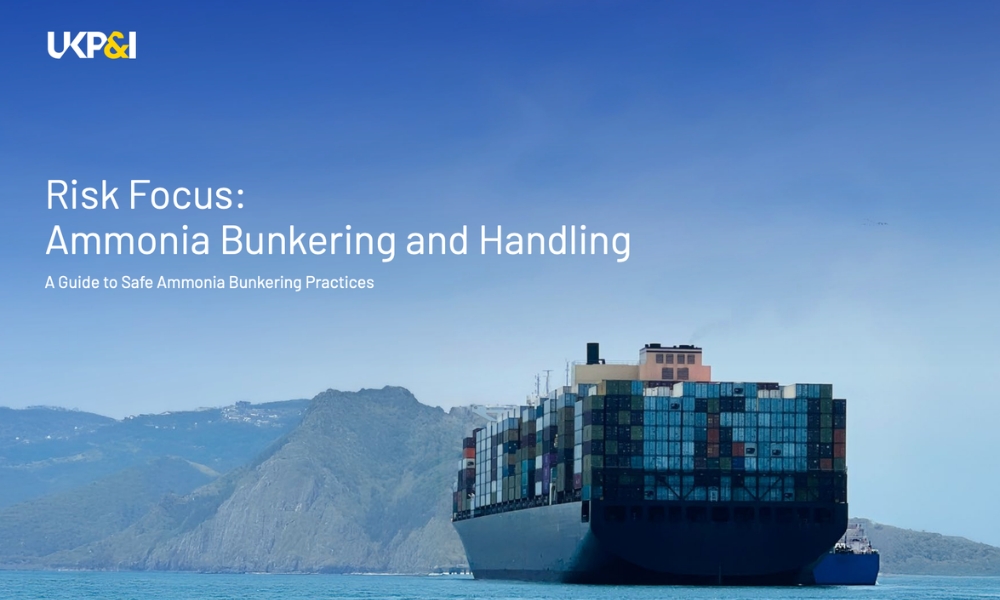
UK P&I Club on Monday (2 March) launched its latest Risk Focus publication, Ammonia Bunkering and Handling, developed in collaboration with Brookes Bell.

The publication provides practical, experience‑led guidance on the key safety, operational and risk considerations associated with ammonia bunkering and handling, from planning and containment through to emergency response and crew competence.

“This guide examines ammonia’s potential as a carbon-free fuel alternative while addressing the unique challenges posed by its toxic and corrosive nature. It explores the physical properties of ammonia alongside critical health hazards and essential first aid measures,” UK P&I Club said on its website. 

Alongside this, UK P&I is also introducing two new Member training programmes focused on the use of ammonia as fuel, developed with leading industry partners to address emerging operational and competency needs.

The first is on ammonia handling training, developed with The Nautical Institute, supporting officers and crew in building a structured understanding of ammonia as a marine fuel. The programme focuses on fuel properties, system awareness, operational hazards, risk controls and emergency response, aligned with developing regulatory and competency expectations.

The second is on critical first aid measures for ammonia and methanol exposure, developed with Red Square Medical, providing practical, scenario‑based training on recognising exposure, immediate response actions and life‑saving first aid. The course is designed to support crews and shore personnel in managing the serious health risks associated with toxic fuel exposure.

Note: The guide titled ‘Risk Focus: Ammonia Bunkering and Handling’ can be read here


Photo credit: UK P&I Club
Published: 4 March, 2026

Continue Reading

Alternative Fuels

UK Chamber of Shipping releases industry-first safety evidence base for alternative bunker fuels

Publication provides preliminary, high-level risk assessments covering five key marine fuel pathways: Battery Energy Storage Systems, biofuels, methanol, hydrogen and ammonia.

Admin

Published

on

By

RESIZED Chris Pagan

The UK Chamber of Shipping on Monday (3 August) published Alternative Fuels: Building the Safety Evidence Base, a report bringing together industry expertise to identify and assess the safety considerations associated with the fuels expected to power shipping’s transition to net zero.

Developed through the Chamber’s Safety of Alternative Fuels Working Group (SAFWG), the publication provides preliminary, high-level risk assessments covering five key fuel pathways: Battery Energy Storage Systems (BESS), biofuels, methanol, hydrogen and ammonia. 

Francesco Sandrelli, Policy Director (Environment) at the UK Chamber of Shipping, said: “Shipping is on a critical pathway to net zero. New fuels and energy sources are moving from pilot projects to commercial reality, but safety, standards and operational readiness must keep pace.

“There is no single fuel that will decarbonise shipping. Different vessel types, trades and operating environments will require different solutions. What is essential is that the transition takes place safely. This publication is an important step towards achieving that goal.”

Among the report’s key findings is the need for robust design and process safety frameworks to support the commercial deployment of alternative fuels. The research also highlights a number of cross-cutting themes, including material compatibility, emergency response preparedness, crew training and competence, and the need for clearer regulatory pathways. 

The report represents a major collaborative effort by industry to build a shared understanding of the opportunities and challenges associated with alternative marine fuels. It provides practical insights into the known risks, highlights where further work is needed, and creates a foundation for future research, regulation and operational learning. 

The SAFWG was established by the UK Chamber of Shipping to support industry understanding of the safety implications associated with emerging zero and near-zero emission fuels. 

The report is the culmination of the Working Group’s first year of activity, during which more than 200 participants from over 50 organisations collaborated through a series of technical workshops delivered by Policy Director Francesco Sandrelli, supported by Robert Merrylees and Paul Markides. 

The publication forms part of the UK Chamber’s wider work to support shipping’s transition to net zero while maintaining the highest standards of safety and operational excellence. 

Future work by the SAFWG will focus on identifying regulatory and knowledge gaps, developing project-specific case studies, expanding stakeholder engagement and establishing an incident and lessons-learned database. 

Note: The report, Alternative Fuels: Building the Safety Evidence Base, can be found here


Photo credit: Chris Pagan on Unsplash
Published: 4 August, 2026

Continue Reading

Ammonia

New report calls for standardised approach to Safe Havens on ammonia-fuelled ships

The Decarb Hub report identifies an opportunity to build a shared, evidence-based approach to Safe Havens as the industry applies new regulatory requirements to ammonia-fuelled vessels.

Admin

Published

on

By

RESIZED william william on Unsplash

Lloyd’s Register Maritime Decarbonisation Hub (The Decarb Hub) on Thursday (30 July) called for a standardised approach to the design and assessment of Safe Havens on ammonia-fuelled vessels, highlighting that inconsistent interpretations of emerging regulatory requirements could result in differing safety outcomes across the future ammonia fleet.

This is set out in a new report, ‘Safe Havens for ammonia-fuelled ships’, which examines how the maritime sector can apply lessons from offshore oil and gas, chemical processing and other safety-critical industries to address a new requirement introduced under the International Maritime Organization’s (IMO) Interim Guidelines for the Safety of Ships using Ammonia as Fuel. The new guidelines now require vessels to incorporate Safe Havens to protect crew in the event of an ammonia release.

However, the report highlights that, as is often the case with interim, goal-based guidance for a new safety concept, the guidelines set high-level requirements that leave room for differing interpretations of what makes an effective Safe Haven. It proposes a shared framework to help vessel designers, operators, classification societies and flag administrations apply these requirements consistently as ammonia-fuelled vessels enter service.

The Decarb’s Hub research found that Safe Havens should not be viewed as standalone spaces designed solely to prevent ammonia exposure. Instead, they should be treated as human-centred systems that form part of a vessel’s wider emergency response strategy.

The report identifies three core functions that every maritime Safe Haven should provide: protection, command and control, and accessibility. Together they are intended to ensure that all crew remain protected from ammonia and other hazards, while enabling the execution of the vessel’s emergency response plan.

Drawing on established practices from industries that routinely manage toxic gas hazards, the report recommends that Safe Haven performance is assessed against realistic worst-case scenarios. It also highlights the importance of calculating Safe Haven endurance periods, assessing accessibility, regular testing and maintenance and human factors considerations to ensure systems continue to perform as intended throughout a vessel’s operational life.

The report concludes that the industry should focus on developing standardised methods for demonstrating Safe Haven performance. Establishing a consistent basis for assessment will help ensure Safe Havens deliver the intended level of protection across the future ammonia-fuelled fleet while supporting regulatory certainty and long-term operational confidence.

Jonathan Bolton, Decarbonisation Risk Analyst at the Lloyd’s Register Maritime Decarbonisation Hub, said: “Ammonia has the potential to play an important role in shipping’s decarbonisation journey, but its adoption must be supported by safety solutions that are robust, practical and consistently applied. Safe Havens are a new requirement for ammonia-fuelled ships and as with any new safety concept, the industry needs practical guidance to build a shared understanding of how Safe Havens should be designed and assessed.

“Our report brings together decades of experience from industries that have long managed toxic gas risks and translates those lessons into a maritime context. By identifying the critical functions that Safe Havens must perform and proposing a common framework for their assessment, we hope to support designers, operators, classification societies and regulators as they work towards the safe deployment of ammonia-fuelled vessels.”

The findings are intended to support shipowners, designers, regulators and classification societies as they develop the first generation of ammonia-fuelled vessels and contribute to the long-term evolution of international regulations governing ammonia safety. 

Note: A copy of the report can be downloaded at Safe Havens for ammonia-fuelled ships. 


Photo credit: william william on Unsplash
Published: 31 July, 2026

Continue Reading

Alternative Fuels

Sallaum Lines orders 1+1 LNG dual-fuel, ammonia-ready PCTC

Company signed a new shipbuilding contract with China Merchants Shipyard for the construction of one + one additional 8,600 CEU Pure Car and Truck Carrier, with delivery scheduled for 2029.

Admin

Published

on

By

Sallaum Lines orders 1+1 LNG dual-fuel, ammonia-ready PCTC

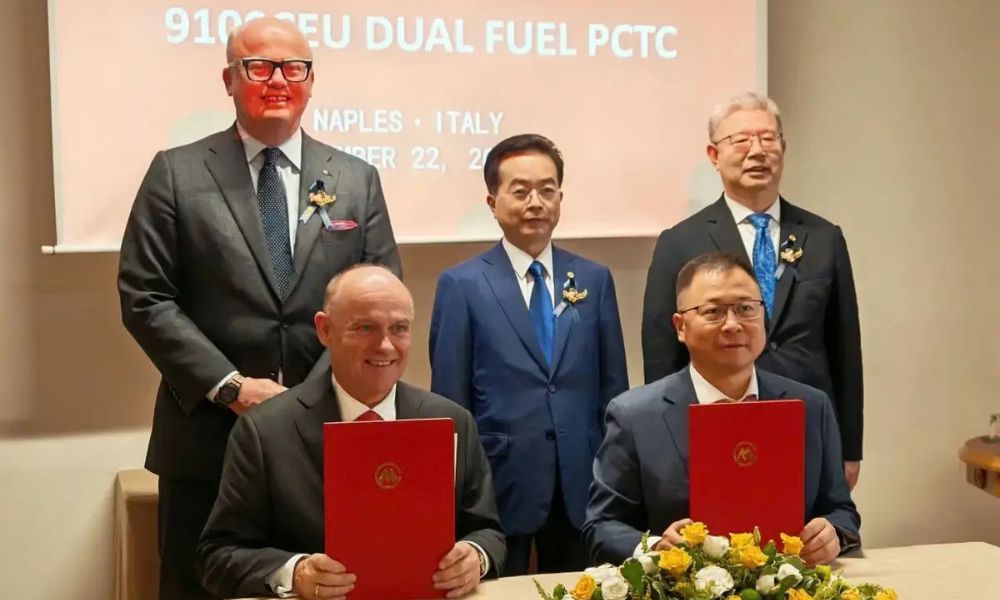
Sallaum Lines on Tuesday (28 July) announced the signing of a new shipbuilding contract with China Merchants Shipyard for the construction of one + one additional 8,600 CEU Pure Car and Truck Carrier (PCTC).

The new vessel will be LNG dual-fuel and ammonia-ready, with delivery scheduled for 2029. 

This latest firm order comes weeks after Sallaum Lines announced a separate newbuilding agreement with Xiamen Shipbuilding Industry Co., Ltd. for two firm 8,600 CEU vessels, with options for two additional vessels.

“The China Merchants order adds further momentum to Sallaum Lines’ newbuilding programme and confirms the company’s continued investment in modern, high-capacity RoRo tonnage at a time when the global PCTC market remains structurally important to automotive supply chains,” the company said. 

The newly signed vessel at China Merchants Shipyard brings Sallaum Lines’ total newbuilding programme to nine vessels, representing a total order value of above USD 850 million. The programme includes four vessels already delivered, one vessel scheduled for delivery in August 2026, one vessel scheduled for delivery in December 2026, and three vessels scheduled for delivery in 2029.


Photo credit: Sallaum Lines
Published: 29 July, 2026

Continue Reading

Trending