Connect with us

Bunker Fuel

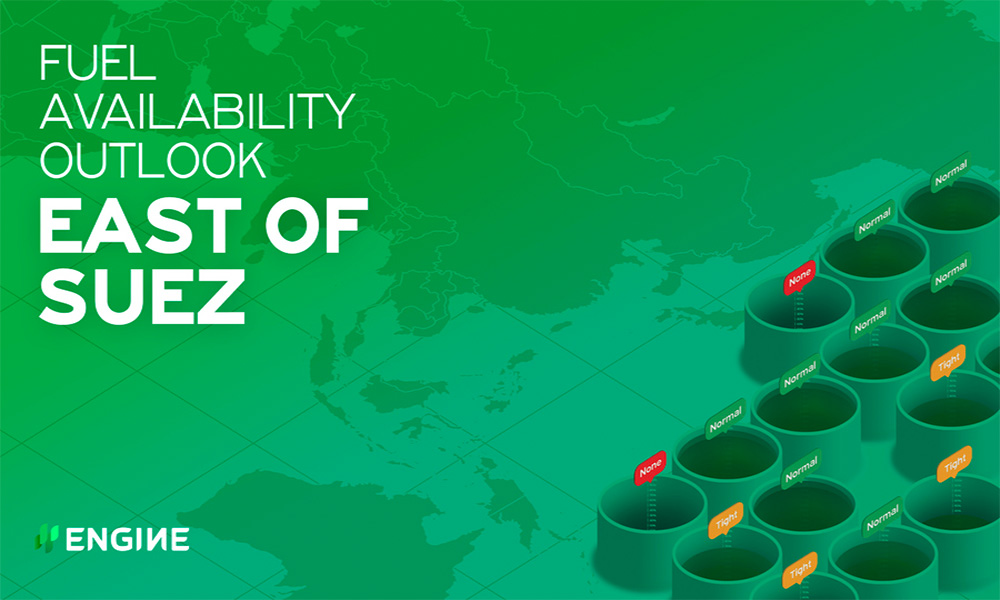
ENGINE: East of Suez Bunker Fuel Availability Outlook (24 Feb 2026)

Demand low in Zhoushan; availability good in Hong Kong; availability very tight across all grades in Fujairah.

Admin

Published

on

RESIZED ENGINE East of Suez

The following article regarding regional bunker fuel availability outlook for the East of Suez region has been provided by online marine fuels procurement platform ENGINE for publication on Singapore bunkering publication Manifold Times:

  • Demand low in Zhoushan
  • Availability good in Hong Kong
  • Availability very tight across all grades in Fujairah

Singapore and Malaysia

In Singapore, VLSFO availability has improved marginally, with recommended lead times easing to 6–10 days, from 8–13 days last week. LSMGO lead times have also shortened, falling to 4–9 days from 8–12 days previously. HSFO now requires about 6–12 days, compared with 8–12 days last week.

The modest improvement stems from softer demand during the Chinese New Year holiday period, which has reduced supply pressure, a source said.

On the inventory front, Singapore’s residual fuel oil stocks have averaged 2% lower so far in February compared with January, according to Enterprise Singapore’s latest data. Total fuel oil inventories have dipped below 24 million bbls, amid a 13% drop in net fuel oil imports this month. Although imports have risen by 259,000 bbls, exports have increased more sharply, up by 680,000 bbls.

In contrast, the port’s middle distillate inventories have averaged 5% higher so far this month, reaching their highest level since November.

Elsewhere in the region, Port Klang reports generally adequate supply of VLSFO and LSMGO—particularly for smaller prompt stems—while HSFO availability remains tight and relatively harder to secure.

East Asia

Availability in Zhoushan has improved across all grades amid muted demand. Lead times for VLSFO and LSMGO have shortened to 3–5 days, compared with 7–10 days last week. HSFO now requires 5–7 days, down from 7–10 days previously.

In Hong Kong, bunker lead times remain steady at around seven days for all grades, broadly unchanged in recent weeks.

Taiwan’s lead times for VLSFO and LSMGO are also largely stable. Deliveries in Keelung and Hualien require about two days’ notice, while Kaohsiung and Taichung continue to advise slightly longer lead times of around three days.

In South Korea, several suppliers are recommending lead times of 3–8 days across all bunker grades, almost unchanged from 3–7 days last week.

In Japan, VLSFO availability remains ample at major ports including Tokyo, Chiba, Yokohama and Kawasaki. Supply is tighter in Nagoya, Yokkaichi, Mizushima and Tokuyama, where recommended lead times are holding at 7–10 days. LSMGO availability is generally steady nationwide, while B24-VLSFO can be supplied on request in Tokyo, Chiba and Yokohama.

HSFO stocks are broadly stable across several ports. Oita reports sufficient availability of all three grades, and Kashima has adequate volumes of both VLSFO and HSFO.

Bunkering activity in Japan is expected to slow on 20 March, due to the observance of Vernal Equinox Day.

Oceania

Bunker supply across Australia remains broadly stable. VLSFO and LSMGO are readily available nationwide, with standard lead times of around seven days.

In Western Australia, suppliers in Kwinana and Fremantle are recommending roughly one week’s notice. Most deliveries are conducted by barge through a single supplier, while LSMGO can also be distributed by truck. Strong afternoon winds continue to disrupt schedules intermittently.

In New South Wales, VLSFO is delivered by both truck and pipeline. Pipeline parcels typically begin at about 70 mt, with smaller volumes transported by truck. Sydney has one operational barge, alongside truck and limited pipeline options at selected berths. Delivery schedules are often adjusted to prioritise naval and cruise vessels. While VLSFO and LSMGO inventories are healthy, HSFO remains tight and generally requires seven days’ notice. The peak cruise season from December to February in Sydney, Cairns and Darwin is placing additional strain on berth and barge availability. A Sydney-based supplier noted that heavy vessel traffic is stretching port logistics, although overall supply conditions remain steady.

In Queensland, Brisbane and Gladstone continue to supply VLSFO and LSMGO with lead times of around seven days. HSFO is available on request in Brisbane. Gladstone may still face occasional weather-related disruptions, and access restrictions persist at Brisbane’s AAT terminal. Two barges operated by separate suppliers are active in Brisbane, handling VLSFO and LSMGO deliveries, while HSFO is supplied on enquiry.

In Victoria, suppliers in Melbourne and Geelong report robust stocks of VLSFO and LSMGO. HSFO remains tight for prompt stems, though Melbourne currently holds sufficient volumes. Both ports rely on a single barge, and lead times are close to seven days. LSMGO can also be trucked to smaller ports, such as Portland and Port Welshpool, within 2–3 days.

Overall, Australia’s bunker market appears balanced, with many deliveries achievable within three to four days due to comfortable stock levels. Even at ports equipped with pipelines, such as Darwin and Dampier, trucks continue to play a key role in distribution.

In New Zealand, supply conditions are steady. VLSFO is readily available in Tauranga and Auckland, with pipeline access at certain berths in Tauranga. Marsden Point can deliver both VLSFO and LSMGO via pipeline to cargo vessels, although truck supply across South Island ports remains limited.

South Asia

Adverse weather conditions are expected to impact operations at India’s Sikka between 25–26 February and at Visakhapatnam on 28 February, potentially disrupting bunkering activities at both ports.

In Sri Lanka, supply conditions remain stable. A supplier operating in Colombo and Hambantota is quoting lead times of around five days for all fuel grades, broadly unchanged from last week.

Middle East

In Fujairah, bunker availability remains extremely tight across all grades. Most suppliers are now quoting earliest delivery windows into March and are unable to confirm firm dates. Lead times across grades range from at least 10–12 days. A few suppliers can still accommodate prompt stems, but these typically come at high premiums. The tightness is being driven by strong demand, compounded by rising geopolitical tensions in the region, particularly escalating Iran–US strains. Many suppliers are delaying loading plans until there is greater clarity on the situation, a source said.

In Basrah, VLSFO and LSMGO are readily available, while HSFO continues to face supply constraints.

Jeddah reports good availability of both VLSFO and LSMGO, though adverse weather is expected to disrupt bunkering operations in Jeddah and Yanbu between 24–25 February.

At Port Suez, stocks of VLSFO, LSMGO and HSFO are nearing depletion. Weather-related disruptions are forecast at Port Suez on 26 February and at Port Said between 26–27 February.

In Ras Laffan, LSMGO remains in tight supply. VLSFO is available only by barge and exclusively at anchorage.

Djibouti is experiencing tight VLSFO availability, while LSMGO stocks are close to exhaustion.

Across Oman—including Sohar, Salalah, Muscat and Duqm—bunker supply conditions remain stable, with suppliers consistently offering LSMGO for prompt delivery.

By Tuhin Roy


Photo credit and source: ENGINE
Published: 25 February, 2026

Continue Reading

Biofuel

BHP and GCMD trial multi-feedstock B100 bio bunker fuel on bulk carrier

Bio-blend in the BHP and GCMD pilot is being used on a BHP-chartered bulk carrier “Berge Lyngor”, which was bunkered in Singapore in early May.

Admin

Published

on

By

BHP and GCMD trial multi-feedstock B100 bio bunker fuel on bulk carrier

BHP and the Global Centre for Maritime Decarbonisation (GCMD) on Wednesday (3 June) said they have blended biofuels from two distinct feedstocks—used cooking oil and waste animal fats —and introduced the lower-emissions marine fuel into a BHP-chartered bulk carrier as part of a pilot project.

The bio-blend in the BHP and GCMD pilot is being used on a BHP-chartered bulk carrier Berge Lyngor, owned and operated by Berge Bulk, transporting BHP iron ore from Western Australia to China. When run on bio-blend, the vessel has the potential to reduce well-to-wake greenhouse gas emissions by approximately 79 per cent per voyage compared to sailing on very low sulphur fuel oil (VLSFO).

The vessel bunkered in Singapore in early May with a B100 bio-blend comprising 50 percent tallow-derived biodiesel, sourced and supplied by HAMR Energy, and 50 per cent used cooking oil (UCOME) supplied by Mitsui & Co Energy Trading Singapore (METS).

Mitsui also blended the fuel and Dan-Bunkering coordinated and executed the bunkering operation, which was performed by Global Energy’s barge MT Maple.

The BHP and GCMD pilot will assess how biofuels from multiple feedstocks can be blended, handled, and introduced under real-world operating conditions using existing used cooking oil bunkering infrastructure.

At the same time, insights from this pilot will help identify solutions to challenges related to fuel quality, handling, traceability, and onboard vessel performance.

Biofuels for global shipping today rely heavily on used cooking oil – a feedstock whose availability is approaching its projected limits. Biofuel from waste animal fats presents a promising option to expand the supply of lower-emissions marine fuels.

The outcomes of the pilot are expected to shed light on the practical steps to integrate biofuel blends from different feedstocks into existing supply chains. The diversity of biofuels will provide shipowners and operators with greater flexibility to optimise fuel procurement based on cost, availability, and lifecycle emissions performance.

Biofuels derived from different feedstocks can exhibit varying properties that may impact operations, including potential corrosion from oxidation, fuel system clogging caused by wax formation, which this pilot aims to assess.

The pilot will trace and verify the biofuel blend’s integrity aimed at bolstering confidence in emissions reductions reporting. The pilot will also provide insights into how robust tracing can support future marine fuel supply chains where biofuels from multiple feedstocks with varying lifecycle greenhouse gas emissions footprints are blended together.

This project is co-funded by the Maritime and Port Authority of Singapore under the Maritime Innovation and Technology Fund (MINT).


Photo credit: Global Centre for Maritime Decarbonisation
Published: 3 June, 2026

Continue Reading

Biofuel

NYK starts one-year B100 bio bunker fuel trial on car carrier

In this trial, NYK will operate a car carrier continuously on B100 for one year to evaluate the impact on engines, fuel supply systems, and operational practices.

Admin

Published

on

By

NYK starts one-year B100 bio bunker fuel trial on car carrier

Japanese shipping firm NYK on Tuesday (2 June) said it has commenced a one-year long-term trial involving the continuous use of 100% biofuel (B100) on an NYK-operated car carrier. 

In this trial, NYK will operate a car carrier continuously on B100 for one year to evaluate the impact on engines, fuel supply systems, and operational practices. High-purity biofuels such as B100 are known to be susceptible to degradation from oxygen, light, and heat, raising concerns about the stability of such fuels during long-term use.

In this trial, the biofuel primarily comprises FAME (Fatty Acid Methyl Ester) derived from used cooking oil and similar feedstocks.

The initiative is designed to evaluate the fuel’s effects on the vessel’s equipment and verify operational safety under real-world conditions. 

Through this effort, NYK seeks to accumulate technical expertise that will support the broader use of high-purity biofuels and further accelerate efforts to reduce greenhouse gas (GHG) emissions.

NYK has been advancing the use of biofuels through various initiatives. In 2024, the company conducted a trial using biofuel blend B24 and subsequently expanded practical usage to B30. However, the company said there remains limited global experience with the long-term continuous use of B100.

“By collecting long-term operational data through this trial, NYK aims to accumulate valuable technical insights to support both the safe operation of vessels and the wider adoption of high-purity biofuels,” it said. 


Photo credit: NYK
Published: 3 June, 2026

Continue Reading

Ammonia

AM Green plans to build green ammonia plant at Indian port

Initiative also includes development of green ammonia handling, storage and bunkering infrastructure, pilot bunkering operations, safety procedures and training programmes, says VOC Port Authority.

Admin

Published

on

By

india flag

VO Chidambaranar (VOC) Port Authority on Friday (29 May) said it has signed a Memorandum of Understanding (MoU) with India’s ammonia producer AM Green Ammonia to collaborate in the development of a green ammonia production plant.

The plant will have a capacity of one million tonnes per annum (MTPA) at Tuticorin.

The initiative also includes development of green ammonia handling, storage and bunkering infrastructure, pilot bunkering operations, safety procedures and training programmes. 

The project is expected to support the development of green fuel corridors connecting VOC Port with major ports in Europe and Asia, thereby strengthening India’s position in the global green fuels value chain.

VOC Port also signed a Memorandum of Understanding (MoU) with Bureau Veritas (India) Pvt. Ltd., to collaborate on Green Port certification, emissions accounting, ESG reporting, safety validation, development of green bunkering practices, and establishment of a Centre of Excellence for green fuels and sustainability.

The port also plans for an upcoming 750 m³ green methanol bunkering facility.


Photo credit: Naveed Ahmed on Unsplash
Published: 3 June, 2026

Continue Reading

Trending