Connect with us

Bunker Fuel Availability

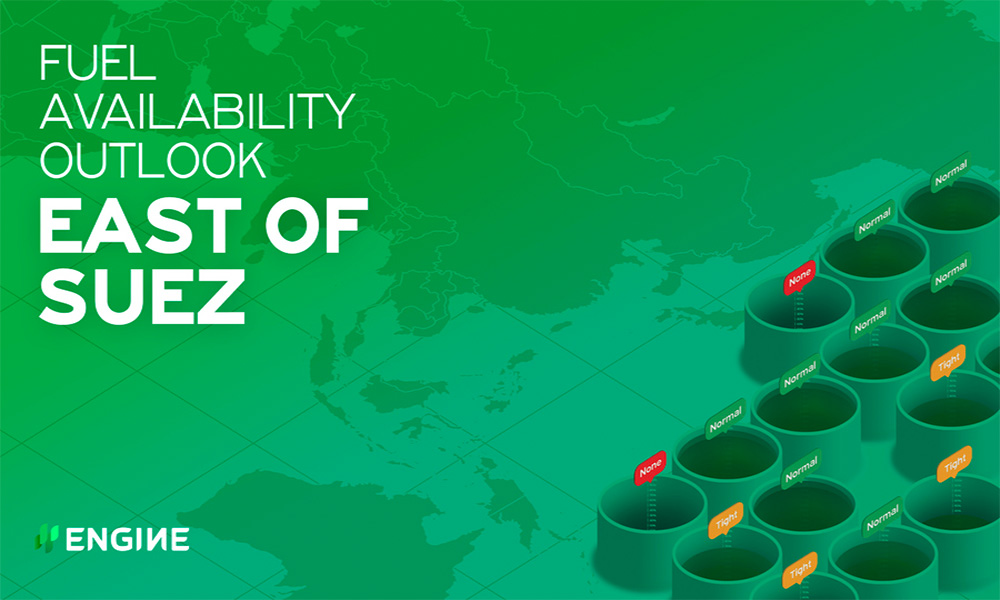
ENGINE: East of Suez Bunker Fuel Availability Outlook (26 Nov 2024)

Bunker demand is low in Singapore; LSMGO supply is good across several Japanese ports; VLSFO and LSMGO availability is good in Oceanic ports.

Admin

Published

on

RESIZED ENGINE East of Suez

The following article regarding regional bunker fuel availability outlook for the East of Suez region has been provided by online marine fuels procurement platform ENGINE for publication on Singapore bunkering publication Manifold Times:
  • Bunker demand is low in Singapore
  • LSMGO supply is good across several Japanese ports
  • VLSFO and LSMGO availability is good in Oceanic ports

Singapore and Malaysia

Bunker demand in Singapore has been quiet so far this week, according to a source. Most suppliers are recommending lead times of about 10 days for VLSFO, although some can accommodate deliveries in as little as two days, typically at a higher price than those with longer lead times.

HSFO supply remains tight, with lead times of 8-13 days, unchanged from last week. LSMGO supply has improved, with lead times dropping from 4-9 days last week to 2-6 days now.

Singapore’s residual fuel oil stocks have remained roughly steady compared to October levels, according to Enterprise Singapore. However, Singapore’s fuel oil stocks have fallen below 18 million bbls, following a sharp 60% drop in the port’s net fuel oil imports this month. Both imports and exports have decreased, with imports falling by 3.98 million bbls—almost double the 1.76-million-bbl drop in exports. In contrast, Singapore’s middle distillate stocks have increased, averaging 3% higher so far this month.

At Malaysia’s Port Klang, VLSFO and LSMGO supplies are abundant, with some suppliers offering prompt delivery for smaller volumes, although HSFO availability remains tight.

East Asia

In Zhoushan, fuel availability remains steady, with several suppliers advising lead times of 5-7 days for VLSFO and 4-6 days for LSMGO and HSFO, similar to the previous week.

In Northern China, VLSFO and LSMGO supplies are abundant at Dalian and Qingdao ports, although HSFO availability is limited in Qingdao. Tianjin is facing tight supply across all fuel grades.

In Shanghai, LSMGO is readily available, but VLSFO and HSFO are in short supply. Fuzhou has good availability of VLSFO and LSMGO, while Xiamen sees good VLSFO supply but restricted LSMGO availability. In both Yangpu and Guangzhou, prompt availability of both grades remains limited.

In Hong Kong, recommended lead times remain consistent at seven days for all bunker grades. However, adverse weather conditions are expected from 26-28 November, which could disrupt bunker deliveries at the port.

In Taiwan’s ports—Hualien, Kaohsiung, and Keelung—VLSFO and LSMGO are readily available, with lead times remaining steady at two days, consistent with last week. In Taichung, lead times for both grades are slightly longer, at around 3-4 days.

Bunker demand in South Korean ports remains subdued due to higher bunker prices. On Tuesday, Busan’s VLSFO grade was priced $34/mt higher than Singapore’s and $23/mt higher than Hong Kong’s VLSFO.

Availability remains steady across South Korean ports, with most suppliers recommending lead times of 6-8 days for all grades. However, rough weather is forecasted from 26 November-1 December, which could potentially affect bunkering at ports including Ulsan, Onsan, Busan, Daesan, Taean, and Yeosu.

In Japan, LSMGO supply remains strong across major ports, including Tokyo, Chiba, Yokohama, Kawasaki, Osaka, Kobe, Sakai, Nagoya, Yokkaichi, Mizushima, and Oita. VLSFO supply is generally stable, while prompt deliveries are limited in Oita. Prompt HSFO availability is tight at Nagoya, Yokkaichi, Mizushima, and Oita, according to a source.

The Philippine port of Subic Bay is anticipating inclement weather from 27-30 November, which may disrupt bunkering operations. Similarly, adverse weather is expected to impact bunkering at the Thai ports of Koh Sichang and Leam Chabang during the same period.

Oceania

In Western Australia, VLSFO and LSMGO are available at the ports of Kwinana, Fremantle, and Kembla, with lead times typically ranging from 7-8 days. In New South Wales, Sydney has adequate LSMGO supplies, but HSFO may require longer lead times.

In Victoria, both Melbourne and Geelong have plentiful stocks of VLSFO and LSMGO, though prompt HSFO deliveries may be challenging. Queensland’s Brisbane and Gladstone ports report sufficient VLSFO and LSMGO with lead times of 7-8 days, but HSFO availability in Brisbane is limited.

In New Zealand, Tauranga and Auckland both have good supplies of VLSFO, with Auckland also having ample LSMGO stocks.

South Asia

VLSFO and LSMGO remain in limited supply at several Indian ports, including Kandla, Mumbai, Tuticorin, Chennai, and Cochin, as it has been in recent weeks. Supply of both grades are subject to availability in Visakhapatnam and Haldia, while a supplier in Paradip is nearly out of stock.

Intermittent adverse weather conditions are forecasted for 27-30 November in the port of Visakhapatnam, which could disrupt bunker operations there.

The India Meteorological Department (IMD) forecasts a deep depression over the southeast Bay of Bengal and East Equatorial Indian Ocean within 24 hours, bringing heavy to very heavy rainfall to Chennai and Puducherry from 25-27 November. Wind speeds may reach 40 mph between 25-26 November.

Kakinada Port Authority has advised that vessel operations could be suspended from 26-29 November if wind speeds exceed 25 knots. Vessels are advised to keep engines ready for operations, monitor weather updates, and adhere to all safety guidelines, according to GAC Hot Port News.

In contrast, Sri Lanka’s ports of Colombo and Hambantota availability is good for VLSFO, LSMGO, and HSFO, with lead times of around seven days.

Adverse weather is forecast for the Sri Lankan port of Colombo from 26-27 November, which may affect bunker deliveries.

Middle East

Prompt availability in Fujairah remains tight, with lead times for all grades around 5-7 days, consistent with last week. Similarly, suppliers in Khor Fakkan are recommending lead times of 5-7 days for all grades.

In contrast, Saudi Arabia’s Jeddah port has sufficient supplies of both VLSFO and LSMGO. Djibouti continues to experience VLSFO shortages, while LSMGO is more readily available. Omani ports, including Sohar, Salalah, Muscat and Duqm have ample LSMGO supplies with prompt delivery options.

By Tuhin Roy


Photo credit and source: ENGINE
Published: 27 November 2024

Continue Reading

Biofuel

South Korea: S-Oil launches B30-VLSFO bio bunker fuel supply

Company says it has established an integrated operating system in the Ulsan region covering the entire value chain, from feedstock procurement and blending to supply.

Admin

Published

on

By

South Korea: S-Oil launches B30-VLSFO bio bunker fuel supply

South Korean petroleum and refining company S-Oil on Wednesday (22 July) said it has started supplying B30 very low sulphur fuel oil (VLSFO), as the company seeks to support shipping’s decarbonisation efforts and growing demand for lower-carbon bunker fuels.

The company said its B30 VLSFO contains 30% sustainable biofuel blended with conventional VLSFO and can be used without requiring modifications to existing vessels, enabling shipowners to comply more readily with emissions regulations from the International Maritime Organization (IMO) and the European Union (EU).

S-Oil said it has established an integrated operating system in the Ulsan region covering the entire value chain, from feedstock procurement and blending to supply. The system combines VLSFO produced at its Onsan refinery with biofuel production facilities and storage infrastructure in the Ulsan region, allowing the entire process to be carried out within a single logistics hub.

According to the company, the integrated supply chain reduces transportation requirements during production while improving supply efficiency and reliability.

S-Oil also highlighted Ulsan Port as a strategic location for marine biofuel supply, noting the port has strong demand for bio-bunker fuels, particularly from car carriers, enabling prompt and stable deliveries to key customers.

An S-Oil official stated: “In the bio-marine fuel market, not only product quality but also securing a stable supply of raw materials and an efficient supply system are important competitive advantages.

“Based on our existing bunkering business capabilities and the excellent supply infrastructure in the Onsan area, we plan to supply stable and competitive low-carbon fuel.”


Photo credit: S-Oil
Published: 23 July, 2026

Continue Reading

Bunker Fuel

Panama bunker fuel sales drops by 10.7% on year in June 2026

Total bunker sales at Panama was 385,100 metric tonnes (mt) in June 2026, compared to sales of 431,147 mt during the similar period in 2025.

Admin

Published

on

By

RESIZED jhernandezb05 from Pixabay

Bunker fuel sales at Panama dropped by 11% in June 2026, according to the latest data from La Autoridad Maritima de Panama, also known as the Panama Maritime Authority (PMA).

Total bunker sales at Panama was 385,100 metric tonnes (mt) in June 2026, compared to sales of 431,147 mt during the similar period in 2025.

In June 2026, the Pacific side of Panama posted bunker sales of 311,400 mt; 185,483 mt of VLSFO, 94,997 mt of RMG 380, 2,722 mt for marine gas oil (MGO), and 28,198 mt of low sulphur marine gas oil (LSMGO) were delivered.

The similar region saw total marine sales of 349,996 mt a year before in June; with VLSFO sales at 206,144 mt, RMG 380 sales at 109,432 mt, MGO sales at 3,043 mt, and 31,377 mt of LSMGO being sold.

Panama’s Atlantic side, meanwhile, recorded total bunker fuel sales of 73,700 during June 2026; the figure comprised 62,169 mt of VLSFO, 382 mt of RMG 380, 3,039 mt of MGO, and 8,110 mt of LSMGO.

It saw total sales of 81,151 mt in June a year before; with VLSFO sales of 60,932 mt, RMG 380 sales of 8,335 mt, 2,935 mt of MGO, and LSMGO sales of 8,949 mt.


Photo credit: jhernandezb05 from Pixabay
Published: 23 July, 2026

Continue Reading

Bunker Fuel

Antwerp-Bruges biofuel bunker sales drops 36% on year in Q2 2026, LNG down 13.4%

Biofuel recorded 26,833 mt in Q2 2026 with 41,939 mt recorded in the same period the year before while port data showed 76,513 mt of LNG being delivered in Q2 2026, down from 88,328 mt.

Admin

Published

on

By

Port of Antwerp-Bruges, Deurganck Dock

The Port of Antwerp-Bruges recently published bunker fuel sales data for the second quarter (Q2) of 2026.

Total bunker sales at the port was 2.05 million metric tonnes (mt) in Q2 2026, compared to sales of 1.99 million mt (+3%) during the similar period in 2025.

Deliveries of ultra low sulphur fuel oil, very low sulphur fuel oil, high sulphur fuel oil and marine gas oil in Q2 2026 (against on year) recorded respectively 164,987 mt (+43.6%  from 114,917 mt), 537,926 mt (+12.8% from 476,746 mt), 659,182 mt (+11.6% from 590,544 mt) and 366,329 (-15.7% from 434,766 mt).

Biofuel recorded 26,833 mt in Q2 2026 with 41,939 mt (-36%) recorded in the same period the year before. 

Port data showed 76,513 mt of liquefied natural gas (LNG) being delivered as a marine fuel in Q2 2026, down by 13.4% from 88,328 mt in Q2 2025. Meanwhile, there has been no deliveries of methanol at the port for the year so far.

Related: Antwerp-Bruges biofuel bunker sales plunge 50.6% on year in Q1 2026, LNG soars 214%


Photo credit: Port of Antwerp-Bruges
Published: 23 July, 2026

Continue Reading

Trending