Connect with us

Technology

SMW 2024: MPA partners with S&P Global and Bunkerchain in digital ship identity

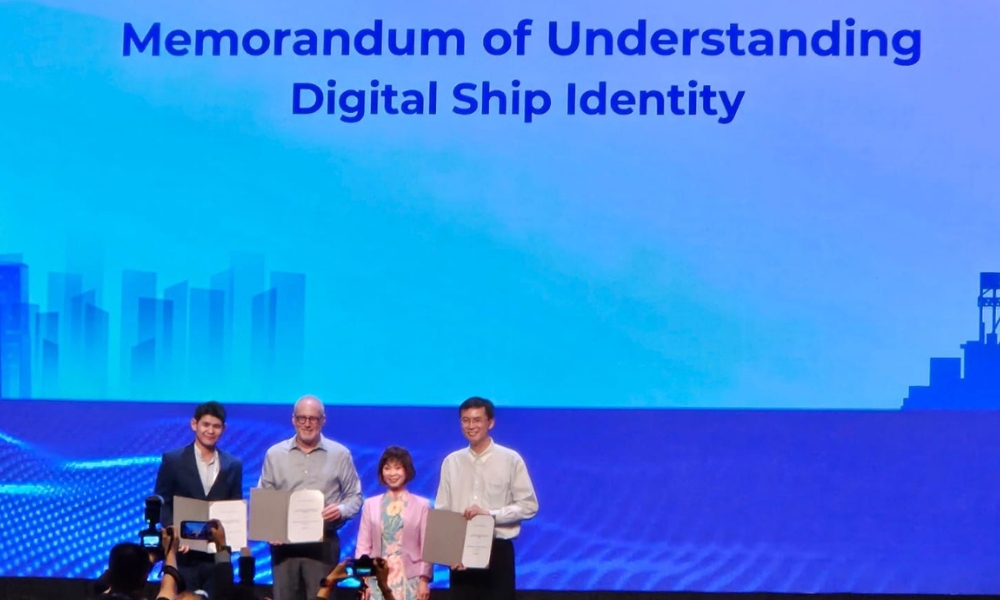
MPA signed a MoU with S&P Global and Bunkerchain to use Singapore as test bed to trial and pilot use of digital ship identity in maritime applications such as digital port clearance and digital bunkering.

Admin

Published

on

SMW 2024: MPA partners with S&P Global and Bunkerchain in digital ship identity

The Maritime and Port Authority of Singapore (MPA) on Tuesday (16 April) announced it signed a Memorandum of Understanding (MoU) with S&P Global Market Intelligence and Bunkerchain to pilot the use of digital ship identity in the republic. 

The signing took place at the ‘Accelerating Digitalisation and Decarbonisation Conference’ at Singapore Maritime Week (SMW) on the same day.

The parties agreed to use the Port of Singapore as the test bed to trial and pilot the use of digital ship identity in maritime applications such as digital port clearance and digital bunkering.

Digital identity refers to the unique representation of an entity in the digital world, which consists of various attributes and data that distinguishes it from others.

“Electronic transactions may be vulnerable to various risks as such identity fraud and data integrity breaches,” MPA said.

“Digital ship identity plays a crucial role in making electronic transactions more secure, trusted, and efficient in the maritime sector. When deployed in tandem with electronic signatures, these digital technologies will eliminate the need for physical ship stamps and wet ink signatures, and accelerate the transition towards a truly digital, secure, and paperless operations.”

MPA, together with Esri Singapore, the Agency for Science, Technology and Research’s Institute of High Performance Computing and the Technology Centre for Offshore and Marine, Singapore, also developed a digital twin proof-of-concept of a methanol bunkering leak incident. 

“The digital twin runs on an interactive web application that integrates weather and ocean current predictions and AIS data to present visualisation of chemical plume dispersions in the event of a bunkering incident involving alternative fuels,” it said.  

“The capability can help enhance planners’ understanding of the behaviour of the plume clouds under various conditions and guide the development of safety and incident response plans and standards.”

The port authority also announced a collaboration with Amazon Web Services (AWS), an Amazon.com company, to support the maritime industry’s digital transformation and green transition. 

MPA will tap on AWS services including cloud, artificial intelligence (AI), and digital twins to enhance the industry’s efficiency, safety, and sustainability outcomes. 

As part of the collaboration, MPA and AWS will develop the maritime Artificial Intelligence and Machine Learning (AI–ML) Digital Hub, the first-of-its-kind in ASEAN region. 

The AI–ML Digital Hub will leverage AWS cloud to enable the maritime industry to pilot innovative AI and generative AI (GenAI) capabilities to trial on the Green and Digital Shipping Corridors, optimising routes and fuel consumption, carbon emissions accounting, and just-in-time arrivals to help ships operate more efficiently, reduce greenhouse gases emissions, and enhance safety of operations.

A memorandum of understanding was signed between Mr David Foo, Assistant Chief Executive (Operations Technology), MPA and Ms Elsie Tan, Country Manager, Worldwide Public Sector, Singapore, AWS.

Related: SMW2024: 18th Singapore Maritime Week opens with ‘Actions meet Ambition’ theme
Related: SMW 2024: MPA to set up facility for maritime workforce to train in handling new bunker fuels
Related: SMW 2024: Singapore-Rotterdam Green and Digital Shipping Corridor partners to implement first-mover pilot projects


Photo credit: Bunkerchain
Published: 16 April 2024

Continue Reading

Milestone

GCMD: Project CAPTURED achieves two regulatory milestones for onboard captured CO2

CO2 captured onboard during the project has been formally recognised for compliance under the EU ETS while a proposal submitted to MEPC 84, based on the project, has received IMO’s in-principle support.

Admin

Published

on

By

RESIZED venti views

Global Centre for Maritime Decarbonisation (GCMD) on Wednesday (21 July) said Project CAPTURED has achieved two regulatory milestones that strengthen the commercial case for onboard carbon capture and storage (OCCS).

This comes following its world’s first demonstration of an end-to-end value chain for onboard captured and liquefied CO2 (LCO2).

Completed in June 2025, the pilot showed that CO2 captured onboard a vessel can be offloaded ship-to-ship, transported overland and permanently bound through carbon mineralisation—a process that converts captured CO₂ into stable materials for industrial use.

The CO2 captured onboard during Project CAPTURED has been formally recognised for compliance under the European Union Emissions Trading System (EU ETS). This means the verified tonnage of captured CO2 can be deducted from emissions requiring the surrender of EU Allowances (EUAs).

To qualify for this recognition, the CO2 must be chemically bound permanently in eligible products. Project CAPTURED demonstrated that CO2 captured onboard vessels can meet this requirement through carbon mineralisation.

The data and learnings from the same demonstration formed the basis of a proposal submitted to MEPC 84. This proposal received in-principle support from the International Maritime Organization (IMO) for recognising carbon mineralisation as a form of permanent CO₂ storage.

Complementing geological sequestration, which is already accepted by the IMO, this recognition broadens the downstream options for CO2 captured onboard vessels, and supports the development of maritime carbon value chains. Beyond providing a permanent storage pathway, carbon mineralisation also creates the potential for captured CO2 to serve not only as a waste stream requiring permanent storage, but also as a feedstock for industrial applications through carbon mineralisation, extending emissions reductions beyond the shipping value chain.

Professor Lynn Loo, CEO, GCMD, said, “Project CAPTURED has moved OCCS beyond technical demonstration. The acceptance of the EU ETS deduction gives captured CO₂ a compliance value. At the same time, IMO’s in-principle support for carbon mineralisation will help clarify how captured CO2 can be treated after it leaves the vessel. Together, these milestones turn a pilot into a verified reference case for maritime carbon logistics, one that links regulatory recognition, commercial value and emissions impact.”


Photo credit: Venti Views on Unsplash
Published: 22 July, 2026

Continue Reading

Technology

Singapore: Ofiniti, ONE trial direct platform integration to streamline bunker workflows

Ofiniti started a trial in Singapore, integrating FuelBoss directly with a bunker buyer’s own platform, with Ocean Network Express as its first buyer-side integration partner.

Admin

Published

on

By

Singapore: Ofiniti, ONE trial direct platform integration to streamline bunker workflows

Ofiniti, the digital platform for maritime fuel operations, on Tuesday (21 July) said it has started a trial in Singapore, integrating FuelBoss directly with a bunker buyer’s own platform.

The company announced Singapore-headquartered container shipping firm Ocean Network Express (ONE) as its first buyer-side integration partner. 

“It is no coincidence we start in Singapore, as the Maritime and Port Authority of Singapore (MPA) remains at the forefront of digitalisation of all things bunkering,” the company said in a social media post.

In November 2023, MPA launched its digital bunkering platform, becoming the world’s first port to implement e-BDN. 

Ofiniti said every bunker delivery still runs on retyped data. 

“The buyer’s system says one thing, the supplier says another, and someone reconciles the gap by email, phone, or PDF. On every stem,” the company said. 

“We built FuelBoss to change this reality.”

With the integration, operational data now flows without manual re-entry, fewer reconciliation errors and faster processing and data, instead of documents, are readily available for procurement and claims workflows. 

“One connection will not transform the industry on its own, but digitalisation gets built one integration at a time. We are grateful to ONE for being willing to go first,” Ofiniti added.

Manifold Times previously reported ONE completing its successful trial of the electronic Bunker Delivery Note (e-BDN) with Shell. 

The e-BDN trial, using the digital bunkering solution developed by Angsana Technology, was conducted on 9 September 2023 at the Port of Singapore, with support from the MPA.

In March 2025, Ofiniti acquired Singapore-based Angsana Technology, with the entire Angsana team joining Ofiniti as part of the acquisition.

Related: MPA Chief Executive: Port of Singapore begins digital bunkering initiative today
Related: Singapore set to become first port in the world to debut electronic bunker delivery notes
Related: ONE completes e-BDN adoption trial with Shell in Port of Singapore
Related: Ofiniti acquires Singapore-based Angsana Technology to advance digital bunkering solutions


Photo credit: Ofiniti
Published: 22 July, 2026

Continue Reading

Technology

Genevos and Koedood Marine Group team up on maritime hydrogen fuel cell deployment

Collaboration will explore how ready-to-use marine fuel cell systems can support shipowners and shipyards in the transition towards zero-emission operations.

Admin

Published

on

By

Genevos and Koedood Marine Group team up on maritime hydrogen fuel cell deployment

Marine fuel cell systems provider Genevos recently said the company signed a Letter of Intent (LOI) with engine supplier Koedood Marine Group to explore the deployment of hydrogen fuel cell systems for inland and coastal maritime transport. 

The LOI was signed by Phil Sharp, co-founder and CTO of Genevos, and Mühlheim, Business Development Director of Koedood Marine Group during the 2026 Advanced Maritime Technology Show in Amsterdam.

Building on Koedood’s proven experience in hydrogen maritime projects – including its ongoing work with Mitsubishi Heavy Industries and TNO on hydrogen engine development – the collaboration will explore how ready-to-use marine fuel cell systems can support shipowners and shipyards in the transition towards zero-emission operations. 

“Koedood has a strong reputation in the maritime sector and a deep understanding of vessel operators’ needs. This LOI is an important step in exploring how Genevos’ hydrogen fuel cell systems can be deployed more widely across inland and maritime applications, helping shipowners reduce onboard emissions with robust, practical and scalable clean power solutions,” said Sharp.

The collaboration aligns with growing market demand for rapidly deployable hydrogen solutions and the wider need to accelerate the adoption of zero-emission technologies across the maritime sector. 

“With this collaboration, we are further strengthening our portfolio of maritime energy solutions. Together with Genevos, we are exploring how we can support our customers in the adoption of hydrogen technology,” said Mühlheim.


Photo credit: Genevos
Published: 20 July, 2026

Continue Reading

Trending