
Business
FuelTrust: Early warning is the best protection against contaminated bunkers
Digital early warning system – combining AI and blockchain technologies – could have helped reduce risks in Singapore bunker contamination case, says Jonathan Arneault, CEO of FuelTrust.

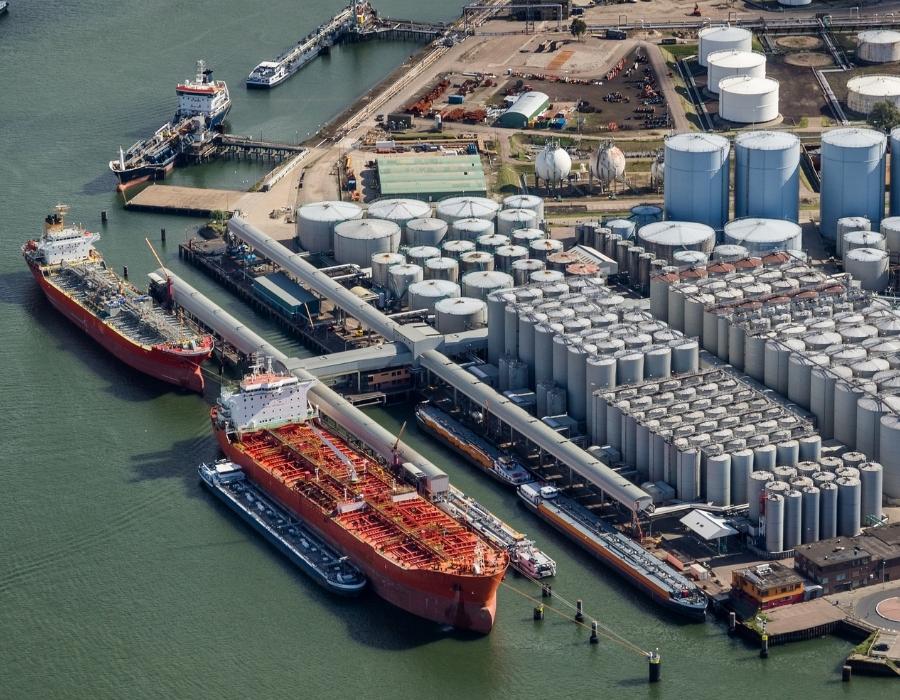
In an exclusive article shared with Manifold Times, Jonathan Arneault, CEO of FuelTrust, a startup company using blockchain and AI to trace the provenance of marine fuels, shares on how a digital early warning system can help protect against contaminated bunkers and warn buyers and suppliers of possible risks before the fuel is bunkered.
The Singapore contamination earlier this year affected hundreds of ships, caused millions of dollar in damages and – like the Houston fuel contamination in 2018 – will most likey result in legal actions for year to come.
The cause of this disruption has been attributed to a batch of high sulphur fuel oil, containing unacceptable concentration levels of chlorinated organic compounds. Unfortunately current ISO 8217 testing methods are not enough to have detected the contaminates in either the Singapore or Houston incidents.

Far reaching costs
Beyond the price of the fuel itself, widespread contamination comes at a big cost. Insurance claims for disruption to cargo delivery and damage to machinery alone could easily run to hundreds of millions of dollars. There are also the costs that shipowners and operators must bear for repairs, vessels out of operation while being fixed and potential penalties for failing to meet contractual agreements. Moreover, a single batch of bad fuel can cause long-term reputational damage to the fuel suppliers involved.
Ship operators are typically advised to avoid taking on contaminated bunkers by selecting suppliers carefully, performing additional tests on bunkers and checking the details of bunker supply contracts in case there is a time limit for giving notice of quality issues. This is good advice for helping to mitigate risks, but it is far from foolproof, and it does not take into account the commercial time pressures operators face.
Tracking and analysing the transactions that a batch of fuel goes through to reach the bunker terminal using digital technology can help protect against these major risks, and warn buyers and suppliers of possible risks before the fuel is bunkered. This digital early warning system can also fit in with the commercial timelines of vessel operators and fuel suppliers alike.
Shared data and insight
Access to the content, history and expected performance of bunker fuel prior to sale or bunkering, allows suppliers and shipowners to reduce their operational and financial risks. Suppliers, in particular, can spread these benefits across their customers. In Singapore, a GCMS (Gas chromatography–mass spectrometry) test would have revealed the presence of the organic chlorides causing the fuel contamination. A digital early warning system, combining AI and blockchain technologies, could have helped reduce the risks in this case, by providing a record of the GCMS lab analysis of the supplier storage fuel tanks.
Importantly, these digital technologies work together. Blockchain technology is used to establish a digital record of a batch of fuel throughout its lifecycle, and to allow suppliers to grant data access only to parties that need the information. Recording information using blockchain technology provides a single source of truth for the fuel lifecycle. AI technology is used to analyse the data held in the blockchain and to identify chemical risk, providing an early warning to ship owners and bunker suppliers based on these insights.
Recording data from the fuel lifecycle using blockchain-based technology provides data security through encryption and permissioned transparency, allowing suppliers to only share this information with their commercial partners – building transparency and trust, but not at the cost of competitiveness.
Digital technology also allows operators and suppliers to receive alerts when AI algorithms detect anomalies or non-compliant fuels before they are bunkered, saving suppliers and shipowners from reputational, operational and commercial damage. Using AI and blockchain technologies requires no hardware or manual resources, meaning these insights can be made available at very low cost – just a few pennies per barrel.
While the scope of the recent incidents in Singapore again brought attention to the persistent, global issue of fuel contamination, fuel quality problems cause debunkering issues every month in ports around the world – most of which never make the news. At FuelTrust, we have developed a digital solution that delivers trusted transparency for the bunker industry, and provides the early warning indicators to alleviate the types of fuel contamination issues that cost the sector hundreds of millions of dollars.
Photo credit: FuelTrust
Published: 15 September, 2022
Alternative Fuels
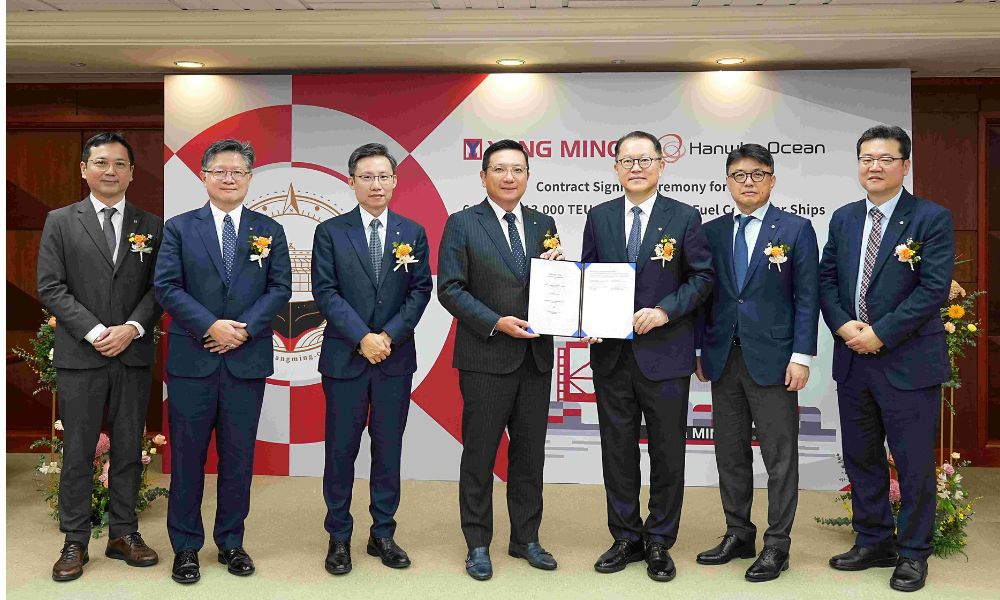
Yang Ming orders six LNG dual-fuel, ammonia-ready containerships from Hanwha Ocean
Each of the six new vessels will have a capacity of up to 13,650 TEU and feature LNG dual-fuel propulsion and Ammonia Fuel Ready specifications.
Alternative Fuels
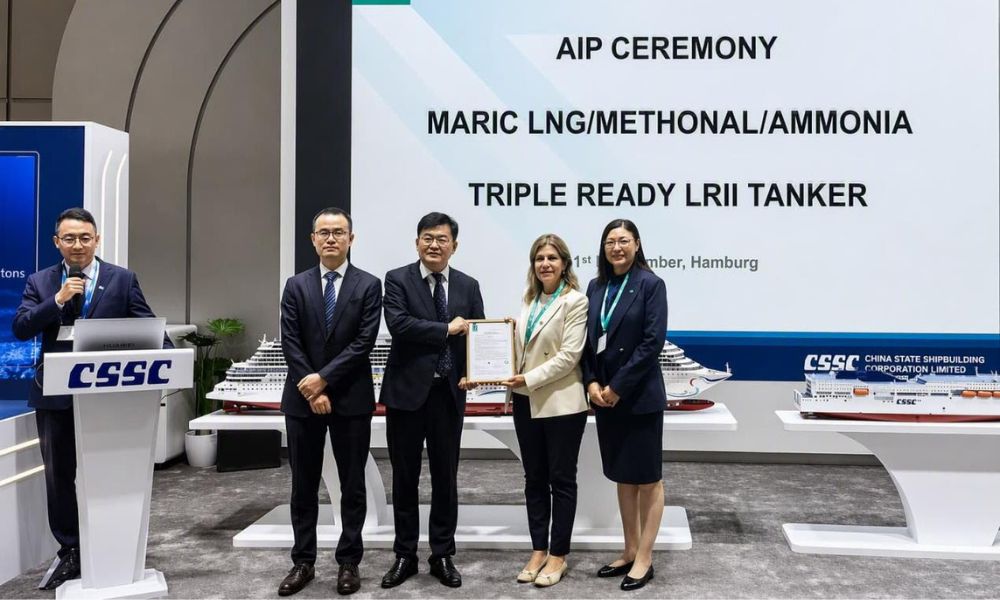
LR, China’s MARIC unveil tanker concept ready for three future bunker fuels
Both secured AiP for a new 114,000 DWT product and crude oil tanker designed to accommodate future conversion to LNG, methanol or ammonia.
Alternative Fuels
DNV: Alternative-fuelled vessel orders hit highest monthly level since October 2024
LNG-fuelled vessels accounted for the vast majority of August activity while the strong summer performance marked a significant acceleration in ordering activity after a relatively slow start to the year.
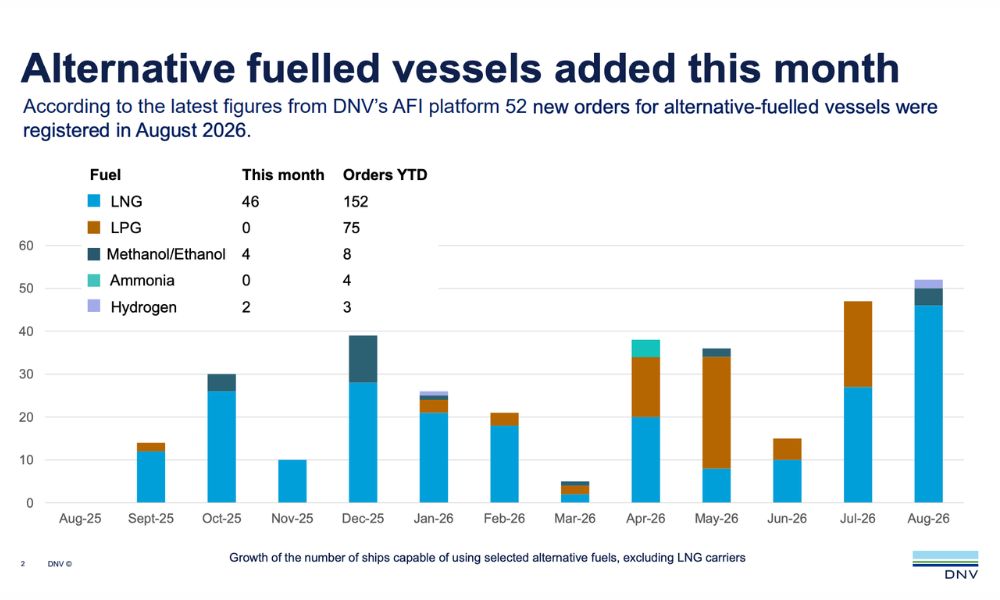
Latest data from classification society DNV’s Alternative Fuels Insight (AFI) platform alternative-fuelled vessel ordering was strong in August, with 52 new vessels added to the platform.
This is the highest monthly total since October 2024 and follows another active month in July, when 47 vessels were added to the database.
LNG-fuelled vessels accounted for the vast majority of August activity, with 46 orders recorded. The container segment led the way with 30 orders, while the car carrier segment contributed a further 12 LNG-fuelled vessels. In addition, four ethanol-fuelled bulk carriers and two hydrogen-powered bulk carriers were added during the month, as well as one LNG bunker vessel.
The strong summer performance marked a significant acceleration in ordering activity after a relatively slow start to the year. In total, 242 alternative-fuelled vessel orders have been placed in the first eight months of 2026, representing a 27% increase compared with the same period in 2025.
LNG remains the dominant fuel choice, accounting for 63% of all alternative-fuelled vessel orders registered so far this year. Container vessels represent the largest share of these LNG orders (59%), followed by car carriers (30%).
Jason Stefanatos, Global Decarbonization Director at DNV Maritime, said: “The past two months have been particularly strong for alternative-fuelled vessel ordering, with August recording the highest monthly total we’ve seen since October 2024. This has helped lift year-to-date orders to a level well above the same period last year.
“LNG remains the leading fuel choice, driven largely by activity in the container and car carrier segments. These sectors have been among the earliest adopters of alternative fuels, supported by predictable liner operations and increasing demand from cargo owners to reduce emissions across supply chains.
“For many owners, LNG offers a combination of emissions reductions, fuel availability and future flexibility while the longer-term fuel landscape continues to evolve.
“At the same time, the latest figures include orders for ethanol- and hydrogen-fuelled vessels, highlighting that owners continue to explore a range of decarbonization pathways. Different segments are making different fuel choices, but the overall level of activity demonstrates continued investment in lower-emission shipping.”
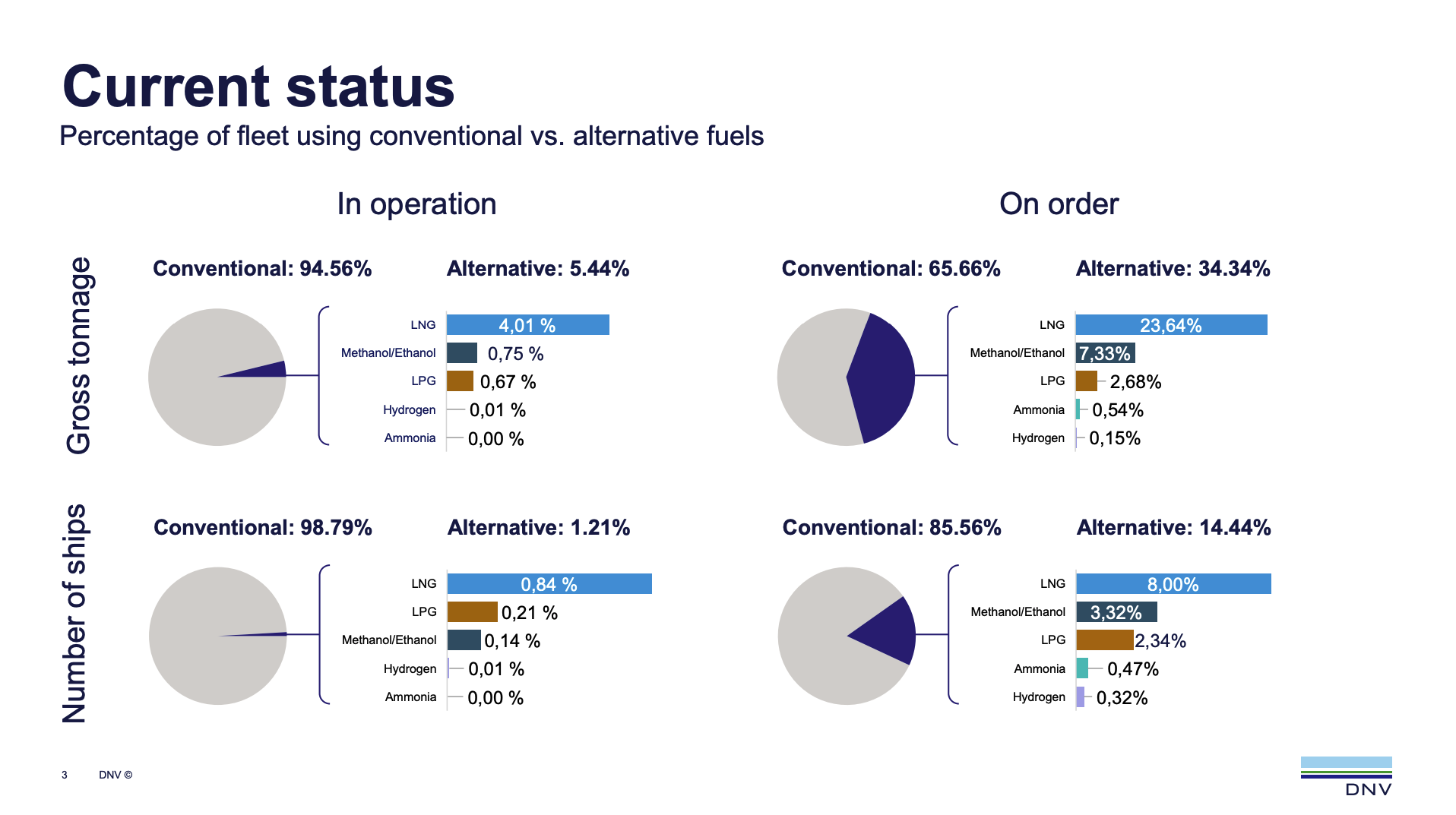
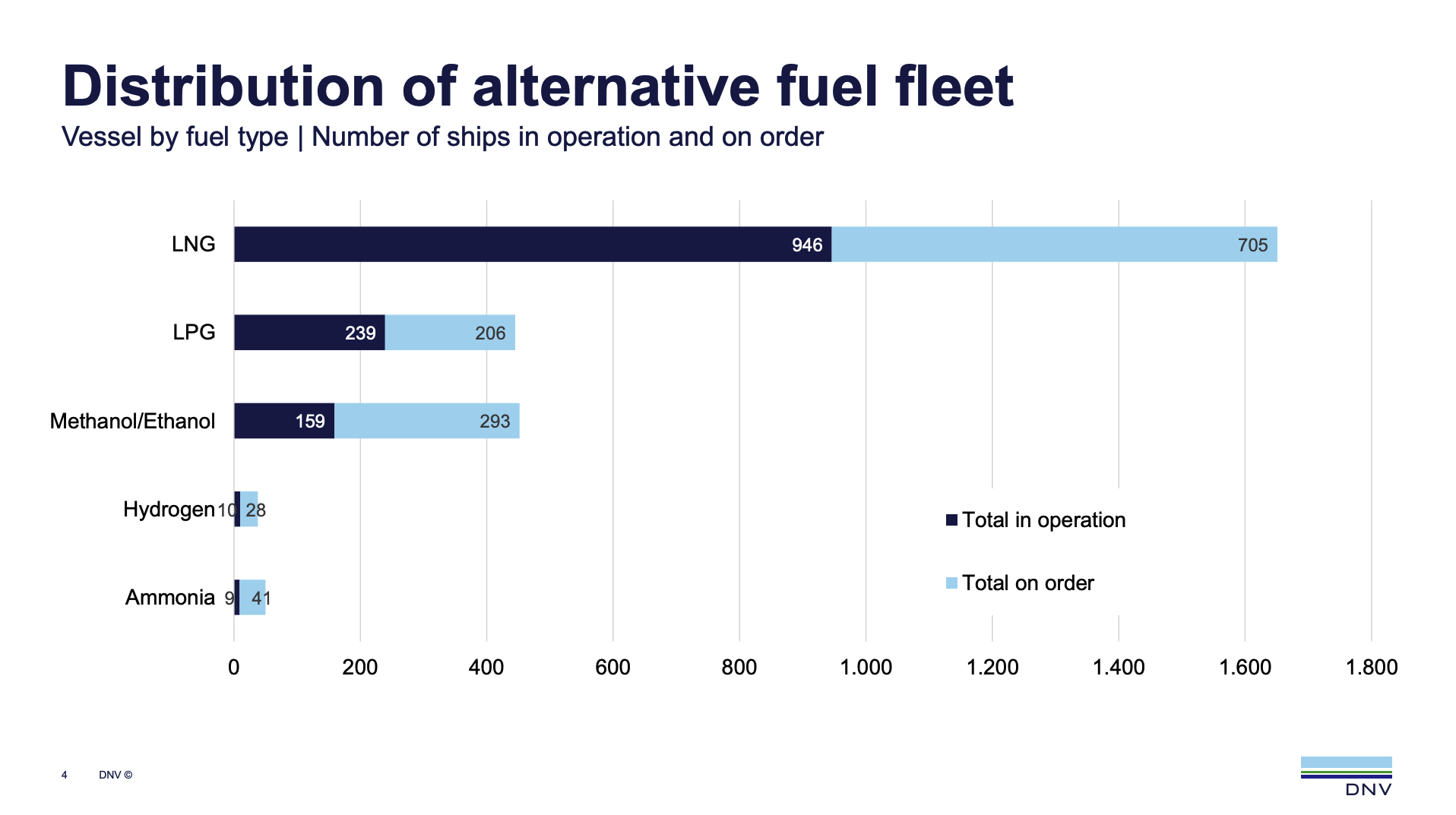
Photo credit: DNV
Published: 4 September, 2026

OUR INDUSTRY PARTNERS

Yang Ming orders six LNG dual-fuel, ammonia-ready containerships from Hanwha Ocean

LR, China’s MARIC unveil tanker concept ready for three future bunker fuels

DNV: Alternative-fuelled vessel orders hit highest monthly level since October 2024

TFG Marine advances global MFM rollout with two US Gulf bunker barges

GENA Solutions: Total renewable and low-carbon methanol project pipeline increases from 61.8 to 62.2 Mt by 2032

Baltic Exchange: Bunker Report (3 September 2026)

ENGINE: Americas Fuel Availability Outlook (3 September 2026)

Singapore-flagged tugboat “Kim Heng 3203” placed under Sheriff’s arrest

US targets five bunker companies in latest sanctions campaign against Iran

Singapore bunkering community supports Living Hope Evangelism’s 7th anniversary outreach for residents in need

China’s bunker market reshaped by tax rebates, trade flows and refining changes, says economist

Hengli Petrochemical’s ex-Singapore trading arm faces winding up application

Rajah & Tann: Bunker disputes are won in the first 48 hours

Report: GCMD outlines practical approach to quantity assurance in marine biofuel supply chains
-
 Vessel Arrest2 weeks ago
Singapore-flagged tugboat “Kim Heng 3203” placed under Sheriff’s arrest
-
 Sanctions2 weeks ago
US targets five bunker companies in latest sanctions campaign against Iran
-
 Events2 weeks ago
Singapore bunkering community supports Living Hope Evangelism’s 7th anniversary outreach for residents in need
-
 Interview1 week ago
China’s bunker market reshaped by tax rebates, trade flows and refining changes, says economist
-
 Winding up2 weeks ago
Hengli Petrochemical’s ex-Singapore trading arm faces winding up application
-
 Bunker Claim5 days ago
Rajah & Tann: Bunker disputes are won in the first 48 hours
-
 Biofuel2 weeks ago
Report: GCMD outlines practical approach to quantity assurance in marine biofuel supply chains
-

 Winding up1 week ago
Singapore: Notices of annual meeting issued for Vroon Shipping Asia and related firms