
Analysis
Singapore logistics tech start-up Portcast receives USD 3.2 million in Pre-Series A funding
Pre-Series A financing led by Newtown Partners with participation from Wavemaker Partners, TMV and Innoport, joining existing investors SGInnovate and others.


Singapore-based logistics tech start-up, Portcast which aims to improve supply chain profitability by accurately predicting cargo flows, on Tuesday (7 September) said it has completed USD 3.2 million (SGD 4.3 million) Pre-Series A financing.
The development was led by Newtown Partners (via the Imperial Venture Fund) with participation from Wavemaker Partners, TMV and Innoport, who join existing investors SGInnovate, among others.
The capital will go towards international expansion, doubling the team size and product enhancement, in particular, moving from predictive Artificial Intelligence (AI) to prescriptive AI and launching new product features such as order-level visibility and scenario planning.
The Singapore-based company enables freight forwarders and manufacturers across the world to achieve real-time visibility, reduce operational costs and improve customer experience, thereby improving profit margins.
It does this by accurately predicting the estimated time of arrivals of more than 90% of ships globally and forecasting demand for over 30,000 trade routes (both air and sea) daily through an intuitive SaaS platform and APIs.
“Global supply chains are under extreme pressure with record delays, unprecedented congestion at ports and constrained capacities. This has led to ridiculously high transportation costs which are being transferred to the end consumer yet service reliability remains low,” says Nidhi Gupta, CEO and Co-Founder of Portcast.
“We believe that companies with predictive visibility on cargo movements have a significantly higher preparedness to downstream planning and customer service, and we have already seen the impact of this with reductions in overall port fees by 20% and manual work by 80% for our customers.”
During her 10 years in the logistics industry in senior leadership roles, Gupta realised the critical importance (and absence) of technology in logistics to enable efficiency. This led her to set up Portcast with her co-founder, Dr. Lingxiao Xia, to transform global shipping – an industry still lagging in digitisation and sustainability.
Since its launch in 2018, Portcast has already amassed an impressive list of freight forwarding and manufacturing customers across the world and predicts over 300,000 shipment events daily.
“The cloud-based technology has the ability to map out the cascading effects of disruptions such as Typhoon In-fa and the Suez Canal congestion, allowing forwarders and shippers to respond and react more effectively in such scenarios,” adds Gupta.
“Portcast has proven its technology not just in the long-haul routes, but also in multi-port voyages and emerging economies, which are harder to predict. We believe the technology has global replicability in automating logistics workflows and digitisation. This aligns with our vision of backing innovative logistics startups and creates synergies in the European and African trading routes”, says Llew Claasen, Managing Partner at Newtown Partners.
Portcast believes that logistics digitisation is at an inflection point. Gartner reports that 50% of product-centric supply-chains will invest in real-time transportation visibility platforms by 2023.
It becomes crucial to not only bring visibility, but also intuitive explainability and scenarios that allow operators to decide what actions to take. This is exactly where the next features of Portcast are being developed.
“Global supply chains create a massive opportunity for big data and machine learning to help optimise procurement and pricing and provide better customer service to consumers,” said Roger Crook, Former CEO of DHL Global Forwarding, Freight and Chairman of Portcast.
“Portcast’s technology will help manufacturers and freight forwarders take advantage of this data, improve delivery times and, ultimately, their own competitiveness.”

Photo credit: Portcast
Published: 9 September, 2021
Bunker Fuel
Alkagesta highlights key insights on European choke point pressures in August
Update covers dual supply crisis currently shaping global bunker markets — a stalled Strait of Hormuz peace process and Rhine water levels at a 140-year record low — and the implications for Singapore.
Bunker Fuel
Integr8 Fuels: Why bunker markets could be lower than we thought
Marine fuel prices could prove lower than previously anticipated as easing refinery margins and improving bunker market fundamentals outweigh a still-uncertain crude oil outlook, says Integr8 Fuels.
By Steve Christy, Expert Contributor, Integr8 Fuels
29 July 2026
We have just seen one false dawn, is there another to come?
Last month, we wrote about how close we were to the expected lows in Brent and Rotterdam bunker prices, but not yet Singapore. Given what has happened since, a month is not only a long time in politics, but also a very long time in the bunker market.
There was a resumption of attacks in the Arabian Gulf region on 13 July, followed by targeted Houthi attacks on Saudi Arabia’s Red Sea oil infrastructure and shipping in the Bab el-Mandeb region, the gateway between the Red Sea and the Gulf of Aden. As a result, Brent futures fell to lows of around $70/bbl in late June and early July before surging to a high of $100/bbl on 23 July. Over the same period, Singapore VLSFO fell to $635/mt before climbing to $865/mt, a swing of $230/mt in just 16 days.
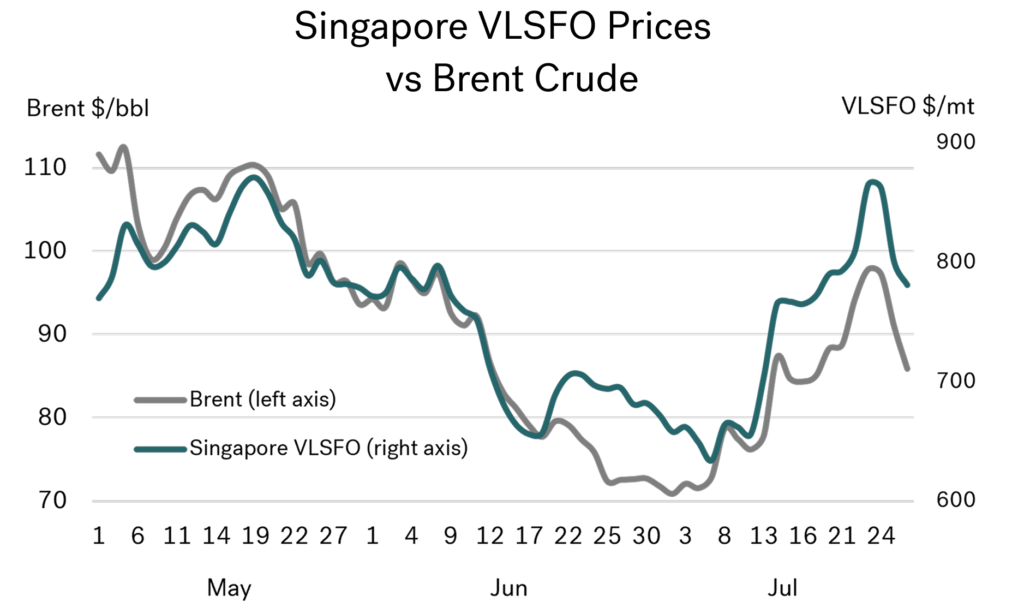
Prices at the start of this week fell sharply after a halt in Arabian Gulf attacks over the weekend, with front month Brent was down to intra-day lows of $84/bbl, and Singapore VLSFO $750/mt. However, at the time of writing there has been a ‘surprise’ attack by Iran, and retaliatory action by the US, with prices rising again. It looks like we could be at another false dawn.
The obvious questions are: will there be a return to peace negotiations, and are we close to the end of the war and free-flowing traffic through the strait of Hormuz (and also the Bab el-Mandeb)? The obvious answer is, we don’t know; there are only a few people that are likely to know the answer to this. All we can do is plan for every eventuality.
Low stocks, higher bunker prices, and a strong Singapore VLSFO premium: it’s a challenge
For those of us in the bunker market, the point we made last month about Singapore VLSFO trading at a strong premium to crude still holds, albeit slightly less pronounced. The loss of supplies through the Strait of Hormuz, together with the added uncertainty surrounding Saudi product exports from the Jizan and Rabigh refineries on the Red Sea, has sustained this premium.
These developments are likely to keep the Singapore VLSFO premium to crude at elevated levels until there is greater confidence that Middle East crude and product supplies are returning to more normal trading patterns. Amid all the price volatility, this Singapore VLSFO premium remains a key indicator to watch.
Backwardation in Brent futures illustrates market psychology
One month ago, backwardation in Brent futures (front month minus second month) had fallen from $7/bbl to virtually nothing, reflecting the market’s belief that an end to the war was little more than a negotiating step away. It wasn’t. The resumption of attacks, coupled with Houthi involvement in the Red Sea, sent prices sharply higher again, with backwardation in the Brent futures market returning to almost $6/bbl.
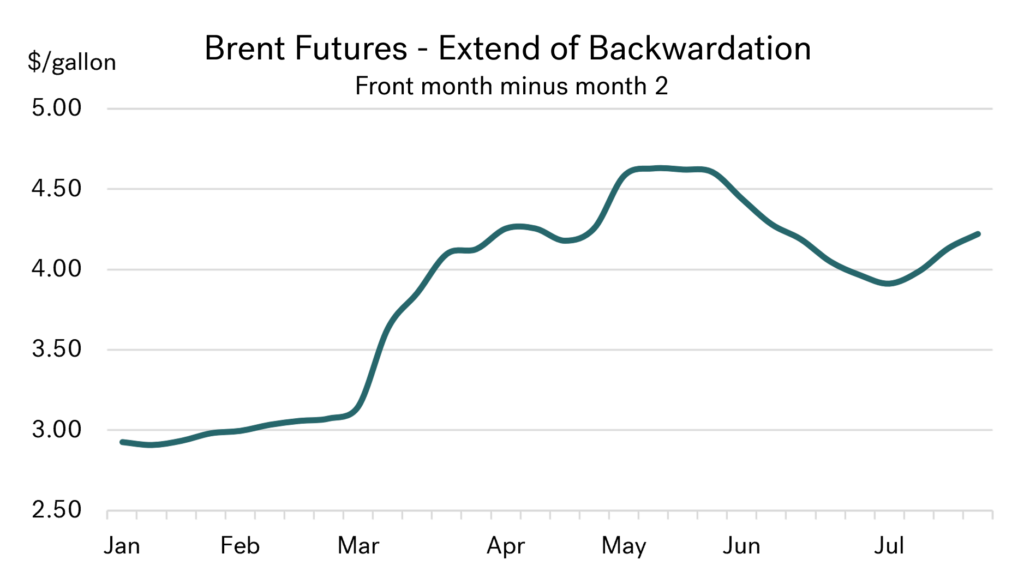
The halt in attacks over the past weekend has taken steam out of the market, with prices and backwardation falling sharply. Where we go from here depends if there is again a belief peace is on the horizon, or if this is another false dawn. The past month highlights how impossible it is to predict an ending to the war, and how fragile any expectations of peace can be.
We cannot ignore the price, but still must look to the future
It is impossible to write a report and not highlight the turmoil of the current market and what is happening. However, we still must look beyond this, to see where we could end up.
In an earlier report, we suggested the run-up to the US mid-term elections in November may be a backstop to the war. However, even this is not guaranteed. There are many dynamic elements to the economy and voter intentions, but one feature that will always crop up in the US is the gasoline price. This has risen from $3/gallon before the war to over $4/gallon for the past four months.
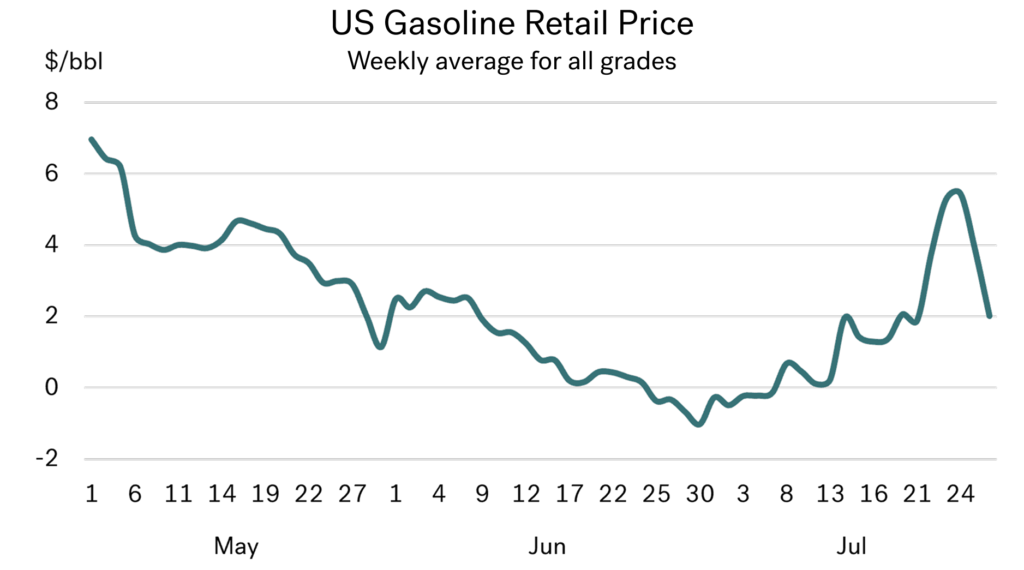
If it comes to it, will Republican voters want to see a resolution to the war and a return to $3 gasoline prices ahead of the elections?
We have a change of heart on how low bunker prices can go
We don’t know exact timings, but in any planning, we must look at what happens when the war does finally end and prices fall, whenever that may be. In past reports we have highlighted the view that Brent crude prices are unlikely to fall back to pre-war levels in the $60s, and Singapore VLSFO unlikely to go back in to the $400s. This may be the point at which these views change.
Previous thinking was based on a relatively short war, where there would be a large loss of oil supply and a massive stock-draw. In this case, tighter stock levels would be sufficient to keep prices higher than their pre-war levels once we returned to ‘normality’. This would mean Brent futures in the $70s (and not in the $60s), and Singapore VLSFO in the $500s, and not the $400s.
A number of mainstream analysts also held this view, although there were some that were lower and some higher.
Given the war has already gone on for much longer than almost everyone expected, this thinking must change. Yes, global stocks have been drawn down at a rapid rate, but this is slowing. Higher pricing and inflationary blows have had a major impact on global oil demand, with current indications that total oil demand in the second quarter of this year was some 4 million b/d lower than year earlier levels.
The graph below shows this sharp drop in demand and even if the war comes to an end relatively soon, and demand gets back towards some normality, a structural loss of more than 1 million b/d in global oil demand is still expected to have taken place because of the extended period of conflict.
If the war goes on for even longer, structural losses in global oil demand are likely to be even greater.

Source: US EIA
It’s a hard road, but we can get there
This means that once the war does end, market psychology will be looking at a rapid increase in oil supplies going into a global market which is much lower in demand. This opens the way for prices to easily return to their pre-war levels of Brent in the $60s and Singapore VLSFO in the $400s.
Now we just need those at the centre of negotiations to get us there.
Photo credit and source: Integr8 Fuels
Published: 30 July, 2026
Bunker Fuel Quality
FOBAS report warns of growing operational risks from ISO-compliant bunker fuels
LR’s latest FOBAS Fuel Quality Report reveals that the biggest fuel quality risks are no longer confined to off-specification fuels, with some compliant fuels creating operational challenges.

OUR INDUSTRY PARTNERS

Yang Ming orders six LNG dual-fuel, ammonia-ready containerships from Hanwha Ocean

LR, China’s MARIC unveil tanker concept ready for three future bunker fuels

DNV: Alternative-fuelled vessel orders hit highest monthly level since October 2024

TFG Marine advances global MFM rollout with two US Gulf bunker barges

GENA Solutions: Total renewable and low-carbon methanol project pipeline increases from 61.8 to 62.2 Mt by 2032

Baltic Exchange: Bunker Report (3 September 2026)

ENGINE: Americas Fuel Availability Outlook (3 September 2026)

Singapore-flagged tugboat “Kim Heng 3203” placed under Sheriff’s arrest

US targets five bunker companies in latest sanctions campaign against Iran

Singapore bunkering community supports Living Hope Evangelism’s 7th anniversary outreach for residents in need

China’s bunker market reshaped by tax rebates, trade flows and refining changes, says economist

Hengli Petrochemical’s ex-Singapore trading arm faces winding up application

Report: GCMD outlines practical approach to quantity assurance in marine biofuel supply chains

Singapore: Notices of intended dividend issued for Ocean Bunkering Services, Hin Leong Marine
-
 Vessel Arrest1 week ago
Singapore-flagged tugboat “Kim Heng 3203” placed under Sheriff’s arrest
-
 Sanctions1 week ago
US targets five bunker companies in latest sanctions campaign against Iran
-
 Events2 weeks ago
Singapore bunkering community supports Living Hope Evangelism’s 7th anniversary outreach for residents in need
-
 Interview1 week ago
China’s bunker market reshaped by tax rebates, trade flows and refining changes, says economist
-
 Winding up1 week ago
Hengli Petrochemical’s ex-Singapore trading arm faces winding up application
-
 Biofuel1 week ago
Report: GCMD outlines practical approach to quantity assurance in marine biofuel supply chains
-
 Winding up2 weeks ago
Singapore: Notices of intended dividend issued for Ocean Bunkering Services, Hin Leong Marine
-

 Bunker Claim3 days ago
Rajah & Tann: Bunker disputes are won in the first 48 hours