Connect with us

Business

EMSA and EEA releases European Maritime Transport Environmental Report

Report shows ships produce 13.5 % of all greenhouse gas emissions from transport in the EU, behind emissions from road transport (71 %) and aviation (14.4 %).

Admin

Published

on

EMSA 01

The European Maritime Safety Agency (EMSA) and the European Environment Agency (EEA) on 1 September (Wednesday) released a new report revealing for the first time the full extent of the impact of the EU maritime transport sector on the environment and identifies challenges to achieving sustainability:

With 77 % of European external trade and 35 % of all trade by value between EU Member States moved by sea, maritime transport is a key part of the international supply chain. Despite a drop in shipping activity in 2020 due to the effects of the COVID-19 pandemic, the sector is expected to grow strongly over the coming decades, fuelled by rising demand for primary resources and container shipping.

Against this background, the European Maritime Transport Environment Report, launched today by the European Environment Agency and the European Maritime Safety Agency, marks the first comprehensive health-check of the sector. 

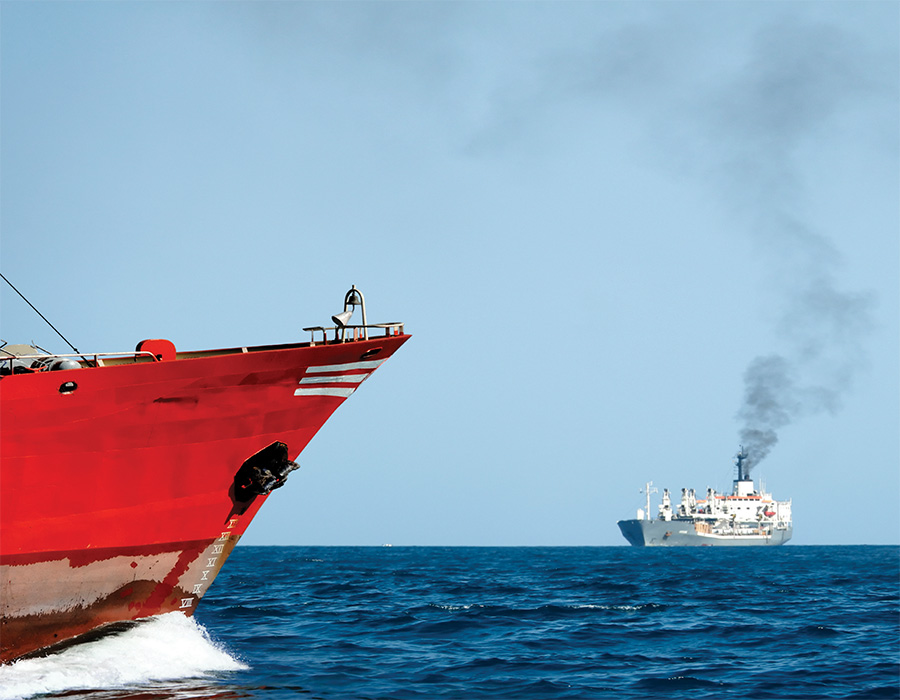
The report shows that ships produce 13.5 % of all greenhouse gas emissions from transport in the EU, behind emissions from road transport (71 %) and aviation (14.4 %). Sulphur dioxide (SO2) emissions from ships calling in European ports amounted to approximately 1.63 million tonnes in 2019, a figure which is expected to fall further over the coming decades due to stricter environmental rules and measures.

Maritime transport is estimated to have contributed to the fact that underwater noise levels in EU waters have more than doubled between 2014 and 2019 and has been responsible for half of all non-indigenous species introduced into European seas since 1949. However, even though the volume of oil transported by sea has been steadily increasing, only eight accidental medium to large oil tanker spills out of a worldwide total of 62 occurred in EU waters over the past decade.

The joint report assesses the current state of emerging maritime transport sustainability solutions, including alternative fuels, batteries and onshore power supply, and provides a comprehensive picture of their uptake in the EU. It also outlines future challenges posed by climate change for the industry, including the potential impact of rising sea levels on ports.

“Our Sustainable and Smart Mobility Strategy makes clear that all transport modes need to become more sustainable, smarter and more resilient —  including shipping. Although maritime transport has improved its environmental footprint in past years, it still faces big challenges when it comes to decarbonising and reducing pollution. Based on all the latest evidence, our policies aim to help the sector confront these challenges, by making the most of innovative solutions and digital technologies. 

This way, maritime transport can keep growing and delivering on our citizens’ daily needs, in harmony with the environment, all the while maintaining its competitiveness and continuing to create quality jobs,” said Adina Vălean, EU Commissioner for Transport.

“This joint report gives us an excellent overview of the present and future challenges related to maritime transport. The message is clear: maritime transport is expected to increase in the coming years and unless we act now, the sector will produce more and more greenhouse gas emissions, air pollutants and underwater noise. A smooth but rapid transition of the sector is crucial to meet the objectives of the European Green Deal and move towards carbon neutrality. 

This will also create new economic opportunities for the European transport industry as part of the necessary transition to a sustainable blue economy. The challenge is immense, but we have the technologies, the resources and the will to tackle it,” said Virginijus Sinkevičius, European Commissioner for Environment, Oceans and Fisheries.

“Innovation-driven sustainability is an opportunity for shipping to complete a transformation on the same scale as the replacement of sails by steam. This new maritime revolution will depend on ships developed through advanced technology and digital solutions, but also on a multi-layered, fully inclusive process at national, European and international level that encompasses safety, security and social aspects as well as environmental ones. But crucial too is shipping’s role as a link in a transnational logistics chain. said Maja Markovčić Kostelac, EMSA’s Executive Director.

This means that every part of that chain —  from ports to the shipbuilding sector, from shippers to the private and public financial sectors —  must be included in our drive towards sustainability.

“While Europe’s maritime transport sector plays a vital role for our economic well-being, this report clearly shows that maritime transport in Europe and the entire international shipping community have an urgent responsibility to step up their efforts to reduce this sector’s environmental footprint.”

While steps have been taken already based on European and international policies, much more is needed for a fundamental shift towards a sustainable maritime transport sector that contributes to secure the future well-being and survival of our most sensitive ecosystems and coastal areas, and the well-being of Europeans,” said Hans Bruyninckx, EEA Executive Director.

Key impacts on the environment

  • Greenhouse gas emissions: in total, ships calling at EU and European Economic Area ports generated 140 million tonnes of CO2 emissions in 2018 (approximately 18 % of all CO2 emissions generated by maritime transport worldwide that year).
  • Air pollution: In 2019, sulphur dioxide (SO2) emissions from ships calling in European ports amounted to around 1.63 million tonnes, approximately 16 % of the global SO2 emissions from international shipping.
  • Underwater noise: Ships create noise which can affect marine species in different ways. It is estimated that between 2014 and 2019, the total accumulated underwater radiated noise energy more than doubled in EU waters. Container ships, passenger ships and tankers generate the highest noise energy emissions from propeller use.
  • Non-indigenous species: Overall, since 1949, the maritime transport sector has accounted for the largest proportion of non-indigenous species introduced into seas around the EU — close to 50 % of all species, with the largest number found in the Mediterranean. A total of 51 species are all classified as high impact, meaning that they can affect ecosystems and native species. The report also notes the limited data available in assessing the full impact on habitats and species.
  • Oil pollution: out of a total of 18 large accidental oil spills in the word since 2010, only three were located in the EU (17 %); better monitoring, enforcement and awareness is helping to reduce oil pollution events even though the amount of oil transported by sea has been steadily growing for the past 30 years.

Navigating towards sustainability

EU maritime transport faces a crucial decade to transition to a more economically, socially and environmentally sustainable sector.

Already, most ships calling in the EU have reduced their speed by up to 20 % compared to 2008, thereby also reducing emissions, according to the report.

In addition, non-traditional fuels and energy sources, such as biofuels, batteries, hydrogen or ammonia, are emerging as possible alternatives for shipping, with the potential to decarbonise the sector and lead to zero emissions. Onshore power supply (where ships shut down their engines and connect to a power source on land while berthed at port) can also provide a clean source of energy in maritime and inland navigation ports.


Photo credit: EMSA
Published: 2 September, 2021

Continue Reading

Legal

Singapore withdraws remaining 127 charges against Hin Leong founder OK Lim

Lim Oon Kuin, also known as OK Lim, was issued a stern warning and a district court granted him a discharge amounting to an acquittal for these charges on 17 July.

Admin

Published

on

By

RESIZED Sora Shimazaki on Pexels

Founder of collapsed oil trader Hin Leong Trading, Lim Oon Kuin, also known as OK Lim, has had the remaining 127 charges against him withdrawn, according to The Straits Times on Monday (20 July). 

OK Lim was issued a stern warning and a district court granted him a discharge amounting to an acquittal for these charges, including those for cheating, on 17 July. The discharge means Lim cannot be prosecuted again for the same offences.

Lim, 84, is currently serving a 13½-year prison sentence after the High Court reduced his original 17½-year jail term in March 2026. He was convicted in 2024 on two cheating charges and one count of abetting forgery in a case prosecutors described as one of Singapore’s most serious trade finance frauds.

Lim was convicted in May 2024 of two charges of cheating the Hongkong and Shanghai Banking Corporation (HSBC) and one count of abetting forgery that proceeded to trial out of a total of 130 criminal charges.

He was first charged in court on 14 August 2020, and was subsequently handed further charges in court on 25 September 2020, 30 April 2021 and 24 June 2021 for his role in perpetuating fraud on various financial institutions. 

A total of 130 charges were eventually brought against him for cheating and forgery-related offences.

Related: Singapore: Hin Leong Founder OK Lim gets jail term slashed to 13.5 years


Photo credit: Sora Shimazaki
Published: 21 July, 2026

Continue Reading

Winding up

Singapore: Coastal Logistics Pte Ltd to be wound up voluntarily

Coastal Logistics was reportedly affiliated with troubled Singapore bunker player Coastal Oil (Singapore) Pte Ltd.

Admin

Published

on

By

RESIZED Drew Beamer

Several resolutions for Coastal Logistics Pte Ltd were made during an extraordinary general meeting held on 14 July, according to a notice in the Government Gazette on Friday (4 July).

The following resolutions were duly passed during the meeting:

As Special Resolution

  • That it has been proved to the satisfaction of the meeting that the Company cannot by reason of its liabilities continue its business and accordingly the Company be wound up voluntarily pursuant to Section 160(1)(b) of the Insolvency, Restructuring and Dissolution Act 2018 (No. 40 of 2018);

As Ordinary Resolutions

  • that Mr. Wong Pheng Cheong Martin and Ms. Koay May Yee, both care of FTI Consulting (Singapore) Pte Ltd, One Raffles Quay, #27-10 South Tower, Singapore 048583 be appointed as the joint and several Liquidators of the Company for the purpose of such winding up; and
  • that the Liquidators be at liberty to open, maintain and operate any bank account(s) or account(s) for monies received by them as Liquidators with such bank(s) as they deem fit; and
  • that a Committee of Inspection will not be formed.

Manifold Times previously reported Nicholas James Gronow, director of Heng Tong Fuels & Shipping and Coastal Logistics, filed statutory declarations for both companies stating the firms cannot continue their businesses due to liabilities.

Both companies were reportedly affiliated with troubled Singapore bunker player Coastal Oil (Singapore) Pte Ltd. 

In 2019, several vessels owned by both firms entered the sale & purchase (S&P) market in Singapore.

Related: Singapore: Director declares Heng Tong Fuels & Shipping’s inability to continue business
Related: Heng Tong Fuels & Shipping in court over DBS Bank bunker tanker loan
Related: Singapore: Bunker tanker “Coastal Neptune” arrested
Related: Heng Tong Fuels & Shipping, Coastal Logistics tankers enter S&P market


Photo credit: Drew Beamer
Published: 21 July, 2026

Continue Reading

LNG Bunkering

PIL’s LNG dual-fuel boxship “Kota Elok” arrives in Singapore on maiden call

As the first of 13 new 13,000 TEU vessels joining its fleet, Kota Elok is equipped to operate on LNG and low-sulphur fuel oil that helps reduce our greenhouse gas emissions.

Admin

Published

on

By

PIL's LNG dual-fuel boxship “Kota Elok” arrives in Singapore on maiden call

Singapore-based Pacific International Lines Pte Ltd on Monday (20 July) said its first 13,000 TEU LNG dual-fuel container vessel, Kota Elok, recently made her maiden call to Singapore on 15 July.

As the first of 13 new 13,000 TEU vessels joining its fleet, Kota Elok is equipped to operate on liquefied natural gas (LNG) and low-sulphur fuel oil that helps reduce our greenhouse gas emissions. 

The vessel also incorporated energy-saving features and digital technologies to reduce fuel consumption and enhance operational performance, as well as a bow windshield to improve aerodynamics, contributing to improved fuel efficiency and lower emissions over the course of long-haul voyages.

“Following Singapore, Kota Elok will continue her voyage on our East Coast Service 1 (ES1) route to South America, calling at ports in Brazil, Uruguay, and Argentina before returning to Asia,” the company said in a social media post. 

Kota Elok also became PIL’s first vessel to receive Lloyd’s Register certification for compliance with the IACS UR E26 and UR E27 cyber security requirements.

Developed by the International Association of Classification Societies (IACS), UR E26 and UR E27 are mandatory cyber resilience requirements for newbuild vessels contracted from 1 July 2024. 


Photo credit: Pacific International Lines
Published: 21 July, 2026

Continue Reading

Trending