Connect with us

Analysis

Newport Fuel Solutions: Curing the fuel stability pandemic

A major contributing factor is longer than expected fuel storage times, thanks to the Covid-19 slowdown in bunker deliveries, writes CEO Ralph Lewis.

Admin

Published

on

5e0418cf27f55 1577326799

The following article ‘Curing the fuel stability pandemic’ has been written by Ralph Lewis, the CEO of refinery-grade fuel treatment additive manufacturer Newport Fuel Solutions, and has been shared with Singapore bunker publication Manifold Times:

A rash of fuel related stoppages and delays have ravaged countless vessels in recent months – most from very predictable issues regarding the stability of IMO mandated 0.5 percent sulfur fuels (VLSFO).

Reports from fuel testing laboratories regarding severe fuel instability of VLSFO-RMG-RMK are unceasing. A continuous series of alerts by the fuel analysis company FOBAS cite instability issues with bunkers from Houston, Singapore, Las Palmas, Rotterdam, and Antwerp, among other areas.

Veritas Petroleum Services (VPS) has also issued numerous alerts, noting that in May 2020 for example, 8.8 percent of samples from European ports were off spec.

This fuel instability pandemic seems concurrent with the global Covid-19 version, and for good reason.

A major contributing factor is longer than expected fuel storage times, thanks to the Covid-19 slowdown in bunker deliveries.

Greatly declining demand for VLSFO-RMG-RMK following the onset of the Covid-19 pandemic resulted in a huge increase in VLSFO-RMG-RMK storage early on. Stored stocks in the Amsterdam/Rotterdam/Antwerp area set a record of 1.74 million mt mid-2020. Singapore storage hit 5 million mt in July 2020. And Fujairah stocks soared mid-year as well.

As VPS explained, ‘Although longer-term storage of marine fuels is possible, it increases the risk of fuel quality issues arising from temperature, stratification, fuel stability….”

This extended storage time especially affects the very particular nature of VLSFO, which has “a lower tolerance to longer term storage and internal stability,” says Naeem Javid, global operations manager of Lloyd’s Register Fuel Oil Bunkering Analysis and Advisory Service.

Of course, many marine fuel treatment companies have opportunistically touted their respective products as the miracle solutions. But not so fast. Overcoming a fuel stability issue with old school sludge dispersant chemistry is not nearly as effective – a situation some vessel operators are discovering with traditional fuel treatment.

The reason? Chemistries that once worked in heavy fuel oil to hold asphaltenes is suspension – preventing their precipitation as sludge – are wholly ineffective in preventing the wave of chemical interactions that occur when two disparate distillate fuels are blended for VLSFO – resulting in rapid fuel quality degradation.

These reactions can begin shortly after the fuel is blended – issues beginning to occur just a matter of days following delivery. Fuel testing of a sample within days of receipt will often be conducted too early for the problem to be detected, as instability reactions are progressive and become much worse over time. For this reason, onboard spot testing for compatibility is often inadequate with VLSFO. Within a few days of bunkering the purification system begins to struggle.

These chemical reactions from fuel bending have been long identified and well understood by petroleum chemists working at the world’s great refineries where fuels are often blended to meet regional demands.

The challenge begins with the fact that fuel chemistry varies greatly in each distillate stream – beginning with the source of the feedstock – the catalysts used for the cracking process – the process method and the variabilities of time and temperature. On any given day at any refinery globally – the chemistry of a particular distillate stream can vary widely regardless of strict control standards. The result? Insoluble are formed when chemically incompatible fuels are mixed.

To quote a Chevron technical description:

“One well established mechanism by which insolubles are formed is the acid-catalyzed conversion of phenalenones and indoles to complex indolyphenalene salts. Phenalenones are formed by oxidation of certain reactive olefins. Indoles occur naturally in certain blends. The required organic acid is either present in a blend component or is generated by the oxidation of mercaptans to sulfonic acids.”

And there are additional factors. The hydrotreatment of fuels to remove sulfur also removes more volatile, higher fractions that contribute to good ignition quality as well as naturally occurring antioxidants. To compensate, refiners typically add a cetane enhancement additive known a 2-ethyl-hexyl-nitrate (2-EHN). Indeed, 2-EHN can boost cetane of an untreated fuel as much as eight numbers when added at a highly aggressive dosage rate.

Yet when these fuels were first introduced in California decades ago, fleet operators with centralized fueling systems began noticing that within days, fuel filter use began to greatly increase. Chevron investigated and discovered that 2-EHN over time decomposed and reacted with certain fuel components to create very high molecular weight structures which not only increased fuel filter plugging but also resulted in deteriorated ignition quality.

These chemical interactions, combined with heat, oxygen and time, form a recipe for fuel Armageddon – destined to turn any healthy purification system into a cauldron of sludge stew.

So, what to do?

Simple. In time, refiners discovered that certain types of amine-based anti-oxidant chemistries were able to completely block the chemical reactions which lead to the formation of insolubles and higher carbon weight molecular structures which were causing excessive fuel system fouling and compromised ignition quality.

Taken a step farther – it was also discovered that these chemistries also blocked the formation of less volatile, high-carbon weight structures which occurred when unsaturated olefinic hydrocarbons would actually join together into unburnable polymeric chains during the combustion process. In other words, it turned out that by blocking this process, thermal stability of the fuel was greatly improved – providing more power per unit of fuel and a reduction in unburned hydrocarbons and emissions.

This is precisely why traditional physical dispersants will predictably fail when a stability problem is the result of chemical reactivity between two fuels. While they may have some limited benefit dispersing some of the material that forms from such reactions – a dispersant will not stop the initial reaction or the progression of a reaction – some of which can be quite rapid and damaging.

THE SOLUTION

Yet there is a cure, time tested to be safe and extraordinarily effective in preventing the fuel stability contagion.

Among Newport Fuel Solutions marine fuel treatment products are two formulas specifically formulated to stop stability issues in marine fuels from the moment two fuels are blended. Both contain 100 percent active chemistries – the same used by refiners globally to address the same issues. And today these products – NP-HFO, and NP-FOT, are on hundreds of vessels, completely preventing slowdowns and stoppages from severely compromised fuel quality.

These chemistries are formulated with refinery-grade amines which block the unwanted chemical reactions which occur following blending. Fuel delivery systems remain clean. Sludge and insoluble precipitation are greatly reduced. Icing on the cake is a marked improvement in thermal stability which provides enhanced ignition quality, inhibition of damaging deposits, and reductions in particulates and unburned hydrocarbons.

Unlike competitive products – Newport does not use any cheap, petroleum “filler” solvents to “water down” the products for greater profitability. The products contain only 100 percent active ingredients – the thinking is that ship owners should enjoy the same low treatment costs as global refiners. With no volatile petroleum solvents – the products are also deemed non-hazardous – safe for personnel to handle – safe to store on board.

Because these are refinery-grade concentrates, treatment cost is far lower than conventional marine fuel additives. With a treatment rate of one liter per 30 mt, NP-FOT is an organic amide/amine product capable of remedying and even reversing fuel stability issues. NP-HFO contains an additional component specifically designed to greatly boost fuel thermal stability – providing better ignition quality for deposit control for VLSFO. NP-HFO is also the choice for vessels with scrubber towers burning conventional RMG380 and RMK 380 fuels.

Since January 2020, vessels treating fuel with either of these products have experienced a 99.2 percent success rate – no fuel system fouling – no stoppages – no charter hire loss – no doubt why Newport products are the choice for many of the world’s greatest fleet operators.

The Author

Ralph Lewis is the CEO at Newport Fuel Solutions, Inc.

Mr. Lewis served as Technology Transfer and Public Information Specialist with Shell Oil and eventually, as Vice President Technical with Power Research Inc for over 32 years.

Contact details:
Phone: +1 832 627 7499
Email: [email protected]
Website: www.newportfuelsolutions.com


Photo credit: Manifold Times
Published: 17 May, 2021

Continue Reading

Bunker Fuel Quality

FOBAS report warns of growing operational risks from ISO-compliant bunker fuels

LR’s latest FOBAS Fuel Quality Report reveals that the biggest fuel quality risks are no longer confined to off-specification fuels, with some compliant fuels creating operational challenges.
Admin

Published

on

By

New FOBAS report warns growing operational risks from ISO-compliant bunker fuels

Classification society Lloyd’s Register (LR) on Tuesday (14 July) warned that ship operators are facing a growing risk from fuels that appear compliant under routine ISO 8217 testing but still present operational risks once onboard.

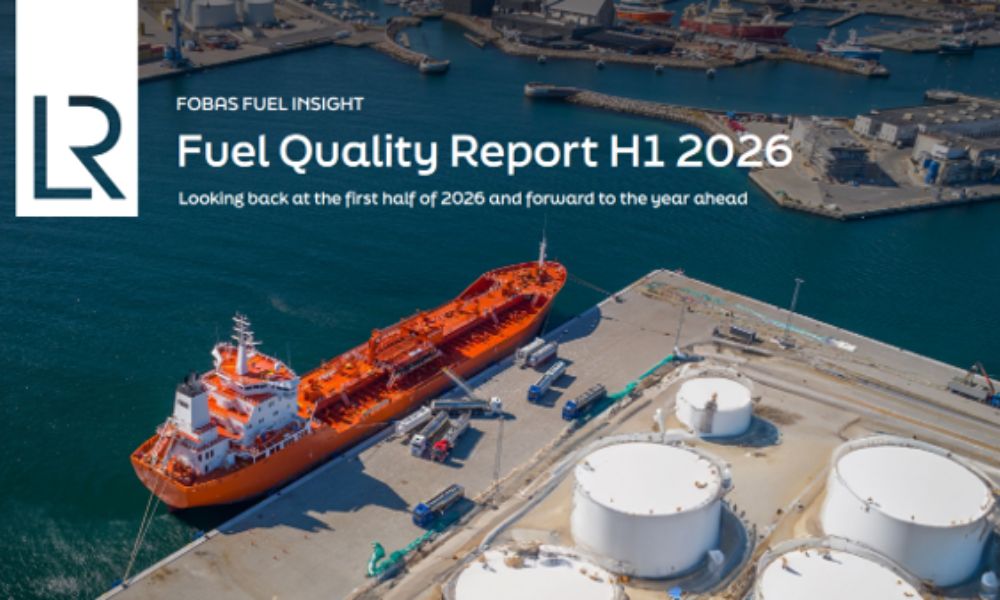
According to LR’s latest Fuel Oil Bunker Analysis and Advisory Service (FOBAS) Fuel Quality Report, covering the first half of 2026, off-specification fuels remain a persistent challenge. 

However, some of the most disruptive cases now involve fuels that pass routine compliance testing but show poor stability or compatibility, or contain non-conventional blend components that are only identified through more detailed investigative analysis.

Several incidents investigated highlighted this trend. In March and April, a number of vessels reported operational difficulties after bunkering fuel in a major bunkering hub. Further forensic analysis found that many of the fuels contained elevated concentrations of Estonian shale oil, in some cases estimated to be around 10-15%.

While shale oil is recognised within ISO 8217 as an acceptable blend component, FOBAS investigations found that higher concentrations can be associated with fuel instability and operational issues affecting filters, separators and fuel pumps.

The report also shows that fuel quality variability remains stubbornly high. Off-specification cases remained elevated throughout the first six months of 2026, suggesting that quality issues are no longer isolated events but a more persistent feature of today’s marine fuel supply chain.

The most common recurring issues included sulphur exceedances, excessive water content, sediment and stability problems, elevated catalytic fines, sodium contamination and low flash point distillate fuels.

At the same time, biofuels (especially FAME blends) are continuing to grow without being a primary source of quality issues. Where issues occurred in blended fuels, they were generally associated with the conventional VLSFO component rather than the FAME fraction.

The report concluded that operators will need to adopt a more proactive approach to fuel management as marine fuels become more diverse and fuel quality risks become harder to identify through routine compliance testing alone.

Greater emphasis on fuel stability, compatibility and understanding fuel composition will be critical to reducing operational disruption and maintaining vessel performance.

Murray Kirkwood, Fuel Specialist Consultant, Lloyd’s Register, said: “The findings from our latest report show that fuel quality risk is evolving. The challenge is no longer simply identifying fuels that fail specification. Increasingly, operators are encountering fuels that meet the required limits but still create operational difficulties once they are stored, handled and used onboard.

“As fuel blending becomes more complex, the distinction that matters is increasingly not between on-spec and off-spec fuel, but between fuels that are operationally resilient and fuels that are operationally fragile. Understanding that difference is becoming essential for shipowners and operators.”

The latest findings reinforced FOBAS’ long-standing view that effective fuel management increasingly depends on understanding fuel behaviour rather than relying solely on pass-or-fail specification testing.

By combining routine fuel quality monitoring with forensic investigation of operational incidents, FOBAS provides shipowners with a clearer understanding of emerging fuel quality risks as the industry continues its transition to a more diverse and complex fuel landscape.

Note: The FOBAS Fuel Insight: Fuel Quality Report H1 2026 is available at FOBAS Fuel Insight: Fuel quality reports | LR


Photo credit: Lloyd’s Register
Published: 15 July, 2026

Continue Reading

Interview

Interview: Alkagesta navigates risk from bunkering ops during turbulent times

As the industry navigates this period of uncertainty, the key question is no longer ‘what will fuel cost?’ but rather ‘will fuel be available?’, highlights Mithat Çiftçioğlu.

Admin

Published

on

By

Mithat MT

Mithat Çiftçioğlu, Marine Fuels Director at Alkagesta, shared his opinion on risk management for bunkering operations under current geopolitical tensions through the April edition of shipping magazine Deniz Ticaret.

The maritime publication, part of the Turkish Chamber of Shipping (İMEAK Deniz Ticaret Odası), has given Manifold Times permission to republish the article:

Fueling Ships in Turbulent Times

From Oil Shock to Fuel Access Crisis: A New Risk Map for Maritime 2026

The final weeks of the first quarter of 2026 mark one of the most complex periods in recent years for global energy and maritime markets. The sharp rise in oil and refined product prices since February 28 may look like a classic energy shock at first glance, but developments in the maritime sector point to a far deeper structural rupture.

What is being debated in the market today is no longer just oil prices. For traders and shipowners operating in the maritime sector and bunker market, the real issue is not the price of fuel — it is access to fuel. The fundamental question in the market has shifted: not what will the price of fuel be, but will fuel even be available?

In light of the Force Majeure cancellations at Asian ports over the past two weeks, another question must also be considered: Will pre-agreed bunker supply contracts actually be delivered?

From Oil Prices to Logistical Reality

Tensions in the Middle East have created a strong geopolitical risk premium in the oil market. Brent crude briefly surpassed the $100 per barrel mark, triggering a search for a new equilibrium across markets. This will inevitably bring inflation and recession back onto the global agenda in the months ahead.

But the rise in oil prices does not only reflect the risk of supply disruption — it also signals the return of one of the most fragile chokepoints in global energy trade:

The Strait of Hormuz

Approximately one-third of the world’s oil trade passes through this narrow waterway. Around 20 million barrels of oil and petroleum products transit Hormuz daily. Any disruption here would therefore affect not only oil prices, but also global refined product flows and the bunker market directly.

Why Strategic Oil Reserves Are Not the Solution

A commonly proposed solution in energy crises is the release of strategic petroleum reserves. However, releasing these reserves does not directly resolve a bunker crisis. Strategic reserves consist of crude oil. To produce bunker fuel, the following chain must be completed:

Crude oil → Refinery → Product logistics → Bunker port

This process takes time. Strategic reserves can temporarily stabilize oil prices, but they cannot solve the access problem in the bunker market in the short term.

Furthermore, the announced reserve release of 400 million barrels, to be drawn down at a rate of 2.5–3 million barrels per day, can only cover a small fraction of the estimated daily loss from the Middle East — optimistically 8–10 million barrels, pessimistically 18–20 million barrels per day.

A Historic Surge in Bunker Fuel Prices

The per-ton price of VLSFO (0.5% sulfur) bunker fuel has surpassed $1,000, reaching approximately double pre-war levels. This also represents some of the highest prices seen since July 2022.

While prices at bunker hubs such as Singapore and Fujairah are approaching $1,100 per ton, European markets have remained comparatively lower.

The Real Problem Is Not Price — It Is Fuel Access

Obtaining bunker quotes for April has become increasingly difficult, particularly at Asian ports. Even where shipowners and traders can secure quotes, the absence of supply guarantees makes pricing extremely challenging.

A senior executive at Oldendorff Carriers summarized the situation in these words:

“We cannot price cargo because we cannot calculate fuel costs; we cannot calculate fuel costs because there is no supply guarantee.”

The CEO of Maersk has compared the current situation to the pandemic era, stating that companies are attempting to source fuel through methods they have never tried before in order to keep global shipping networks supplied.

While supply is tight and prices are near their peak in Singapore and Fujairah, Rotterdam appears relatively more balanced. However, as the conflict drags on, risk perception in European markets is also rising.

The surge in bunker prices will not only increase costs — it will also affect global maritime transport capacity. Ships are expected to reduce their speeds to conserve fuel. This could lead to a reduction in effective carrying capacity, creating new logistical bottlenecks in global trade.

The importance of working with reliable, long-term partners has never been more apparent than during a crisis such as this.

The Widening Price Spread Between Fuel Types

A notable development in the bunker market in recent weeks is the rapid widening of price differentials between different fuel types. Two spreads in particular have expanded significantly:

  • Marine Gas Oil (MGO) – VLSFO
  • VLSFO – HSFO

Rising demand for distillate products, refinery production balances, and regional supply tightness are all contributing to this widening. As a result, bunker purchases have become not merely a matter of price level, but a strategic decision tied to product type and port selection.

An Unexpected Development: Biofuels Becoming Competitive

Another noteworthy development in the bunker market is that biofuels have remained at relatively competitive price levels. This creates two important opportunities for shipowners.

On one hand, biofuels remain competitively priced in certain markets. On the other, they offer a means of compliance with new regulations entering into force in Europe — particularly the FuelEU Maritime and EU ETS frameworks, which require reductions in carbon intensity. In this context, biofuels have become a strategic option for many shipowners.

Conclusion: Active Bunker Management Is The New Normal

The 2026 bunker market presents one of the most complex energy trading environments in recent years. The rise in oil prices, geopolitical risk at the Strait of Hormuz, tightness in physical fuel supply, and widening price spreads between fuel types have made bunker fuel management more critical than ever.

The prevailing view in energy markets is that as long as the risk at the Strait of Hormuz persists, turbulence in the bunker market will persist with it. As time passes, the depletion of commercial stocks may deepen the existing supply tightness further.

For this reason, the current situation is viewed not merely as an energy crisis, but as a new stress scenario testing the logistical infrastructure of global trade.

The view increasingly heard across energy markets is this:

“As long as Hormuz remains closed, it will not be oil prices but fuel access that constitutes the defining risk for global shipping.”

Finally, for shipowners and operators, bunker strategies are shifting away from a passive purchasing approach toward a model grounded in active risk management.


Photo and article credit: Deniz Ticaret
Published: 7 May 2026

Continue Reading

Analysis

T&E: Overreliance on traditional bunker fuels costs shipping USD 395 million a day due to Iran conflict

Development has made alternative fuels increasingly more competitive, states Eloi Nordé, shipping policy officer at T&E.
Admin

Published

on

By

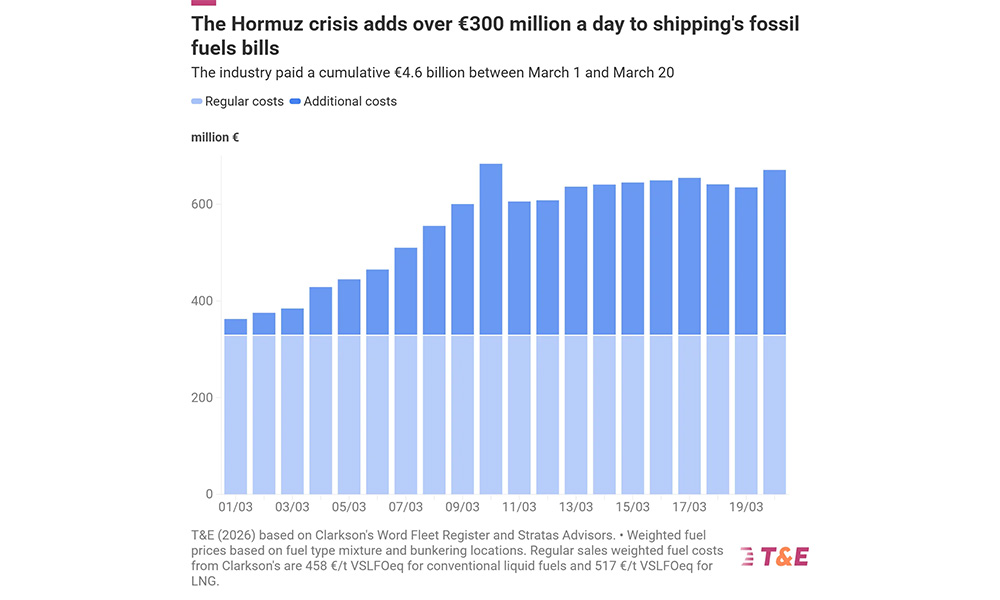
The Hormuz crisis adds over 300 million a day to shippings fossil fuels bills

The European Federation for Transport and Environment (T&E) on 27 March highlighted the adoption of green marine fuels would reduce the shipping industry’s exposure to fuel price shocks in future.

It noted shipping companies are spending an extra €340 million (USD 394.74 million) a day in additional fuel costs as a result of the latest conflict in the Gulf.

As 99% of the global fleet runs on fossil fuels, the industry is directly exposed to fuel price volatility and supply disruptions. Efficiency measures, electrification and e-fuels would reduce the industry’s exposure to price fluctuations.

According to T&E, marine fuel prices have escalated rapidly, with VLSFO reaching €941 per tonne in Singapore, up 223% since the start of 2026. At the same time, LNG prices have risen by 72% since early March. Since February 28, shipping companies have incurred more than €4.6 billion in additional fuel costs.

The development has made alternative fuels increasingly more competitive. As fossil fuel prices reach record highs again, the cost gap with e-fuels is narrowing.

T&E’s research shows that the cost gap between marine gas oil – one of the more expensive fossil fuels – and e-fuels has shrunk to near parity (+5%) in some ports.
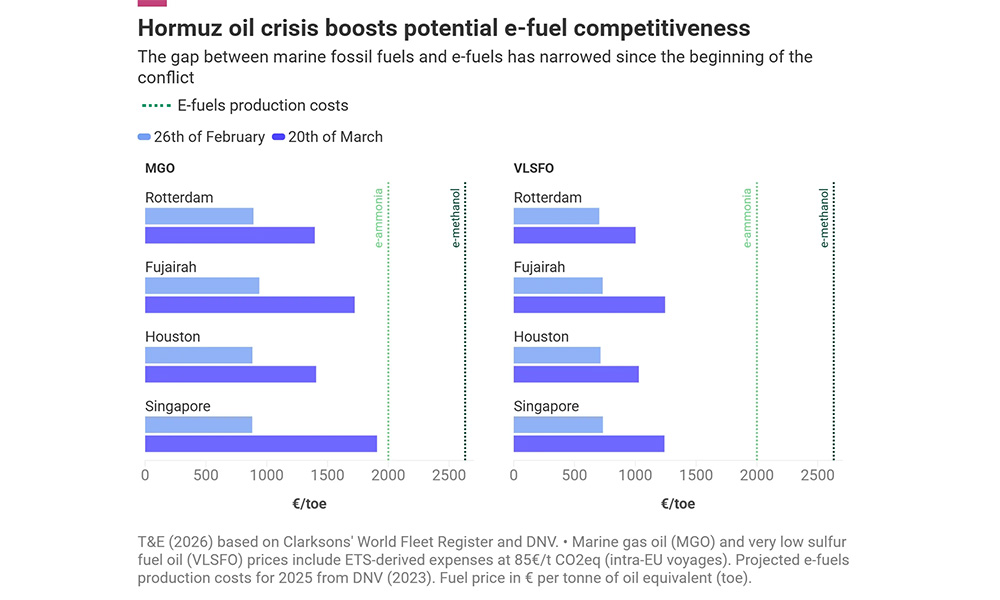
Hormuz oil crisis boosts potential e fuel competitiveness

While the trend may be temporary, it shows that the volatility of fossil fuel markets offsets much of the structural cost disadvantage of clean fuels.

“Chaos in the Strait of Hormuz is putting global maritime trade under the spotlight. But it’s on the oil markets where its impact will be felt the most. The war is costing the industry millions every day,” said Eloi Nordé, shipping policy officer at T&E.

“Some governments and parts of the industry have spent the last year bashing green maritime measures as being too expensive, yet those costs pale in comparison to this super-disruption.

“If anything, this crisis should be the catalyst for more investment in European e-fuels and greater uptake of energy efficiency measures to avoid fossil fuel shocks in the future.”


Photo credit: European Federation for Transport and Environment
Published: 2 April 2026

Continue Reading

Trending