Connect with us

Business

Auramarine: VLSFO fuel quality; is the worst yet to come?

Ship owners and operators must therefore remain diligent in 2021 and maintain awareness of the ever evolving and volatile marine fuel market.


Admin

Published

on

Teemu Jutila MT

Teemu Jutila, Director, Engineering and Products, at Finland-based fuel supply systems solutions provider Auramarine on Tuesday (27 April) provided Singapore bunkering publication Manifold Times an article focusing on the rapidly transforming marine fuels market and its future challenges.

In 2019, the shipping industry was facing somewhat different pressures than what it faces today. With IMO 2020 on the horizon, the industry was waiting with nervous anticipation to see the impact of the new regulation. Some predicted momentous disruption – from the availability, and cost of very low sulphur fuel oil (VLSFO), to the price spread for heavy fuel oil (HFO) and scrubbers – the debate around the most economically and environmentally viable compliant solution was in full force. We can now look back in confidence and say, whether it be due to preparedness from certain quarters, or low oil prices which diluted the cost of VLSFO, that the transition was, for the most part, smooth.

The quality of new VLSFO products were also an initial concern. In particular, the variable and wide-ranging viscosities, densities, as well as their other unknown properties, which could result in costly damage to fuel supply systems, and in worst case scenarios, engine failure. However, with ship owners and operators increasing their level of due diligence and seeking expert counsel in relation to newer fuels, major quality issues were mainly avoided.

Whilst all appears to have worked most favourably at present, a number of industry opinion formers believe that despite this current increase in quality and standards, ship owners and operators must be aware that this is only an initial phase of the IMO 2020 challenge. Indeed, once the world begins to recover from the aftershocks of the COVID-19 pandemic, it is entirely possible that the price development and increasing demand for high quality fuels in other industries may result in a decreased availability of such fuels in the marine pool, as well as wider variations in fuel qualities across blends. This therefore leaves us with the question of whether the maritime industry will have to manage the risks that come with introducing lower quality fuels to a vessel’s fuel supply systems.

Ultimately, the introduction of low-quality fuel to a vessel’s fuel supply system can cause more frequent service intervals than typically required, as well as an increased need for daily maintenance. This can lead to higher operating costs for the ship owner or operator and, in worst case scenarios, issues such as engine failure. Ship owners and operators must therefore remain diligent in 2021 and maintain awareness of the ever evolving and volatile marine fuel market.

This means that to stay one step ahead of the curve, owners and operators need to continue to engage and consult with experts and seek counsel on the implementation of fuel supply systems, modernisations, and upgrades. This is especially important with the existing global fleet set to be in operation for many years. From the perspective of the vessel’s fuel supply systems, this is about looking at the whole lifecycle of the asset, focusing on the total cost of ownership, rather than just a commoditised, granular focus on the initial installation and price.

With this in mind, our LifeCycle services team provide in-depth counsel and advice to our customers to ensure the safeguarding of their systems throughout the vessel’s lifecycle. This includes implementing an integrated and strategic approach to managing spare parts to repair, modernise, and upgrade systems and components to always ensure operational continuity, and reduced downtime, whatever the market conditions.

The reality is that the marine fuel market is rapidly transforming. The last year has been unparalleled with the impact of the global pandemic and economic consequences diluting the effect of IMO 2020.  In conjunction with this, the industry pivot towards decarbonisation is also transforming and evolving the marine energy supply chain.  Ship owners and operators can therefore not afford to stand still, rest easy or operate with a false sense of security. The challenges that lie ahead must be met with joint collaboration in order to futureproof operations and ensure that the efficient, safe, cost-effective and compliant movement of vessels are always preserved.


Photo credit: Auramarine

Published: 27 April, 2021

Continue Reading

Legal

Singapore withdraws remaining 127 charges against Hin Leong founder OK Lim

Lim Oon Kuin, also known as OK Lim, was issued a stern warning and a district court granted him a discharge amounting to an acquittal for these charges on 17 July.

Admin

Published

on

By

RESIZED Sora Shimazaki on Pexels

Founder of collapsed oil trader Hin Leong Trading, Lim Oon Kuin, also known as OK Lim, has had the remaining 127 charges against him withdrawn, according to The Straits Times on Monday (20 July). 

OK Lim was issued a stern warning and a district court granted him a discharge amounting to an acquittal for these charges, including those for cheating, on 17 July. The discharge means Lim cannot be prosecuted again for the same offences.

Lim, 84, is currently serving a 13½-year prison sentence after the High Court reduced his original 17½-year jail term in March 2026. He was convicted in 2024 on two cheating charges and one count of abetting forgery in a case prosecutors described as one of Singapore’s most serious trade finance frauds.

Lim was convicted in May 2024 of two charges of cheating the Hongkong and Shanghai Banking Corporation (HSBC) and one count of abetting forgery that proceeded to trial out of a total of 130 criminal charges.

He was first charged in court on 14 August 2020, and was subsequently handed further charges in court on 25 September 2020, 30 April 2021 and 24 June 2021 for his role in perpetuating fraud on various financial institutions. 

A total of 130 charges were eventually brought against him for cheating and forgery-related offences.

Related: Singapore: Hin Leong Founder OK Lim gets jail term slashed to 13.5 years


Photo credit: Sora Shimazaki
Published: 21 July, 2026

Continue Reading

Winding up

Singapore: Coastal Logistics Pte Ltd to be wound up voluntarily

Coastal Logistics was reportedly affiliated with troubled Singapore bunker player Coastal Oil (Singapore) Pte Ltd.

Admin

Published

on

By

RESIZED Drew Beamer

Several resolutions for Coastal Logistics Pte Ltd were made during an extraordinary general meeting held on 14 July, according to a notice in the Government Gazette on Friday (4 July).

The following resolutions were duly passed during the meeting:

As Special Resolution

  • That it has been proved to the satisfaction of the meeting that the Company cannot by reason of its liabilities continue its business and accordingly the Company be wound up voluntarily pursuant to Section 160(1)(b) of the Insolvency, Restructuring and Dissolution Act 2018 (No. 40 of 2018);

As Ordinary Resolutions

  • that Mr. Wong Pheng Cheong Martin and Ms. Koay May Yee, both care of FTI Consulting (Singapore) Pte Ltd, One Raffles Quay, #27-10 South Tower, Singapore 048583 be appointed as the joint and several Liquidators of the Company for the purpose of such winding up; and
  • that the Liquidators be at liberty to open, maintain and operate any bank account(s) or account(s) for monies received by them as Liquidators with such bank(s) as they deem fit; and
  • that a Committee of Inspection will not be formed.

Manifold Times previously reported Nicholas James Gronow, director of Heng Tong Fuels & Shipping and Coastal Logistics, filed statutory declarations for both companies stating the firms cannot continue their businesses due to liabilities.

Both companies were reportedly affiliated with troubled Singapore bunker player Coastal Oil (Singapore) Pte Ltd. 

In 2019, several vessels owned by both firms entered the sale & purchase (S&P) market in Singapore.

Related: Singapore: Director declares Heng Tong Fuels & Shipping’s inability to continue business
Related: Heng Tong Fuels & Shipping in court over DBS Bank bunker tanker loan
Related: Singapore: Bunker tanker “Coastal Neptune” arrested
Related: Heng Tong Fuels & Shipping, Coastal Logistics tankers enter S&P market


Photo credit: Drew Beamer
Published: 21 July, 2026

Continue Reading

LNG Bunkering

PIL’s LNG dual-fuel boxship “Kota Elok” arrives in Singapore on maiden call

As the first of 13 new 13,000 TEU vessels joining its fleet, Kota Elok is equipped to operate on LNG and low-sulphur fuel oil that helps reduce our greenhouse gas emissions.
Admin

Published

on

By

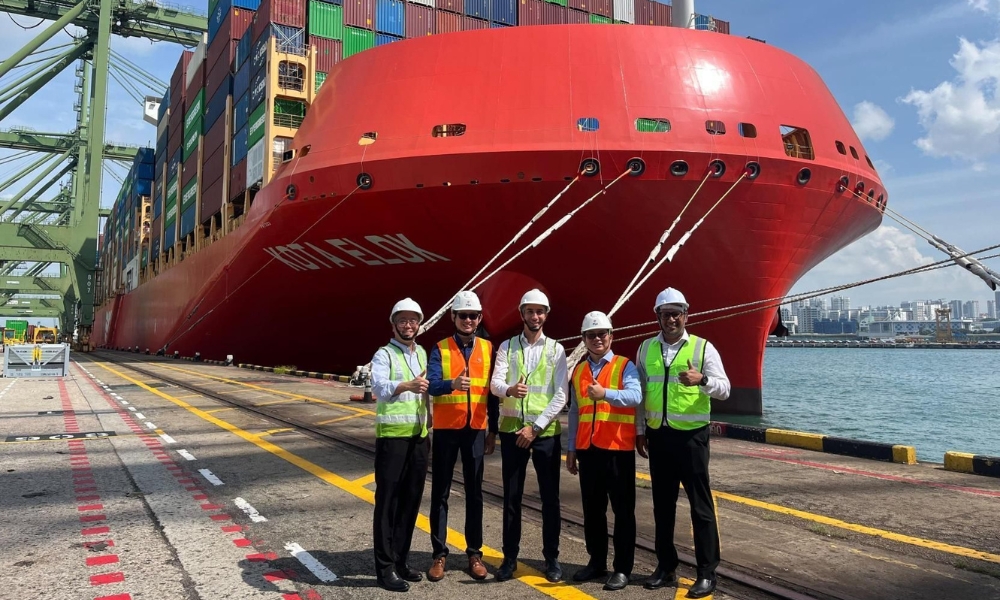
PIL's LNG dual-fuel boxship “Kota Elok” arrives in Singapore on maiden call

Singapore-based Pacific International Lines Pte Ltd on Monday (20 July) said its first 13,000 TEU LNG dual-fuel container vessel, Kota Elok, recently made her maiden call to Singapore on 15 July.

As the first of 13 new 13,000 TEU vessels joining its fleet, Kota Elok is equipped to operate on liquefied natural gas (LNG) and low-sulphur fuel oil that helps reduce our greenhouse gas emissions. 

The vessel also incorporated energy-saving features and digital technologies to reduce fuel consumption and enhance operational performance, as well as a bow windshield to improve aerodynamics, contributing to improved fuel efficiency and lower emissions over the course of long-haul voyages.

“Following Singapore, Kota Elok will continue her voyage on our East Coast Service 1 (ES1) route to South America, calling at ports in Brazil, Uruguay, and Argentina before returning to Asia,” the company said in a social media post. 

Kota Elok also became PIL’s first vessel to receive Lloyd’s Register certification for compliance with the IACS UR E26 and UR E27 cyber security requirements.

Developed by the International Association of Classification Societies (IACS), UR E26 and UR E27 are mandatory cyber resilience requirements for newbuild vessels contracted from 1 July 2024. 


Photo credit: Pacific International Lines
Published: 21 July, 2026

Continue Reading

Trending